The Whitlock family threw me into the pits of the dead so I could not take part in the queen’s selection. Sarah said that without me, she would be the only daughter of the house. Her mother said no king would ever search a grave for a bride. They were right.
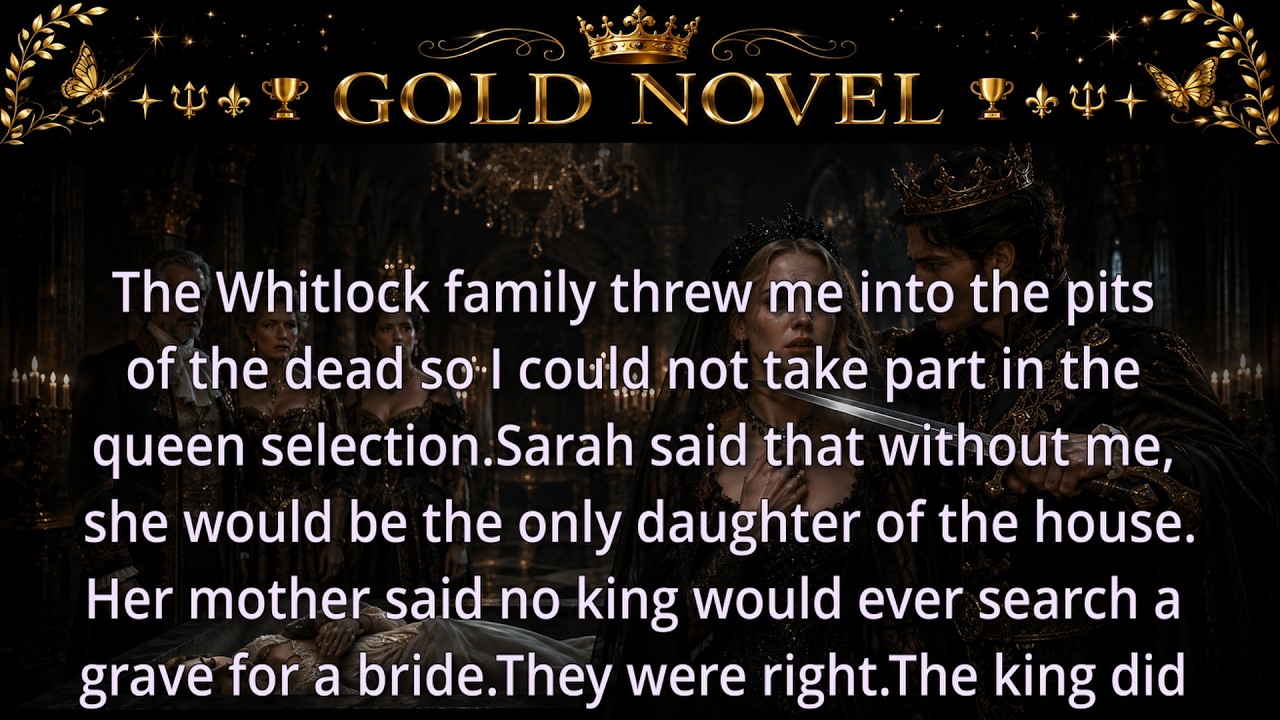
The king did not come to the grave for a bride. He came for the girl who had pulled a poison nail from his heart three nights earlier. He came for the woman who had touched the bone crown without dying. He came for me.
When King Dorian Blackwell entered the hall of our house, Sarah was wearing my black veil and holding my amulet. “I am the one who saved your life,” she said. The king approached her slowly. For one moment, everyone thought he would kiss her.
Instead, he drew his sword. Then he said, “Tell me what name I whispered when I was dying. ”
Sarah Whitlock froze. It was a lovely sight.
Not beautiful. Exactly. Beauty required softness, and Sarah had only ever been soft on the outside. The rest of her was polished bone, jealousy, and the kind of hunger that smiled with teeth hidden.
She stood in the middle of Whitlock Hall beneath the iron chandeliers, wearing my black veil as if mourning had been made for her pretty face. My amulet lay against her throat, the silver chain too loose because she had stolen it in a hurry. A smear of ash still marked one edge of the veil where I had used it to bind a dying man’s wound. My wound?
Really? Because some injuries began in another person’s chest and ended inside your life. King Dorian Blackwell waited. He did not blink.
He was tall, black-haired, pale in the way winter marble was pale, with a long dark coat buttoned to his throat and a crown case carried behind him by two royal guards. Everyone called him the bone king because Blackwell kings were crowned with relics, ruled through death law, and smiled less often than statues. I had thought the title was exaggerated. Then I saw him point a sword at my stepsister while half the noble families of our county watched in terrified silence.
No exaggeration. Excellent branding. Sarah opened her mouth, closed it. Opened it again.
“Your Majesty,” she whispered, trembling beautifully. “I was frightened. I barely remember anything. ”
Her mother, Lady Mora Whitlock, stepped forward with a hand pressed to her chest.
“My king, Sarah has been overwhelmed by your presence. She is delicate. The night she saved you was terrifying. Perhaps if you gave her a moment, she could recall.
”
Dorian did not look away from Sarah. “I asked the woman who claimed she saved my life. ”
Mora went still. It was the first time I had ever seen anyone interrupt her cruelty without raising their voice.
Mora ruled Whitlock House with thin smiles, pale gloves, and silence sharpened into a weapon. Servants feared her. Tenants lowered their heads before her carriage. Even my late father’s old friends had stopped visiting after she made it clear that the true daughter of Lord Whitlock had become something less convenient than memory.
But Dorian Blackwell did not lower his head. His sword remained angled toward Sarah’s heart. Not touching, not threatening enough for court scandal, just close enough to remind everyone that kings did not need to shout when steel could finish the sentence. Sarah swallowed.
“I heard you say, ‘Beloved, no. ’” The word fell like a lid closing. “No,” she tried. “Mercy.
No, Mother. ”
Dorian’s face changed barely. But the air in the hall turned colder. Mora gripped her skirt.
Sarah’s eyes shimmered with panic now. Real panic. Not the decorative kind she used when she wanted a necklace, a carriage, or my bedroom. “My king, I was bleeding, too,” Sarah said.
“I remember pain. ”
I almost laughed from behind the hidden passage door. Sarah had never bled for anyone but herself, and even then she complained the blood ruined lace. Dorian stepped closer.
“You wore this veil when you bound my wound? ”
“Yes. ”
“You pulled the grave iron nail from my chest? ”
“Yes.
”
“You touched the bone crown? ”
Sarah hesitated only for a breath. “Yes. ”
Dorian’s eyes turned black.
Not metaphorically. The pale gray of them deepened until they looked like grave soil after rain. “Then answer. ”
The hall held its breath.
The servants lined against the wall stood rigid. My father’s portrait watched from above the fireplace, stern and helpless in paint. Cousins, minor nobles, and Mora’s friends stared at Sarah with growing confusion. The black veil trembled around her shoulders.
My veil, my blood still stiff in the edge, my amulet warming against her stolen throat. Three nights earlier, I had left Whitlock House through the scullery door with a cracked basket, an empty stomach, and a knife small enough to hide inside my sleeve. I had not gone looking for kings. Kings belonged to ballads, battlefields, and execution platforms.
I had gone looking for grave herbs. Mora had cut my meals again after Sarah complained I looked too healthy for someone raised by charity. Charity in Mora’s language meant my own father’s house, my own mother’s jewels, my own inheritance papers locked somewhere I had never been allowed to see. So I survived the way hidden girls survived.
Quietly. I gathered herbs near old burial grounds and made remedies servants bought in whispers. Grave mint for fever, moonroot for infected cuts, saltthorn paste for bruises, morning tea for women who cried at night and needed their hands steady by morning. My mother had taught me before she died.
“Evelyn,” she used to say, folding dried leaves into cloth, “grief lives in the body, too. Treat it with respect. ”
Mora called those lessons peasant superstition. Mora also called starvation discipline, so her opinions had always been under review.
That night, the old burial grounds behind Whitlock land were covered in fog. The graves leaned crooked beneath dead trees. I kept my lantern low, partly so guards would not see me, partly because graveyards deserved manners. I found the grave herbs under the angel statue with no face.
Then I heard a man breathing like death had a hand around his throat. He lay between two broken tombs, black coat torn, one glove missing, blood spreading beneath him. Beside him rested a crown made of pale bone and dark iron. I knew the bone crown at once.
Everyone did. It was the ancient crown of Blackwell, made from the bones of the first queen, the woman who had bound the kingdom’s dead to protect the living. It recognized truth, blood, sacrifice, and morning healer power. It burned false claimants.
It rejected pretty lies. It accepted only the rightful queen. Naturally, I found it lying in wet grass beside a dying stranger while I was stealing herbs for dinner money. My life had always had timing issues.
The man’s eyes opened when I knelt. “Do not touch me,” he rasped. I looked at the black spike driven beneath his ribs just above his heart. “Then die more quietly.
I am trying to think. ”
His mouth twitched. Even half dead, he had excellent arrogance. The nail was grave iron.
Necromantic metal. I had only seen drawings in my mother’s old notes. Grave iron was forged in burial smoke and poisoned with restless bone dust. Ordinary people who touched it died.
Healers who touched it without proper blood protection rotted from the hand inward. I should have run. I did not. He watched me tear my sleeve, gather grave mint, and press my fingers around the nail.
The cold hit first, then the voices. Not words. Names. Hundreds of names crushed into the metal, screaming without mouths.
I bit down on my own tongue and pulled. The nail resisted like it wanted to stay inside him. Black veins crawled up my fingers. The bone crown shifted in the grass, opening slightly, bone points moving like a sleeping flower waking to storm.
The man stared at me. “You should be dead. ”
“I hear that often from my stepmother’s cooking. ” I pulled harder.
The nail came free. Blood followed, dark and hot. The man convulsed. I pressed grave mint and morning ash into the wound, murmuring the little healing words my mother had taught me.
They were not temple prayers. They were older, lower, the kind spoken over bodies when mothers had no priests and widows had no coins. The bone crown opened wider. It did not burn me when my elbow brushed it.
Instead, it hummed like recognition. I wrapped my black veil around the man’s chest and tied it tight to hold pressure. He tried to speak. I leaned closer.
“Assold,” he whispered. The name was broken with longing. I had not known then that Assold was his dead mother, the previous queen of bones. I only knew a dying man should not be allowed to follow the person he loved into darkness if a stranger still had hands.
“She is not here,” I told him. “But I will not let you follow her tonight. ”
His eyes fixed on my face, then closed. I stayed until his breathing steadied.
Then I ran before dawn could expose me. I left the nail wrapped in cloth inside my basket. I left the veil on his chest. I left without knowing I had saved the king.
Stupid, really. One expected royalty to die in more organized locations. When I returned to Whitlock House, dirty, shaking, veil gone, fingers blackened from grave iron poison, Mora was waiting in the kitchen. Sarah stood behind her in a silk morning robe that used to be mine.
Mora’s eyes moved over my torn dress, my empty throat, my missing veil. “Where were you gathering herbs? ”
“At midnight, plants keep strange hours. ”
Sarah saw my hand.
“What happened to you, thorns? ”
Mora stepped closer. She smelled of lavender and cold decisions. Two hours later, the royal decree arrived.
King Dorian Blackwell sought the woman who had saved his life, touched the bone crown, and carried morning healer blood. He would choose his queen from the woman proven true. Mora read it once. Then again.
Sarah’s face went pale with understanding. She had not left the house that night, but I had. I had come home injured, filthy, without my black veil. The next thing I knew, Mora’s men dragged me beneath the old Whitlock mortuary and threw me into the death pits.
“No king would search a grave for a bride,” Mora said from above. As the trap door opened, Sarah leaned over beside her, smiling, with my amulet already clutched in her hand. “Without you, I will be the only daughter of the house. ”
Then they dropped me.
The death pits were not ordinary pits. That would have been too kind for Whitlock history. They were an ancient necromantic foundation beneath the estate, older than the house, older than the chapel, older than the pretty family crest Mora liked to stamp onto invitations. For generations, cruel nobles had used those pits to erase people.
Servants who heard too much. Witnesses who refused money. Unwanted heirs. Inconvenient children.
Women whose deaths were easier to explain as illness if there was no body. They fell into darkness and became silence. I hit bone before stone. Pain burst through my shoulder.
My breath left me. The trap door slammed shut and all light vanished. For a while, I was only sound. My own breathing.
Dirt shifting. Something moving. Then the dead began to rise. At first I thought they would tear me apart.
I saw hands in the dark, jawbones, torn sleeves, rings still on finger bones, a child’s ribbon tied around a wrist with no flesh, a woman’s skull cracked at the temple. I tried to crawl back, but my injured shoulder failed. The dead came closer. Then they knelt.
Every one of them. Bone knees struck the pit floor in a ripple of ancient grief. A skeleton wearing a rusted royal seal bowed its head before me. I stared, shaking.
“No,” I whispered. “No, I am no one. ”
The darkness answered without words. The bone crown had touched me.
The grave iron had not killed me. The old blood in me, the blood my mother had hidden under kitchen remedies and morning songs, had woken. The dead did not mistake me for their queen. They recognized someone who still owed them justice.
I was terrified. Of course I was. Only fools felt nothing when corpses bowed. But fear had never fed me, never protected me, never opened a locked door.
So I pushed myself upright with one working arm and looked at the dead of Whitlock House. “If you are here because someone threw you into the dark,” I said, voice shaking but alive, “then rise. Tonight we have the same enemy. ”
The pit moved.
Not like a crowd. Like memory waking. The dead parted before me. The skeleton with the royal seal placed an ancient key into my bloody hand.
It was cold as winter, heavy with black dust, and shaped like a rib. Then the lowest wall opened. A passage. Old catacombs ran beneath Whitlock House.
Tunnels Mora either did not know or had been arrogant enough to forget. The dead led me through them. They touched walls and stone remembered doors. They pointed with bone fingers toward old records sealed behind rotten wood.
They showed me names carved into hidden pillars. Mara Finch, maid, age nineteen. Orin Vale, stable boy, age twelve. Thomas Whitlock, second son, disputed heir.
Lydia Gray, witness. Name after name after name. House Whitlock had not thrown me into a grave. It had thrown me into an archive.
By the time I found the hidden door behind the main hall, I was covered in dirt, blood, grave ash, torn fabric, and the judgment of every person my family had tried to forget. Which brought me back to Sarah, standing before King Dorian Blackwell with my veil on her shoulders and no answer in her mouth. Dorian’s sword hovered. “Tell me,” he said.
“What name did I whisper? ”
Sarah shook her head. “I… I was frightened. ”
Mora stepped in again.
“Your Majesty, perhaps this test is unfair. ”
Dorian turned his head slowly. The hall temperature seemed to drop. “I was dying.
The woman who saved me answered the name I spoke. She will remember. ”
Behind the wall panel, I smiled despite the blood in my mouth. Then I pushed the hidden door open.
The hinges screamed. Every head turned. Sarah screamed louder. I stepped into Whitlock Hall with grave ash falling from my hair and the ancient key clenched in my fist.
“Assold,” I said. The word moved through the hall like a bell tolling underground. Dorian’s eyes found mine. For one breath, he looked exactly like the man in the graveyard again.
Not king. Not bone king. Just a dying son who had whispered for his mother and heard a stranger refuse to let him follow her. I looked at him.
“She is not here,” I said. “But I told you I would not let you follow her that night. ”
The sword lowered. Sarah’s face crumpled.
“No. She is lying. ”
Mora recovered faster. “She is contaminated by the dead.
Your Majesty, she was found wandering, filthy and mad. Sarah is the true daughter presented to you. ”
I laughed. It hurt.
I did it anyway. “Presented? Is that what we call theft when the gown is expensive? ”
Sarah pointed at me.
“She is a monster. ”
Behind me, beneath the floor, something knocked once. Then again. The chandeliers trembled.
I smiled at Sarah. “No king would search a grave for a bride. But a grave remembers who was thrown into it. ”
Dorian stepped toward me.
Not too close. That mattered. Men who saw wounded women often mistook rescue for ownership. Dorian looked at my torn sleeve, my injured shoulder, the grave iron stains on my fingers, and stopped where I could choose whether to meet him.
“You were thrown into the death pits,” Mora said. “Your Majesty, old servant’s tales. The pits are sealed. ”
The floor knocked again.
This time the portraits shook. Dorian looked at Mora. “Apparently not. ” He turned to the guard carrying the crown case.
“Open it. ”
The hall recoiled. The bone crown emerged from black velvet. It was smaller than I remembered and more terrible.
Pale bone points curved upward like frozen flames, joined by black iron thorns. No jewels. No gold. No mercy.
It did not shine. It listened. Sarah took a step back. Dorian faced her.
“If you are the woman who saved me, wear it. ”
Sarah’s lips parted. “I…”
Mora whispered, “Do it. ”
Sarah looked at the watching nobles, the servants, the king, the crown.
Her pride trapped her where truth could not. She reached out. The moment her fingers touched the bone crown, smoke rose from her skin. Sarah screamed.
A black mark burned into her palm, shaped like a closed eye. False claim. She dropped to the floor, sobbing. The crown did not move.
Dorian looked at me. He did not command. He offered. I stepped forward.
My injured shoulder throbbed. My knees shook. My hair was a ruin. And my dress had lost its argument with death.
I looked nothing like a queen selection bride. Good. Crowns should know what survival looked like before ceremony washed it clean. I touched the bone crown.
It was warm. The bone points opened like a flower. The walls of Whitlock House shook so violently that dust rained from the ceiling. Beneath us, hundreds of dead knelt again, and this time everyone felt it.
The floor bowed under the weight of buried witnesses. Dorian’s voice was low. “The crown accepts her. ”
“No,” Mora said.
For the first time in years, she sounded small. “Yes,” I said. Sarah clutched her burned hand. “You cannot be queen.
You are a servant. ”
I looked down at her. “I was a daughter before you stole my room. I was an heir before your mother hid the papers.
I was alive before you threw me into the pit. Try to keep up. ”
Dorian’s gaze went to Mora. “For attempted murder of a crownbound morning healer, theft of royal evidence, false claim to the bone crown, and conspiracy against the throne, I should execute you now.
”
The guards drew steel. Mora went white. Sarah sobbed harder. I lifted my hand.
“Do not. ”
Dorian looked at me. Not offended. Not surprised.
Listening. That mattered too. “Evelyn. ”
The sound of my name in a king’s mouth made the hall go still.
Not servant. Not girl. Not disgrace. Evelyn.
I looked at Mora and Sarah, at the two women who had starved me, erased me, dressed themselves in my belongings, then dropped me among bones because they believed no one would open the grave. “Do not take them quickly,” I said. “They threw me to the dead because they believed no one would look for me. First, I want the entire kingdom to learn where the king found his queen.
”
Dorian’s mouth curved slightly. Not a smile. Something darker. “Then we will give them a trial.
”
The public trial at Blackwell Palace began three days later. By then the kingdom had already heard pieces. The bone king had found his savior in a noble house. The false bride had burned under the crown.
The true woman had walked out of the death pits. House Whitlock had hidden graves beneath its foundations. Gossip ran faster than royal horses and had worse manners. The trial hall of Blackwell Palace was carved from black stone veined with bone white mineral.
Above the throne hung banners of past queens, each painted with the bone crown resting on her head. Assold Blackwell watched from the largest banner, stern and beautiful, with gray hair braided over one shoulder and one hand over her heart. Dorian sat beneath her, not wearing his crown. The bone crown rested on a black pedestal between us.
I stood as witness, not bride. That was Dorian’s choice. He had told me the night before, “The crown recognized you. I found you.
But whether you stay is yours to decide. ”
I had stared at him, waiting for the catch. There was none. Strange man.
Dangerous, but strangely respectful. I had not decided yet whether that made him wise or simply well-trained by dead queens. The hall filled with nobles, priests, guards, city witnesses, royal record keepers, and servants from Whitlock House who had been summoned under crown protection. Mora and Sarah stood in chains.
Not dungeon chains. Court chains. Silver. Visible.
Humiliating. Sarah kept her burned hand wrapped in cloth, but everyone knew what lay beneath. The black mark of false claim had already become the most discussed hand injury in the kingdom. Dorian opened the trial.
“House Whitlock claimed Sarah Whitlock saved my life. The bone crown rejected her. Evelyn Whitlock spoke the secret known only to the woman who found me dying. Today, we determine what crimes were committed beneath Whitlock roof and how many dead were hidden under its name.
”
Mora lifted her chin. “My family is loyal. ”
I looked at her. “Your house had more bodies than loyalty.
”
The first evidence was the grave iron nail. Dorian’s physician presented it in a sealed glass case, black, twisted, still stained with both his blood and mine. The court murmured when the royal necromancer confirmed it was grave iron. Poison metal meant to kill Blackwell blood slowly enough to prevent immediate crown response.
Then the black veil. My veil. Blood tested. Dorian’s blood and mine.
Morning healer residue woven through the cloth. Then my amulet, taken from Sarah’s neck. The clasp was scratched where she had torn it from my jewelry box. Then Sarah’s burn mark.
She refused to show it until Dorian looked at her. “Show the court. ”
She unwrapped her hand. The black closed eye mark had sunk deep into her palm.
It would never fade. A priest whispered, “False bride. ” Sarah cried. For once, nobody rushed to comfort her.
Then came the ancient key from the death pits. Then the inheritance papers. Oh, those were beautiful. Not an appearance.
They were water-stained, folded, hidden inside a locked iron chest beneath Mora’s private sitting room. But when royal record keepers opened them, they proved Lord Whitlock had named me sole heir of the estate, with Mora granted only a widow’s residence, and Sarah no claim to Whitlock blood or property. Mora had hidden them the week after my father’s funeral. She had taken my room, my mother’s jewels, my books, my dowry, my legal name.
Then she had put an apron in my hands and called it gratitude. The servant testimonies followed. Cook Hesta spoke of meals withheld. Stable boy Ren spoke of seeing Sarah wear my gowns after Mora said I was too low for silk.
Old nurse Ka testified that my mother Leora had not been lowborn as Mora claimed. She was morning healer blood. “Last known woman of the old line,” Ka said, voice shaking. “Lord Whitlock married her in secret rites before the chapel wedding because he feared enemies would seek her blood.
”
Murmurs rolled through the hall. I looked at Mora. She would not meet my eyes. All my life she had told me my mother was shameful.
A charity bride. A woman my father regretted. But my mother had been the last morning healer of an ancient bloodline, the kind the bone crown recognized, because the first queen of bones had been bound to the same magic. Morning healers could touch grave iron, speak peace to restless dead, cleanse death poison, and stand between the living and the forgotten.
My mother had taught me grave herb recipes because she knew survival sometimes had to be disguised as housework. The trial did not end with my family, because the nail had a maker’s mark. Voss. Lord Cashen Voss, a pale noble with silver rings and regency ambitions, sat in the west gallery pretending calm.
Calm had not abandoned him. Dorian’s captain brought in the Whitlock vault ledger found beneath the death pits. Mora had stored grave iron weapons for Cashen Voss in exchange for money and protection. She had not stabbed Dorian herself, but she had hidden the tools, taken payment, and promised silence.
The nail from Dorian’s heart carried dust from the Whitlock vault and the Voss mark beneath the corrosion. Cashen stood. “This is absurd. ”
The bone crown turned toward him.
Not physically. Worse. Everyone felt it. He sat down.
Cowardice had excellent survival instincts. Dorian’s guards arrested him before sunset. Conspiracy against the crown. Attempted regicide.
Use of necromantic weapons. Treason by grave iron. Cashen did not scream. He fainted.
Less dignified, but honest. Then Sarah tried one last time. “I only wanted a chance,” she sobbed. “Evelyn had the blood.
She had the name. She had everything by birth. I had nothing. ”
I turned slowly.
“Nothing? Sarah, you slept in my room, wore my dresses, ate from my table, spent my inheritance, and called me servant while I mended your hems. No. You did not want a chance, Sarah.
You wanted my life while the blood was still warm on it. ”
Mora snapped. “I acted for my daughter. ”
I looked at her, at the woman who had smiled while men carried me to a pit.
“Then it would be cruel to separate you from the fall you built together. ”
The court went quiet. The first judgment came that day. Mora and Sarah lost the Whitlock name.
Their noble status was stripped. Every stolen jewel, gown, coin, carriage, and property claim was seized. House Whitlock passed legally to me. They lost household protection.
They lost court welcome. They lost inheritance, title, servants, seals, and the right to speak as Whitlocks. They were thrown out of Blackwell Palace with nothing but plain clothes and the mark of false claim on Sarah’s hand. But not killed.
Not quickly. Death would have made Mora a tragic widow and Sarah a pitiful girl. I wanted them alive long enough to learn what they had taught me. What it meant when doors did not open.
When no one believed your tears. When no title softened hunger. When no house called you family. Dorian watched them dragged from the hall.
“You are harsher than execution. ”
“I learned from nobles. ”
He looked at me with something like approval. I ignored the warmth it caused.
I had revenge to finish. Because Mora and Sarah had lost rank, but not stupidity. Before my official crowning, they made their final move. I should have expected it.
People who built lives on theft rarely accepted a verdict just because truth arrived with witnesses. They called it unfair when the tools they used turned toward them. Mora and Sarah allied themselves with remnants of Cashen Voss’s faction. Bitter nobles.
Dismissed guards. Paid grave workers. And one temple scribe who had apparently decided treason sounded better with candles. Their plan was simple.
Open part of the death pits beneath the city during the public morning ceremony for the erased dead. Let corpses rise. Make the crowd panic. Prove Evelyn Whitlock was cursed, monstrous, a bride of the dead.
Then force Dorian to cast me aside before the bone crown could be placed on my head. It was not a clever plan. But cruel people often confused cruelty with intelligence because both left others bleeding. The ceremony took place in Blackwell Square, where thousands gathered around the newly opened memorial stones.
Names recovered from the death pits had been carved into black pillars. Some had family waiting. Some did not. All had candles.
I stood before the crowd holding the bone crown in both hands. Dorian stood beside me, sword lowered but ready. He had been careful since the trial. Never pushing.
Never assuming. Never acting as if finding me in a grave entitled him to my future. That was probably why, when the bone crown asked me in dreams whether I would stand beside him, I had not said no. I had said, “Only if I stand as myself.
” The crown had hummed. Dead queens were very opinionated. Halfway through the ceremony, the ground cracked. Screams broke across the square.
A section of stone near the fountain collapsed, revealing old tunnels beneath the city. Dead hands rose from the dark. Bones climbed over broken bricks. A cold wind blew out every candle.
Sarah appeared on the steps of the old courthouse, hair loose, face wild, burned hand raised. “Look at her! She is not a queen. She is a monster.
”
Mora stood behind her, thinner now, face sharpened by disgrace. “She commands the dead. She will drag Blackwell into the grave. ”
The crowd panicked.
Dorian moved in front of me. I touched his arm. “No. ”
He stopped.
Again. He listened. I stepped forward alone, the bone crown cold and open in my hands. The dead advanced.
Hundreds of them. Some old. Some recent. Some tiny enough to make mothers in the crowd sob.
Then they reached the edge of the square and stopped. One by one, they knelt. Not to Dorian. Not to the guards.
To me. The panic changed shape. Fear became silence. Sarah’s scream died in her throat.
I lifted the crown. “They did not rise to take the city. They rose because you used them as garbage and expected them to stay silent. ”
The dead turned.
Not toward me. Toward Mora. Toward Sarah. Toward the noble families in the square who suddenly looked pale beneath generations of inherited cleanliness.
Then the dead began to speak. Not with mouths. With memory. Images rose above the square.
A maid pushed through a hidden door beneath Whitlock House. A stable boy dragged by two men. A crying child with Whitlock eyes. A pregnant servant who had seen Cashen Voss deliver grave iron crates.
A scholar holding inheritance records before Mora’s predecessor ordered him silenced. A young woman, my mother, Leora, arguing with Lord Whitlock’s brother about closing the pits forever, before dying months later from a winter fever. The dead now whispered that the fever had not been natural. My hands tightened on the bone crown.
I had thought my mother’s death was grief, illness, bad luck. The dead showed me poison in a silver cup. Mora had not done that one, but House Whitlock had. The family had been rotten before she arrived.
She had merely enjoyed the inheritance. The whole city saw that House Whitlock had used the death pits for decades to erase servants, witnesses, heirs, unwanted children, inconvenient women, and anyone whose existence threatened noble comfort. I had been the last victim, not the first. Mora ran.
Not far. The dead did not touch her. They did something worse. They followed slowly, silently, each step knocking bone against stone.
Sarah dropped to her knees. “Evelyn, please. ”
I looked at her. She had said my name many times in my life.
As an order. A joke. An insult. Never with respect.
It sounded strange now that she needed mercy. Dorian stepped beside me. “The law allows death for necromantic uprising. ”
“I know.
”
“Will you ask for it? ”
I looked at Mora and Sarah, trembling before the dead they had tried to use. “No. ”
Sarah sobbed with relief.
Too early. The next morning, before the full court, I chose named death. It was older than execution and colder than exile. In Blackwell law, named death meant a person’s name was erased from noble registries, inheritance scrolls, temple protections, property records, household seals, legal bloodline documents, and guild protections.
They remained alive. But socially and legally, they became no one. No noble house could employ them. No temple protected them.
No guild accepted them. No estate could shelter them. No servant had to obey them. No creditor recognized old privilege.
No one could call them lady again. Mora understood first. She staggered. Sarah did not.
“Named death? ” Sarah whispered. “But where will we go? ”
I looked at the black mark on her hand.
“Wherever doors open for people with no title. ”
Mora’s voice cracked. “This is cruelty. ”
I smiled faintly.
“You threw me into a grave because you believed that without a name, I would stop existing. Now you will learn the worst darkness is not death. It is living where no one calls you with honor. ”
The sentence was carried out before sunset.
Their names were scraped from Whitlock records. Their seals broken. Their property seized. Their temple protections struck.
Their family entries marked void. Sarah, who tried to become queen, begged outside the palace gates three nights later, the black burn of false claim still visible on her hand. No carriage stopped. No guard bowed.
No woman offered her a veil. Mora, who said no king would search a grave for a bride, was seen sleeping near the cemetery wall before winter fully ended. The city did not pity them for long. Pity had memory.
Mine had witnesses. House Whitlock became mine. I did not live there. Not at first.
I walked through it after the judgment with royal guards, record keepers, and a line of dead beneath the floor, still waiting for names. My old room had been stripped of Sarah’s silks. My mother’s portrait was found hidden in a damp storage closet. I hung it in the main hall.
Then I opened every locked room, every ledger, every buried chest, every sealed cellar. House Whitlock did not become a noble home again. I turned it into a sanctuary for abused children from noble families, hidden heirs, servants seeking crown protection, and anyone whose bloodline had become a weapon against them. The first child arrived two weeks later.
A boy with bruised wrists and a title older than the uncle who wanted him gone. He refused to sleep in a room with a lock. So we removed the lock. Simple things could be holy.
The death pits were opened fully under crown supervision. The bones were identified where possible. The unnamed were given names carved in stone. The place became the Hall of the Unburied.
Not a pit. Not a secret. A sacred place where the forgotten dead could be witnessed and noble houses could remember that the dark kept records. My crowning happened at Blackwell Palace beneath banners of old queens and the newly carved names of the unburied.
Dorian stood at my side, but not in front of me. The court watched in silence as I lifted the bone crown myself. Before I placed it on my head, Dorian spoke quietly. “The crown recognized you.
I found you. But whether you stay is yours to decide. ”
“I am staying,” I said. His eyes held mine.
“Because of me? ”
I looked at the court. The nobles who had learned fear. The servants who had learned they could testify.
The children who now had a sanctuary. The dead whose names had returned. “No. Because I want the power to make sure no one else is thrown into darkness and called forgotten.
”
Dorian’s mouth softened. “Good. ”
That was all. Good.
No claim. No ownership. No grand speech about fate. Just space.
I placed the bone crown on my head. It did not burn. It opened. The palace shook as every royal tomb beneath Blackwell answered.
The dead queens recognized me. The dead in the Hall of the Unburied bowed. The living court followed, because for once it had learned from the dead. I became bone queen of Blackwell.
Not as a prize. Not as a rescued girl polished for a throne. As proof. If someone threw you among the dead, you could return with an army of truths behind you.
My first laws were written before the coronation feast. No noble house could hide or erase an heir. No servant testimony could be dismissed only because of rank. Every suspicious household death required crown investigation.
The death pits were sealed from private use forever. Hidden inheritance documents had to be registered with the crown. Abused children of noble houses could seek royal protection without permission from the family abusing them. The dead without names received proper burial and names carved in stone.
The nobles complained, naturally. Nobles called accountability instability whenever it interrupted dinner. Dorian listened to three objections before he looked at me. “Would you like them removed?
”
I looked at the complaining lords. “No. I would like them recorded. ”
They sat down quickly.
Records had become fashionable weapons. Months passed. The kingdom changed slowly, then all at once. Servants came forward.
Old graves opened. Inheritances surfaced. Private mortuaries were inspected. Several noble families suddenly discovered urgent reasons to leave the capital.
We stopped them politely with guards. House Whitlock filled with children, witnesses, widows, and quiet people who slept badly but began to eat better. The Hall of the Unburied became a place where the living brought flowers and the dead rested under their names. Dorian remained dangerous.
He was still the bone king. He still frightened ambassadors by answering threats with silence and paperwork. But he never asked me to be softer. Never asked me to hide the ash under my nails.
Never asked me to forgive for the sake of peace. That more than any crown made staying possible. One winter evening I stood beside him at the throne room window. Snow fell over Blackwell City.
Far below, beyond the market lamps, two thin figures moved near the cemetery wall. Sarah and Mora. No carriage slowed for them. No merchant bowed.
No one called them lady. They were alive, hungry, nameless. Sarah’s black mark showed whenever she held out her hand. Mora’s face had lost the smooth certainty that cruelty would always have a roof.
Dorian followed my gaze. “Do you regret not giving them a quick death? ”
I watched Mora pull her shawl tighter. I watched Sarah turn away when a child pointed at her burned hand.
Once I had slept hungry beneath their roof while they wore my mother’s jewels. Once they had thrown me into darkness because they thought graves were quiet. “No,” I said. “They threw me into a grave because they believed that without a name I would stop existing.
Now they will learn the worst darkness is not death. It is living where no one calls you with honor. ”
Dorian nodded. Below, the cemetery bell rang once.
Not for death. For remembrance. I touched the bone crown. It was warm now.
Not gentle. Never gentle. But mine. The Whitlock family threw me into the pits of the dead to steal my crown.
They did not understand that the dead remember better than the living. And when I returned, I did not return alone. I returned with every name they had tried to bury.