The rain hadn’t stopped for three days when I buried her. I remember that more than anything else—not the priest’s voice, not the lilies, not the dirt hitting the casket. Just the cold November rain, the kind that gets under your collar no matter what. I stood in a black suit that didn’t fit anymore.
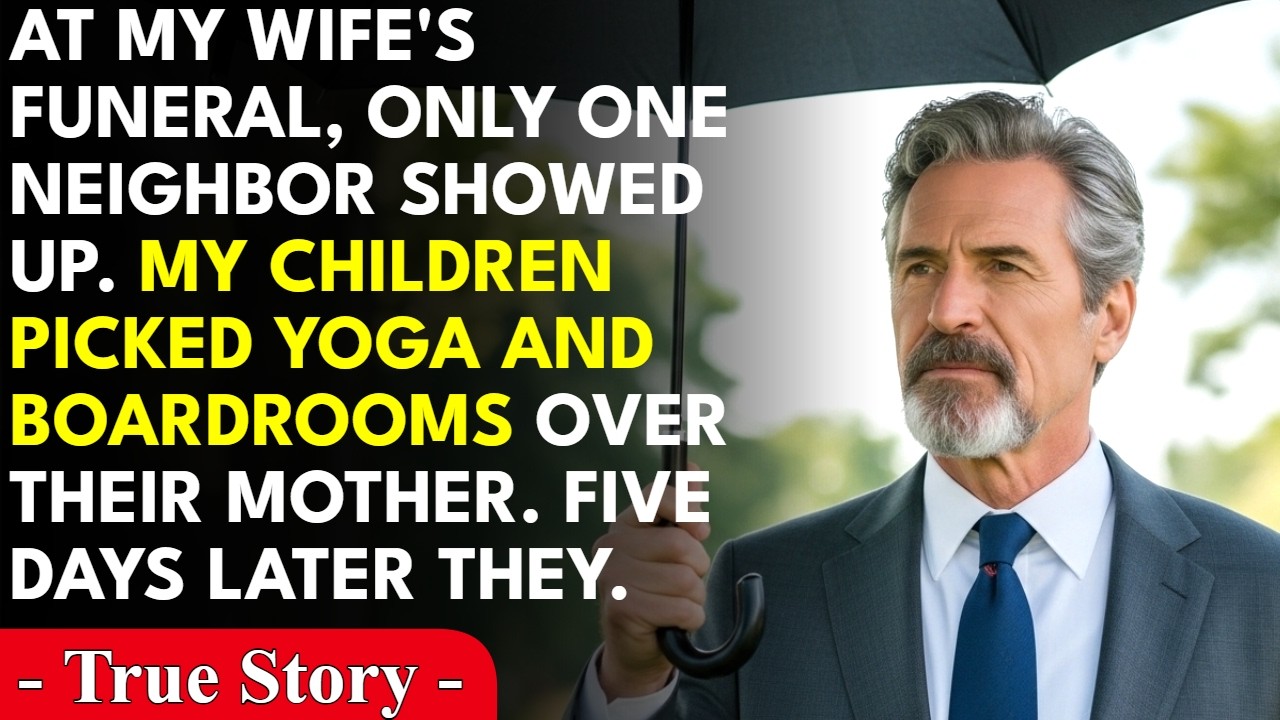
I’d lost twelve pounds in the four months she was sick. Two people showed up to the funeral. Father Halsey, because he was paid to, and Mrs. Whitcomb, the eighty-four-year-old neighbor who’d brought Margaret soup every Tuesday.
Her son was at work, so she’d taken a taxi. I held her umbrella when it turned inside out, and she kept saying, “I’m so sorry, dear. ”
My son and daughter were not there. They knew the date.
They knew the time. I’d called each of them the day after their mother died, still wearing the cardigan she’d bought me for our anniversary. My son had a board meeting he couldn’t reschedule. He runs an investment firm in Charlotte, or he says he does.
My daughter had a wellness retreat in Sedona, nonrefundable. She said her mother would have wanted her to take care of herself first. I am sixty-seven years old. I built a machine parts business from nothing, starting in my garage in 1981 with three thousand dollars.
By the time I sold a controlling interest, Margaret and I had accumulated enough that our children noticed. She never wanted them to know the specifics. She used to say knowing the number ruined people. She was right.
We were always there for them—always. When he needed a loan for his first business, we wrote the check without asking a single question. When she moved to Denver, we paid for the movers. When she criticized our town, we looked at pictures of her new life, and Margaret never let the phone get cold.
We drove across the country for the grandkids’ birthdays. We listened to her complaints about his wives. We kept loving them, kept being the parents they could count on. But we took our last trip to Portland, Maine, two summers before she got sick.
She was healthy then, laughing on the dock, the wind catching her hair. I remember thinking she looked younger than her sixty-three years. We talked about the will, about simple things that matter—the quilt she was making from the children’s baby clothes, a letter she wrote to each of them that I found after she died, unopened. She kept them in a small wooden box with a carved cardinal on the lid.
She waited for a time when they might be ready to read them. She died on a Tuesday, in her sleep, with the window cracked open and the sound of rain outside. I woke to find her gone. I called my daughter first.
She told me the week of the funeral was bad—she had appointments, commitments. My son said he was in a negotiation and would rearrange his schedule. He never did. They didn’t come to the funeral.
They didn’t help with the arrangements. They didn’t ask how I was holding up. The day after the funeral, I went through her things. I found the amended will in a folder on her desk, the one with the cardinal on the cover.
She’d made changes six weeks before she died. I didn’t understand why until I read the memorandum she’d left for me. In it, she described the condition of each inheritance. Each child would receive fifty thousand dollars if they attended the service.
If they didn’t attend, they’d be disinherited from that portion. The rest of the estate would go to a trust providing for me, then to a foundation supporting elementary school teachers after my death. She included a letter, addressed to me, explaining her decision. I sat with it for weeks.
I read it so many times I memorized the words. She wrote that she loved them more than words could say, but that love needed a spine. She said she was not doing this to punish them. She was doing it to give them the only gift she had left: the gift of standing on their own feet.
I kept delaying. The pain of losing her was still raw, and I couldn’t bear the thought of losing them too. We tried to have a family meeting once. They came on a Saturday in January, driven by the lawyer’s letter.
They sat in our living room like strangers. We tried to talk, but they spoke about the weather, about their busy lives, about everything except her. When I mentioned the will, my son said he needed his lawyer present, and my daughter looked at me like I’d slapped her. They left without even asking to see the quilt she’d made.
That evening, I stood in her garden, where she’d spent every spring planting her tomatoes and peppers. I talked to her out loud, told her I was sorry I didn’t do it sooner. The cardinal landed on the fence, just like she’d said it would, and watched me with its dark eye. It stayed longer than usual, then flew off.
The next day, I called Mr. Kessler, our attorney. He’d been with us for decades, and he knew her wishes better than anyone. The courier came with the envelope—the formal will, the medical affidavits, the video recording.
I hadn’t watched the video yet. I decided I would, alone, before I faced them. Friday came. I spent the day preparing the house.
I cleaned the windows she used to wash by hand. I hung fresh curtains. I filled the vase on the dining table with roses from the garden. The house looked neat and orderly, but it felt empty.
I set out the photographs—the wedding, the children’s graduations, the years in between. I wanted them to see what mattered. Whether they saw it was up to them. At six o’clock, they arrived.
My son stepped out first, wearing a dark suit and a stern expression. He hadn’t dressed like that for the funeral. He hadn’t dressed like that at all in years. My daughter followed, holding a bouquet of store-bought flowers, wrapped in plastic.
She put them on the table as if they were a formal offering. We exchanged polite greetings, but my hands were cold. The meeting began, but it didn’t go as they expected. They challenged everything—the validity of the will, my role as executor, the very foundation of our family’s wealth.
My son quoted lawyers and statutes. My daughter spoke about her needs, her children, her future. They talked over each other, building a wall between us, each word sharpening the distance. When I told them about the condition—fifty thousand each if they attended the funeral—they were stunned.
“Is this a joke? ” my son demanded. My daughter’s face went pale. I explained that the will had been properly witnessed, notarized, and recorded.
It was real. They hadn’t met the condition. They looked at each other, then at me. For a moment, I thought the silence would break them.
But then my son started to argue about legal technicalities, and my daughter pleaded about misunderstanding. They didn’t ask about her. They didn’t ask about the garden. They didn’t ask about how I was holding up.
They only talked about the money. I watched them fall apart. My son’s voice escalated, going hoarse at the edges. His cell phone rang, and in the middle of his argument, he actually turned to answer it.
That’s when something in me closed. The door narrowed, then shut. Not with anger, but with clarity. I saw the truth of who I raised, and I knew it was time to accept it.
I stood up. I walked to the door and opened it. “I think you should go,” I said. “We’re not getting anywhere, and I’m tired.
” My son started to protest, but I raised my hand. “Goodbye,” I said. After they left, I went to the porch. The sky had cleared, and the garden was golden.
The cardinal perched on the fence again, singing. I sat in the wicker chair where she used to sit, and I felt the quiet settle around me. I watched the garden until the light faded, and the sun slid down behind the maple. I thought about the two children I’d raised, the ones who’d grown up in this house, who’d learned to ride bikes on this street, who’d carved pumpkins on this porch.
And I thought about the two people who’d sat in my living room today, strangers in their mother’s home. I wondered when they’d become those people. I wondered if they ever knew they had a choice. That night, I did something I should have done a long time ago.
I poured two glasses of water, sat at the kitchen table, and took out the stack of letters I’d started writing to them years ago, when they were children. Letters about forgiveness, about kindness, about what it meant to be a family. I read them all, slowly, one by one. Then I put them back in the box, tied the ribbon, and placed it in the closet.
The next morning, I called Mr. Kessler and told him to proceed with the terms of the will. He asked if I was sure. I said yes.
I hung up the phone, put on my gardening gloves, and went outside to pull weeds. The sun was warm on my back. The cardinal was still there. A few weeks later, I started sleeping better.
The grief didn’t go away, but it softened. I began to find peace in small things: the smell of fresh soil, the sound of rain on the roof, the memory of her voice. I didn’t go to the cemetery every day anymore. I went on Sundays, bringing flowers from the garden.
I’d sit on a bench and talk to her, and I’d tell her about the peonies, about the finches, about the latest book I was reading. I’d tell her about the weather, about the quiet, about the strange comfort of being alone. It wasn’t the life I expected. But it was the life I needed.
I learned to let them go because I had to let myself go. I learned that love can be whole even when it’s not returned. I learned that the heart heals in its own time, and that sometimes, the people we love stay with us even when they leave. One afternoon, I was at the garden when a car pulled up.
It was my daughter. She stepped out slowly, looking at the garden, at the house, at me. She didn’t say much. She just walked over and stood beside me, hands in her pockets.
We watched a butterfly settle on the lavender. The cardinal sang from the fence. “I’m sorry,” she said. Her voice was quiet.
“I didn’t understand. ”
I didn’t look at her. I kept looking at the garden. But I nodded.
The silence stretched, a bridge between us. She didn’t ask for anything. She didn’t mention the will. She just stood with me, watching the trees, and for a moment, the garden felt a little fuller.
My son called a week later. He spoke stiffly at first, about the weather, about work. Then he asked about the tomatoes. He said he remembered the way she used to make sauce.
I told him the recipe was hers, written in a notebook on the kitchen shelf. He said he’d like a copy. I told him he could come get it. They both came, on the same day, unannounced.
They sat on the porch, and for the first time in months, we talked. It wasn’t easy. There was awkwardness, pain, silence. But we talked.
We remembered. We told stories about her. I watched them look at each other, something shifting in their faces, a bridge being rebuilt. They didn’t stay long.
They had lives, appointments, places to be. But they hugged me goodbye. My daughter’s embrace felt different—real, warm. My son shook my hand, then pulled me in.
“Take care, Pop,” he said. It’s a start. Now the garden grows. The tomatoes come in red and sweet.
The peonies bloom. The cardinal still returns, perched on the fence, watching. I sit on the porch with my cup of tea, and I feel, for the first time, something like peace. The rain ended months ago.
The sun has returned. And I am learning, every day, to live a new kind of life—one with less waiting and more watching, with less silence and more open doors. The garden grows, the cardinal sings, and on the windowsill, the book of faces stays open.
I am letting the light in.