I signed out early on a Friday afternoon because my husband texted me that his mother had a surprise waiting. I buckled my one-year-old daughter into her car seat and drove seventy miles from base, thinking we were going to celebrate something good. Instead, I walked into my own living room to find thirty of my husband’s relatives standing in total silence. No one smiled.
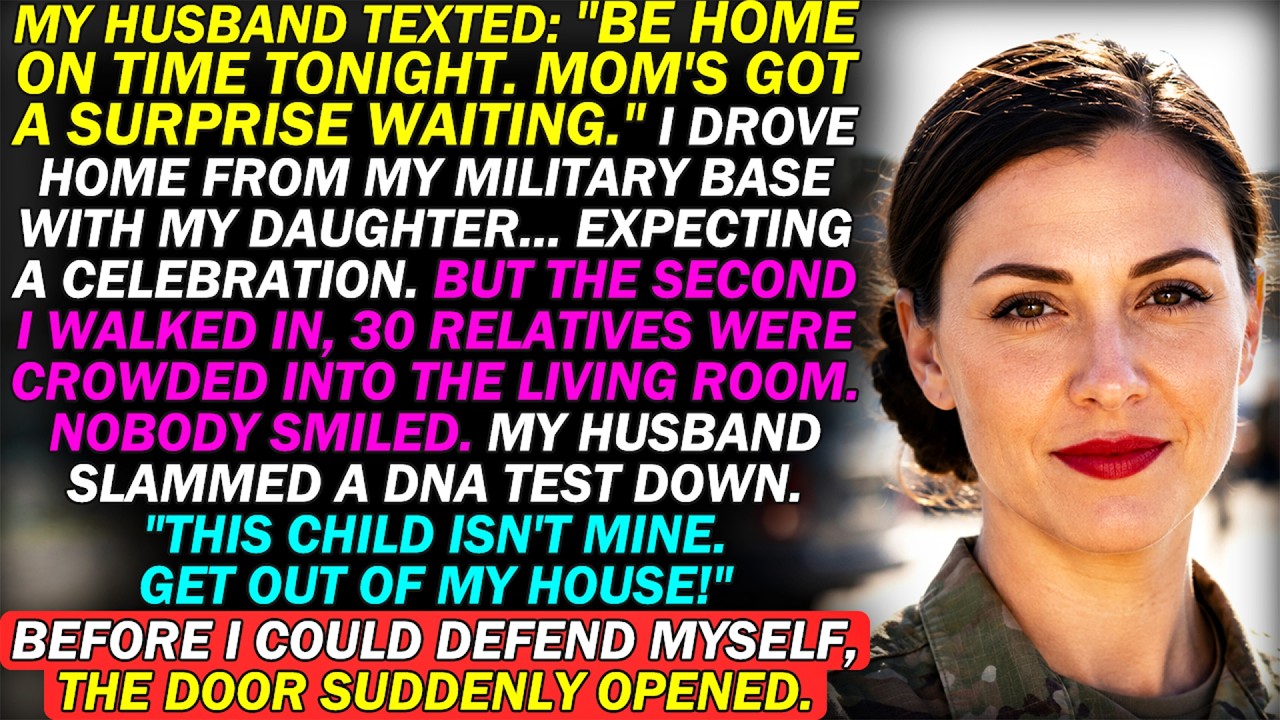
No one looked at my daughter. My husband slammed a sheet of paper on the coffee table and announced that the child on my hip wasn’t his. My mother-in-law screamed at me to get out of her house. That sheet of paper was the first shot in a war my husband had spent months preparing.
What he didn’t prepare for is what I do for a living. I move proof for the Army. Pallets, manifests, receipts. Over the next four months, I built a paper trail that ended in a courtroom with those same thirty relatives watching.
That Friday started ordinary enough. Our street in Marwood was parked bumper to bumper as I carried Ava inside, diaper bag on one shoulder, a lemon cake in my free hand. The door was unlocked. The living room was full of people I could name every one of.
Aunts, cousins, Uncle Gene, neighbors from two doors down. Not one of them said hello. Ryan stood in the middle like a man giving a listing tour. My mother-in-law Sandra stood at his shoulder with her church face on.
“What’s going on? ” I asked. Ryan picked a folder off the mantel, pulled out a single sheet, and slammed it down hard enough to rattle the coasters. “DNA results,” he said.
“This child isn’t mine. ”
I actually laughed. One short breath of a laugh, because it was the most ridiculous sentence I’d ever heard in that house. Nobody laughed with me.
Sandra’s voice came in high and shaking, the way it does when she’s been rehearsing. “You wore that uniform and shamed this family. Get out of my house. ”
She pointed at the door behind me with her whole arm, like she was directing traffic.
Thirty faces turned toward me in one motion. Ava grabbed the collar of my jacket. Behind my back, I heard the doorknob turn. Staff Sergeant Maya Reyes stepped into that living room in civilian jeans and her duty day posture, holding a Manila folder against her chest.
She looked at the crowd. The crowd looked at her. “Am I early? ” she said in a voice that could halt a convoy.
She was not early. She was exactly on time, because two weeks before that night, I had asked her to meet me at the house at 7:30. It had to do with a bank and a number that didn’t sleep. But what matters is what one witness does to a room like that.
Thirty people can convince each other of anything. Thirty people plus one outsider suddenly remember what they actually know, which in this case was nothing. I set the lemon cake on the entry table, walked to the coffee table, and picked up Ryan’s sheet of paper. A lab name I’d never heard of.
A percentage in bold. And near the bottom, one small detail that made me steadier instead of weaker. I didn’t say what it was. “Ava and I will be at my quarters,” I said.
“You can talk to my lawyer. ”
Then I picked up my daughter’s bag, nodded to Maya, and walked out through the door she was still holding open. Behind me, Sandra was still shouting about her house. That was the last time I ever walked out of that door believing it might blow over.
Here’s who they picked this fight with. My father was a supply sergeant, twenty-two years in uniform, a man who could find you a fan belt in a sandstorm. When I was sixteen, somebody in his unit cooked the books and let the blame drift toward him. Dad refused to fight it in the open.
He took a quiet discharge, moved us home, and spent his last eleven years being half believed at the hardware store. He had one sermon, delivered over the tailgate of his truck. “People lie. Paper doesn’t blink.
”
I swore I would never die the way he was dying, misread by a town too lazy to check. I met Ryan Tolliver at a wedding when I was twenty-seven. Third-generation realtor, the kind of charm that makes a room lean toward him. We married when I was twenty-nine.
At thirty-one, I bought the house in Marwood. My VA loan, my thirty-one thousand down, saved one deployment at a time. Both names went on the deed because that’s what marriage is supposed to mean. Our arrangement was simple.
Weekdays, Ava stayed with me in family housing at Fort Merrick. Weekends, we drove to Marwood and played house with the Tolliver name. I thought the commute was the hard part of my marriage. The hard part was living with a man who was taking inventory of everything I had.
That night in my quarters, with Ava asleep against a rolled towel, I opened my laptop and did what I’d been doing for two weeks. I watched the numbers. Fourteen days before the ambush, my banking app had locked me out. The bank said the recovery email on our joint accounts had been changed, not by me.
I changed every password I owned that night, turned on transaction alerts, and rerouted my paycheck into an account with only my name on it. I also asked Maya to come with me to Marwood on the nineteenth because I intended to ask my husband one calm question about money. Now, with printouts across my kitchen table, I could see the whole shape of it. Our joint savings had held a shade over fifty thousand in October.
It held nineteen hundred now. Eleven transfers over five months, forty-eight thousand two hundred in all, every one to the same place: Tolliver Realty Operating. He hadn’t stolen it in the legal sense. His name was on that account, same as mine.
One date stopped me cold. The transfers started in November. The DNA test showed up in April. He wasn’t a betrayed husband who found proof.
He was a man in a hole building a story to climb out on my back. Monday morning, my battalion commander called me into his office before I’d finished my first coffee. Lieutenant Colonel Park slid a printout across the desk. An email sent Friday night at 11:02 p.
m. from an address made of random letters. Subject line: Conduct of CPT Toliver. Attached was a scan of Ryan’s so-called DNA test, plus three paragraphs accusing me of adultery.
In the army, adultery isn’t just a sad story. Under the rules we live by, it can be a punishable offense. An accusation like that, in writing, with an exhibit stapled to it, isn’t something a commander can shrug at. He has to look into it.
Which meant an inquiry. A flag on my file. My packet for major, the one going before the promotion board that fall, would sit while strangers asked my co-workers about my marriage. My husband hadn’t just aimed at my house.
Before that Friday was even over, somebody had been at a keyboard aiming at my career. A divorce takes half. This was designed to take all of it. The house, my daughter, my rank, my name.
I got in my truck and made two calls. The second one was to a general. Major General Raymond Hayes commands the division, and eleven years ago he commanded me in Kuwait. I asked for ten minutes.
He gave me twelve. “Here’s what I can do, Captain,” he said. “Nothing. I can’t put my thumb on the scale for you.
What I can do is make sure nobody else puts theirs on it, either. The inquiry runs by the book. No shortcuts, no whisper campaign, no career funeral before the facts are in. You bring receipts.
That’s your lane. It’s always been your lane. ”
Then he got me thirty minutes with Major Dan Whitfield, a JAG attorney with a surgeon’s patience. Whitfield looked at the scan of Ryan’s test for about a minute and a half and almost smiled.
“This is a home kit result at best,” he said. “No verified identities, no chain of custody, no court in this state will treat it as proof of anything. ”
He couldn’t represent me in a civilian divorce, but he could translate the battlefield. “Get a civilian family lawyer today, answer the petition, and ask the court to order a real test, the legal kind where everyone shows ID and a stranger seals the tubes.
Make the paper fight fair. And paper will win. ”
The petition arrived that Thursday, hand delivered to the base gate like a dare. Ryan was filing for divorce.
He wanted exclusive use of the Marwood house. He wanted temporary custody of Ava. His lawyer had typed the reasons in a neat stack: the mother resides in military quarters; the mother is subject to field rotations and deployment on short notice; the mother’s schedule is incompatible with a stable home. Behind the petition came a second envelope.
If I signed over my interest in the house and waived any claim to the business accounts, Ryan would agree to keep the paternity matter private. Grace Kessler, the family lawyer I’d hired on Whitfield’s advice, read it once. She’s fifty-two, wears reading glasses on a chain, and has the bedside manner of a wood chipper. “This isn’t a divorce,” she said.
“This is a foreclosure with your wedding photos in it. He manufactured a scandal and now he’s selling you the silence. ” She slid the envelope back across the table. “We’re not buying.
We’re going to court. ”
Kessler spread Ryan’s test on her conference table. “No collection site, no signature from any technician, no case number format she’d ever seen from an accredited lab, nothing showing who swabbed whom or when or who watched. Real paternity evidence has a chain of custody.
A neutral third party checks ID, takes the samples, seals them, ships them, and signs every handoff. This thing? This is a horoscope with a percentage on it. ”
The lab name printed across the top was GenServe Diagnostics.
I called customer service that afternoon. The number rang into a robotic voicemail that repeated the number back to me and hung up. I called again. Same robot, same dead end.
No lab I’ve ever dealt with runs its phones like that, and the Army has made me deal with many. Kessler filed our response and a motion that became the spine of everything that followed: a request that the court order genetic testing, the legal kind. Both parties, photo ID, witnessed collection, accredited laboratory. “He built his whole case on one piece of paper,” she said.
“So we’re going to ask the court to make the paper real. Innocent men welcome a better test. ”
The temporary orders hearing lasted forty minutes. Ryan’s lawyer, a smooth man named Prather, used the phrase “the marital home” the way realtors say “charming.
” He mentioned my upcoming nine-day training rotation three times. He never once said I was a bad mother, which is the cleverest way to say it. The judge kept Ava with Ryan Monday through Friday. Status quo, he called it.
It was nobody’s status quo. It handed my daughter’s Tuesdays to the man who’d staged a tribunal in her living room. Kessler caught my arm in the hallway. “This is the round military mothers lose.
I’ve watched it for twenty years. The final hearing is the fight. Don’t spend yourself here. ”
The family went quiet around me the way a town goes quiet before a tornado.
Ryan’s sister Beth, who’d taught Ava to clap, texted: “Please just sign whatever he sent. Don’t drag the family through this. ” Cousins unfriended me in a neat little row. The pastor’s wife looked through me at the grocery store like I was a window with a bad view.
Somebody told the base spouses group that I’d stepped out on my husband. I typed the long message. You know the one. The dates.
The bank alerts. The explanation. Three paragraphs of my father’s daughter begging a jury that had already voted. I sat on my bed at 1 a.
m. and read it over, then deleted the whole thing. Explaining yourself to people who helped build the stage is just applause from the wrong side. Maya watched me do it over pizza the next night and shook her head slow.
“You keep proving you can bleed quietly. One of these days, try winning loudly. ”
Then an envelope with no return address showed up at my quarters. Inside was a blank cream card.
No message at all. Just a name, signed in a slanted, old-fashioned hand at the bottom: Ruth. Ryan’s grandmother. The only Tolliver who hadn’t been standing in that living room.
While the family voted, I did logistics. The subpoenaed bank records landed on Kessler’s desk, and I spent a weekend turning that box into a binder with color-coded tabs. Red tabs: eleven transfers, November through March, totaling forty-eight thousand two hundred. Blue tabs: the childcare ledger from the base center, every weekday sign-in since Ava was eight weeks old, my initials morning and evening.
It’s hard to call a woman an absent mother when her handwriting shows up twice a day for a year. And then the green tab, the one that made Kessler put her glasses up in her hair. In February, someone had applied online for a home equity line of credit against the Marwood house — sixty thousand dollars — with my electronic signature on the application. I never signed it.
The application had been submitted at 2:14 on a Tuesday afternoon from an IP address that resolved to the offices of Tolliver Realty. It died quietly in underwriting because the fraud alerts I’d set up made the bank call my cell, and I told them the truth: no, that was not me. Freeze it. At the time, I’d assumed identity thieves.
Now I knew the thief’s middle name. Kessler looked at the green tab for a long minute. “He needed money badly enough to forge your name in February. Remember that when you’re tempted to think any of this was about love, or doubt, or that little girl.
This was a man drowning, looking around for something buoyant to stand on. ” She paused. “That would be me. ”
Ava spiked a fever on one of my weekends, tugging her left ear and crying that ragged cry.
I took her to urgent care in Marwood. When the nurse called us back, Sandra was sitting in the waiting room. Ryan had texted her. She followed us in, and I let her because Ava reached for her.
Sandra sang the counting song while the doctor checked Ava’s ears. Ear infection, amoxicillin. In the parking lot, Sandra stood beside my truck and talked to me like a woman instead of a verdict. “You think I’m cruel?
I was twenty-nine once, in the same town, with people saying things about my husband. A woman is what this town says she is. I learned that the hard way. You’ll learn it, too.
”
There was no meanness in her voice. That was the frightening part. She was reciting the town’s catechism. Then she straightened her coat.
“Ryan would never lie about blood. ” And she walked to her car. In the first week of May, the court granted our motion, and Ryan’s side lost its manners. Prather objected in writing and in person: testing was redundant, invasive, insulting to a grieving father.
He actually said “grieving” about a man whose child was alive and teething. Kessler answered with one sentence. “If Mr. Tolliver trusts his results, your honor, a better lab can only agree with him.
”
The judge signed the order. Legal paternity testing, both parties and the child, government-issued photo ID, samples collected under observation at a certified facility, chain of custody documented from swab to lab bench. Collection, May ninth, nine a. m.
I stuck the appointment card to my refrigerator with a tomato magnet, dead center. My father’s voice came up out of some tailgate from 1998. People lie. Paper doesn’t blink.
The commander’s inquiry moved through my unit that same month, polite and heavy, like a piano being walked upstairs. People I’d trained, people whose weddings I’d stood up in, sat across from an investigating officer and answered questions about my marriage, then avoided my eyes at the fuel point. My promotion packet was formally frozen. Then Ryan’s team filed a fresh exhibit: a sworn declaration from Sandra stating that at Thanksgiving, in her kitchen, I had confessed to an affair with a man from the base.
I read it standing up. Thanksgiving in her kitchen. I had been nursing a five-month-old and basting a turkey while Sandra told me which pan I was ruining. The phrase “the man in question” appeared twice.
Sandra has never in her life said “the man in question. ” She talks like a church bulletin, not a deposition. “They didn’t need to beat me in court,” I told myself. “They needed me tired, broke, ashamed, and gone before the truth finished lacing its boots.
”
Discovery is a beautiful word. It means the other side has to hand you things they’d rather burn. Kessler demanded the original digital file of the GenServe report and sent it to a forensic document examiner named Howard Feld, a quiet man who has spent thirty years making paper testify. I did my own homework.
At the ambush, Ryan had waved around the swab kit he claimed he’d used on Ava in secret, like a man producing the murder weapon. Kessler’s discovery demand covered that kit, too. A cardboard box has a shipping label. A shipping label has a tracking number.
Kessler subpoenaed the carrier’s records, and one Tuesday morning the answer came back on a single page:
The kit was delivered to the Marwood front porch on April fourteenth at 2:47 p. m. I set the two pages side by side. The so-called report, with its results, percentage, letterhead, was dated April fifth.
The test existed before the test kit did. Nine days before. You can fake a letterhead. You can fake a signature and a phone number and a lab that answers in a robot’s voice.
But a delivery scan sits in a carrier’s database time-stamped by machines that have no idea who’s married to whom. Paper can be printed. History can’t. I slept eight hours that night for the first time in a month.
May ninth came in bright and ordinary. The collection office was a beige suite next to a dentist, and it ran on the sacred boredom of procedure. A technician named Denise checked my ID against her list, checked Ava’s birth certificate, photographed us, and gloved up. Ryan arrived eleven minutes late with sunglasses on his head, working the room out of habit.
“Y’all make a guy feel famous,” he told Denise. Denise did not look up. “Photo ID, please. ”
She swabbed Ava’s cheek while my daughter sat on my lap chewing the ear of a rubber giraffe.
She swabbed mine. She swabbed Ryan’s. Each swab went into its own sleeve, sealed with evidence tape, initialed, logged. Chain of custody isn’t a phrase.
It’s a little ceremony, and every step of it says the same sentence: nobody gets to be alone with the truth. On his way out, Ryan bent down as if to say goodbye to Ava and put his voice just under the hum of the air conditioner. “Doesn’t matter what the tube says, Claire. Everyone already believes me.
”
Then he thanked Denise loudly and left, trailing cologne. He wasn’t wrong. Belief is loud, and his family’s belief had thirty voices and a church pew. The Army did what the Army does.
It sent me to the field for nine days — rain, radios, four hundred soldiers’ worth of chow and fuel to move. Exactly as Ryan’s lawyer had predicted with such sorrow. Ava stayed in Marwood under the temporary order. I got a video call window most evenings: seven minutes of a pixelated baby smearing yogurt while Sandra’s voice offered commentary from offscreen.
Those nine days were the worst of the whole war. On night six, in a tent that smelled like diesel, Maya and I split a care package brownie, and I told her the whole story of my father. The cooked books, the quiet discharge, the hardware store. I’d never told anyone all of it.
“He kept every receipt that proved him innocent. Boxes of them. He could have cleared his name in a week. ”
“So why didn’t he?
” Maya asked. I heard myself say the true thing out loud for the first time. “Because he was proud. He decided that if the town needed proof, the town didn’t deserve him.
And it killed him. Not the lie. The silence. ”
When we rolled back through the gate on day nine, two envelopes were waiting in my quarters.
The lab and Feld. I opened the lab’s envelope standing up, still in a dirty uniform. Probability of paternity: 99. 99%.
Ryan Tolliver was Ava’s father, said the accredited laboratory, the witnessed swabs, the sealed tubes, the unbroken chain of signatures. I sat down on the kitchen floor of my quarters and cried for about ninety seconds. Then I washed my face, because I know the difference between a battle and a war. Here’s what that number changed in Marwood.
Nothing. Kessler formally served the results on Ryan’s counsel that week. And Ryan, I have to give the devil his due, had already moved. Two days before the results landed, he’d called a family meeting at Sandra’s, wept at her kitchen table, and unveiled the new script.
He was a victim too. That testing website had defrauded him. He’d swabbed his own daughter in good faith, paid his money, and been handed a lie that broke his heart. And now the lawyers say the real test proves Ava is his.
Thank God. “He cried,” Beth told me later. “Actual tears, on cue. ”
And the chorus took it up in one breath.
Poor Ryan, deceived by the internet, and notice how he never stopped loving that little girl. The same thirty people who’d watched me get pointed out of my own front door simply revised the story and kept their seats. But the second envelope was still sitting on my counter. Feld’s report was forty-one pages, and it didn’t paint.
Piece one: the GenServe report was built from a template — a novelty paternity certificate sold online by a company whose own website says, in small gray letters, “For entertainment purposes only. ”
Piece two: the file’s metadata. The author field read rtolliver. Created and last saved on March thirtieth at 11:38 at night.
Piece three: the money. The template cost $39. 99, purchased March thirtieth with a Tolliver Realty debit card. Receipt to Ryan’s own email.
Piece four: that robotic phone line for GenServe customer service — an internet phone number registered March twenty-eighth, paid for with the same debit card. He hadn’t just faked a document. He’d built a little theater set around it, box office and all. Piece five: the anonymous email to my commander had been sent through an account created that same week from the same block of internet addresses as the realty office.
Every road on Feld’s map drove back to the same desk. An author. A man who typed his daughter out of his own blood on March thirtieth, ordered a prop kit on April ninth to wave at his uncles, and scheduled a firing squad for April nineteenth. Kessler read all forty-one pages twice, took her glasses off, and asked me the question the whole story had been marching toward.
“We can end his freedom, Claire. Or end this war. Pick. ”
I picked the next morning at six a.
m. over black coffee. Step one wasn’t the district attorney. Step one was the court that had been lied to.
Kessler drafted a motion for sanctions: fraud on the court. She attached everything — Feld’s forty-one pages, the template overlay, the metadata, the debit card, the tracking sheet showing the kit arriving nine days after its own results. Filing it meant standing up in public records and calling my husband a forger in ink under my own name. “If any piece of it wobbled,” Kessler said, “you’d be the vindictive army wife who cried forgery.
”
I read every page one more time, checked the exhibits against my own binder like I was inventorying a convoy, and signed. My hand didn’t shake. That night, I took off my wedding ring, wrapped it in the receipt copy of the sanctions motion, sealed both in an envelope, and wrote the date on the outside. I put it in the fireproof box next to my father’s discharge papers.
Then I slept, and I did not dream about the living room. A sanctions motion is a public document, and Marwood reads its public documents the way other towns read box scores. Within a week, the story forked. Half the town held the line.
But the other half had now read words like “metadata” and “novelty certificate” and “entertainment purposes only,” and you could feel the pews shifting weight. Two sellers pulled their listings from Tolliver Realty. Then a third. Thursday night, Beth called.
She was crying before I said hello. “The Thanksgiving thing,” she said. “Mom’s declaration. Claire, I was standing in the kitchen the whole time you were there.
You talked about turkey and the baby’s ears. That’s all. ”
She’d seen the declaration language too. Heard Prather’s paralegal walk Sandra through it: “Just sign it.
It’s a formality. It keeps the family safe. ”
I asked Beth the only question that mattered. “Will you put what you just told me in an affidavit?
”
The line went so quiet I could hear her kitchen clock. “He’s my brother,” she whispered. “And she’s my mother. ”
I told her I understood, and I did.
I’d watched a family vote before. That Sunday, my phone rang from a number I didn’t know, and a voice like dry paper said, “This is Ruth Tolliver. Come Tuesday. I make the tea at three.
”
Ruth lived at the edge of town in the first house the family ever owned. She was eighty-four and poured tea like a woman who’d outlived every argument in the county. “I know what my grandson is,” she said. “I’ve known since he sold his own bicycle twice in one summer.
”
Then Ruth gave me the only inheritance she had to hand out that day: history. Long before I came along, there’d been money trouble in the family. Her son’s doing. Back when Sandra was a young wife new to the name.
The family had needed someone to carry the shame quietly, so the name could keep selling houses. Everyone had looked at Sandra. And Sandra had signed what she was asked to sign and swallowed what she was asked to swallow. “She lost her election,” Ruth said, stirring her tea.
“And she lived. And she made a religion out of it. This family’s been voting on the truth since before you were born. Somebody has to lose an election and live.
”
I asked if she’d say any of it in court. “No,” she said, plain as weather. “I’m too old to change teams in public. But I wanted you looking at the right target.
It was never you they were voting against. It’s what you didn’t need from them. ”
My phone buzzed at a red light. Kessler.
“They blinked. Settlement conference Friday. His side requested it. ”
Thursday evening, the night before the conference, I stopped at the mediation building downtown to drop exhibit copies.
Ryan was waiting by the elevators like a coincidence in a good jacket. “Claire. Five minutes. No lawyers.
”
I gave him the five minutes because I wanted to see the salesman work one more time. He offered me everything. The house. The savings, repaid with interest.
Ava, whatever schedule I wanted. All I had to do was withdraw the sanctions motion and let Feld’s report disappear into a sealed settlement. He said “heal” twice. When I didn’t answer, the register changed and the real Ryan surfaced like a fin.
“You should think about what winning even gets you. Even if you take all of it, you’ll still be the woman thirty people watched get thrown out of her own house. That’s the version they’ll tell at every table in this town forever. That never washes off, Claire.
I made sure of it in one night. You can’t undo it in a hundred court dates. ”
Then the elevator came, and he stepped in and smiled at me until the doors closed. I stood alone in that concrete lobby, hating him with my whole rib cage, because the cruelest thing he’d said all year was the one true sentence in it.
I didn’t sleep much that night. The settlement conference convened in a borrowed conference room with bad coffee and a view of the courthouse flag. Prather came in gray-faced, flanked by a second lawyer they’d added for the occasion, which told me everything about how Feld’s report had landed. Kessler laid her copy on the table like a place setting and leaned close.
“Say the word, and I walk this across the street to the district attorney. Forgery, fraud. He put a fabricated document in front of a judge. They take that personally.
You’d own the house, the settlement, likely the business by the time the dust cleared. ”
I asked for ten minutes and stood in the hallway with Maya, who had taken leave to sit in a plastic chair and be my spine. Two futures side by side. Future one: handcuffs, headlines, Tolliver Realty a carcass, Sandra ruined at sixty-three.
And Ava at eight, at twelve, at seventeen, learning that the reason there’s no dad at the recital is that Mom pressed, with the town retelling it forever with me cast as the woman who burned the family down. Future two had only one thing in it, but I couldn’t stop looking at it. A record. Permanent, public, in his own voice.
My father had boxes of receipts and no one to read them into a record. I had both, and only one shot at choosing right. I walked back in. “I have one offer,” I said.
“It’s not negotiable. ”
I stayed standing, because some things you deliver on your feet. “One: Ryan appears at the final hearing in open court and reads a sworn admission into the record that he fabricated the test, that he staged the nineteenth of April, that I never betrayed him. His words, his voice.
Two: I receive sole legal and physical custody of Ava. He gets supervised visitation, with a path to more if he stays honest. Three: the house is deeded to me alone, the forty-eight thousand two hundred comes back, plus my legal fees of nineteen thousand four hundred. Four: a notarized retraction goes to my commanding officer.
In exchange, I withdraw my request for a criminal referral. ”
Prather stared at me the way you’d stare at a hand grenade rolling to a stop with the pin still in. They had walked in braced for total war and been handed surrender terms that let their client keep his freedom. Kessler leaned in, and under the table her hand found my wrist.
“You’re giving up the kill shot. ”
“I know,” I said. “I’m trading it for the record. ”
Ryan never said a word.
He signed the term sheet like a man signing a listing on a house he’d grown up in. The final hearing fell on a hot Thursday in August, and the Tolliver family came to court the way they’d come to my living room: in force, in their church clothes, thirty strong. Sandra, front row behind her son, chin up, purse on her knees. There was one difference in the seating chart.
Beth walked past her mother’s row, past thirty years of assigned seats, and sat down directly behind me. Her affidavit had been filed two weeks earlier — the kitchen, the turkey, the declaration that didn’t sound like Sandra. Now she sat at my back where a witness belongs, hands folded, shaking slightly, magnificent. The judge handled the divorce terms first, dry as inventory.
Custody as agreed. Deed as agreed. Restitution as agreed. Then she said, “I understand there’s a statement.
”
Ryan stood up. I watched a man who had never once in nine years read from a script he didn’t love unfold a single sheet of paper with both hands to keep it from moving. He read it flat, fast, like a hostage, but he read every word. He had purchased a novelty certificate online on March thirtieth.
He had entered the false result himself. He had arranged the gathering of April nineteenth for the purpose of confronting me publicly. The complaint to my command repeated claims he knew to be false. And then the sentence I’d built four months around, his voice cracking open in the middle of it: “Claire Toliver never betrayed me.
I fabricated the test. All of it. ”
Somewhere behind me, someone made a sound like a hymnal dropping. Sandra stood up in the middle of the sentence, gathered her purse, and walked out of the courtroom with her heels striking the floor like a clock being wound too tight.
She did not look at me. Her son kept reading to the room she’d left. The judge accepted the admission into the record, granted the sanctions motion, and said the words I’d traded my kill shot for: “The court notes the petitioner’s request, in the interest of the minor child, that no criminal referral be pursued. The court reserves its own discretion on that question.
”
“Reserves. ” Meaning Ryan would spend a few years checking his mail carefully. Which struck me as a fair tax on a man who’d once mailed my career a bomb. Outside, on the courthouse steps, most people were kind.
A reporter asked for a comment; I declined, politely, twice. Then Mrs. Albright from the church choir took both my hands in hers and said, “I’m so glad it worked out, dear. Still, where there’s smoke, you know.
”
And she patted my knuckles and walked off to lunch. There it was — the residue, the thing Ryan had promised me in the elevator lobby, the stain that thirty witnesses and a notarized retraction and a court transcript cannot fully bleach, because some people prefer the smell of smoke to the boredom of facts. I stood on those steps and let it hurt. Then I let it go.
One breath in, one out. That same afternoon, the Army finished its own paperwork. Inquiry closed, unsubstantiated. Flag lifted.
Retraction filed. And General Hayes called me personally, which generals do not do to congratulate you on your divorce. “Your packet’s moving again, Captain. Your name’s in a good spot on the command list.
I need your answer on something inside seventy-two hours. ”
What Hayes had for me was the future I’d been running toward since I was eighteen: battalion command track, the schools that feed it, the on-ramp to lieutenant colonel and beyond. I asked for the seventy-two hours and spent them the honest way. Lists on the kitchen table, Ava asleep down the hall, the tomato magnet holding a photo now instead of an appointment card.
Then I drove to division headquarters and told a two-star general no. I asked for the instructor billet instead. The logistics captain’s course at Fort Merrick. Three years of stability, home by six, one address for Ava, an off-ramp from the fast track that most officers never take on purpose.
Hayes heard me out with his hands flat on the desk. “You’d have gotten it. ”
“I know,” I said. “That’s what makes it a choice.
”
He stood and walked to the window. “Twenty-six years in, Captain? I’ll tell you the only ledger that matters. It’s not the rank.
It’s the number of people who’d raise their right hand and swear for you under oath, unpaid, on a Thursday. Yours is full. ”
That night, I finally understood the difference between my father and me. It isn’t pride, and it isn’t paper.
He kept his receipts in boxes no one ever opened. One man against a town, alone on purpose. I’d let people read mine — a sergeant, a lawyer, a general, a sister-in-law with shaking hands. Proof isn’t what saves you.
Witnessed proof is. So I wrote it all down for the one witness who matters most. A letter to Ava, sealed, marked for her eighteenth birthday, with the transcript folded inside. Truth in a drawer, not on a wall.
The deed transfer recorded on a Tuesday in September, and Kessler mailed me the keys in a padded envelope with a sticky note that said, “Go home. ”
I drove the seventy miles one more time, alone on purpose for the last time, and stood in the doorway where the whole war had started. The living room was empty. Ryan had taken the furniture.
Fine. Let the man have chairs. Without it, the room where thirty relatives once stood shoulder to shoulder turned out to be small, ordinary — just a room with good afternoon light and a scuff on the floor where a coffee table used to catch a slammed folder. I walked through and opened everything.
Both windows, the kitchen window over the sink, the back door, the front door, wide until the September air walked through the house like it was thinking about buying. I stood in that cross breeze and heard it one more time, the way you test a bruise. “Get out of my house. ”
Her house.
It was never her house. It was never even really his. It was the house my deployments paid for. The one my name had been on since the day I signed.
And now the only name. The next weekend, Ava’s crib went into the sunny bedroom, and Maya carried boxes and ate half the pizza, and my daughter slept her first night in a home nobody could stage a tribunal in, because her mother owns the door, and her mother decides who walks through it, and her mother leaves it open on purpose. The months since have been almost suspiciously quiet. The restitution cleared in two payments on schedule.
Tolliver Realty is still standing, smaller, run these days mostly by a cousin. Towns like Marwood don’t burn their old names. They just stop repeating them as often. Ryan comes to his supervised Saturdays at the family center.
Some weeks he’s good with Ava — the duck song, the giraffe. And some weeks he cancels with a realtor’s apology, and I write both kinds of Saturday down in a notebook, because I’m still my father’s daughter, just the revised edition. Sandra sent a card on Ava’s second birthday. Pink, glitter, a bear holding balloons.
She signed it with one letter: C. No message. I understood it completely. It’s as far as her religion allows her to travel, and the door she’s standing behind is one she built herself.
I wrote back. Thank you. She loved the bear. Some elections you lose.
Ruth taught me you can live anyway. Beth comes by most Sundays with banana bread and zero apologies left to make. She made hers under oath, which is more than most people ever do. And in October, we had the party we never got in April.
Ava turned two in the backyard of the Marwood house. Maya on cake duty, Kettler in weekend clothes nobody knew she owned. Half the block invited. General Hayes stopping by for exactly twenty minutes in a golf shirt to inspect the burgers and pronounce my logistics sound.
Thirty-some people laughing in and out of my living room, and the front door propped wide open the entire afternoon, with the same tomato magnet holding the guest list to the refrigerator. Last April, a door opened behind me and saved my name because one friend walked through it. Now I keep it open on purpose and I watch who walks in. And every single one of them would raise a right hand for me on a Thursday.
That’s the fortune I took out of the worst year of my life. The house came with it. If this year taught me one thing worth engraving, it’s this: a lie needs a full room to stay alive, but the truth only needs one witness and a place where things get written down.
So build your life where things get written down, and never be too proud to hand somebody the pen.