The last words my father ever spoke to me as his daughter were: “The day you put on that Marine uniform, you stopped being my daughter. ”
Fifteen seconds later, my sister’s fiancé, a Navy SEAL commander, looked at the scar on my wrist, went pale, and addressed me in a voice that silenced the entire room. “Ma’am, are you the Black Panther of the Marines? ”
The laughter died so abruptly that I could hear the ice settling in the crystal glasses.
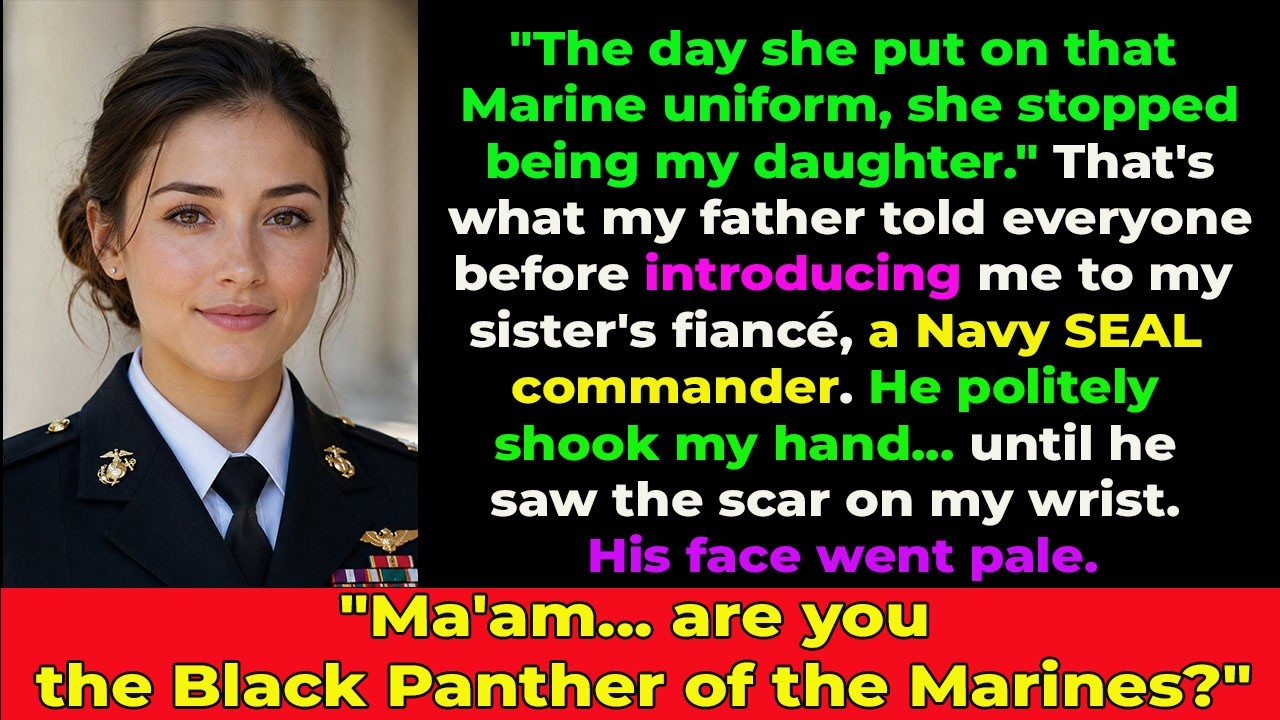
My father stood frozen beside the dining room table, still holding the champagne flute he’d raised to celebrate my younger sister Emily’s engagement. His proud smile slowly faded as every pair of eyes turned from him to me. I wanted to disappear. Not because of what Commander Daniel Carter had said—but because I had spent twenty-two years making sure nobody outside a very small circle ever connected my face to that old call sign.
“Daniel,” Emily whispered with an embarrassed laugh, “what are you talking about? ”
He didn’t answer her. Instead, he looked directly into my eyes, as if asking permission to continue. I gave the slightest shake of my head.
He understood immediately. “I’m sorry,” he said politely. “I thought she reminded me of someone. ”
The room slowly came back to life.
Someone forced a laugh. My aunt reached for another dinner roll. The conversation stumbled forward, but nothing felt normal anymore—especially not for me. That single sentence had unlocked memories I’d spent years burying beneath disciplined deployments and silence.
It had all started twenty-two years earlier. I grew up outside Wilmington, North Carolina. Dad owned one of the largest construction companies in the county. Mitchell Construction built schools, churches, veterans housing, and neighborhoods people were proud to call home.
Dad believed in hard work, loyalty, and that a person’s word mattered more than a contract. But he also believed sons carried family legacies. Since he never had one, he expected me to become one. From the time I was twelve, he brought me to job sites every Saturday morning.
He taught me to read blueprints, pour concrete, negotiate with suppliers. He’d point across unfinished buildings and say, “One day, Sarah, all this will be yours. ” Back then, I believed him. Then September 11th happened.
Like millions of Americans, I watched the towers fall on television. I watched firefighters climb upward while everyone else ran down. I watched Marines standing guard over a country that suddenly felt vulnerable. Something inside me changed that morning.
Not overnight, but permanently. While my classmates talked about football and spring break, I read everything I could about military service, leadership, and Marine Corps traditions. The more I learned, the more certain I became. I wasn’t running away from home.
I was running towards something bigger than myself. Dad called it a phase, then a rebellion. Finally, a betrayal. The day I told him I’d accepted an appointment to officer candidate school, he stared at me for nearly a full minute before speaking.
“You’ve lost your mind. ”
“I’ve made my decision. ”
“No,” he snapped. “You’ve made mine.
”
Mom stood silently in the kitchen doorway. Emily cried. I stayed seated. Dad walked across the room until he stood directly over me.
“You want to wear a Marine uniform? ”
“Yes. ”
“You’d rather salute strangers than help your own family. ”
“It isn’t like that.
”
“It is exactly like that. ” His voice grew louder with every sentence. “You’ll throw away everything I’ve built. ”
“I’ll always be your daughter.
”
His eyes hardened. “No. ” He pointed toward the front door. “The day you put on that Marine uniform”—he paused long enough for the silence to hurt—“you stopped being my daughter.
”
I thought he’d calm down. I thought Mom would convince him. I thought time would fix everything. Instead, he never came to my commissioning ceremony.
He never answered my letters. Every birthday card I mailed came back unopened. Every Christmas package disappeared somewhere between Wilmington and Camp Lejeune. Mom found quiet ways to stay in touch.
She’d send recipes, pictures of Emily, little clippings about home. Never once did she ask me to quit. Her letters always ended the same way: *I’m proud of you. Stay safe.
Love, Mom. *
I carried those letters through training, deployments, promotions, and more sleepless nights than I could count. They reminded me that someone back home still believed I belonged. Years passed.
Emily built a successful career selling coastal homes. Dad expanded the company. Mom quietly became the bridge between worlds that refused to meet. Then cancer took her faster than any of us expected.
By the time I arrived home from overseas, the funeral was over. Dad barely looked at me. We spoke fewer than twenty words that entire weekend. After that, I stopped coming home—not because I hated him, but because every visit reopened wounds.
Neither of us seemed willing to heal. Then, six months ago, Emily called. “I met someone. ”
“I’m happy for you.
”
“I want you to meet him. ”
“I don’t think Dad wants that. ”
“I don’t care what Dad wants. ” There was a long silence.
Then she quietly added, “Mom would have wanted both her daughters at my engagement dinner. ”
That sentence stayed with me. So I requested leave, drove nearly three hours from Camp Lejeune to Wilmington, and checked into a small Hampton Inn instead of staying at the family house. I ironed my civilian clothes and left my dress blues hanging untouched in the closet.
I had learned years ago that wearing my uniform around Dad only made things worse. When I walked into Emily’s engagement dinner, everyone hugged her. Everyone congratulated Daniel. Dad shook hands with business partners he’d invited.
Then he noticed me standing near the entrance. His smile vanished. He waited almost twenty minutes before acknowledging I existed. Finally, as guests gathered around the dining table, he lifted his glass.
“I’d like everyone to meet my younger daughter, Emily, and her fiancé, Commander Daniel Carter, United States Navy. ”
Applause filled the room. Then he looked toward me. “And this,” he sighed dramatically, “is my other daughter.
The one who chose war over family. ”
Nobody laughed the second time. Not even Emily. I forced myself to smile.
“I came to celebrate Emily. ”
Dad shrugged. “I suppose even strangers get invited to weddings. ”
The word stung more than I wanted anyone to know.
Daniel stepped forward before I could answer. He extended his hand. “It’s an honor to finally meet Emily’s sister. ” His grip was firm, professional.
Then his thumb brushed across the old scar running along my wrist. Everything changed. His eyes locked onto mine. Recognition spread across his face.
His breathing stopped. In a voice barely above a whisper, he asked the question that changed the course of my family’s life forever. “Ma’am, are you the Black Panther of the Marines? ”
Nobody moved.
Commander Daniel Carter was still holding my hand, his eyes fixed on the scar across my wrist like he’d just seen a ghost. I gave him the smallest shake of my head. He understood. Military people learn very quickly when silence is more important than curiosity.
He released my hand, straightened his jacket, and forced a polite smile. “My apologies,” he said evenly. “I thought she reminded me of someone I once heard about. ”
The room let out a collective breath.
My father chuckled. “There you go,” he said, lifting his glass again. “For a second there, I thought Sarah had actually done something important. ”
Several guests laughed politely.
Daniel didn’t. Neither did Emily. She looked from him to me with growing confusion. “Danny,” she asked quietly, “what’s going on?
”
“Nothing,” he replied. His answer fooled everyone except me. I’d seen that expression before. It was the look Marines and SEALs wore after discovering that someone standing quietly beside them had once carried responsibilities they couldn’t even ask about.
Dinner continued, but no one was really eating anymore. My father launched into another story about his newest building project. He loved being the center of attention. Normally, people admired him for it.
Tonight, even he could tell something had shifted. Daniel barely touched his steak. Every few minutes, I’d catch him glancing in my direction before quickly looking away. He wasn’t being rude.
He was trying to solve a puzzle. Finally, my father noticed. “So, Commander,” he said loudly enough for everyone to hear, “what exactly did you think my daughter was? ”
Daniel chose his words carefully.
“I was mistaken. ”
Dad grinned. “I figured. ” He pointed toward me with his fork.
“Sarah always had a vivid imagination. ”
I said nothing. Years ago, I would have defended myself. Not anymore.
Sometimes silence protects your dignity better than arguments ever could. But Dad wasn’t finished. “When she was a teenager,” he continued, “she thought she was going to save the world. ” A few relatives smiled awkwardly.
“I told her the world already had enough soldiers. It needed daughters. ”
The words landed harder than he intended. Even Emily looked down at her plate.
Daniel slowly set his knife on the table. “Sir,” he said respectfully, “with all due respect. ”
Dad leaned back confidently. “Go ahead.
”
“I don’t think military service makes someone less of a son or daughter. ”
Dad shrugged. “That’s because you wear the uniform. ”
“I do, and I thank you for your service.
”
“But family should come first. ”
Daniel nodded thoughtfully. “I understand why you feel that way. I spent thirty years building this company,” Dad gestured toward me, “and she walked away.
”
I looked out the dining room window toward the backyard where I’d played softball as a little girl. The old oak tree was still there, and the swing Dad had built with his own hands. Time changes people. Sometimes it leaves places untouched.
Daniel spoke again. “May I ask something? ”
Dad smiled. “Of course.
”
“When was the last time you asked your daughter what she actually did in the Marines? ”
Dad frowned. “I know enough. ”
“What did she do?
”
“She was an officer. ”
“What kind? ”
Dad hesitated. “I don’t know.
”
“What unit? ”
Silence. “What deployment? ”
More silence.
“What awards? ”
Nothing. The room suddenly became very quiet. Daniel wasn’t trying to embarrass him.
He was making a point. Dad finally waved his hand dismissively. “Those things don’t matter. ”
“They matter to the people who served beside her.
”
Dad looked irritated. “Listen, Commander. ”
“Daniel is fine. ”
“Daniel.
” He leaned forward. “I appreciate your respect for the military. I truly do. But let’s not pretend Sarah was some kind of war hero.
”
My heartbeat slowed—not because I was angry, but because I recognized where this conversation was heading. Daniel inhaled slowly, then asked the question I’d hoped he wouldn’t. “May I ask what rank she retired at? ”
Dad laughed.
“I have no idea. ”
Daniel looked at me. I nodded once. “Colonel,” he answered quietly.
Every head turned toward me. Emily blinked. “What? ”
Dad stared at Daniel.
“No. ”
Daniel didn’t react. “Yes, sir. ”
Dad looked at me.
“Is that true? ”
I took a sip of water before answering. “Yes. I retired six months ago.
”
Nobody spoke. My aunt finally whispered, “I thought you were still a captain. ”
I smiled gently. “So did most of the family.
”
Emily looked like she might cry. “Sarah, why didn’t you ever tell me? ”
“When I asked softly, every conversation ended before we reached that part. ”
She lowered her eyes.
She knew I wasn’t blaming her. Life had simply carried us in different directions. Dad folded his arms. “So what?
So she retired after more than two decades of service. ”
Daniel nodded. “True, but very few reach that rank. ”
Dad’s voice hardened.
“You seem awfully impressed. ”
Daniel looked directly at him. “I am. ”
My father leaned back in his chair.
“You still haven’t explained why. ”
Daniel hesitated. His clearance allowed him to know fragments. Mine required me to protect the rest.
“There are stories,” he finally said. “What stories? ”
“Stories told during joint training. ”
Dad rolled his eyes.
“Ghost stories. ”
“No, sir. Professional ones. ” He paused.
“There was a Marine officer whose call sign was Black Panther. ”
The name seemed almost unreal spoken aloud after all these years. Daniel continued. “Nobody knew her real identity.
Most of us assumed the stories were exaggerated. ”
“What stories? ” Emily asked. Daniel smiled faintly.
“The kind older operators tell younger ones. About impossible missions. About leaders who refused to leave anyone behind. About someone who volunteered for the assignments nobody else wanted.
”
Dad snorted. “So basically military fairy tales. ”
Daniel didn’t smile. “No, sir.
The people telling those stories had scars. They weren’t the type to invent heroes. ”
The room became silent again. My father looked toward me, then laughed once more.
“If she’s this famous,” he folded his hands confidently, “prove it. ”
I closed my eyes for just a second. Because I knew exactly what Daniel was about to ask next. And once he did, there would be no putting the past back inside the box where I’d kept it hidden for twenty-two years.
The silence settled over the dining room like a heavy blanket. My father leaned back in his chair—the confidence of a man who had spent his whole life believing he could never be proven wrong. “If she’s this famous,” he repeated with a smirk, “prove it. ”
Several relatives shifted uncomfortably.
Emily looked ready to change the subject, but Daniel gently placed a hand on hers. “It’s all right,” he said quietly. Then he turned to me. “Colonel Mitchell.
”
I couldn’t remember the last time anyone had called me that outside a military ceremony. “I know you don’t owe anyone an explanation,” he continued. “But if you still have it”—he hesitated—“would you mind showing him your challenge coin? ”
I closed my eyes for a moment.
The leather pouch. I knew exactly where it was—not because I carried it to impress anyone, but because after twenty-two years in uniform, there were a few things I simply couldn’t leave behind. It sat inside the overnight bag I’d left near the front hallway. For a long moment, I didn’t move.
I had spent decades making sure my military life stayed separate from my family. Keeping those worlds apart had become second nature. If I opened that pouch tonight, there would be no closing it again. Emily reached across the table and gently touched my hand.
“You don’t have to,” she whispered. I smiled. “I know. ”
Then I stood.
“I’ll be right back. ”
Nobody spoke while I walked into the hallway. I opened my small travel bag. Under a folded sweater sat the worn brown leather pouch.
The zipper had been repaired twice. The leather was cracked from years of deployments, airports, barracks, and storage lockers. I held it for a second before returning to the dining room. Dad laughed as I sat down.
“What is that, my wallet? ”
One uncle joked; more nervous laughter followed. I ignored them. Slowly, I unzipped the pouch.
Inside were only a handful of items—nothing shiny, nothing arranged for display, just pieces of a life. First came an old military identification card with the corners worn smooth. Next, several challenge coins. Then a folded American flag patch that had once been sewn onto a combat uniform.
Finally, a small velvet case. I laid everything on the table without saying a word. Daniel’s expression immediately changed. He wasn’t looking at decorations.
He was looking at history. His eyes settled on one challenge coin near the center. Without touching it, he whispered, “I’ve only seen one of these before. ”
Dad frowned.
“It looks like an ordinary coin. ”
Daniel shook his head. “No, sir. It isn’t.
” He looked at me. “May I? ”
“You may. ”
He picked it up carefully—almost reverently.
One side displayed the eagle, globe, and anchor of the Marine Corps. The other carried an insignia very few Americans had ever seen. No unit name, no mission title—only an engraved panther’s head beneath a simple Latin phrase: *Silentium Servat. * Silence protects.
Daniel let out a slow breath. “My God. ”
Dad rolled his eyes. “So?
”
Daniel looked around the table. “This coin wasn’t sold. It wasn’t given away. It wasn’t earned during ordinary service.
” Nobody interrupted him. “It was presented only to personnel who participated in a classified joint task force. ”
Emily stared at the coin. “You know this?
”
“I’ve heard about it since I was a boot. I never believed I’d actually see one. ”
Dad folded his arms. “Anybody can buy fake military memorabilia.
”
Daniel slowly turned the coin over. “No. ” He pointed to a tiny serial engraving barely visible near the edge. “Every authentic challenge coin from that task force carried an individual identification number.
”
Dad laughed again. “So you’re telling me this little coin proves she’s some kind of superhero? ”
“No,” Daniel answered calmly. “It proves she was there.
”
The room remained silent. My father wasn’t convinced. “People exaggerate military stories all the time. ”
“They do.
And that’s why I haven’t mentioned the missions. ” Daniel looked back toward me. “Because she can’t. ”
He understood.
Classified operations stay classified. Real professionals don’t tell dramatic war stories at family dinners. Sometimes the bravest thing a service member carries home is silence. Emily picked up the folded American flag patch.
“It looks so old. ”
“It is,” I said softly. “It came off my first deployment. ”
She carefully placed it back down.
“I wish Mom could have seen all this. ”
The words caught in my throat. “So do I. ”
Dad shifted impatiently.
“If she’s got medals, where are they? ”
I looked at him. “They’re in a closet. ”
“You don’t display them?
”
“No. ”
“Why not? ”
“Because they remind me of people who didn’t come home. ”
Nobody breathed.
That answer changed something—not dramatically, just enough. One of my cousins quietly lowered his eyes. An elderly uncle who had served in Vietnam slowly nodded to himself. He understood.
Veterans often recognize each other without needing explanations. Daniel carefully opened the small velvet case. Inside rested a Bronze Star with Valor. Next to it lay the Navy and Marine Corps Commendation Medal.
There were no speeches, no dramatic music—just quiet recognition. Daniel closed the case again. Then, without saying another word, he stood. The movement surprised everyone.
He stepped back from the table, placed his arms at his sides, straightened his shoulders, and rendered me a perfectly sharp military salute. It wasn’t ceremony. It wasn’t politics. It wasn’t because of rank.
It was respect between two people who understood what sacrifice sometimes costs. Instinct took over. I returned the salute. For several long seconds, neither of us moved.
Across the room, my uncle Frank slowly pushed back his chair. Frank had served two tours in Vietnam with the Marines. Age had bent his shoulders. Arthritis made walking painful.
But he stood anyway. Then he saluted. Another guest rose—a retired Army sergeant. Then another, a former Air Force pilot.
Within moments, nearly every veteran in the room was standing. Not because they knew my story, but because they understood what Daniel’s salute meant. No words were necessary. Dad remained seated, looking around the room, confused, almost frightened.
“What? ” His voice cracked. “What is everybody doing? ”
Nobody answered immediately.
Finally, Uncle Frank spoke. His voice was rough with age. “When one warrior recognizes another,” he looked directly at my father, “the rest of us pay attention. ”
For the first time in my entire life, my father looked at me not with anger, not with disappointment, but with uncertainty.
As though he had suddenly realized the daughter he thought he knew had lived an entire lifetime beyond the reach of his judgment. And for the first time, he wanted answers. The veterans who had risen to salute me did so with quiet dignity. There was no applause, no dramatic speeches, no attempt to turn the evening into a military ceremony.
They simply acknowledged another veteran, then returned to their seats. The silence that followed was heavier than any argument my father and I had ever had. Dad looked around the room, searching for someone to tell him this had all been an elaborate misunderstanding. No one did.
Finally, he looked at me. “What exactly did you do? ”
His voice had changed. The arrogance was still there, but mixed with something unfamiliar.
Uncertainty. I folded the leather pouch and slipped it back into my overnight bag. “I served. ”
“That’s not an answer.
”
“It’s the only one I can legally give. ”
He frowned. “You mean you can’t tell your own father? ”
I almost smiled at the irony.
“For twenty-two years, you never asked. ”
Those words landed harder than I’d intended. Dad looked away first. Emily quietly reached over and squeezed Daniel’s hand.
She knew this wasn’t really about military secrets. It was about twenty-two years of silence that neither of us had known how to break. One of Dad’s business partners cleared his throat. “I think maybe we should leave.
”
“No,” Dad said quickly. His eyes never left me. “I want to hear this. ”
“There isn’t much to hear.
”
“There has to be. ”
I shook my head. “My career wasn’t one story. It was hundreds.
Most of them belong to people who trusted me with their lives. I don’t tell those stories. ”
Dad rubbed his forehead. “I don’t understand.
”
“I know. ”
For the first time all evening, Daniel spoke softly. “Sir, maybe the better question isn’t what she did. ”
Dad looked at him.
“Then what is it? ”
“What did it cost her? ”
That question lingered in the room because every veteran there already knew the answer. Years.
Birthdays. Christmas mornings. Funerals. Friends.
Sleep. Pieces of yourself you never quite get back. Dad looked at me again. “So tell me why.
Why you chose this over us? ”
I stared at the family photographs hanging on the dining room wall. There was one of Emily’s high school graduation. One from my parents’ twenty-fifth anniversary.
One of Mom holding her first grandchild, my cousin’s little girl. There wasn’t a single photograph of me after I turned eighteen. Not because I hadn’t sent any. Because Dad had never hung them.
“You really want to know? ” I asked. “Yes. ”
I took a slow breath.
“When I was seventeen, you took me to visit the USS North Carolina. ”
He blinked. “I remember. ”
“You told me every generation has people willing to protect everyone else.
”
“I did. ”
“You pointed at the names on the memorial wall. ” He nodded slowly. “You also told me courage isn’t measured by what people say.
It’s measured by what they do. ”
His face softened. “I did say that. ”
“I believed you.
”
He looked confused. “I don’t understand. ”
“I joined the Marines because I believed the lessons you taught me. ” The room became perfectly still.
“I believed duty mattered. I believed honor mattered. I believed serving something bigger than yourself mattered. ” I smiled sadly.
“Everything I became started with you. ”
His eyes widened. “But you couldn’t accept that the lessons you taught me led somewhere you never expected. ”
He didn’t answer, because he couldn’t.
The truth often arrives quietly. It doesn’t shout. It simply removes every excuse. Emily brushed away tears.
“I never knew that. ”
“I never told anyone. ”
Dad sat down heavily. “I thought—I thought you joined because you wanted to get away from me.
”
I shook my head. “No. I joined because I wanted to become the person you raised me to be. ”
His shoulders slumped.
Then something unexpected happened. My aunt Carol spoke. She had been sitting quietly all evening, saying almost nothing. She looked directly at my father.
“Frank. ”
He turned toward her. “You’ve been telling this family for twenty years that Sarah abandoned us. ” He didn’t respond.
“You never once mentioned that you threw her out. ”
The room froze. Dad’s face lost its color. “Carol, no.
”
She rarely interrupted anyone. Tonight she did. “I was there. I heard exactly what you said.
You told an eighteen-year-old girl that if she wore that uniform, she wasn’t your daughter anymore. ”
Dad swallowed hard. “I was angry. ”
“You were.
And every year after that—no answer. You skipped her commissioning. ” Silence. “You skipped every promotion.
” Silence. “You mailed back every birthday card unopened. ” Silence. “You made your choice over and over again.
”
Nobody spoke. Emily stared at our father as if she were seeing him for the first time. “You told me Sarah stopped calling. ”
Dad closed his eyes.
“I couldn’t… I couldn’t forgive her. ”
I looked down at my hands. The scar Daniel had recognized stretched across my wrist, faded now after many years. I’d gotten it pulling another Marine out of a damaged vehicle overseas.
It had healed long ago. The wound between my father and me never had. Daniel finally broke the silence. “Sir.
”
Dad looked up. “Do you know what surprised me most tonight? ”
“What? ”
“It wasn’t Colonel Mitchell’s medals.
It wasn’t her rank. It wasn’t even the challenge coin. ”
Dad frowned. “What was it?
”
“She never once tried to make you feel small. ” Everyone looked at me. Daniel continued. “She could have walked into this house wearing dress blues covered in ribbons.
She didn’t. She could have corrected every insult. She didn’t. She could have embarrassed you in front of everyone.
She never tried. ” He paused. “She came here because her sister asked. ”
Emily lowered her head and quietly cried.
Dad looked at me with eyes that suddenly seemed much older than they had just an hour earlier. “Is that true? ”
“Yes. ”
“You really came only for Emily?
”
“I lost Mom,” I answered gently. “I wasn’t willing to lose my sister, too. ”
For the first time that night, my father had no comeback, no criticism, no anger—only regret. And although neither of us knew it yet, that regret would lead him to a place he had refused to visit for more than two decades.
The truth. Three weeks passed after Emily’s engagement dinner. No one in the family mentioned what had happened—at least not to me. Emily called every few days just to check in.
She never brought up the challenge coin or Daniel’s salute. Instead, we talked about ordinary things: her wedding plans, the stubborn leak in her kitchen sink, whether I’d finally planted tomatoes in the little garden behind my townhouse near Camp Lejeune. For the first time in years, we sounded like sisters again. Dad never called.
I wasn’t surprised. A man who had spent more than twenty years believing he was right wasn’t going to change overnight. Still, something had changed. Emily told me he had stopped making jokes about my military career.
He no longer referred to me as “the other daughter. ” He’d even asked Daniel questions about the Marines. Small steps. For most families, they wouldn’t mean much.
For ours, they meant everything. Then Daniel called. “Sarah, are you coming to the Marine Corps birthday celebration next Saturday? ”
I smiled.
“You know I usually avoid those big public events. ”
“I know. That’s why I’m asking. I think you should come.
”
“You sound like you know something. ”
He laughed. “I honestly don’t. But I have a feeling you’ll regret missing this one.
”
I almost declined. Retirement had made me appreciate quiet weekends—no inspections, no travel orders, no alarms in the middle of the night. Just coffee, books, and the peaceful rhythm of ordinary life. But something in Daniel’s voice made me reconsider.
The following Saturday, I drove to Jacksonville, North Carolina, where a local Marine Corps League chapter was hosting its annual birthday celebration. The banquet hall wasn’t fancy. It didn’t need to be. The walls were decorated with American flags, Marine Corps colors, and photographs from different generations of service.
Young lance corporals stood beside gray-haired Korean War veterans. Vietnam Marines laughed with men and women who had served in Iraq and Afghanistan. Families filled the tables. Children chased each other between chairs until parents reminded them to settle down.
It felt like every military gathering I’d ever attended. Respectful, warm, grounded. Emily and Daniel arrived just after I did. To my surprise, Dad was with them.
He looked uncomfortable in a navy blazer instead of his usual work clothes. When our eyes met, neither of us knew quite what to say. Finally, he cleared his throat. “You look well.
”
“So do you. ”
That was it. Not exactly reconciliation, but it was the first civil conversation we’d had in years. Emily smiled with obvious relief.
The ceremony began with the traditional cake cutting. An elderly Marine who had fought in Korea stood beside a nineteen-year-old private fresh out of boot camp. Together, they cut the first slice—one generation passing its legacy to the next. I’d seen the tradition dozens of times.
It still brought tears to my eyes. After dinner, the master of ceremonies stepped to the podium. “We have several distinguished guests with us tonight. ”
He recognized local veterans, community volunteers, and Gold Star families.
Then he paused. “I’ve just been informed we have one additional guest whose presence deserves special acknowledgement. ”
I assumed someone important had arrived late. The master of ceremonies looked toward the entrance.
“Ladies and gentlemen, it is our honor to welcome retired General Thomas Whitaker. ”
The room erupted in applause. Even after retirement, General Whitaker remained one of the most respected Marine officers in the country. I’d served under his command years earlier—only briefly, but long enough to understand why Marines trusted him.
He walked slowly to the stage, declining assistance despite his age. His hair had turned completely white. His back wasn’t as straight as it once had been. But his eyes were exactly as sharp as I remembered.
He thanked everyone for supporting veterans, spoke about the importance of family, honored those who never came home. Then he stopped in the middle of his remarks. His gaze swept across the audience. Suddenly, it landed on me.
For a long moment, he simply stared. Then a smile spread across his face. “I’ll be damned. ”
Several people turned to see who he was looking at.
The general stepped away from the podium. Without another word, he walked directly toward my table. I stood automatically. Old habits never disappear.
When he reached me, he extended both hands. “Colonel Mitchell. ”
“It’s good to see you again, sir. ”
He smiled warmly.
“I was hoping retirement hadn’t made you forget us. ”
“I couldn’t if I tried. ”
He laughed. Then he looked around the room.
“Do you mind if I borrow you for a moment? ”
Before I could answer, he turned back toward the audience. “Ladies and gentlemen, I’ve just realized someone very special has been sitting quietly among us all evening. ”
Every eye in the room followed him.
I immediately felt uncomfortable. General Whitaker noticed. He lowered his voice just enough for only me to hear. “Relax.
I’m not about to violate classified information. ”
That made me smile. He returned to the microphone. “Most heroes never become famous.
They don’t write books. They don’t appear on television. They don’t ask for recognition. They simply do their duty.
”
He motioned for me to join him. Reluctantly, I stepped onto the stage. Dad watched from our table, his face filled with confusion. The general continued.
“Colonel Sarah Mitchell spent more than two decades serving this nation. There are operations I cannot discuss. There are achievements I cannot describe. And there are lives she helped save that history may never fully record.
”
The room was completely silent. “But I can tell you this. I trusted her. So did every Marine who ever served beside her.
”
He reached into his jacket pocket. “I’ve carried this for several years. I always hoped I’d find the right opportunity. ”
He removed a small presentation box and opened it.
Inside rested a commemorative challenge coin bearing the insignia of Headquarters Marine Corps. Not an award, not a medal—simply a token of respect from one Marine to another. General Whitaker handed it to me. “You earned this a long time ago.
”
I accepted it with both hands. “Thank you, sir. ”
Then something happened that I never expected. General Whitaker took one step back, raised his hand, and saluted me.
The entire room stood. Hundreds of Marines, veterans, families. One by one, they applauded. Not loudly, not wildly—with the steady respect that only those who understand service can give.
I looked toward my family. Emily was openly crying. Daniel stood proudly beside her. And my father—my father wasn’t applauding.
He wasn’t speaking. He simply stood there with tears running silently down his face. For the first time since I was eighteen years old, he wasn’t looking at the daughter who had disobeyed him. He was looking at the woman he had never truly known.
The applause lasted less than a minute. It wasn’t the kind of applause you hear after a concert or a political speech. It was quieter than that, more sincere. When it finally faded, General Whitaker shook my hand one last time.
“Take care of yourself, Colonel. ”
“You, too, sir. ”
He smiled. “We spent years teaching young Marines how to lead.
” Then he glanced toward my father. “Sometimes the hardest mission comes after retirement. ”
With that, he walked away. I stood on the stage for another moment, unsure what to do.
Recognition had never been comfortable for me. I’d spent most of my career trying to keep attention focused on my Marines instead of myself. Now an entire room was looking at me. I simply nodded my thanks and stepped down.
People approached one after another. Some wanted to shake my hand. Others simply said, “Thank you for your service. ”
A Korean War veteran hugged me without saying a word.
An Iraq veteran introduced me to his teenage granddaughter. “I want her to meet someone who understands leadership,” he said. The girl smiled nervously. “I’ve been thinking about joining the military.
”
“Whatever path you choose,” I told her, “choose it because it gives your life purpose—not because someone else expects it. ”
She nodded thoughtfully. Eventually, the crowd began to thin. Emily and Daniel stayed close.
Dad hadn’t moved. He was still standing beside our table, staring at the commemorative challenge coin resting in my hand. For a long time, neither of us spoke. Finally, Emily touched his arm.
“Dad. ”
He blinked as though waking from a dream. “I…” His voice cracked. “I need a minute.
”
He slowly walked toward the exit. I watched him disappear through the banquet hall doors. Daniel looked at me. “Go.
”
“I don’t know if he’s ready. ”
“He may never be. ” Daniel smiled gently. “But I think tonight is the first time he’s wanted to be.
”
I nodded. Outside, the November air carried just enough chill to remind everyone that winter wasn’t far away. The parking lot overlooked a small memorial garden with a stone monument honoring Marines from Onslow County who had never returned home. Dad stood beside it with his hands buried in his coat pockets.
I walked over quietly. Neither of us spoke for nearly a full minute. Finally, he broke the silence. “When you were little…” He looked at me.
“You used to follow me everywhere. ”
I smiled faintly. “You hated that. ”
“I pretended to.
”
A tiny laugh escaped both of us. “I’d be measuring lumber,” he continued. “And there you’d be, with that little plastic tape measure from your toy toolbox. ”
“I remember.
”
“You’d tell every worker you were the boss. ”
“I thought I was. ”
“You probably were. ”
The smile faded.
“I kept thinking about something the general said. ”
I waited. “He said the hardest mission comes after retirement. ” He finally looked at me.
“I think he was talking about me. ”
A tear rolled down his cheek. “I’ve spent twenty-two years convincing myself I was protecting my family. ” His eyes filled with tears.
“But I wasn’t. I was protecting my pride. ”
The words hung between us. No excuses, no blame.
Just truth. “I couldn’t understand why you’d choose something that took you away from home. I thought every deployment was another decision against us. ”
I answered softly.
“It was never against you. ”
“I know that now. ” He swallowed hard. “I didn’t then.
”
A breeze rustled the American flags lining the memorial walkway. Dad stared at the names engraved on the stone monument. “I’ve been looking at those names for years. I always thought about their parents.
” He paused. “I never imagined I’d become the parent who rejected a child willing to stand beside them. ”
Neither of us spoke. He took a deep breath.
“There are things I need to say. ”
“You don’t have to. ”
“Yes, I do. ” He turned to face me completely.
“I’m sorry. ”
Two simple words. Words I’d stopped expecting years ago. “I’m sorry for throwing you out.
I’m sorry for every letter I sent back. I’m sorry I missed your commissioning. ” His voice trembled. “I’m sorry I wasn’t there when you became an officer.
I’m sorry I wasn’t there when you became a major. I’m sorry I wasn’t there when you became a lieutenant colonel. ”
He looked down. “I didn’t even know you became a colonel.
”
A tear rolled down his cheek. “I missed twenty-two years. ”
“You did. ”
“I can’t get them back.
”
“No. ”
His shoulders shook. “I kept telling everyone you abandoned us. But you were protecting families all over this country.
I couldn’t even protect my own relationship with my daughter. ”
I felt tears forming in my own eyes—not because the pain suddenly disappeared, but because it had finally been acknowledged. “You know what hurt the most? ” I asked.
He nodded slowly. “I think I do. ”
“No. ” I shook my head.
“It wasn’t the words. It wasn’t being thrown out. It wasn’t missing birthdays. ”
He looked surprised.
“What was it? ”
“I spent years hoping that one day you’d ask me how I was doing. ” His face crumpled. “Not what rank I was, not what medals I had.
Just…” I struggled to finish the sentence. “…whether I was okay. ”
He covered his mouth. For several seconds, he couldn’t speak.
Finally, he whispered, “I should have. ”
“You should have. ”
“I was afraid. ”
“Of what?
”
“That if I called… you wouldn’t want to hear my voice. ”
I smiled sadly. “Dad. I waited twenty-two years.
I would have answered on the first ring. ”
He began crying openly. So did I. Without thinking, he stepped forward, then hesitated.
“May I…? ”
He didn’t finish. He didn’t have to. I closed the distance myself—for the first time since I was eighteen years old.
My father hugged me. Not the quick, awkward embrace people exchange at holidays. A real hug. The kind a father gives his daughter when he realizes just how close he came to losing her forever.
Neither of us said anything. There were no dramatic speeches, no promises that everything would magically become perfect. Life doesn’t work that way. Trust isn’t rebuilt in a single evening.
It grows through small choices, honest conversations, showing up. When we finally stepped apart, Dad smiled through his tears. “I can’t change the past. ”
“No.
”
“But if you’ll let me…” He took a slow breath. “I’d like to spend whatever time I have left earning the right to be your father again. ”
I looked at the man standing before me. He wasn’t the father who had disowned me twenty-two years earlier.
He was simply an aging man who had finally found the courage to admit he had been wrong. And sometimes that kind of courage deserves a second chance. Winter gave way to spring. And with it came a kind of peace I never thought I’d experience.
Not perfect peace. Life doesn’t hand out endings that neat. But the silence between my father and me was no longer filled with resentment. It was filled with conversations.
At first they were short. He’d call on Sunday afternoons. Sometimes he’d ask if I’d watched a college basketball game. Other times he’d tell me about a church project Mitchell Construction had volunteered to build.
Neither of us mentioned the past very often. We didn’t have to. We had finally started building something more valuable than winning an argument. We were building trust, one phone call at a time.
Then one evening, Emily called. “Dad has a favor to ask. ”
I laughed. “He can ask me himself now.
”
“I know. ” She laughed too. “He’s just nervous. ”
A few minutes later, my phone rang again.
Dad. I answered before the first ring finished. “Hi, Dad. ”
There was a long pause.
Hearing that word seemed to catch him off guard. Finally, he cleared his throat. “Emily’s wedding is next month. ”
“I wouldn’t miss it.
”
“I was hoping…” He hesitated. “I was hoping you’d wear your dress blues. ”
I closed my eyes. For a moment, I couldn’t speak.
Twenty-two years earlier, that same uniform had cost me my place in his home. Now he was asking me to wear it with pride. “You sure? ” I asked gently.
“I’ve never been more sure of anything. ”
The morning of the wedding arrived bright and warm. The ceremony was held at a small waterfront chapel overlooking the Intracoastal Waterway near Wilmington. Emily had always preferred simple things.
White flowers, wooden pews, friends and family gathered together under Carolina blue skies. I dressed slowly that morning. Every ribbon, every insignia, every polished button carried memories—some joyful, some painful. As I adjusted the collar of my Marine Corps dress blue uniform, I caught my reflection in the mirror.
For years, I’d seen only the officer. That morning, I saw a daughter coming home. When I arrived at the chapel, conversations quietly stopped. Not because people were staring at medals, but because they understood what that uniform represented.
Service. Sacrifice. Years they had never truly imagined. Dad stood near the entrance greeting guests.
The moment he saw me, his eyes filled with tears. He walked over without saying a word. Then he gently straightened one side of my collar—just like he used to do before my high school softball games. “There,” he smiled.
“Perfect. ”
I swallowed hard. “Thanks. ”
He looked at me for a long moment.
“I should have said this years ago. ”
“What? ”
“You wear that uniform beautifully. ”
I laughed through my tears.
“You always worried about whether I looked presentable. ”
“I still do. ”
Emily stepped outside a few minutes later. The moment she saw us standing together, she froze.
Then she smiled the same smile our mother used to wear whenever the family was together. “I think Mom would like this,” she whispered. “I think she already knows,” Dad answered softly. As guests found their seats, Dad walked to the front of the chapel to welcome everyone.
He cleared his throat. “I’d like to say something before we begin. ”
The room grew quiet. He looked toward Emily first, then toward Daniel, then finally toward me.
“For many years,” he began, “I believed success meant convincing your children to follow the path you chose for them. ” He paused. “I was wrong. ”
Nobody moved.
“My oldest daughter taught me something I should have understood a long time ago. Courage isn’t raising children who obey you. It’s raising children with enough character to follow their own calling. ”
His voice trembled.
He smiled at me. “This is my oldest daughter, Colonel Sarah Mitchell, United States Marine Corps, retired. I spent too many years introducing her as my disappointment. ” He shook his head.
“Today…” His eyes filled with tears. “…I introduce her as one of the finest people I’ve ever known. ”
The chapel erupted into warm applause. Not loud, not overwhelming—just heartfelt.
Daniel stood first. He rendered a crisp salute. Several veterans in attendance quietly followed. I returned the salute, then lowered my hand.
Because today wasn’t about military honors. It was about family. Emily and Daniel exchanged vows beneath stained-glass windows as sunlight streamed across the chapel floor. They promised to choose each other every day, to forgive, to listen, to stay.
I couldn’t help thinking those promises weren’t meant only for marriage. Families need them, too. After the ceremony, children gathered around me during the reception. One little boy pointed at my ribbons.
“Were you a superhero? ”
His mother looked embarrassed. “I’m sorry. ”
I smiled.
“It’s okay. ” I knelt so I could look him in the eye. “Nope. I was just part of a team.
”
He thought about that. “So heroes have teams? ”
“The best ones do. ”
Another little girl asked whether girls could become Marines.
I smiled. “Absolutely. But remember something—the uniform doesn’t make someone honorable. It’s the choices they make while wearing it.
”
Dad overheard those words. He nodded quietly. “I wish I’d learned that sooner. ”
That afternoon, after most of the guests had left, I drove alone to Oakdale Cemetery.
Mom rested beneath a simple granite headstone shaded by old oak trees. I placed a small bouquet of white lilies beside her grave. Then I carefully removed my white dress gloves and laid them next to the flowers. “I finally came home, Mom.
”
A gentle breeze stirred the branches overhead. “I know you never stopped believing in me. ” I smiled through tears. “And you never stopped believing in him either.
”
I looked toward the sky. “You were right. People really can change. ”
As I walked back toward my car, I realized something that had taken me more than two decades to understand.
The greatest revenge isn’t making someone suffer for the pain they caused you. It’s refusing to let that pain turn you into someone who can’t forgive. My father had spent years imprisoned by pride. I had spent years protected by distance.
In the end, neither of us truly won until we found the courage to meet each other halfway. If there’s someone in your life you’ve been waiting to hear from—or someone you’ve been too proud to call—remember that tomorrow is never guaranteed. Sometimes one honest conversation can heal wounds that decades of silence never could.