The smell of smoke and cheap beer hit me before I even stepped into the yard. Men were laughing too loudly, the kind of laughter that fills the silence so no one has to feel anything real. My father stood in the center of it all, one hand gripping a bottle, the other already reaching for me. He pulled me in by the shoulder, pride gleaming in his eyes, not for me, but for the story he was about to tell.
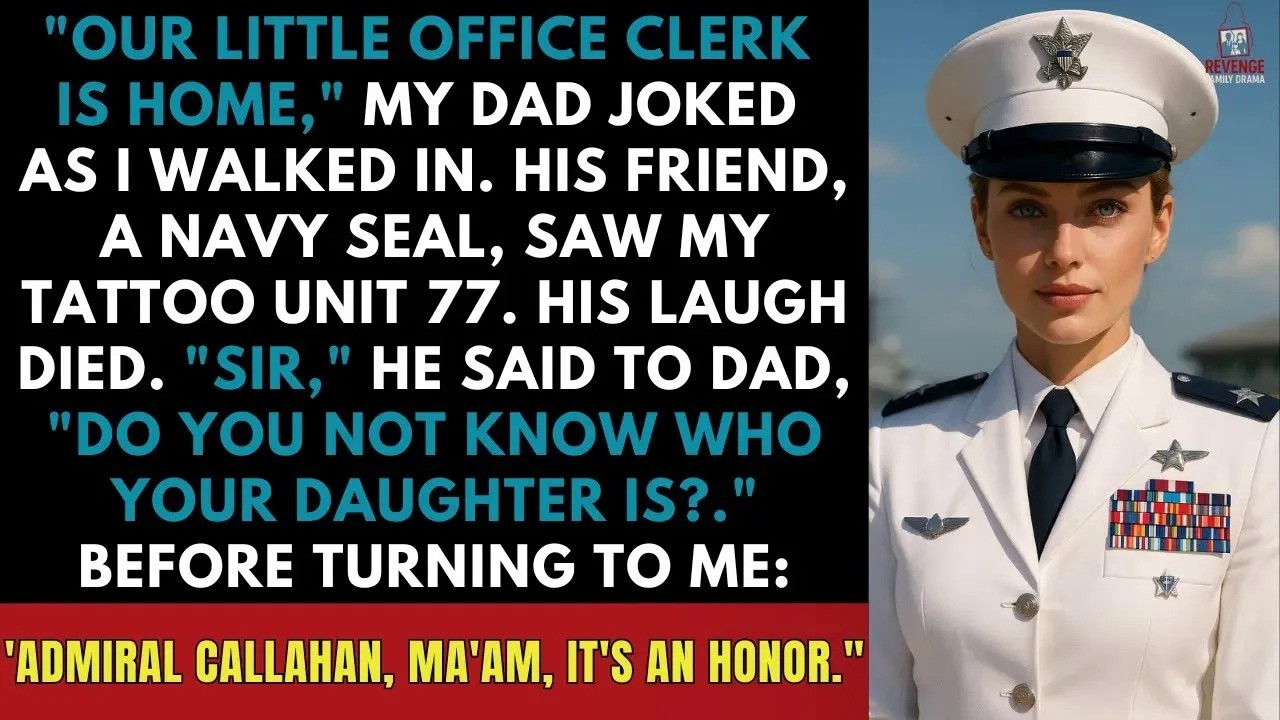
“Everyone, this is my little clerk from the base office. Keeps the paperwork straight for the real soldiers. " The crowd erupted. I smiled the way you do when you’ve trained your face to hide the hit.
The beer bottle cracked in my grip, a thin line of amber dripping down my fingers. I said nothing. I’d learned long ago that silence was safer than the truth. Then, I saw him, a man younger than most, watching from behind the smoke.
His eyes locked on the silver insignia on my chest, that small triangular emblem I never thought anyone here would recognize. His laughter stopped first. Then, he straightened, heels clicking together, posture sharp and deliberate. “Colonel Hudson, ma’am, it’s an honor.
" Every sound in the yard died at once. A single drop of beer hit the metal table, echoing louder than the laughter had. My father froze mid-smile, confusion and disbelief crawling across his face. I didn’t speak.
I didn’t need to. The truth hung there between us, two decades of secrets, of sacrifice he’d never cared to see. I turned away before he could say anything, sunlight flashing off the silver rank on my shoulder. For the first time in my life, my father saw me, and it broke something in both of us.
I grew up to the sound of engines shaking the air and the sting of jet fuel burning the back of my throat. At Eglin, life revolved around orders, salutes, and the quiet discipline of men who didn’t talk about what they’d seen. My father was one of them. Steady hands, sharp eyes, heart locked behind regulations.
He never raised his voice, never raised a hand, but every sentence came out like a command. “Don’t cry. Crying doesn’t fix aircraft. Failure isn’t an option.
Hudson. " He never called me his daughter, just Hudson. To him, affection was weakness. I thought that was love until the day my mother died of lung disease when I was 16.
After the funeral, he boxed up her uniform and said we wouldn’t speak of it again. I joined ROTC because I wanted to continue what he started. When I told him I’d been accepted into the Air Force, he took a long pull from his coffee and muttered that they were finally letting girls play soldier. He didn’t come to my commissioning ceremony.
Instead, he mailed an empty envelope with a folded slip of paper inside. Three words, “Keep your head down. " I kept it in my wallet. Over the years, it bled from sweat, rain, and once my own blood after a field drill.
Whenever someone doubted me, I touched that note like armor and worked twice as hard. At 28, I was handpicked for Project Meridian, a classified program where barely 1% of officers were women. I never told him the truth. When he asked what I was doing, I said it was logistics.
He smiled, relieved. “Perfect. That’s safer for you. " He didn’t know safe was the word I hated most.
Seven years later, I was no longer a rookie. I commanded an air support operation in Syria, Falcon Echo, a mission to extract a SEAL team pinned down under fire. The call was mine. Strike in or lose them all.
I chose to act. Six men made it out. Two didn’t. 30 seconds of hesitation cost them their lives.
When I got home, the news replayed footage of the rescue. My father sat in his chair, beer in hand, watching the coverage like it was a game. He shook his head. “That operation proves war isn’t for everyone.
Women get emotional. " I froze. He was talking about my mission, the one I led. I forced a smile.
“Maybe, but someone had to make the call. " He shrugged, uninterested. I didn’t explain further. Some truths weren’t worth defending.
That Christmas, I sent him a card and one of my commendation ribbons. He sent an empty envelope back. Not a word inside. Just air and silence.
Six months later, while reviewing a classified report, I saw the list of survivors from Falcon Echo. The last name on it, late, Nathan Cross. The realization hit me like turbulence. The man I’d saved in that desert, the one whose life had cost me two others, was still out there.
And one day, he’d meet my father. I didn’t know it then, but that meeting would complete the circle neither of us knew we’d been living in. Destiny was already setting the table. I barely slept after that barbecue.
My father’s voice, “our little clerk,” kept looping in my head, tangled with the image of Commander Nathan Cross saluting me in front of everyone. I’d led men through combat zones, but I couldn’t get a single honest word past my throat when it came to him. Three days later, a message appeared on my phone. “Specter 9, I owe you my life.
Cross. " I froze. That code name belonged to me alone, buried deep inside Project Meridian. We met at a coffee shop overlookingthe bay.
He moved like a soldier trying to pretend he wasn’t one. Over black coffee, he said I’d saved six men that day in Syria. He’d heard my voice over the radio, steady, cold, and assumed I was a man. I told him my father had made the same mistake.
Nathan said my father often bragged about Falcon Echo, calling it the real men’s operation. I almost laughed at the irony. Then he slid a document across the table, half redacted. Commanding officer, Cole Blair Hudson, Joint Tactical Meridian.
My name. My father had worshipped a ghost, never realizing his own daughter commanded that mission. Nathan’s eyes held steady on mine. “He deserves the truth.
" He said. I didn’t stop him when he added, “If he asks, I won’t lie. " The next night, my father hosted dinner for his old unit. I set the table, the air thick with barbecue smoke and memory.
He started his stories, “Back in my day, real soldiers didn’t need computers. " And when someone asked about me, he cut in, “She keeps the boys organized. Important, but not combat. " I stayed silent.
Then one of them mentioned Falcon Echo. My father grinned. “Now that’s what real soldiers look like. " Nathan put down his glass.
“Sir, that operation was hers. " The room froze. My father blinked, confusion twisting into disbelief. “You’re joking.
" “No, sir. I was there. She pulled us out. " Silence fell hard.
The clock ticked once, twice. My father stood, muttering, “Excuse me,” and disappeared inside. As I cleared the table, one of his friends said softly he was proud of me. I smiled faintly.
He never learned how to show it. From the kitchen came a thud, a fist against the wall,anda hoarse curse. I didn’t go in. That night I packed my bag and left thenote he’d once written me.
“Keep your head down. " Underneath, I added, “I did. And I still got higher than you ever looked. " I didn’t speak to my father after that night.
I left Pensacola the next morning and told myself distance would dull the sting. Weeks later, I returned only to collect what I’d left behind. The house felt smaller, air thick with smoke and oil, like time itself refused to move on. In his study, once off limits, I opened a drawer and found a yellowed envelope, trembling handwriting across the front.
“For Blair, if I ever find the right words. " I sat down and unfolded thenote. “You’ll never understand what I’m trying to protect you from. I saw what war did to your mother.
She came back coughing blood, smiling through it. I can’t watch that happen again. " I stared at the paper until the ink blurred. The anger I expected never came.
Only a strange aching clarity. He hadn’t hated me. He’d been terrified of war, of loss, of seeing me vanish the same way she had. Out on the porch, the bay stretched gray beneath a heavy sky.
Salt wind pressed against my face. In my pocket, the old watch he’d given me ticked once, then stopped again at 12:03, theminute my mother died. He’d been living there ever since. As I turned to leave, my phone rang.
Nathan’s voice cracked over static. “He came to see me yesterday. " “My father? " “Yeah.
Didn’t say much. Just asked if you were really in command that day. " “What did you tell him? " “That we wouldn’t be alive if you weren’t.
" There was silence. Then his voice softened. “He cried, ma’am, said he spent his whole life trying to protect you from what you were built to conquer. " It was the first time anyone told me my father cried.
That night, I wrote him, “You don’t have to protect me anymore. I’m safe because you taught me how to survive everything, even you. " He never replied, but forthe first time in years, I wasn’t angry, just empty, quiet. 3 months passed.
I buried myself in work, though his voice lingered in my head. “That’s safe for you. " It used to sound like a command. Now I heard it as a prayer.
One autumn night, I sat in my Pentagon dorm, TV humming in the background, when a familiar voice cut through the noise. My father, standing beneath the American flag at a veteran’s hall, “My daughter serves. She doesn’t push papers. She keeps people alive.
I’m proud of her. " I froze. The screen blurred. Either bad reception or my eyes.
He’d said it out loud, in public, where he’d once mocked me. My hands shook too hard to dial, so I texted instead. “Thank you. That’s all I needed.
" Minutes later, the phone rang. “Didn’t know how else to say it," he rasped. “You just did," I whispered back. He admitted he’d started seeing a counselor after that dinner.
Said the guy told him he’d been angry for30 years. “Maybe it’s time I learn something new," he said. “Like what? " I asked.
“Like how to be your father instead of your sergeant. " I laughed. Really laughed, for the first time about us. The next day, an email arrived from his old military account, unsent, unfinished.
“Proud doesn’t even start to cover it. " Attached was a photo, my mother in her nurse’s uniform, her hand on his shoulder, me between them holding a toy plane. He’d hidden it for20 years. I printed itand taped itinside my locker.
After that, he called every week. Never long, never emotional. “You eating right? Still flying?
" Those two questions became the closest thing we ever had to”I love you. " When his name flashed on my phone, Dad, incoming call, I smiled and answered. A year after that speech, I was nominated for promotion to Brigadier General. The ceremony took place at Naval Base Coronado, where I’d once coordinated joint missionswith SEALs.
I hadn’t planned to invite him, but2 days beforethe event my aide said there was a Mr. Hudson on the guest list. I simply answered, “Let him in. " The California sun was brutal that morning, glaring against my white dress uniform.
I stood before the audience, voice steady as I repeated the oath to serve with honor, to command with integrity, to protect without pride. When I lowered my hand, I heard a rough cough from thesecond row. My father was there, uniform pressed, silver insignia dulled by age, hand gripping a cane. Our eyes met.
He nodded once before bowing his head. The announcer’s voice rang clear. “Presenting Brigadier General Blair Hudson, Commander of Project Meridian. " The hall rose to its feet.
My father’s tears caught the light. They weren’t weak. They were an apology spoken in a language he finally knew. Afterward, he opened a small leather box.
Inside lay his old pilot’s ring. “You earned it more than I ever did," he whispered. “That’s not true," I said. “It is.
You flew higher than I ever dreamed. " The ring was a little loose, but forthe first time, it fit my heart perfectly. As he turned to leave, he looked back once. “For what it’s worth," he said softly, “I’m honored to be your father.
" No medals, no rank, no applause had ever meant more. The war between us was finally over. Neither of us had won, but both of us had survived. A year later, my father was gone.
The heart that had survived wars, command, and silence finally gave out in his sleep. The funeral was held at Arlington National Cemetery under a cold, still sky, the kind of quietthat hums with reverence. I stood at attentionin my white dress uniformas the honor guardfolded theflag with slow precision. Each crease felt like the closing of a chapter neither of us hadthe courage to write together.
When they handed it to me, I placed his pilot’s ring on top ofthecoffin and whispered, “You don’t need to carry it anymore. " Later, while sorting through his belongings, I found a small USB drive labeled for Blair. My pulse quickenedas I plugged it in. His voice filled theroom, raspy, deliberate, fragile.
“You weren’t my little clerk. You were theone who kept my brothers alive. I was wrong about everything. And if you ever wonder, yes, I saw you.
Every damn day, I saw you. " I sank intothe chairandcried, not from grief, but from thestrange peace thatcame withfinally being seen. Then thescreen flickered. A second file appeared, an old scanned photograph.
My mother in her nurse’s uniform, my father standing beside her, and me between them, clutching a toy airplane. At theedge ofthefile, a note in his handwriting read, “The girl with the plane grew up to fly the world. " I pressed my palm to thescreen, tracing thesmall figure ofthat little girlwho’d spent her life chasing his approval. The recording continued.
His voice grew weaker near theend. “If they ever ask, tell them I was proud. " Thewords landed softly, like a saluterfrom somewhere beyond reach. I copied thefile to my phone, then deleted theoriginal, not out of bitterness, but because I didn’t need to hear it again.
Some things are meant to be said once and remembered quietly. Through thewindow, I watched a bird crossthe gray sky. Thewind rattledthe blinds, whispering something only my heart could translate. “That’s my girl.
" I closed theUSB, placed itbeneaththefolded flag, and lowered bothintotheearth. The pianofrom thechapel drifted faintly throughtheair. Notes of release, of forgiveness, of everything we never said. The war between us had ended long before this day.
But now, finally, it was at peace. Three years later, theworld was quieter. I had traded thenoise of command for thesteady rhythm of instruction. Now, a major general teaching cadetsattheAir Force Academyin Colorado Springs.
Thewind smelled of jet fueland dawn. Familiar, steady, grounding. On therunway below, a group of young women checked their flight suitsfor their first solo. I watched them move.
Shoulders squared, voices crisp. Among them was a girl with Nathan Cross’s eyes. His daughter, Amelia. She turned toward me, helmet tucked under her arm.
“Ma’am, did your father ever believe in you? " she asked, earnestand hesitant. I smiled. Theanswer simple now.
“Eventually. " She nodded, lowered her visor, and started toward her aircraft. As she climbed in, I called after her, my voice carrying acrossthe wind. “Respect isn’t given, it’s revealed.
When you stop waiting for permission to exist. " Theengines roared to life, one after another. TheT-38s rising intothepale gold of sunrise. I tilted my face upward, following them intothelight.
On my hand, thering gleamed. A replica of my father’s, engraved with small, long, stubborn letters. “Keep your head up. " Themetal caught themorning sunlike a promise.
For years, that phrasehad been his command. Now it was mine, reshapedby understanding. A soft chime brokethestillness, a message waiting in my inbox. From Nathan.
“Ma’am, she’s going to Meridian next year. " I laughed. Thesound caught between pride and disbelief. Tears came quietly, uninvitedbut welcome.
Thecircle had closed. Thedaughter once dismissed had becomethewoman shapingthenext generation. Theone her father feared she would become. Yet theone he had unknowingly raised her to be.
Outside, thesky over Eglinshimmered, vastand forgiving. I imagined him somewhere beyond those clouds, watching. Maybe smilingthatsame restrained smilehe always wore when he didn’t know how to say I’m proud. Theaircraftscut throughthehorizon, sunlight glinting off theirwings.
Thehum in theair felt like music, soft, steady,andfinal. I touched theinsignia on my chest. It’ssilver warmfrom thesun, andwhispered intothewind, “We made it, Dad.
" Thelight stayed on my faceas thelast jet disappeared intotheblue.