The phone rang on a Tuesday afternoon. It was my daughter, her voice light and quick, the way it always is when she wants something. “Mom, I have a work thing on Saturday. Could you watch the kids?
Just this once? ”
Before she even finished the sentence, I heard myself say it. “Of course, honey. No problem.
”
I hung up. My quiet weekend was gone. And somewhere inside me, something small and tired just sighed. I have spent decades sitting with seniors as a psychologist, listening to their stories, their exhaustion, and the quiet, unspoken wish to be heard and respected in their own families.
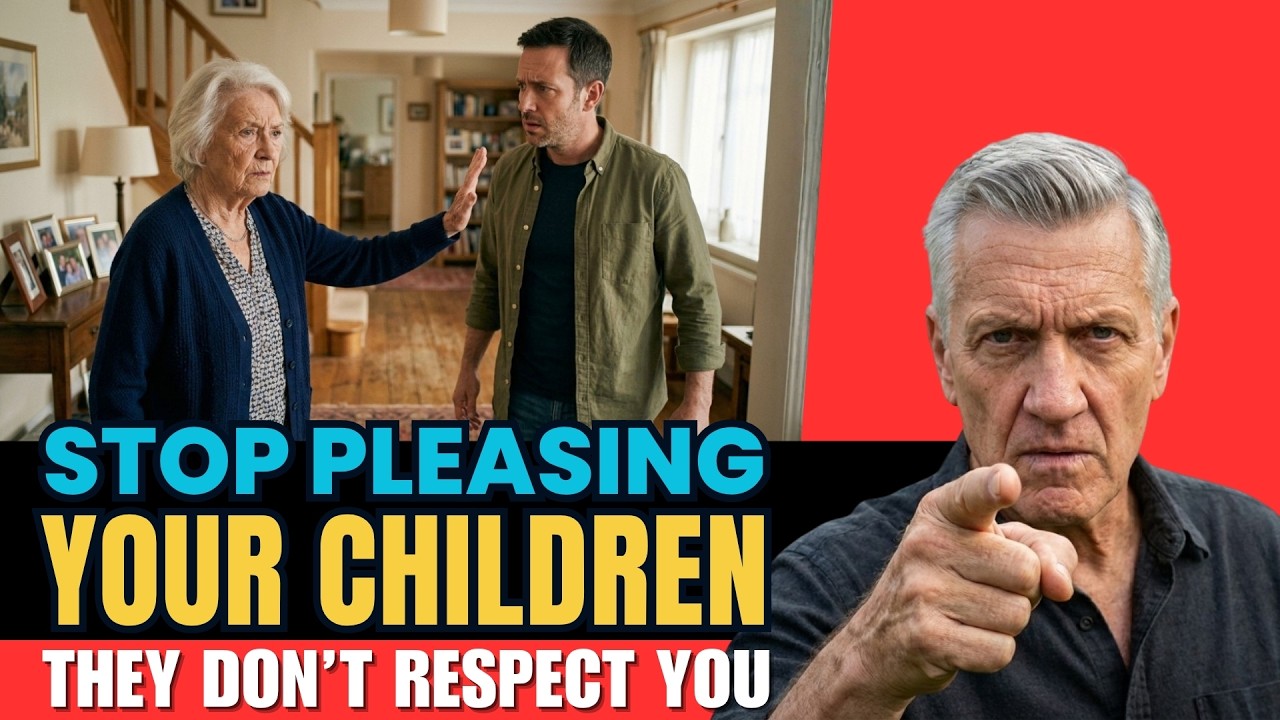
And I have learned something important. There are moments, right now, at this stage of life, when saying no to your adult children is not selfish. It is the most loving, self-respecting, and relationship-preserving thing you can possibly do. Why is it so hard?
Because it’s not weakness. It’s psychology. Most of us who are parents built our entire identity around being the one who gives. The one who shows up.
The one who holds things together. For decades, good parent meant being available. Saying yes. Sacrificing.
And now your children are grown, but the habit didn’t leave with them. There is also a quieter thing at work. Many seniors carry a persistent fear of being seen as difficult, demanding, or a burden. So they say yes to keep the peace.
They swallow their needs and tell themselves, “It’s fine. It’s just this once. ”
But here is what the research tells us. When you consistently override your own needs to please your adult children, two things happen.
First, you slowly erode your own sense of self-worth and autonomy. Studies on aging consistently show that loss of personal control is one of the greatest predictors of depression and decline in older adults. Second, and this is the painful irony, the less you push back, the less they respect you. Not because your children are bad people.
But because all of us unconsciously take for granted what we are never asked to consider. Boundaries are not walls. They are not acts of rejection. They are bridges to honest, mutual respect.
Here are the five times you should say no. Let me describe a woman I’ll call Margaret. She was 68, recently retired, and finally had the home she dreamed of. A quiet Tuesday morning with her coffee.
A spare room she had turned into a reading space. A weekend that belonged to her. Within six months of retirement, the spare room was full of her son’s boxes from his last move. The grandkids were dropped off most Friday afternoons, sometimes without so much as a text.
Her daughter had a key and used it whenever she needed something. Margaret wasn’t unhappy about any one of these things. But together, she told me, she felt like a guest in her own home. After 60, after decades of raising children and making space for everyone else, your home is no longer a community resource.
It is your sanctuary. When adult children treat it as available on demand, they are communicating, whether they mean to or not, that your space and time are less valuable than their convenience. And when you silently allow it, you confirm that message. There is a profound difference between choosing to help and being assumed to be available.
Choice is empowering. Assumption is diminishing. So what do you say when the call comes? Try this.
“I love spending time with them, but I need some notice. My weekends matter to me, too. Can we find a time that works for both of us? ”
No lengthy explanation.
No apology. And if someone shows up unannounced, you are allowed to say, warmly, “I wasn’t expecting company today. Let’s plan something soon. ”
The first time you say this, it may feel enormous.
They may seem surprised. But within weeks, the dynamic shifts. You get more notice. More consideration.
And quietly, without anyone announcing it, you get more respect. A home you control is a life you control. This one is more subtle. And in some ways, more dangerous.
Because it often arrives dressed up as concern. “Mom, have you thought about a smaller place? Stairs aren’t great at your age. ”
“Dad, I made you an appointment with Dr.
So-and-so. I think you need a second opinion. ”
“We really think you should let us handle your finances just to make it easier on you. ”
Sometimes these conversations are completely appropriate.
There are real moments when adult children need to step in. But I’m talking about the pattern. The gradual, well-meaning erosion of your decision-making authority over your own life. In psychology, we call the need to direct your own life autonomy.
And the research is unambiguous. Seniors who maintain a strong sense of personal autonomy are healthier, happier, sharper, and live longer than those who relinquish it, even when the relinquishing is voluntary. The psychologists Deci and Ryan were clear. Autonomy is not a luxury.
It is a fundamental human need that does not expire at 60, 70, or 80. When your adult children begin making decisions for you rather than with you, especially about your home, your health care, your money, or your daily life, something important is being taken from you. It is often unintentional. Your children love you.
They worry. That worry can tip, almost invisibly, into control. Your job is to notice it. And to gently, firmly, redirect it.
“I hear your concern, and I appreciate it. I really do. But this is my decision to make. If I want your input, I promise I’ll ask.
”
Say it calmly. Say it once. Then mean it. Every time you stand firm on your right to make your own choices, you are sending a message about who you are.
You are a capable, experienced, fully formed adult. Not a project to be managed. The moment you stop deciding, others will start deciding for you, permanently. This is the single most common and most damaging pattern I have seen in families where seniors are struggling.
Not from illness. Not from loneliness. From financial anxiety that was entirely preventable. It usually starts small.
A loan for a car repair. Helping out with a month’s rent during a hard stretch. A little extra for the grandchildren’s school supplies. You give it, because you love them.
Because it feels good to help. Months pass. The loan is never repaid. The next hard stretch comes.
And the ask comes with it. “I know this is a lot, Mom, but we just need to get through this one more time. ”
“Dad, you know I’d pay you back if I could. You’re the only one we can turn to.
”
And so you give again. Because how do you say no to your own child? To your grandchildren’s well-being? There is a profound difference between helping someone through a genuine crisis and repeatedly rescuing someone from the consequences of their own patterns.
The first is love. The second is enabling. Enabling does not help. It harms.
It removes the natural pressure that motivates growth and responsibility. It teaches your children that there is always a safety net, no matter what choices are made. And meanwhile, your retirement savings erode. I have sat with women in their mid-70s who cannot afford their medication because they spent their savings propping up an adult child’s lifestyle.
That is not love. That is a tragedy. How do you say no? There are two versions.
If you want to be gentle: “I love you, and I’m not in a position to do that right now. ”
No lengthy explanation. No financial disclosures. No debate.
I love you. I can’t. If the pattern has gone on long enough that it needs to be named: “I have helped before, and I always will if there is a true emergency. But I’ve realized that helping this way isn’t actually helping you.
That has to change for both our sakes. ”
You may be met with hurt or anger. But consider what you are modeling for your grandchildren who are watching. There is nothing more loving than believing in someone’s ability to stand on their own feet, even when they don’t believe it themselves yet.
You can love them deeply and still let them stand on their own. This is the situation that makes my heart ache a little, because it touches on something beautiful. After 60, after the career, after raising children, something remarkable becomes possible. A kind of freedom.
A second chance at becoming more fully yourself. Some of you are dating again, perhaps after losing a spouse. Some are traveling solo. Taking a painting class.
Making new friends who light you up. And then someone, often a well-meaning adult child, says, “Are you sure that’s a good idea at your age? ” Or, “I just don’t want you to get hurt. ” Or the one that cuts deepest, “Mom, don’t you think it’s a little soon?
”
Erik Erikson described the primary psychological task of later life as integrity, the process of looking at your life fully and finding meaning in it. Of choosing to live rather than simply to wait. When adult children push back against your growth, your relationships, your joy, they are asking you to be smaller so that they can feel more comfortable. Sometimes their discomfort has nothing to do with you.
It is about their own grief around your aging. Their own anxiety. That is their work to do. Not yours to carry.
When someone questions your choices, here is what you say. “I know this might be surprising to you, but I’ve lived long enough to know what makes me feel alive. I need you to trust me on this. I’m not asking for your permission.
I’m sharing something that makes me happy. ”
Say it with love. Say it with a smile, even. But say it.
You do not need permission to be fully alive after 60. Not from your children. Not from anyone. I’ve saved this one for last, because I believe it is the most important.
You have a follow-up appointment with your cardiologist on Thursday. Your daughter calls Wednesday night in tears. Her car won’t start. Could you drive her children to school in the morning?
You cancel your appointment. Or you’ve been managing chronic back pain with a specific routine three mornings a week. Your son calls most mornings to talk through his troubles, sometimes for an hour. By the time you hang up, the window for your exercises is gone.
Or you are not sleeping well because you are on call emotionally for a child going through a crisis. Their stress has become your stress. Their insomnia, effectively your insomnia. None of these feel dramatic in isolation.
Each feels like love. But seniors who consistently deprioritize their own health for the benefit of their adult children experience measurably worse physical and cognitive outcomes. Faster decline. More hospitalization.
Less independence. There is also an emotional pattern worth naming. The phrase “You’re the only one I can count on” is one of the most effective and most damaging things an adult child can say to a senior parent. Because it locks you into a role that is not sustainable and not healthy for either of you.
You cannot pour from an empty cup. And at 65, at 72, at 78, your cup refills more slowly than it did at 40. That is not weakness. That is biology.
Here is what to say. “I want to be here for you for a long time, years and years. The only way I can do that is if I take care of myself first. That’s not me choosing me over you.
That’s me making sure I’m still standing when you need me. ”
Taking care of your health is not a selfish act. It is the most generous thing you can do for the people who love you. The most loving thing you can do for your family is stay strong, healthy, and here.
So let’s bring this home. Putting this into practice, actually saying no to someone you raised, someone you would do anything for, is one of the hardest things a person can do. The first time will feel enormous. Your voice might shake.
They might be surprised. There might be a moment of awkward silence or a flash of hurt feelings. That is okay. Because people respect most what they cannot take for granted.
When you show your adult children that your time matters, your decisions matter, your home matters, your health matters, your joy matters, you don’t push them away. You give them something far more valuable than compliance. You give them a parent they can genuinely admire. Quick reminder of the five.
Your home is your sanctuary. Your decisions are yours. Your financial security is not their safety net. Your happiness needs no approval.
Your health comes first. There is something that has stayed with me across decades of clinical work. I have heard it in different words from hundreds of seniors who found the courage to finally say no, to finally take up space, to finally live on their own terms. They almost always say some version of the same thing.
“I just wish I had done this sooner. ”
You have time. Whatever your age, whatever your family situation looks like right now, you have time. Not to be difficult.
Not to push people away. But to finally be honest with the people you love and with yourself. That is what strong looks like at this stage of life.