The ballroom at Fort Hood’s event center glittered with army blue and gold, the annual Army Ball in full swing. I wore my dress uniform, every ribbon precisely aligned over my heart, and I was actually happy. It was my thirty-first birthday, and for the first time ever, my husband’s family had agreed to attend a military function with me. I had been so desperate for their approval that I had ignored every warning sign.
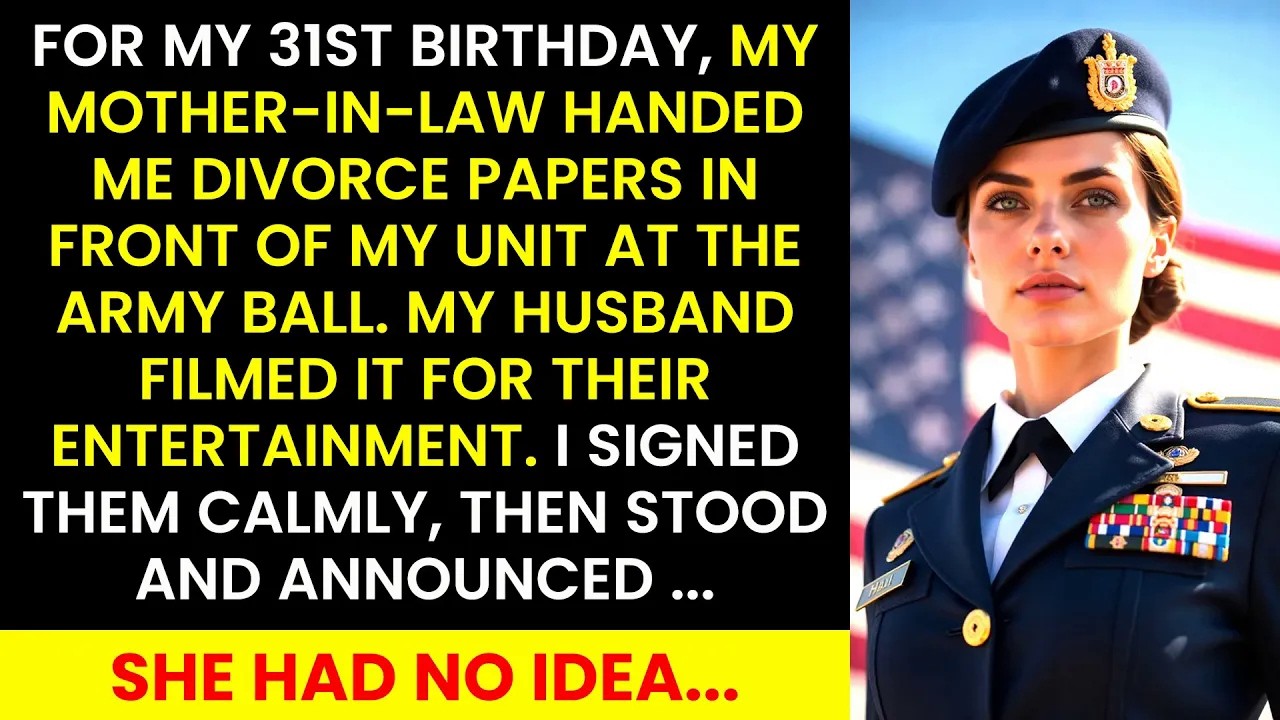
Margaret, my mother-in-law, rose from her chair and clinked her glass. The conversation at our table died. David pulled out his phone and pointed the camera at my face. I tensed, but said nothing.
“Julia,” Margaret said, her smile polished and cold. She slid a glittering pink envelope across the white linen tablecloth. “We know how much you value service, so we are serving you with this. ”
My fingers felt numb as I opened the envelope.
Inside were the words “Petition for dissolution of marriage. ” Divorce papers. My husband had signed them days ago. Margaret leaned in, her voice sweet enough for the whole table to hear.
“My son needs someone who can attend charity galas in Dallas, Julia. Not someone content to play in the mud. ”
David was still filming. His hand was steady.
He had known this was coming. That night, I made no scene. I simply stood up and walked out, leaving them frozen at the table. Two years ago, I had married David believing I was joining a loving family.
I was wrong. Margaret was old money from Highland Park, Dallas, and she never let me forget my place. At her cocktail parties, she introduced me as “David’s wife, Julia, she’s a sergeant,” saying the rank the way someone might say “plumber” or “convict. ” At Thanksgiving, she laughed at my gratitude for my service and implied I was uneducated.
At Christmas, while David received a Rolex, I received a book on transitioning from military to manual labor, with a set of cheap nurse’s scrubs tucked inside. David never defended me. His silence was its own kind of betrayal. Then I overheard a phone call.
Margaret’s voice was clear through the slightly open study door. “You cannot let her embarrass this family any longer. She’s a grunt. You have to make a choice.
It’s her or the fortune. ” David’s answer came after a long pause. “I know, Mom. I’ll handle it.
”
That was when I decided I had to become someone they couldn’t ignore. I enrolled in online classes through the University of Maryland Global Campus, studying at a small desk every night after ten-hour workdays at the logistics depot. I finished my first semester with a 4. 0 GPA.
But when I needed the financial aid application, I asked David to sign it. He swept the papers onto the floor. “More debt for what? For this fantasy?
” he spat. “Julia, be realistic. You don’t have what it takes. You’re not officer material.
”
Without his signature, I couldn’t get the loan. My plan died. I stopped studying. I started applying for civilian jobs instead, but every application was met with an automated rejection.
Later, I learned Margaret was using her connections to block every door I tried to open. One night, after a silent dinner, I sat in my Jeep in the unit parking lot and cried. First Sergeant Michael Carter found me there. He handed me a steaming cup of black coffee and stood in the darkness, not prying.
“Whatever is happening out there,” he said, nodding toward the gate, “don’t let anyone tell you you’re not good enough. Don’t let them take what you’ve earned in here. ”
He told me about his own divorce, how his wife had cleaned out the house after his third deployment. Then he said something that lodged in my chest: “This uniform understands us better than the person sleeping in our bed.
” He also told me he had backdated a leadership commendation I had missed, protecting me when I was too distracted to submit it myself. For the first time in two years, someone saw me as Sergeant Hall, not David’s wife. About a week before the ball, I found a message on LinkedIn from a recruiter at Aegis Defense Solutions. She had seen my profile on a veterans’ job board.
“Your experience in complex logistics management and your ability to lead small teams under high pressure is precisely what we are seeking. ” Then came the sentence that changed everything: “A military background like yours isn’t something to be transitioned from. It is an invaluable asset. ”
I interviewed with a retired Navy captain.
It was easy. I talked about an FTX where I coordinated three units in the dark with bad radio signals to get tank parts to the front line before morning. He just nodded. “That’s exactly what this job is, just the front line is a boardroom in DC.
”
The offer arrived on Friday. Project Manager, Logistics and Integration, Austin, Texas. $85,000 a year, nearly double my military pay. I printed the letter and hid it in the silk lining of the black clutch I planned to carry at the ball.
But I couldn’t accept the offer. Margaret’s voice echoed in my head: “You’re not smart enough for that world. You’ll fail. ” David’s voice joined in: “You’re wasting your time.
” I sat in my car, my finger hovering over the delete button, convinced I wasn’t good enough. Then First Sergeant Carter found me again. He asked if I knew the serenity prayer. “Accept the things you cannot change, the courage to change the things you can, and the wisdom to know the difference,” he recited.
He pointed at the headquarters building. “Your problem is that your enemies have stolen your wisdom. They’ve convinced you that everything is a steel door. You cannot change them, Hall.
That’s the serenity part. You can change you. That’s the courage part. Don’t let them steal your wisdom.
”
I accepted the offer that night. The next few days were strange. Margaret called to confirm I was ready for the ball, saying it would be “the last time you attend an event as part of this family. ” I just smiled and told her I wouldn’t miss it.
David was overcompensating, trying to touch my back, asking which uniform I would wear. I found an email on our home computer a few days before the event, a chain from Margaret’s family lawyer. David’s reply was short: “Looks good. I agree to all terms.
Please proceed with the service at the event as discussed. ” He wasn’t a puppet. He was a co-conspirator. The night of the ball, I shined every button on my uniform and slid the Aegis offer letter into my clutch.
Then I walked into the ballroom and sat down at Table 12 next to First Sergeant Carter. Margaret made her toast. She slid the pink envelope across the table. David filmed.
Emma giggled. I opened the envelope, pulled out the divorce papers, and signed them with the black pen I always carried. Then I slid them back to Margaret. “Thank you,” I said, my voice calm.
“This is the most generous gift you could have given me. ”
David lowered his phone. “That’s it? ”
“Oh no, David,” I said.
“That’s not all. ” I pulled out the Aegis letter. “I have an announcement too. I just accepted a position as project manager at Aegis Defense Solutions, starting salary $85,000 a year, with a relocation package to Austin.
”
Margaret’s face drained of color. Emma dropped her phone. First Sergeant Carter stood up, raised his glass, and boomed across the ballroom: “A toast to Sergeant Hall, to her birthday, and to her bright, valuable future. ” My table rose to their feet, cheering.
The battalion commander walked over from the VIP table and shook my hand. “The Army’s loss is the industry’s gain, Sergeant. You are one of our finest NCOs. ” The Halls sat in silence, humiliated, isolated in a sea of respect that was all pointed at me.
I didn’t say goodbye. I just walked out into the cool Texas night, took a breath that was the first real one I had taken in two years, and drove home. David didn’t come home that night. I slept in the middle of the bed.
The divorce was settled quickly. My lawyer, Ms. Evans, was thrilled. “They filmed it.
That’s premeditated cruelty, Sergeant. We have exhibit A. ” Under Texas law, cruelty was grounds for an unequal division of assets. I kept my Jeep, my money, my military pension, and my TSP.
Margaret’s old-money lawyers couldn’t fight the video. The grunt’s dirty money was fully protected. David texted me the night after the ball, furious, then pleading, then desperate. “It was all mom’s idea.
I love you. ” I read it and felt nothing but pity. Then he showed up in the barracks parking lot in the rain, begging me to stay, to go to counseling. “David, your life belongs to your mother,” I said.
“My life belongs to me. Goodbye. ”
I got in my Jeep and drove off post. At the first gas station, I blocked his number.
The past was behind me. Eighteen months later, I stand in my office on the twenty-second floor in Austin. My door reads: Julia Hall, Senior Project Manager. I have a six-figure salary and my own condo near Zilker Park.
The very skills Margaret mocked, the discipline she called rigid, the leadership she called bossy, are the reason I’m here. My first performance review promoted me. Then an email arrived from Fort Cavazos, the post formerly known as Fort Hood. They were asking me to be the keynote speaker for the transition assistance program.
I stood on that stage in the same auditorium where I once sat, terrified. Three hundred soldiers in camouflage looked up at me. “Eighteen months ago, I was a sergeant here,” I said. “People in your life might tell you that your military experience isn’t valuable out there.
They’ll tell you that you’re just a grunt. They are wrong. ”
First Sergeant Carter sat in the front row, retired now, wearing a civilian polo shirt, smiling a quiet, proud smile. He had always seen me.
I finished my speech. “You cannot change the minds of people who refuse to understand you. But you can change your life. Be brave enough to change the things you can.
”
The soldiers stood, cheering. In the end, Margaret’s vicious birthday gift wasn’t a curse. It was the key. That hateful, glittering envelope was the greatest gift I ever received.
It was the gift of my own life.