On a Tuesday afternoon, I sat in my car outside my son’s house, waiting to pick up the kids. I had just canceled my own doctor’s appointment for the third time. My knee had been hurting for months, and I kept ignoring it. And in that moment, I asked myself a question I’d never dared to ask before: “What am I doing?
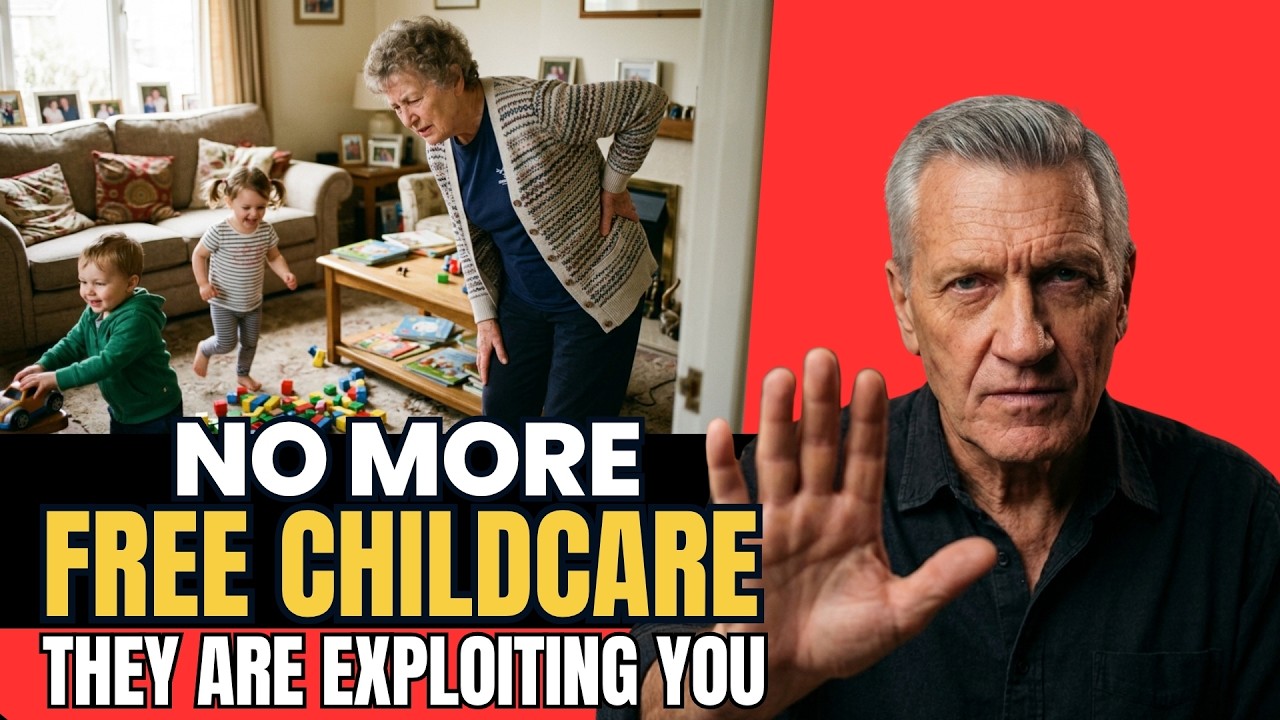
”
I’m a psychologist. I’ve spent over forty years counseling families. I’ve sat across from thousands of exhausted, resentful grandparents who felt their lives had slipped away. I could see the pattern in everyone else’s life.
But I couldn’t see it in my own. I was the free babysitter. Every week. Every holiday.
Every “emergency” that wasn’t really an emergency. It didn’t start that way, of course. It never does. It starts with something small.
Your daughter has a job interview. “Mom, can you watch the kids for a couple of hours? ” Of course. You’re happy to help.
That’s what family does. Then it’s a regular Tuesday. Then it’s every Tuesday and Thursday. Then it’s, “Can you pick them up from school, too?
” Then it’s summer break, and suddenly you’re running a daycare out of your living room five days a week, with no pay and no end date. I call this the slow slide. At no point does anyone sit down and say, “We’ve decided Grandma is now our full-time child care provider. ” There’s no conversation, no agreement, no acknowledgement.
It just becomes the arrangement. And because it happened gradually, you feel like you can’t complain. After all, you said yes every step of the way, didn’t you? But saying yes to helping once is not the same as agreeing to help forever.
Consent is not a lifetime contract. There’s another force at work here, and it’s powerful: guilt. American culture has created this unspoken rule that good grandparents are always available, always willing, always putting the family first. And if you push back, if you say, “Actually, I have plans,” you risk being labeled selfish, cold, uninvolved.
I had a patient, let’s call her Margaret. Seventy-two years old, retired teacher. She watched her three grandchildren four days a week. When she told her daughter she wanted to cut back to two days, her daughter said, “I guess you just don’t want to be part of their lives anymore.
”
That sentence kept Margaret coming back five days a week for another year. One sentence. That’s all it took. And underneath the guilt, there’s something even deeper: fear.
Fear that if you say no, you’ll lose access to your grandchildren. Fear that they’ll grow up not knowing you. Fear that your own children will pull away. I understand that fear.
I’ve felt it myself. But I’ve also learned, both professionally and personally, that fear is a terrible reason to give up your life. Let’s talk about what this arrangement is actually costing you. And I don’t mean money, although many grandparents spend hundreds of dollars a month on food, supplies, and activities for grandchildren they’re watching for free.
I’m talking about the costs nobody talks about. Your body is paying. Chasing toddlers at sixty-five is not the same as chasing toddlers at thirty. Your knees know it.
Your back knows it. Your blood pressure knows it. I’ve seen grandparents postpone surgeries, skip medications, and ignore symptoms because they didn’t have time to see the doctor. One gentleman I counseled put off a cardiac evaluation for four months because he was watching his grandson every morning.
Four months. With chest pain. Your mind is paying. The psychological toll is enormous.
It’s not the children themselves. You love those children. It’s the feeling of being invisible. Of being needed but not valued.
Of realizing that you are appreciated for what you do, not for who you are. There’s a term in psychology: compassion fatigue. It usually applies to caregivers and healthcare workers, but I see it in grandparents all the time. The exhaustion, the emotional numbness, the quiet resentment that you feel guilty for even having.
Your marriage is paying. I’ve counseled couples in their seventies who are fighting, not about money, not about health, but about the grandchildren. One wants to say no. The other is afraid to rock the boat.
The tension builds. The resentment grows. And slowly, the retirement you planned together—the trips, the quiet mornings, the freedom—disappears. Your life is paying.
This is the big one. You worked thirty, forty, maybe fifty years. You earned your retirement. You had plans.
Travel, hobbies, volunteering, friends, a book club, a garden, a second chapter. How much of that have you actually done? I had a patient tell me once, through tears, “I retired five years ago, and I haven’t had a single day that was truly mine. ” Five years, gone.
And she wasn’t going to get them back. Here’s the psychological truth that nobody wants to hear: chronic self-sacrifice does not create gratitude. It creates expectation. The more you give without limits, the more people expect without asking.
That’s not because your children are bad people. It’s because that’s how human psychology works. When something is always available, we stop noticing it. We stop appreciating it.
We start assuming it. I told you about my Tuesday afternoon—the canceled appointment, the knee pain. But the real turning point came later that night. I was sitting at my kitchen table, and my wife looked at me and said something I’ll never forget: “You know, you’d never let one of your patients live like this.
”
And she was right. If a patient had told me this story—a sixty-eight-year-old man ignoring his health, giving up his hobbies, feeling resentful but afraid to speak up—I would have looked them in the eye and said, “You are enabling a pattern that is hurting you and isn’t helping them. ” But when it was my own family, I had blind spots the size of Texas. That night, I asked myself a question that changed everything.
If I disappeared tomorrow, if I were simply gone, would my family miss me? Or would they miss the free child care? Sit with that for a moment. Because the answer tells you everything.
Now, I want to be very clear. I’m not saying your children don’t love you. I’m not saying they’re using you on purpose. Most of the time, this pattern is completely unconscious.
They grew up with you solving their problems. You were always there. And they’ve simply continued expecting it because nobody ever drew a line. But here’s what I learned in forty years of counseling: when you do everything for your adult children, you’re not helping them.
You’re preventing them from becoming fully capable adults. Every time you cancel your plans to rescue theirs, you’re sending a message: you can’t handle this without me. And over time, they start to believe it. Setting boundaries isn’t selfish.
It’s one of the most loving things you can do for them and for yourself. Let’s get practical. Because knowing you need boundaries and actually setting them are two very different things. Here are four principles I teach in my practice and that I used in my own life.
Principle one: available, not on call. There’s a huge difference between being a loving grandparent who is available to help and being an on-call babysitter who has to justify their schedule. Being available means, “I’d love to see the kids. Let’s find a time that works for both of us.
” Being on call means, “Drop the kids off whenever you need to. I’ll figure it out. ” One is a relationship. The other is a service.
Principle two: set a schedule and stick to it. Decide what you can genuinely offer with joy, not resentment. Maybe it’s one day a week. Maybe it’s two afternoons.
Maybe it’s one weekend a month. Whatever it is, make it specific, make it clear, and make it consistent. And present it as a positive, not a punishment. Don’t say, “I can’t do this anymore.
” Say, “I want to make sure the time I spend with the grandkids is my best time, so I’m going to commit to Wednesdays. That’s our special day. ” You’re not taking something away. You’re defining what you can give.
Principle three: use I statements. When you set a boundary, talk about your needs, not their behavior. Don’t say, “You always dump the kids on me at the last minute. ” That’s an accusation.
It will start a fight. Say, “I need to protect my health and my energy, so I need more notice when you’d like my help. ” That’s a boundary. It invites cooperation.
Here are some more phrases you can use: “I love spending time with the grandkids, and I also need time for myself. ” “I’m not able to commit to a regular schedule right now, but I’m happy to help when I can. ” “I’ve realized I need to prioritize my health, so I’m making some changes to my availability. ” “Let’s talk about an arrangement that works for both of us.
” Notice, none of these sentences contain the word “you. ” That’s intentional. The moment you point fingers, people get defensive. Keep the focus on your needs, and the conversation stays productive.
Principle four: allow your children to be disappointed. This is the hardest one. And it’s the one that stops most grandparents from ever setting boundaries. Your children might be upset.
They might say things that hurt. They might give you the silent treatment for a week. They might say, “I guess we can’t count on you. ” And here’s what I need you to hear: that is their right.
They’re allowed to feel disappointed. And you are allowed to survive their disappointment. Their feelings are not your responsibility to fix. Your children are adults.
They will adapt. They will find other child care. They will adjust. And here’s the beautiful part: they will respect you more for it.
Not right away, maybe. But eventually. Because people don’t respect doormats. They walk on them.
Now, I know exactly what some of you are thinking. You’re thinking, “But I’ll feel so guilty. ” Of course you will. Guilt is one of the most powerful emotions in the human experience.
And when it comes to family, guilt has a megaphone. But here’s what I’ve learned in forty years: guilt is a feeling, not a fact. Guilt says, “You did something wrong. ” But protecting your health, your happiness, and your retirement is not wrong.
It’s necessary. Let me teach you to tell the difference between two kinds of guilt. The first is healthy guilt. Healthy guilt shows up when you’ve actually done something harmful.
You broke a promise. You said something cruel. You let someone down when they truly needed you. Healthy guilt helps you course correct.
It’s useful. The second is manipulated guilt. And this is the one most grandparents are drowning in. Manipulated guilt shows up when someone else is upset about your boundary, and you take responsibility for their feelings.
Your daughter is frustrated? That must mean you did something wrong. Your son gives you the silent treatment? You must be a bad parent.
No. You’re a parent who finally stopped setting themselves on fire to keep someone else warm. And let me address something directly, because I hear it in my practice all the time. Some adult children—not all, but some—use guilt as a tool.
They know exactly what to say. “Mom, I thought family was supposed to help each other. ” “Don’t you want to be part of your grandkids’ lives? ” “I guess some grandparents just care more than others.
” If you’ve heard versions of these sentences, I want you to recognize them for what they are: manipulation. Not necessarily malicious manipulation. Often, it’s unconscious. Your children learned it because it works.
And it works because you let it. The next time you hear one of those sentences, here’s what I want you to do. Take a breath. And say calmly: “I love you, and I love those kids.
And I also need to take care of myself. Both of those things can be true at the same time. ” That’s it. You don’t need to argue.
You don’t need to defend. You just state your truth and let it stand. I want to tell you what happened when I finally set my own boundaries with my family. At first, it was uncomfortable.
My son was annoyed. My daughter-in-law was quiet. There were a few awkward phone calls. I won’t sugarcoat it.
The first two weeks were tense. But here’s what happened after that. My son and his wife found a part-time babysitter. They adjusted their schedules.
They figured it out because they had to. And then something beautiful happened. When I did see my grandchildren, on my terms, on my schedule, I was present. I was rested.
I was actually happy to be there. I wasn’t watching the clock. I wasn’t nursing a sore back. I wasn’t silently counting the hours until bedtime.
My grandchildren noticed the difference. “Grandpa, you’re fun today,” my granddaughter said to me once. And I almost cried, because I realized how many months I’d spent with them while running on empty, showing up but not really there. Here’s the paradox that I’ve seen play out in hundreds of families: when you say no, the relationship gets better, not worse.
Better because you’re no longer operating from obligation. You’re operating from choice. And that changes everything. The energy you bring, the patience you have, the joy you feel.
Your children start to see you as a person again, not just a resource. They call to ask how you’re doing, not just to ask if you’re available. They start to appreciate your time because it’s no longer unlimited. And you, you start to remember who you are—not just grandma, not just grandpa, but a person with interests, with dreams, with a life that matters.
I started playing golf again. My wife and I took a trip to Santa Fe, our first vacation in three years. I joined a men’s reading group at the library. Small things, maybe, but they were mine.
So here’s what I want to leave you with today. You raised your children. You did that job, and you did it well. The proof is right there in front of you.
They grew up. They built lives. They had children of their own. That chapter is complete.
Now it’s your chapter, your time, your turn. Loving your grandchildren does not mean losing yourself. Being a good grandparent does not mean being a free babysitter. And setting boundaries is not selfish.
It’s survival. You have ten, fifteen, twenty good years left if you take care of yourself. Don’t spend them in someone else’s living room, watching someone else’s schedule, living someone else’s life.
Spend them living yours.