The night my father told me to leave, he didn’t raise his voice. He didn’t need to. He looked at me, Melissa King, his daughter, and said, “You’ll never command respect. You’re not built for it.
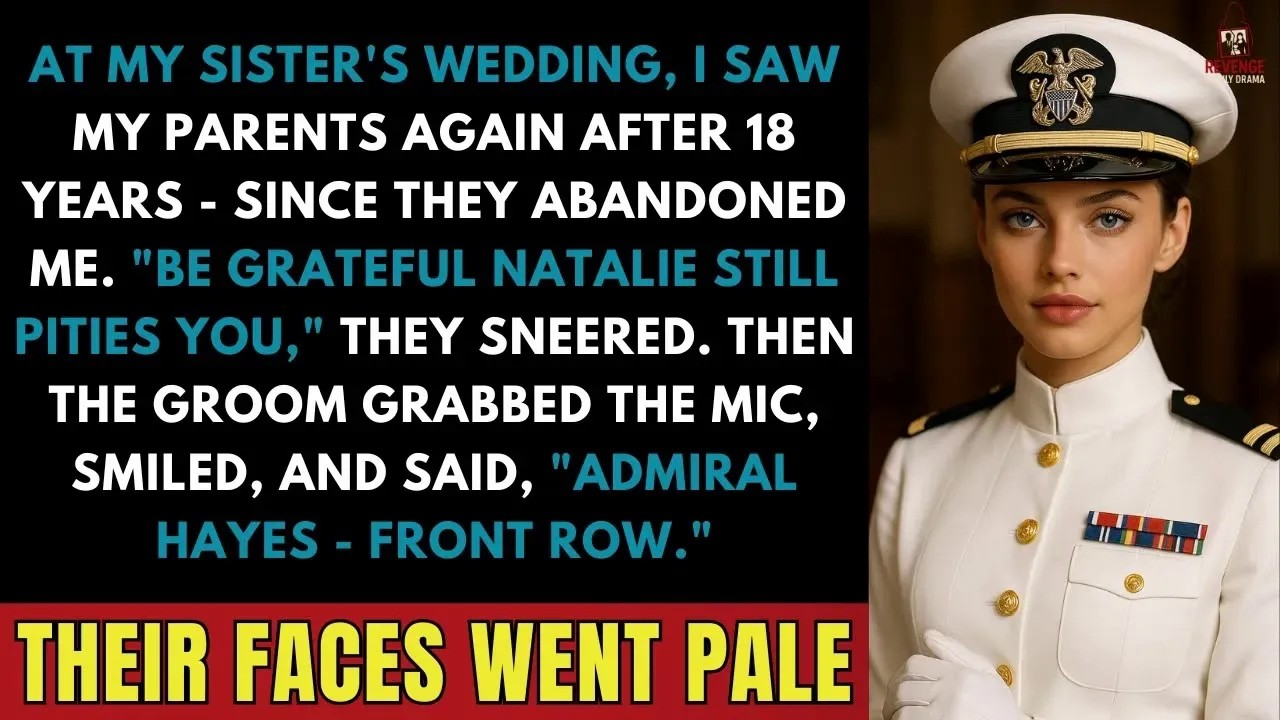
” He closed the door before I could breathe a word. Behind him, my mother stayed still, eyes down, as if silence could make her safe. That was the night I learned love can sound like an order. And twenty years later, at my sister’s wedding, that same man had to stand and salute me.
The envelope lay on my desk, white and perfect, the kind of letter that pretends to bring peace but carries something else. The handwriting was smooth, careful, familiar enough to freeze me for a heartbeat. Madison King. I hadn’t seen that name in twenty years.
I didn’t have to open it to know what waited inside, but I did anyway. A soft scent of roses drifted out, tangled with something colder. Pity. Inside was a silver embossed card.
It’s been long enough. Maybe it’s time. No warmth, no apology, just civility wrapped in expensive stationery. Typical Madison.
Always graceful when it cost her nothing. The morning light over Newport was sharp and clean, but it couldn’t cut through the heaviness in my chest. I stared out the window, past the harbor, back into a memory I’d spent two decades outrunning. The last time I’d heard her voice, it came from a porch I was no longer welcome to stand on.
I’d kept walking straight into the kind of life where respect had to be earned, not handed down with a family name. Now they wanted me back, not for reconciliation, but for appearances. Charleston loved its traditions, and nothing ruined a wedding like a missing sister. I folded the letter carefully, the way you fold a scar so it doesn’t reopen, and set it aside.
I wasn’t going back to settle scores. I was going back to see if the ache still knew my name. I left Newport early Friday morning, air damp and cold enough to sting. My Navy SUV hummed down I95, the highway stretching endlessly south like a thread pulling me backward through time.
Every mile carried a memory I’d buried but never erased. I could still see my father, Captain Raymond King, standing in the kitchen the morning everything broke. His uniform was spotless, his voice calm, and that was what made it hurt the most. He never shouted.
He dissected you with restraint. The smell of shoe polish and strong coffee filled the room as he said what he believed was wisdom. You want attention, not service. The Navy doesn’t need women who crave applause.
I remember the letter from Annapolis trembling in my hands, my voice trying to steady itself. I just wanted to earn what he had. He folded his paper slow, deliberate, as if sealing a coffin, then said, Earn it somewhere else. That night, I left with a single duffel bag.
My mother stood at the window, gripping a tin of cookies she’d baked but never offered. Be careful out there, she’d whispered. Twenty years later, those cookies were crumbs in a metal box I still kept. Proof that love had once existed, even if courage hadn’t
The Charleston city line appeared at noon.
The sky was bright, the river calm, but my chest grew heavier with every sign that told me I was home. The town hadn’t changed. Only I had. At a red light, I opened the hotel’s event app, scrolling through the guest list for Madison’s wedding.
My eyes stopped cold. Lieutenant Blake Anderson. The name punched through nerves. Then a memory surfaced: Djibouti, Operation Tidal Veil.
A young voice over calms. Command angel. We’re trapped. I shut the screen and let the silence settle.
The world was small, and sometimes it chose the exact moment to repay its debts
The red brick house by the Cooper River looked exactly as it had the day I left. Time hadn’t moved an inch. The wooden door creaked when I pushed it open, the sound sharp enough to scrape against memory. The air inside smelled of polished leather, tobacco, and the faint echo of old authority.
He was there, seated in his worn leather chair, back straight, eyes still razor sharp. Age had carved lines into his face but not softened him. Still pretending that uniform fits, he said, his tone part sarcasm, part command. I looked around the room.
The framed family photo on the wall behind him had been trimmed cleanly. My image cut away. I smiled faintly. It fits better than your approval ever did.
He didn’t flinch. The paper lay folded on the coffee table beside a cup of black coffee gone cold. Even time obeyed him here. I broke the silence first.
How’s Madison? Happy, he said. Engaged to a good Navy man. You’ll see him soon.
I told him I’d heard. He looked up, the faintest hint of a smirk. Just behave. Don’t make it about you.
The words almost made me laugh. Two decades later, and he still believed I needed a spotlight. Sunlight spilled through the window, glinting off the river. I realized I hadn’t come back for forgiveness.
I’d come back to prove I didn’t need it. When I left, the afternoon light had turned gold. The door closed behind me with the same weary creak, the same final sound that had once ended my youth. But this time, I didn’t cry
The Riverside Hotel glowed in soft gold, the air thick with champagne and Charleston charm.
I sat at the far end of the table, the polite corner reserved for people who didn’t belong. My shirt was crisp, without medals. The waiter hesitated beside me. Water, I said.
Keeps me honest. Whispers drifted through the jazz. That’s her, the Navy one. Never married.
I let them talk. Shame was a language I’d stopped speaking long ago. Madison arrived in pale blue, trying to smile through nerves. You look strong, she said.
You look nervous. I answered. Her eyes flicked toward our father near the podium. Captain Raymond King, still commanding attention without a word.
When asked for his drink, he didn’t look up. Scotch. Neat. Same as always.
The room fell silent. Madison lifted her glass. To family, old and new. Her voice trembled.
My father stood, adjusting his tie like a man reporting for duty. Family is where we learn service, he said. Some of us serve, others perform. Laughter rippled.
I simply smiled. Silence. I’d learned, carried more weight than argument
When the dinner ended, Lieutenant Blake Anderson approached. Were you ever in Djibouti?
He asked quietly. Operation Tidal Veil. Someone’s voice saved us. It was yours.
I met his eyes. I was the ops commander. Then I owe you my life, he said. Does Madison know?
I asked. Not yet. Let me handle that tomorrow. As I walked out, jazz fading behind me, my father’s voice followed, low, cutting.
Some medals are polished lies. He still didn’t understand. Some honors aren’t polished at all. They’re earned in silence
Charleston woke under a veil of fog.
I drove to the cemetery, lavender in my hands trembling like breath. My mother’s stone read: Evelyn King. She waited in silence. I placed the flowers and stayed there until I heard Madison’s voice.
I shouldn’t have come. Neither should I, I said. She pulled a faded envelope from her purse. It’s from Mom.
She wrote it before she died inside. Her handwriting wavered. If I had been braver, I would have followed you out that door. Silence isn’t peace, it’s decay.
My throat closed. Why now? Because dad told me to destroy it, Madison whispered. I couldn’t.
He wants you to sign something. The house, the inheritance. So that’s why you wanted me here. No, at first maybe.
But Blake said you were coming, and I thought we could fix things. Peace isn’t a family project, I said. It’s something you practice. She cried softly.
I’m sorry for keeping the letter. Then don’t keep anything else. When I reached the car, a military Jeep idled across the road. Blake sat inside, eyes steady, hand raised in a quiet salute.
I nodded back. Tomorrow everything would change
Charleston blazed under sunlight, the air thick with salt and expectation. St. Philip stood bright on Meeting Street, bells striking steady like a heartbeat I couldn’t ignore.
I arrived early. My white uniform pressed, ribbons small and quiet, reminders of where I’d been. Inside, the organ swelled. The stained glass scattered red and blue light across my shoulder like old scars turned into color.
I sat in the back, calm, unseen. The priest smiled warmly. We’re honored to have Captain Melissa King with us today. The title hung a moment before my father’s voice cut through.
Rear Admiral. Only if she believes it. Laughter trickled down the pews. I straightened my back, the first thing he ever taught me, using his own lesson to rise above him.
Madison entered, radiant and trembling. For a heartbeat, she looked like the little girl who used to hide beside me. Then she turned away, all grace and composure. Light rippled across the floor, soft and sharp at once.
A man near my father whispered. Didn’t your daughter serve too? My father’s answer carried easily. Serve?
She commanded from a desk. Not the same thing. The words burned, but I didn’t move. If he’d ever heard explosions through a headset, he’d know how wrong he was
When Madison spoke her vows, her eyes flicked to me.
Blake held her hand, but his gaze didn’t leave mine. The bells rang. The crowd rose. I stepped outside into the wind off the river.
Charleston shone, bright and quiet before the storm
Cooper Hall glittered against the water, its walls of glass reflecting gold. Jazz drifted through the room. I sat at the edge where I could see everything. My father presided at the head table, posture flawless, eyes scanning like he was still commanding a fleet.
He rose for a toast. Family is service, he said. Some of us learn it early, others confuse it with pride. The room froze.
Madison’s smile trembled. I set down my glass. Silent. The pause stretched until his voice broke under it.
A young officer whispered near him. Is that your daughter? A phase? My father replied.
Every family has one. My stomach turned cold. Still, I lifted my fork and cut my cake with measured calm. Then Blake stood, microphone in hand.
There’s someone here tonight who deserves recognition. Madison’s eyes widened. He gently pulled away. This woman led us through storms most of you couldn’t imagine.
He turned to me. Admiral Melissa King. Ma’am, you saved my team during Operation Tidal Veil. A groomsman rose.
Then another rose and saluted. The sound of chairs scraped like surf. My father sat frozen. Color drained.
Madison wept. I stood, returned the salute, and the room erupted. Not in noise, but in reverence
When the music returned, Madison came to me, whispering through tears. You saved him, and me, too.
I smiled faintly. Someone had to stand first. The gold light from the chandeliers shimmered across my uniform, catching on the edges of white fabric and small, unshowy ribbons. I stayed standing in the middle of the hall, the room holding its breath around me.
Blake’s voice carried through the silence, steady and reverent. For fifteen years, she never told anyone. She didn’t need to, because the people who lived because of her. We remember.
One sailor rose first, his hand snapping to a salute. Another followed, then another. The sound of chairs scraping the floor echoed like distant thunder. In ten seconds, the entire hall was on its feet.
I had stood in storms, in the roar of engines and gunfire. But this, the quiet weight of respect, was louder than any battle I’d ever fought. Someone near the back whispered, She’s the Black Widow. The old code name rippled through the air.
A ghost from a lifetime I’d buried. I felt the corner of my mouth lift. Not pride, not victory, just relief. After years of carrying silence, it finally felt light
My father hadn’t moved.
His face had gone pale, his hand trembling around a napkin for a heartbeat. I thought he’d turn away, walk out like he had before. Instead, he set the glass down and stood. Slowly, he met my eyes, and I saw it: the collapse of certainty, the surrender of a man who’d built walls out of command.
I straightened, lifted my hand to salute. He returned it. The movement careful, imperfect, but whole. Two officers, two generations, one salute ending twenty years of unspoken war
The applause began softly, like rain against metal, spreading through the room.
Blake handed me the microphone. Would you like to say something, ma’am? I looked at the faces before me, tearful, astonished. Quiet.
No, I said calmly. Everything’s already been said. I placed the microphone down and returned to my seat. Madison’s hand found mine, trembling.
You didn’t have to come. I did. I told her. Not for them.
For me. Outside, beyond the glass walls, the Cooper River shimmered under the moonlight, still vast and finally at peace, just like the part of me that had been waiting to exhale
Charleston was quiet under the street lamps, their light stretching long and thin across the wet pavement. I drove slowly along the river road until the red brick house appeared through the haze. The porch light was on.
After twenty years, that single bulb glowed. Not for anyone returning, but for something still standing. I parked, stepped out into the warm night, and climbed the old steps. My knuckles tapped the wood twice.
Knock, knock. From inside came the sound of slow footsteps, measured and familiar. The door opened. My father stood there, no tie, sleeves rolled up, the stiffness gone from his shoulders.
His face looked smaller somehow, the lines deeper, the certainty softer. I made coffee, he said. Then I’ll sit, I answered. We took our places at the kitchen table, the same one where everything had broken two decades ago.
The faint scent of shoe polish still lingered, now mixed with fresh coffee. Between us lay the morning paper, still folded, untouched, as if time itself had paused here. He spoke first, his voice rough. I shouldn’t have said those things tonight.
You said them twenty years ago, I told him. Tonight just gave them a microphone. Silence stretched. I looked at his hands, thin, veined, trembling slightly.
He asked, Were you ever scared? Every time, I said. But I moved anyway. He exhaled a long, uneven breath.
I told myself I was protecting you when I pushed you out. You were protecting your story, I said. That story cost all of us. He nodded faintly.
But we’re still here. The old clock ticked between us, each sound steady, identical to the one that filled this house the night I left. After a while, he glanced at the door. Those two knocks.
What do they mean? I smiled. It’s how you say I’m here, and I mean no harm. He turned toward the door, lifted his hand, and tapped twice.
Knock, knock. I’m here, he repeated softly. And I mean no harm. We sat in that fragile peace.
No tears, no apologies, just two people acknowledging the quiet truth at last
Before I left, he rose, walked to the wall, and stared at the family photo. The cut frame was still there, the empty corner where I used to be. He opened a drawer, pulled out the missing piece,and carefully taped it back. Time to put it back, he murmured.
Respect starts closest to your hands, I said and stood. When I stepped outside, the porch light glowed steady above me. It didn’t call me home. It simply stayed lit, warm, patient, enough to keep the darkness from closing in
Dawn stretched across the Cooper River, soft and golden, the kind of light that forgives.
My footsteps fell steady against the boardwalk. Each one tracing the same path my father once walked beside me, teaching me to swim in these waters. The air was cool, salted with memory, but lighter now. No heaviness, no ghosts pressing on my chest, only breath, only rhythm, only peace
The phone buzzed in my pocket, a small vibration that broke the quiet.
I slowed, pulled it out,and read the message glowing against the morning sky. Vice Admiral appointment confirmed. Congratulations, Admiral King. For a moment, I just stood there watching the river move beneath the bridge.
No rush of pride, no surge of tears, just a quiet smile that came from somewhere deep where closure finally lives. I didn’t forward the message. I didn’t tell anyone. Some victories don’t need an audience
Last night before sleep, I’d opened my old leather journal, the one that’s followed me through deployments and silence,and written, “Respect isn’t inherited.
It’s earned and maintained. ” Now, standing beneath a sky turning rose and blue, I added a single line. And sometimes it’s restored quietly, one knock at a time. The first sunlight touched the river, scattering in long ribbons across the water.
Charleston woke slowly, the sounds of gulls and car engines folding into the hum of a city that had both broken me and built me again. I inhaled deeply, filling my lungs with the air that once felt stolen from me. People ask what revenge feels like. I thought: it feels like this, breathing easy in the same town that once took your air.
I started running again, crossing the bridge, the river shimmering beneath. Every stride felt lighter, as if the past had loosened its grip, one breath at a time. The wind moved through my hair, carrying the scent of salt and sunlight. No eyes on me, no applause, no need for validation.
I didn’t need forgiveness or acknowledgement. I didn’t need to be seen to know I was whole. The town that once silenced me now echoed only with calm. The sound of waves against the shore.
The rhythm of a heart finally at rest. And as I crossed the last stretch of the bridge, the light widened around me, steady and clear. For the first time in my life, I didn’t feel watched or judged. I just felt still.
And in that stillness, I knew I had won