The stench of the Cook County Courthouse—stale coffee, cheap floor wax, and defeat—clung to the air as my stepmother’s manicured fingers dug into my shoulder. Her Tom Ford perfume was suffocating. “You think a few cheap metals can save him? This house, the bank accounts, the company—they’re mine now.
Your father is going to rot in prison. You should have died on that battlefield. ”
I am Sophia Morris, 29 years old, a United States Marine Corps officer. I had clawed my way back from a near-fatal anaphylactic shock in the ICU, only to stand here and watch Evelyn hand down a death sentence to my father.
She walked into that courtroom smug, thinking everything was sealed. But she didn’t know that someone who just walked out of the grave never goes into battle without a loaded weapon. Inside courtroom 302, a well-oiled machine was grinding my father down to the bone. Evelyn had taken the front row, a lace tissue pressed to her face—the grieving wife, the brave victim.
Up at the prosecutor’s table stood Andrew Vale, pale and gutless, reading the $40 million wire fraud indictment in a droning voice. And then there was my father, Lucas, sitting in a faded orange jumpsuit. His broad shoulders were caved in. He stared at the scuffed floorboards.
He wasn’t fighting. He had accepted the role they forced on him—a scapegoat for his own wife’s dirty money. Judge Cross sat frozen in his wheelchair, a hollowed-out ghost. He tapped his gavel, preparing to finalize the lie.
I didn’t knock. I pushed the heavy brass handles. The hinges shrieked. I didn’t scream.
I just walked down the center aisle in my combat boots, each step a calculated strike. The entire courtroom turned. A heavyset bailiff stepped forward. “Ma’am, you can’t—”
I snapped my head toward him and gave him the kind of dead, hollow stare you only get from watching people bleed out in the dirt.
He froze. He stepped back. I reached the wooden gate and stopped dead center. Parade rest.
Total discipline in a room full of cowards. My eyes locked on the man on the bench. “Your Honor,” I said. “Let my father go, and I will make you walk again.
”
A collective gasp rippled through the gallery. Evelyn’s fake tears vanished. At the defense table, Lucas jerked his head up, his eyes wild with panic. He mouthed the words silently: *Go home.
*
Vale slammed his palm on the table. “Objection, Your Honor! Remove this woman immediately! ”
Judge Cross didn’t move.
Something flickered in his dead eyes. He raised a bony finger. “You have 30 seconds, young lady. ”
I dropped the bomb.
“The indictment states my father was at his desk at Victory Corp. manually initiating a $40 million offshore wire transfer at 2 a. m. on November 14th.
That is a physical impossibility—because at exactly 2 a. m. on November 14th, Lucas Morris was holding my hand in the intensive care unit while a machine breathed for me. ”
Vale’s jaw dropped.
He looked frantically toward Evelyn. She was gripping her purse so hard her knuckles were white. Judge Cross leaned forward. “Which hospital?
”
Memories grabbed me by the throat, dragging me back to hell. For seven years, I let the Marine Corps break me down and build me back up. Every month, two-thirds of my hazard pay went straight to Evelyn—the unspoken tax for keeping the upper-middle-class illusion alive. She spent it on her golden boy, her son who had flunked out of community college twice.
I was just the ATM in combat boots. The toll of my deployments finally caught up to me on November 14th. The moment I stepped off the plane at O’Hare, a delayed reaction triggered massive anaphylactic shock. My throat closed.
I hit the terminal floor. They rushed me to Hope Memorial. Evelyn never showed up—she was “entertaining clients. ” But Lucas came.
He burst through the ICU doors in wrinkled pajama pants and a hastily thrown-on coat. He didn’t say a word. He just grabbed my hand and sat in that hard plastic chair for nine straight hours, lips moving in a silent prayer. That night killed the weak, hopeful part of me.
Have you ever been the invisible one in your own family? Poured your blood and money into people who only saw you as a transaction? If you know that hollow, freezing feeling, hit the like button. Leave a comment and tell me I survived it.
I blinked, pulling myself back into courtroom 302. “Hope Memorial,” I answered. Evelyn was sweating under her foundation. She realized I wasn’t the quiet little ATM anymore.
Vale scrambled to his feet. “This is nothing but a cheap emotional defense tactic! The defendant could have remoted in from a hospital laptop. ”
I raised my left hand.
“Victory Corp server logs show the system mandates a physical biometric fingerprint scan. There is no remote access for transfers over $10 million. Someone physically sat in my father’s chair at 2 a. m.
”
Vale looked like a fish suffocating on dry land. Right on cue, the courtroom doors groaned again. Martha Oliver walked in—a senior trauma nurse from Hope Memorial, a Black woman who had spent 30 years pulling gunshot victims back from the brink on the South Side. She had zero patience for fools.
She marched straight into the witness box. “Lucas Morris did not leave room 4208,” she said. “He sat in a plastic chair next to his daughter’s bed from 6 p. m.
until 4 a. m. I checked her vitals every 45 minutes. He was holding her hand every single time.
”
Vale wiped his forehead. “Your Honor, this witness is not on the approved docket! ”
Martha turned slowly. “I gave this exact statement to two detectives three weeks ago.
I signed a sworn affidavit. ”
The room went dead silent. Judge Cross grabbed the wheels of his chair, dragging himself forward. His eyes were suddenly blazing.
“Prosecutor Vale,” he rasped. “Why is a sworn affidavit from a primary alibi witness missing from the official court file? ”
Vale looked desperately at Evelyn. She didn’t even blink.
She turned her head away, cutting him loose. Judge Cross swung his gavel down with brutal force. *Crack. * “This trial is suspended for 48 hours pending an immediate internal investigation.
Bailiff, remove the defendant’s restraints. ”
The handcuffs clanked open. My father rubbed his raw wrists, tears welling in his tired eyes. But I knew better than to celebrate.
Evelyn stood up, slipping into her mink coat. As she passed me, she stopped. Her eyes were pitch black, cold, calculating—the look of a cornered animal realizing it has to fight to the death. She walked out.
My military training kicked in. The suspension wasn’t a victory. It was a red alert. Evelyn had dirty cops on her payroll and 40 million reasons to ensure this case never saw the inside of a courtroom again.
Tonight, they would tie up the loose ends permanently. They were going to kill Martha. I turned to my father and the nurse. “We have to move now.
”
The Chicago cold hit us like a physical blow. I pointed to my battered Ford F-150. My father didn’t argue. As I pulled away from the curb, I glanced in the rearview mirror.
A black SUV with tinted windows pulled out behind us. I hit the gas, weaving through traffic, running a yellow light. A garbage truck cut the intersection behind me, boxing in the SUV. “Where are we going?
” Lucas asked, his voice cracked. “Sophia, she is going to kill us all. ”
“We have work to do,” I replied. I drove south to Englewood, pulling into a trash-strewn alley behind a faded brick apartment complex.
“Keep the engine running,” I ordered. “Don’t unlock the doors for anyone but me. ”
I took the rusted fire escape up to the second floor. In the dim hallway, two men stood outside Martha’s door.
Plain clothes, but standard-issue Chicago police boots—Mendoza’s guys. One was picking the lock. The other leaned against the wall. Zero warning.
I closed the distance in four strides. I grabbed the lockpicker’s neck and drove his face into the exposed brick. *Crunch. * He dropped.
The second guy reached inside his jacket and pulled out a black stun baton. I stepped inside his guard, caught his wrist, and drove my forearm down hard against his elbow. A sharp pop echoed down the hallway. He screamed.
I kicked his knee, dropping him. I knocked three times. “Martha, it’s Sophia Morris. Open the door.
”
She peered out, clutching a kitchen knife, and stared at the two bleeding men. “Pack your medication,” I said. “We have three minutes. ”
She grabbed a duffel bag without asking questions.
Back in the truck, my father stared out the window, his worldview collapsing. You can’t trust the police when the chief is on Evelyn’s payroll. There was only one place left to go—a blind spot no one would check. I drove to a subterranean parking garage beneath a brutalist concrete building.
We knocked on a heavy steel door in a damp, freezing hallway. Judge Cross opened it. His basement office smelled like mildew and rotting paper. Stacks of case files lined the concrete walls.
“You just declared war on a system that cannot be beaten,” Cross rasped. “They own this city. ”
I reached past him and pulled the deadbolt shut. “I didn’t declare war.
I came to end it. ”
Cross switched on an outdated computer. I took the keyboard and accessed the county’s secure backup drive. I ran a cross-reference search between Victory Corp’s internal communications and the prosecutor’s sealed dockets.
A hidden spreadsheet opened. The blue light washed over my face. Fifteen names. Fifteen different people—shift supervisors, union auditors, low-level accountants.
For eight years, Evelyn and Congressman Castayano had used Victory Corp as a washing machine for illegal campaign funds. Whenever a regulator got too close, Evelyn pulled a name from this list. A sacrificial lamb. Fifteen families destroyed so a politician could buy a vacation home and my stepmother could wear Tom Ford.
My father read the names over my shoulder. He buried his face in his hands, letting out a broken sound. He finally understood he was never a husband to Evelyn. He was just an insurance policy waiting to be cashed out.
Cross let out a heavy exhale. “You think I don’t know how this city works? Five years ago, a case landed on my desk. A project manager accused of embezzlement.
He had proof Castayano was involved. I signed the subpoena. At 9 p. m.
, I was walking to my car in the courthouse garage. A utility truck with no plates pinned me against a concrete pillar and crushed both my legs. ”
He looked up at me, tears filling his eyes. “They kept me alive as a warning.
A living puppet. ”
I stepped toward him. “You closed your eyes, and fifteen families were crushed under your cowardice. Today my father almost lost his life in an orange jumpsuit.
Your legs might be paralyzed, Judge. But if your honor is paralyzed too, you don’t deserve to wear that robe. ”
His bottom lip trembled. He gripped the armrests.
Something dangerous flared in his eyes. He opened his mouth to speak—but a boxy TV in the corner flickered to life. “We interrupt our scheduled programming,” the anchor said. “Cook County prosecutor Andrew Vale has been found dead, recovered from the icy waters of the Chicago River.
Police Chief Mendoza is ruling it a suicide. ”
I stared at the screen. Evelyn hadn’t just scrubbed the crime scene. She had eliminated her weakest link.
Vale panicked in the courtroom, so they put a bullet in his head and threw him in the river. Case closed. Miles away, in the affluent North Shore suburbs, Evelyn sat in my father’s living room with Congressman Castayano. He poured two glasses of pinot noir.
Their crystal clinked. “I told you the little soldier girl wouldn’t change a thing,” Evelyn laughed. “The $40 million is secure. Let her run around the city.
She has nothing. The money always wins. ”
Down in the basement, my father stared at the screen. “She killed him.
Evelyn killed a man. ”
Martha was crying quietly. I didn’t waste breath on comfort. I sat in front of the computer.
“You don’t understand what she’s capable of,” Lucas pleaded. “I understand exactly what she is,” I replied. “But she made a tactical error. She thinks Vale was just a loyal dog.
Vale was a coward—and cowards don’t walk into the dark without a flashlight. ”
The analog clock ticked. One a. m.
Two a. m. Exactly three a. m.
—*beep. * A new window popped up. An automated email routed through an encrypted proxy. The subject line: *LIFE INSURANCE—AUTO SEND IF LOGIN FAILS FOR 24 HOURS.
* Vale’s dead man’s switch. He knew Evelyn would kill him eventually, so he rigged the game from the grave. I grabbed the mouse. A massive zip file began downloading.
Wire transfer receipts, offshore account numbers, audio files. Vale was a spineless coward, but he was an obsessive hoarder. When you handle dirty money for Chicago’s elite, you keep receipts. I plugged in headphones and clicked the first file.
Evelyn’s voice hissed through: “Transfer the 40 million into the dark fund. Cayman routing. Do it tonight, Andrew. ”
The next file—a voicemail from Mendoza’s burner phone: “Vale is done.
Handle him exactly like we planned. Make it look like he jumped. ”
I pulled the headphones off. I didn’t dial 911.
You don’t call the local precinct when the chief of police is running the hit squad. I punched in a direct encrypted line to the FBI’s regional field director—a contact from my intelligence rotations at Quantico. The line picked up on the first ring. I read the Cayman routing numbers.
I gave them Castayano’s digital signature logs. No begging. Just the raw facts of a federal wire fraud and murder conspiracy. “Courtroom 302, 9 a.
m. ,” I said. “Bring the heavy hardware. ”
I hung up.
Then I opened an untraceable email and pasted the 15 names—the scapegoats sitting in state prisons, stripped of everything. I typed two sentences: *Cook County Courthouse, Courtroom 302, 9 a. m. today.
Come get your lives back. *
The ghosts were waking up. At six a. m.
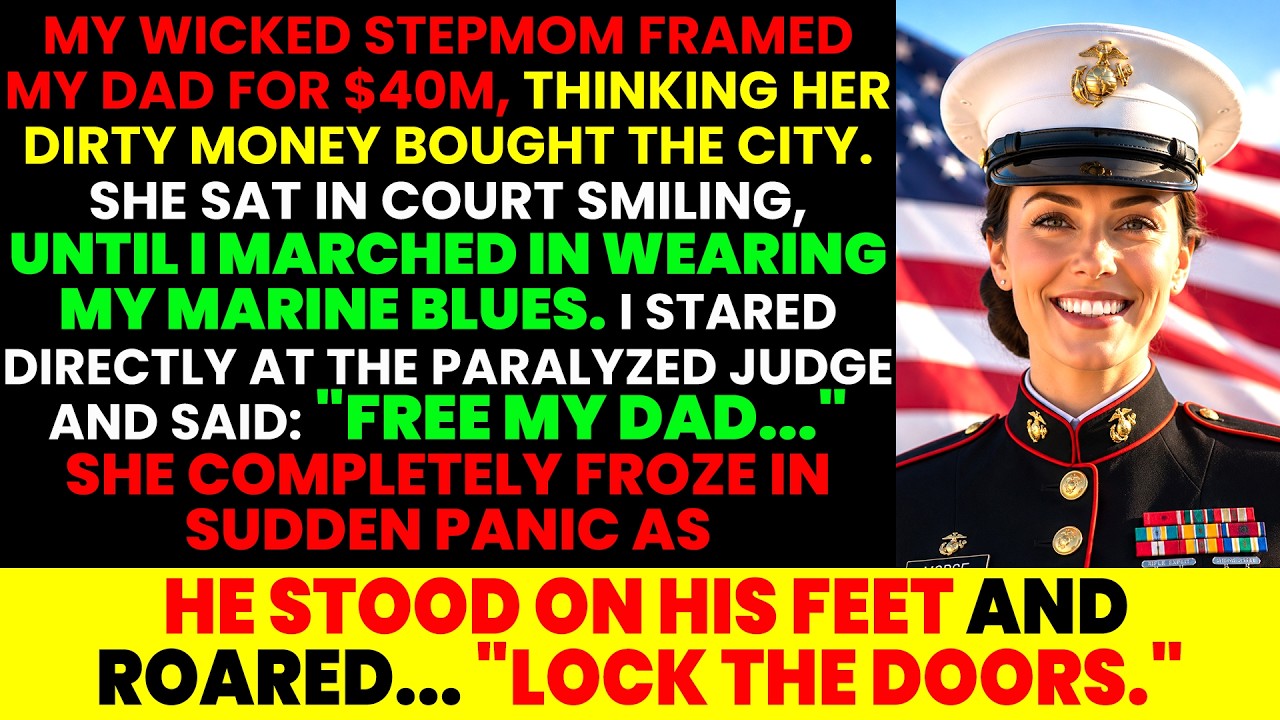
, I stood in front of a cracked mirror in my full dress blues. The stiff collar dug into my neck. I fastened the brass buttons one by one. I brushed my hand over my ribbons—the Combat Action Ribbon, the Purple Heart.
“A few cheap metals,” Evelyn had sneered. She thought money made her untouchable. Today, this uniform was going to be the shield that broke her jaw. Judge Cross stared at me from his wheelchair.
He grabbed the edge of his desk, knuckles white. He ground his teeth, pushing himself up. His atrophied legs trembled violently. He shoved the wheelchair backward—it slammed into the filing cabinets.
Cross stood there, hunched, shaking, gripping the desk. But he was standing. He looked up at me, eyes burning. He gave a single rigid nod.
It was time to drag the rats into the light. Before we walked through those courthouse doors, I asked you something: have you ever had to armor up to face the people who were supposed to protect you? If you know what it’s like to use their doubt as your weapon, hit the like button. Comment “armored up” so I know you’re with me.
And subscribe, because you don’t want to miss how this ends. At 9 a. m. , I stood just around the corner from the courtroom, listening to the muffled, arrogant laughter inside.
They thought they had won. I stepped out of the shadows. Inside courtroom 302, the heat was cranked too high. The gallery was packed.
Camera shutters clicked. Evelyn sat in the front row in a pristine white pantsuit—pure, innocent, untouchable. Beside her sat Congressman Castayano in a dark pinstriped suit. They expected the judge to dismiss the charges in absentia.
They expected to walk out clutching 40 million stolen dollars. Then the heavy brass handles turned. The doors swung open. Judge Cross stepped through.
He moved brutally slow—no wheelchair. Every step was a violent, agonizing effort. He gripped a heavy wooden cane, knuckles shaking. For the first time in five years, the man was not sitting.
He was a towering, grim specter draped in black judicial robes, dragging his legs toward the bench. He pulled himself up into his chair. Evelyn’s smile cracked. The blood drained from her face.
Castayano glanced toward the side exit—but I was already blocking the door. I stepped in behind Cross in full dress blues. I stopped at the exact spot I’d stood 48 hours ago and snapped into parade rest. I didn’t come alone.
Behind me filed 15 people—the ghosts. An older Black man with a severe limp. A young mother clutching a faded purse. A middle-aged accountant who looked like he hadn’t slept in a decade.
They fanned out across the back of the courtroom, a solid human wall blocking the main doors. Evelyn spun around. A low, ragged sound escaped her throat—the raw animal sound of a predator realizing it just walked into a steel trap. Judge Cross raised his gavel.
*Crack. * “Court is in session,” he rasped. “We are not here to hear the state’s indictment against Lucas Morris. We are here to hear the voices of the people you sacrificed to turn the justice system into a slaughterhouse for your own greed.
”
Castayano stood up. “This is highly irregular! I demand to know—“
“Sit down, Congressman. ”
Cross locked eyes with the bailiff.
“Lock the doors. Not a single person leaves this room. ”
I walked to the court reporter’s desk, pulled a black thumb drive from my breast pocket, and jammed it into the projector. I hit play.
Evelyn’s voice blasted through the speakers: “Clean the old man up. Pin the wire transfer on his terminal. Give them a scapegoat. ”
The silence was suffocating.
Then the projector screen dropped, flashing a decrypted offshore banking ledger. At the bottom, next to a $15 million transfer, was Congressman Castayano’s digital signature. Ironclad. Castayano’s face turned to ash.
He scrambled out of his chair, lunging toward the judge’s private chambers. He grabbed the knob—and the door exploded open. Three men in tactical gear stepped through. The yellow letters on their vests read: FBI.
“Federal agents! Don’t move! ”
The main doors clicked open. A dozen more agents swarmed in.
Police Chief Mendoza raised his hands without a fight—he knew the machine was broken. Two agents closed in on Evelyn. She lost her mind. “Get your hands off me!
Do you know who I am? You can’t touch me! ” She thrashed, kicking and screaming. They slammed her face down onto the defense table.
Her perfect foundation smeared across the oak. Her hair came unraveled. The handcuffs clamped down over her diamond-encrusted Rolex. She locked eyes with me.
Her face crumpled into a pathetic mask. “Sophia, please tell them to stop. I’m your mother. We’re family.
Please, you have to help me. ”
I uncrossed my hands and took two slow steps toward her. I stood directly over the woman who bled my father dry, who left me to die in a hospital bed, who ordered a hit on a nurse to protect a bank account. I didn’t feel angry.
I just felt clean. I leaned down, low enough that only she could hear. “You were right, Evelyn. I should have died on that battlefield.
But I didn’t. So now you get to rot in a federal cell. You were never my family. ”
I turned my back and walked away.
Six months later, the Chicago winter finally broke into a bitter spring. Fifteen federal exonerations. Fifteen criminal records wiped clean. Victory Corp was seized and auctioned off for scrap.
Evelyn and Castayano took blind plea deals—life without parole, maximum security. A dead man’s encrypted files were more than their high-priced lawyers could fight. Evelyn’s offshore accounts were frozen, her designer bags seized, her perfume replaced by the smell of industrial bleach. My father was fully exonerated.
The state cut him a settlement large enough to retire on a beach somewhere warm. But Lucas didn’t buy a boat. He rented a cheap storefront in Englewood and opened a legal aid clinic for blue-collar workers—union guys, mechanics, trauma nurses, people who couldn’t afford to fight the machine. The pain was still there; I could see it when he stared at his black coffee some mornings.
But he had a purpose. We stood in the rotunda of Chicago City Hall, packed with real families. Martha Oliver stood in the front row, head high. Judge Cross stood on heavy aluminum crutches.
His hands shook with the effort, but his spine was straight. He looked at the 15 people in the front row. Then he bowed his head and offered a deep, public apology. My father stepped forward and gripped the judge’s shoulder—a calloused hand forgiving a broken man.
Cross turned to face me. I was in my dress blues, pristine, squared away. “Officer Morris,” he rasped. “You walked into a slaughterhouse and didn’t flinch.
You taught an old coward what real courage looks like. ”
He pinned the civilian merit medal onto my left breast, right next to my combat ribbons. The bronze felt cold, heavy, real. I didn’t cry.
I took one sharp step back and delivered a crisp, flawless military salute. I held it for three full seconds. Mission accomplished. I defended my family.
I tore down a corrupt empire. And I did it without firing a single bullet. Listen to me. Real strength doesn’t come from screaming the loudest.
It comes from the cold, hard truth you hold in your hands. If you’ve ever been bled dry by people who share your last name—treated like a bank account, an afterthought, the invisible child—remember this. Your worth is not determined by their broken scales. You don’t owe them your sanity just because you share a bloodline.
Forgiveness doesn’t mean giving them the keys back to your life. Armor up, set the boundary, and let the truth do the talking. We survive, and we win.