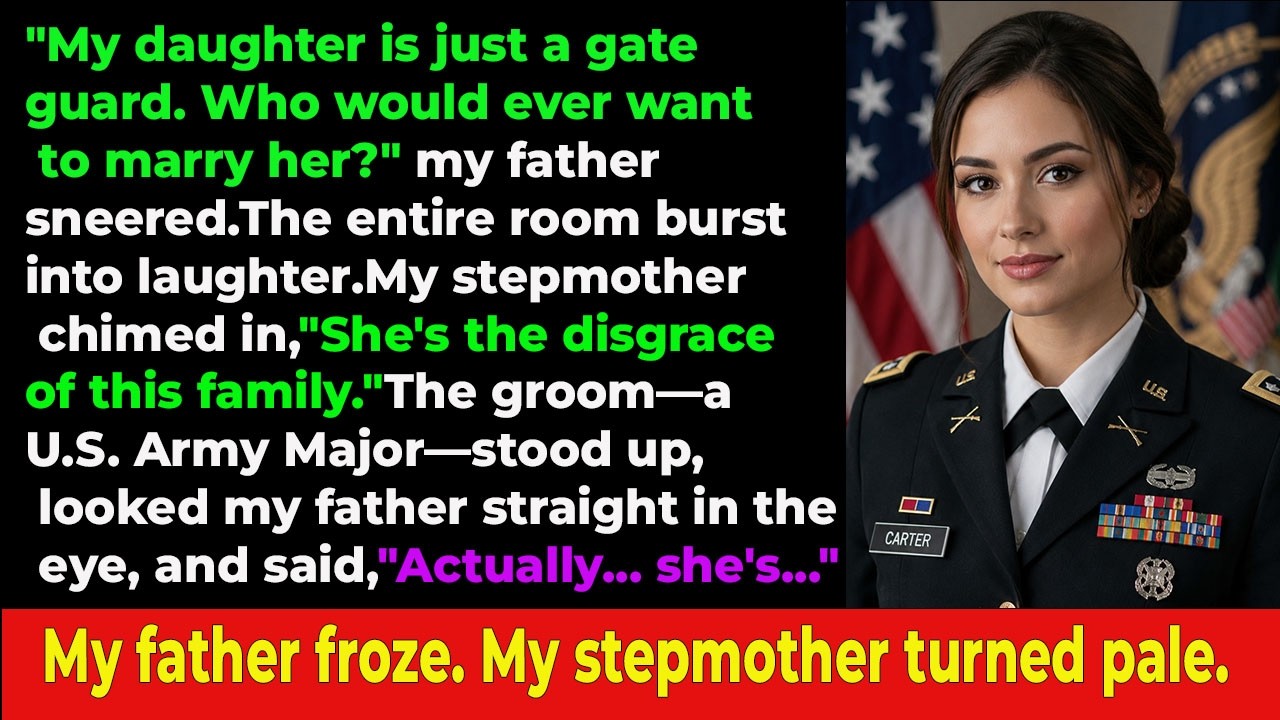
The loudest laugh at my sister’s wedding came from my own father after he called me just a gate guard. Twenty minutes later, nobody in that ballroom was laughing. I’m Emily Carter, 36 years old. Until that Saturday afternoon in Savannah, Georgia, I honestly believed I’d made peace with the way my family saw me.
Turns out I was wrong. My half-sister Britney was marrying a US Army major at the Marriott Savannah Riverfront. White roses, crystal chandeliers, navy tablecloths. My father had spared no expense.
He wanted everyone in Chatham County to know his daughter was marrying a military man. I arrived alone. Not because I didn’t have friends—I just didn’t have anyone I wanted to bring into that family gathering. I parked my twelve-year-old Ford Explorer, straightened my Navy dress, and sat behind the wheel.
*You can do this*, I whispered to myself. Growing up hadn’t been easy after my mom passed away when I was fourteen. Dad changed after the funeral. Then he married Linda, whose six-year-old daughter Britney became the new center of his world.
Britney got dinners at Outback for average grades. I got a card in the mail for graduating near the top of my class. Britney got a Honda Civic at sixteen. I bought my own used pickup after working two summer jobs.
Thousands of little things. Eventually, they just became normal. The ceremony itself was beautiful. Britney looked genuinely happy.
For a moment watching her walk down the aisle, I forgot every old resentment. I even felt proud of her. At the reception, I sat toward the back with two older cousins. Halfway through dinner, one of Ethan’s uncles pulled up a chair beside me.
“So, Emily,” he asked, “what do you do? ”
I opened my mouth. Dad answered first. “Oh, that’s easy.
” He grinned. “My daughter is just a gate guard. Who would ever want to marry her? ”
The words echoed louder than they should have.
Several tables went quiet. Then someone chuckled. Another person laughed harder. Within seconds, the laughter spread across the room.
I stared at my untouched dinner. The mashed potatoes had already gone cold. Old Emily would have cried. Younger Emily might have yelled.
The woman I’d become simply folded her napkin, took one slow breath, and reached for my water glass. Dad wasn’t finished. “I told her years ago she should find a real career. I guess checking driver’s licenses is all she’s cut out for.
”
I looked across the ballroom. Britney wouldn’t meet my eyes. I quietly pushed my chair back. No speech, no dramatic exit.
Then I heard another chair scrape against the floor. Major Ethan Brooks stood. Not quickly, not angrily. Deliberately.
He adjusted his dress uniform and looked directly at my father. “Actually,” he said evenly, “everyone stopped. Even the band members looked over. ”
Ethan took another step forward.
“She’s the officer who saved my career. ”
The room went completely still. My father forced out a laugh. “Now that’s a good one.
”
No one joined him. Ethan kept his eyes on my father. “I’m not joking. I’ve wanted to thank Emily properly for three years.
I never imagined I’d have to do it like this. ”
I wished the floor would open beneath my chair. Not because I was ashamed—because I hated being the center of attention. Dad crossed his arms.
“She’s been checking IDs at Hunter Army Airfield for years. ”
Ethan nodded. “She does. ”
Some people think I had a moment of triumph here, but honestly, I just wanted to disappear.
“Before that,” Ethan continued, “she worked in physical security operations supporting overseas deployments. Three years ago, someone attempted to gain unauthorized access using forged credentials before our deployment. Emily caught the discrepancy. The situation was contained before anyone got hurt.
”
Someone near the back whispered, “Wow. ”
“The truth is,” Ethan said, “most people never notice professionals like Emily because when they’re doing their job correctly, nothing happens. ”
That sentence hit me harder than I expected. Nothing happens.
Exactly. Success in my line of work usually meant nobody ever knew there had been a problem. Dad still looked unconvinced. “If she’s so important, why is she standing at a gate now?
”
I finally spoke. “Because I asked for that assignment. ”
Every face turned toward me. “I transferred back to Georgia because I wanted a quieter life.
”
Dad laughed. “Convenient answer. ”
“It happens to be the truth. You remember when I came home six years ago?
You barely visited. I’d just finished one of the hardest assignments of my career. I wanted to sleep through the night again. I wanted weekends where my phone didn’t ring every hour.
”
A few older guests nodded. One elderly veteran quietly murmured, “I understand that. ”
Ethan spoke again. “The army needs people in every role.
Some jobs are visible. Some aren’t. But every one of them matters. ”
Silence.
Dad stared at him before shrugging. “I still don’t see what’s so impressive. ”
After the chaos, I quietly picked up my purse near the ballroom doors. Britney caught me.
“Emily, I’m sorry. ”
“For what? ”
“I didn’t know Dad was going to say that. ”
I believed her.
She hugged me—awkward, but real. Driving home that evening, my phone had twelve missed calls. Texts reading, “Is what Ethan said true? ” and “Why didn’t you ever tell us?
” and “I’m sorry for laughing. ”
I didn’t answer. Some things don’t need explaining. I made chamomile tea and sat on the back porch, listening to crickets.
I believed the worst was over. I couldn’t have been more wrong. By Monday morning, my father had already started telling an entirely different story. Around 9:00, my supervisor, Sergeant First Class Denise Alvarez, pulled me aside.
She slid her tablet across her desk. It was Facebook—a public post from my father. “I figured you should see this before someone else showed you. ”
His caption read: “Funny how some people invent exciting military stories after spending years checking IDs at the gate.
Guess every family has someone desperate for attention. ”
Underneath, dozens of comments. “Stolen valor is disgusting. ” “The groom probably exaggerated.
” Sad if that’s true. Denise watched me carefully. “So, why would your father post this? ”
Because admitting he’d been wrong would cost him more than accusing his daughter of lying.
I didn’t say that out loud. By Wednesday, the situation had moved beyond family gossip. I was called into the administrative office. A civilian employee from installation security introduced himself politely.
“Ms. Carter, this won’t take long. We’ve received an anonymous complaint. It alleges you falsely represented your military experience outside official channels.
”
For a moment, I simply blinked. Then I almost smiled—not because it was funny, but because it was absurd. I’d done the opposite. He nodded, having already reviewed my personnel file.
But regulations required documenting every complaint. Even my promotion package was temporarily placed on hold pending completion of the administrative review. Then Major Ethan Brooks knocked on my office door. “I owe you an apology.
I made your situation worse. ”
I shook my head. “You exposed him. ”
He looked unusually serious.
“There’s something I learned after the wedding. My unit recently reviewed vendor contracts for an upcoming facilities project. One company name sounded familiar. ”
He slid an invoice across my desk.
Carter Hardware and Supply. Dad’s company. “I noticed they advertised themselves as a veteran-owned business. ”
I looked up immediately.
“They’re not. My father never served. ”
“I know. I checked.
There were also references to military partnerships that don’t exist. ”
For the first time since the wedding, genuine fear settled in my chest. Not for myself—for my father. This wasn’t family gossip anymore.
Ethan met my eyes quietly. “Emily, I think your father has been committing fraud. ”
I barely slept that night. I sat at my kitchen table at 5:30 the next morning with a cold cup of coffee.
I picked up my phone three times to call my father. Three times I put it back down. I wasn’t afraid of the conversation. I was afraid of what I might hear.
I called the installation legal assistance office. A civilian attorney named Melissa Grant returned my call. “Do you have any personal involvement in your father’s business? ”
“No.
”
“Have you ever signed documents for him? ”
“Never. ”
“Have you benefited financially? ”
“No.
”
“If you possess information suggesting false representations involving federal contracts,” she said, “report the facts through the proper channels. ”
“I don’t want revenge. ”
“I didn’t ask whether you wanted revenge. I asked whether the information appears credible.
”
Truth, not revenge. There was a difference. Friday evening, I drove to Carter Hardware and Supply. The faded red sign, the squeaky front door, the smell of lumber and motor oil.
Every aisle held memories—where Dad taught me how to use a tape measure, where Mom brought homemade cookies every Christmas. Dad looked up from his desk. His expression hardened. “What do you want?
”
I placed Ethan’s folder on his desk. “You tell me. ”
He flipped through the first few pages, then closed the folder. “I don’t know where you got this.
”
“It says your company is veteran-owned. ”
“It’s marketing. ”
“It isn’t. It involves federal contracts.
It becomes my business when you’re using military connections that don’t exist. ”
He stood. “You think you’re smarter than everybody because you wear a uniform? ”
“You embarrassed me.
That groom made me look like a fool. ”
“You did that yourself. ”
His face turned red. “You abandoned your family.
”
“No. I built my own life. ”
He shoved the folder back across the desk. “I’m done talking.
”
I looked at him, wanting him to stop me, to admit he’d made mistakes. Instead, he picked up the phone and pretended to dial a number. The following Monday, I submitted the documents exactly as Melissa had advised. No accusations, no dramatic statement.
Just copies of records and a factual explanation of how they had come into my possession. Then I waited. Weeks passed. My promotion review finally cleared.
The anonymous complaint was officially closed with no findings. But somewhere beyond my routine, investigators were asking questions. Then Thanksgiving arrived. Dad hosted dinner as usual.
I actually thought we might get through the afternoon peacefully. Then one of Dad’s business associates asked Ethan about army life. “Speaking of security,” Dad laughed, “my oldest daughter still thinks checking driver’s licenses makes her some kind of military expert. ”
A few uncomfortable chuckles drifted around the table.
Nobody laughed the way they had at the wedding. I calmly buttered my dinner roll and didn’t respond. When my phone buzzed later, it was Denise. “The contracting investigation has officially become formal.
”
I closed my eyes. Somewhere beyond my control, the truth was moving forward on its own. Three months later, Savannah held its annual Veterans Day celebration in Forsyth Park. Dad’s company had sponsored the event for years.
His banner hung near the main stage: “Proud supporter of America’s heroes. ”
I almost didn’t attend, but Denise convinced me. Around noon, Dad stepped onto the stage. Then I noticed three people walking toward the sponsor tent—a man, a woman, another man, federal identification badges clipped to their jackets.
They waited politely until he finished speaking. When the applause ended, they approached him. I couldn’t hear the first words, only saw Dad’s confident smile disappear. The lead investigator handed him a folder.
I recognized the expression: confusion, then concern. Across the park, Dad finally looked up. Our eyes met. For the first time in my life, I didn’t see anger in his face.
I saw fear. About an hour later, he walked toward me alone. “Did you know about this? ”
“I knew there were questions.
”
“You reported me. ”
“I reported documents. ”
“You could have warned me. ”
I looked at him for a long moment.
“I tried. I came to your office. I gave you every chance to explain. ”
He looked down at the grass.
“You never asked who I really was. ”
Neither of us spoke again. The investigation continued for several months. By late February, it became public.
Dad’s company had falsely presented itself as a veteran-owned business on multiple government applications. Certain certifications had been represented inaccurately. Contracts were cancelled or suspended. The penalties were financial, but the damage to his reputation hurt far more.
Several longtime employees lost their jobs. Ray retired earlier than he’d planned. Good people often pay the price for decisions they never made. A week later, I finally received the promotion that had been delayed for months.
It wasn’t grand—just a small gathering in the administrative building. Denise handed me my new badge. Coworkers brought cupcakes from Publix. That afternoon, walking across the parking lot, I realized healing and success aren’t the same thing.
One helps your career. The other takes much longer. Then one evening in April, someone knocked on my front door. Britney stood there holding a paper grocery bag.
“I brought pie. ”
I laughed. “You’ve never baked a pie. ”
“I bought it.
”
We sat on the back porch while the sun settled behind the pine trees. “I owe you an apology,” she said. “I spent years pretending Dad treated us the same. He didn’t.
”
She told me things I had never known. How Linda constantly compared us when I wasn’t around. How Dad convinced Britney that I had chosen work over family because I didn’t care. “I believed him,” she said.
“For years. ”
Forgiveness didn’t happen in that moment. It began because Britney accepted responsibility without making excuses. We started meeting for lunch every other Saturday.
Nothing complicated. We were building an adult relationship from scratch. One afternoon in early summer, an envelope arrived in my mailbox. The return address surprised me.
Inside was a handwritten letter from Dad. “Emily, I don’t expect you to forgive me,” it began. He admitted he’d measured people by titles and appearances. He confessed that when Ethan corrected him at the wedding, he wasn’t embarrassed because I’d succeeded—he was embarrassed because everyone discovered how little he knew about his own daughter.
He didn’t ask for money. He didn’t blame anyone. He simply ended: “I’m trying to become a better man than the one who laughed at his own child. ”
I placed the letter in the same wooden box where I kept photographs of my mother.
I didn’t call him that day, or the next. Some wounds deserve time instead of rushed conversations. About two months later, I agreed to meet him for breakfast at a small restaurant halfway between our homes. No dramatic speeches, no tears.
Just two people sharing pancakes and coffee. For the first time in decades, we didn’t pretend to be strangers. Could we ever recover everything we’d lost? Probably not.
Some bridges can be repaired. Others simply become places where you stop and remember. Today, when people ask what I do, I still smile. I work in installation security.
Sometimes I’m at the gate. Sometimes I’m behind the scenes. Every part of the job matters.
And I’ve learned that the people who truly respect you don’t need a long explanation to understand your worth.