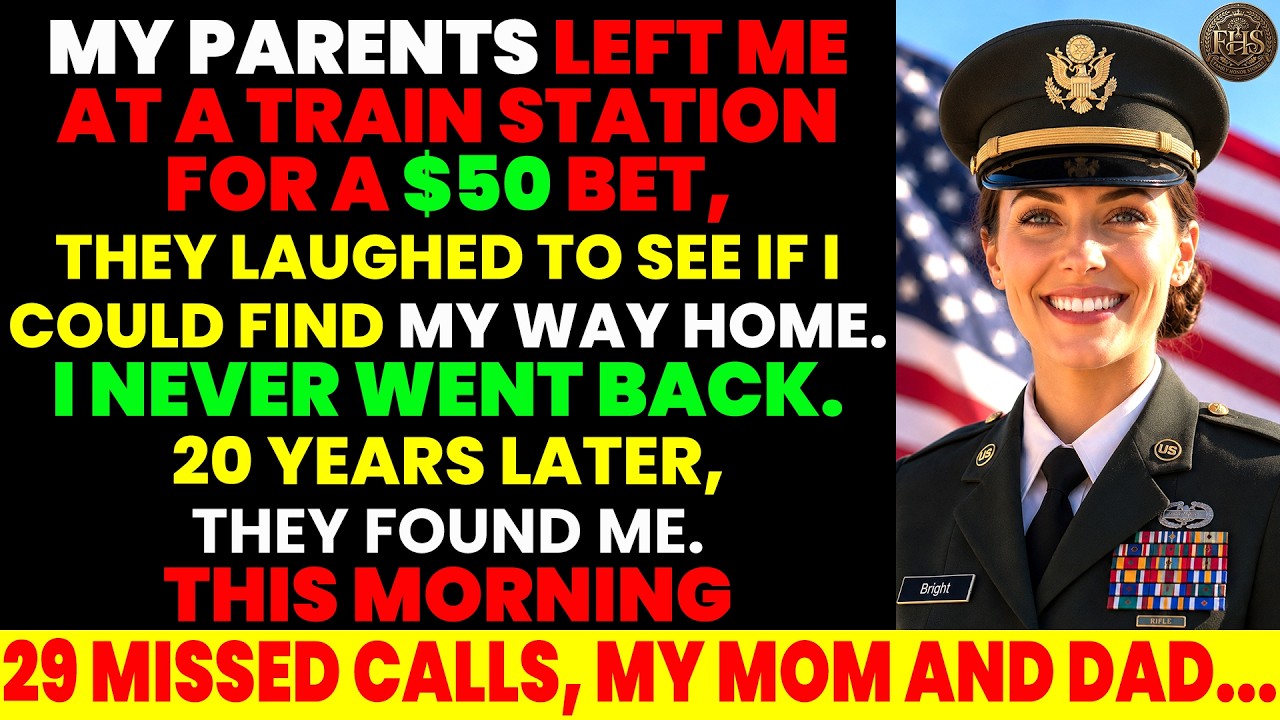
The bedroom was silent except for the clock. I stood at attention in front of the mirror, my Class A uniform crisp and sharp, the brass name tag reading “Bright” pinned perfectly above my right pocket. Army Sergeant First Class Malia Bright. That’s who I became.
That’s who I had to be. Then the phone started buzzing. I picked it up, and the screen was a wall of notifications. Twenty-nine missed calls.
All from Illinois. The area code I hadn’t seen in twenty years. My finger, the same one that never trembled on a rifle trigger, froze above the screen. The air went thin.
I felt the cold sweat break out before I even read the text. The text came from a number I hadn’t saved, but I knew the voice. My sister, Hannah. The golden child.
The one who stayed behind. It wasn’t a greeting. It wasn’t an apology. It was a casualty report.
*Their empire is gone. Come home. *
I locked my jaw. Crying is a liability.
I pressed my hands flat on the desk and forced myself to breathe. I wasn’t going to let them pull me back into that nightmare. Not after everything I’d done to survive. Ranger saved me from that spiral.
My German Shepherd, a retired bomb dog with a jagged half-ear and the kind of hyper-vigilance only combat understands, shoved his nose under my palm and growled at the phone like it was an IED. I dropped to one knee and pressed my forehead into his shoulder. “Stand down, buddy. We’re secure.
”
The panic passed. I stood up. I was calm again. Cold.
Tactical. I didn’t block the number. You never sever the enemy’s communication lines when you don’t know the blast radius. I let them leave voicemails.
I let them text. I gathered intel while they screamed into the void. But you can’t work a case without returning to the scene. So I went back.
Not as Abigail Mercer, the terrified little girl. But to understand what I was facing, I had to dig up the grave I’d been buried in. Willow Creek, Illinois was a picture of perfect suburbia. Manicured lawns, white fences, and my parents, Richard and Eleanor Mercer, playing the starring roles.
Richard ran Mercer Tactical, selling survival gear to middle-aged men who wanted to play soldier. Eleanor gave speeches at the veterans club about discipline and toughness, despite never having served a single day in uniform. They threw backyard barbecues, grilled expensive steaks, and smiled for the neighbors who worshiped them. The moment the front door closed, the performance ended.
The smiles vanished. The air dropped ten degrees. There was no mother and father in that house. There was only a twisted kind of martial law designed to feed their superiority complex.
If I skinned my knee and cried, Eleanor would stand over me with her arms crossed. “A wounded soldier is dead weight. Get up or get left behind. ” If I asked for a second piece of bread, Richard would sneer.
“Greed kills the unit. You eat what you need to survive. Anything else makes you soft. ” They weren’t raising a child.
They were training a punching bag they could legally own. The worst moment came when I was eight. We were at a mall. My sneakers had blown out, the sharp plastic cuff digging into my heel until I was bleeding through my sock.
I asked for a pair of clearance shoes. Just something that wouldn’t make me bleed. Eleanor didn’t answer. She grabbed my arm and dragged me to the food court, shoving me down on a bench next to the trash cans.
“You want to survive? Start by sitting here alone. Nobody owes you a damn thing. ”
They left me there.
For three and a half hours. I sat frozen, biting the inside of my cheek so I wouldn’t cry, because I already knew my tears were their fuel. Hundreds of strangers walked past. I saw the blood on my sock.
Nobody stopped. When they finally came back, they had shopping bags. Expensive clothes. An iced coffee.
No shoes. Richard pulled out a crumpled twenty-dollar bill and tossed it at Eleanor’s chest. “You win. I called it completely wrong.
I figured the little rat wouldn’t have the guts to move an inch. ”
I wasn’t a daughter. I was a prop. My isolation and pain were just a parlor trick, entertainment for a Saturday afternoon.
After that, I learned to turn invisible. I walked on the edges of my feet so the floor wouldn’t creak. I kept my head down. The only place I could breathe was under my bed, where I drew with charcoal pencils.
I drew falcons and tired, kind soldiers, not men like my father. My art was my only air supply. When I was twelve, my art teacher submitted a drawing of mine to a state competition. I got a perfect grade.
My stupid, desperate twelve-year-old brain thought it was currency. I thought a state-level achievement would earn me one warm look. Just one moment of peace. I left my report card and the drawing on the dining table.
Eleanor saw the C in physical education first, then the drawing. Her face tightened. She ripped it down the middle. Then again.
She crumpled it into a ball and threw it at my chest. “This isn’t a daycare. Art is garbage. ”
Richard walked in, nudged the crumpled paper with his boot like it was dog waste.
“You are embarrassing the Mercer bloodline. We need to scrub this trash out of your head. ”
That night, I taped the drawing back together on my bedroom floor. But I heard them whispering downstairs through the air vent.
“She needs a field exercise,” Eleanor said, her voice carrying a sickening thrill. “Something she will never forget. Something to break this habit. ” I heard the ice clink in a glass.
A toast. The next morning, it was all calm. No screaming. Bacon frying.
Richard told me we were taking a sudden trip to Chicago. I believed it was an olive branch. I was so desperate for safety that I climbed willingly into the back of his black SUV. The child safety locks clicked.
The door handle went dead. My stomach dropped. I was in a cage with no handles on the inside. Eleanor turned around in her seat and started firing.
“You think you’re special? You are meat. You are prey. When the wolves come, do you think your little drawings are going to save your life?
” I sat there for an hour and a half, absorbing every word. We pulled up to Chicago Union Station. “Out! ” Richard barked.
I followed Eleanor through the brass doors into a massive, freezing hall. Thousands of people moved in every direction. I stuck to her heel, terrified of being swallowed by the crowd. She stopped at the dead center of the hall, by a concrete pillar.
“Stand exactly right here. Hold this position. We will be back in twenty minutes. ” She leaned in.
“Do not move. Do not talk to anyone. And do not embarrass me by crying. ”
I nodded.
They walked away. Within ten seconds, they vanished into the crowd. They didn’t look back. An hour passed.
Two. I stood frozen, my back pressed to the cold pillar, my teeth chattering. The deadline came and went. I didn’t know what to do.
Moving meant disobedience. Disobedience meant a backhand. I was completely trapped in her rulebook. I watched normal families walk past, fathers holding their daughters’ hands.
I was a ghost. Then I saw it. A black SUV crawling along the street outside, the Mercer Tactical decal catching the light. Relief flooded me.
They came back. The exercise was over. I pressed myself flat against the glass and waved frantically, jumping on my toes. The SUV didn’t pull over.
The passenger window rolled down. I saw my parents staring directly at me. Not frantic. Not relieved.
Richard had a sick, satisfied smirk on his face. The look of a predator watching a deer step on a landmine. Eleanor leaned out the window. Her voice cut through the glass like a rusted ice pick.
“I bet you 50 bucks you don’t have the survival instincts to find your own way home. ” She threw her head back and laughed. Richard flashed me a slow, mocking thumbs-up. Then he hit the gas and disappeared.
The world stopped. They didn’t forget me. They didn’t lose me. They threw me away.
And they loved every second of it. My entire life was just a fifty-dollar bet to kill an afternoon. My legs gave out. I stumbled backward into the crowd.
I was a ghost again, too terrified to talk to anyone, too brainwashed to ask for help. I’d been taught that police meant trouble, that strangers meant predators. They had alienated me completely, then dumped me in the middle of a transit hub where a stranger was the only thing that could save me. It was a perfect trap.
I finally collapsed in a dark alcove. I bit my lip until I tasted blood. I refused to cry. A shadow fell over me.
I braced for a backhand. Instead, a woman crouched down to my eye level. Her uniform was crisp. Her name tag read “Gonzales.
” Officer Maria Gonzalez. She didn’t grab me. She didn’t demand answers. “Have you eaten anything today, sweetheart?
”
That simple question broke the seal. Twelve years of reinforced concrete cracked. I sobbed, and the whole truth spilled out. The SUV.
The window. The fifty-dollar bet. Officer Gonzalez didn’t judge me. She led me into a back security office and pressed a cup of hot chocolate into my hands.
A Chicago detective, Officer Thomas Reed, pulled up the surveillance footage. He watched the SUV slow down. He watched my mother lean out the window. He watched them speed away.
His face went cold. He wasn’t seeing strict parenting. He was seeing monsters playing with their prey. He called my parents.
I heard Eleanor answer: “Is she crying? Tell her the exercise isn’t over until she figures out the train schedule. ”
Officer Reed slammed his hand on the desk. “Leaving a twelve-year-old girl alone at a major transit hub to win a bet is child abandonment.
You have exactly one hour to get down here before I issue warrants for your arrest. ”
Forty-five minutes later, a caseworker took me to an emergency foster placement. That’s where I met Arthur and Evelyn Bright. Arthur was a retired combat photographer.
Evelyn was a schoolteacher. My first night at their house, I dropped my fork on the floor. I instantly locked up, waiting for the strike, the screaming, the punishment. Arthur just picked it up, got me a clean one, and sat back down.
He didn’t make a big deal of it. In that silence, I realized the difference. Discipline in a soldier protects people. The discipline my parents practiced was just a weapon to crush the weak.
A week later, I stood in a courtroom. Richard and Eleanor sat at the defense table with a high-priced corporate lawyer. He called their stunt “an advanced independence protocol. ” He spoke for ten minutes about rugged traditional values.
Judge Vance let him finish. Then he picked up his gavel. “This court finds the actions of the Mercers to be deliberate, premeditated psychological abuse. Your options are a state-monitored family therapy program and unannounced visits for the next three years, or you can voluntarily relinquish your parental rights today.
”
The courtroom went silent. This was the moment. They would fight for me. They would say they went too far.
Eleanor didn’t blink. She gave her lawyer a single sharp nod. Richard signed the form without hesitation. They chose the business.
They knew a state-monitored abuse program would leak, ruin their image, tank Mercer Tactical. They sold me out to protect a brand. Judge Vance looked at me. “Abigail, is there anything you want to say?
”
I stood up. I looked at those two people. They wouldn’t even meet my eyes. “No.
”
That was the last word Abigail Mercer ever spoke. I became Malia Bright. Arthur bought me better charcoal pencils and taught me that drawing wasn’t a hole to hide in; it was a tool to record the truth. I took that weapon to an army recruiter.
I became a visual information specialist, turning chaotic data into tactical intelligence. I sealed off Illinois completely and built a fortress out of iron discipline. I thought the nightmare was over. But trauma doesn’t vanish because you put on boots.
It waits. Five years ago, my husband David asked me to wait by the ice machine at a grocery store while he grabbed coffee. Ten minutes passed. I couldn’t move.
My hands went cold. The linoleum turned into the limestone of Union Station. I was a thirty-year-old decorated NCO, suffocating in a safe place because someone told me to stand still near an exit. David came back.
He saw my rigid spine and my white knuckles. He didn’t roll his eyes or tell me to toughen up. He took my frozen hands and said, “I’m right here. Stand down.
The order is canceled. ”
We adopted Ranger the next month. We both had scars. We both chose to protect people worth protecting.
So when the text came and the voicemails piled up, I didn’t shake. I listened. My sister Hannah’s voice came through the speaker thin and broken. She explained it all.
Eleanor was dying of pancreatic cancer. Richard had a stroke and dragged his left leg. But the real killer was their arrogance. Eleanor posted a condescending rant about parenting online.
Aunt Linda exposed the fifty-dollar bet. A court clerk leaked the case files. A former employee tore down Richard’s corporate image. The veterans club cut ties.
The boycott started. Mercer Tactical went bankrupt. And Hannah, the golden child, finally read the court documents and realized what they were. She looked at her three-year-old son and legally cut them off completely.
Richard and Eleanor lost the house. They were living in a cramped apartment over a laundromat. No money. No status.
No power. They weren’t calling to apologize. Narcissists don’t feel remorse. They feel consequences.
They were calling because they were cornered and terrified of dying alone. They expected me to play the forgiving daughter and bail them out. I didn’t return the call. I powered off the phone.
I pulled out my Class A uniform. I wasn’t flying back to Illinois as a daughter. I was going back to clear the final minefield. I parked in the cracked asphalt lot of a decaying strip mall.
Apartment 4B. The smell hit me first: cheap antiseptic, stale smoke, human decay. I stepped over the threshold. Richard sat slumped in a wheelchair, his face sagging from the stroke.
Eleanor lay in a hospital bed, her skin waxen, her hair gone. She forced a weak, trembling smile. “Abigail. My baby finally came home.
”
I didn’t move. “I am Malia,” I said. “Sergeant First Class, United States Army. ”
Richard tried to rally.
“We made some mistakes. You don’t turn your back on blood over a mistake. ”
I tilted my head. “A mistake is reading the wrong coordinates.
Forgetting to set a parking brake. Driving a twelve-year-old girl to a major transit hub, abandoning her, and gambling on her life is not a mistake. It is a calculated attack. ”
Eleanor started crying.
Ugly tears. For herself. “Please. We have nothing left.
You have a job, a house. You have to take us with you. We are your parents. You owe us.
”
I let my hands drop to my sides. I took a slow breath. I’d been keeping this round in the chamber for twenty years. “You bet fifty bucks I didn’t have the survival instincts to find my own way home.
I did. I just used those instincts to make sure I never came back to your hell. ”
I turned and walked to the door. “Is this it?
” Richard croaked. “Is this goodbye? ”
I grabbed the doorknob. I didn’t look back.
“I said goodbye twenty years ago. ”
I stepped out. The deadbolt clicked behind me. The Illinois air was sharp and clear, burning the stench of that apartment out of my lungs.
I stopped next to my rental car and looked at my hands. They were shaking. But not from fear. Not from cold.
It was the rush of pure release. A lifetime of tension bleeding into the frozen concrete. I was free.