The morning my sister called to tell me our father was dead, he was sitting three feet away from me, stealing bacon off my plate. It was 6:30 in the morning. I put the call on speaker. My sister Simona’s voice came through cold as a bank statement.
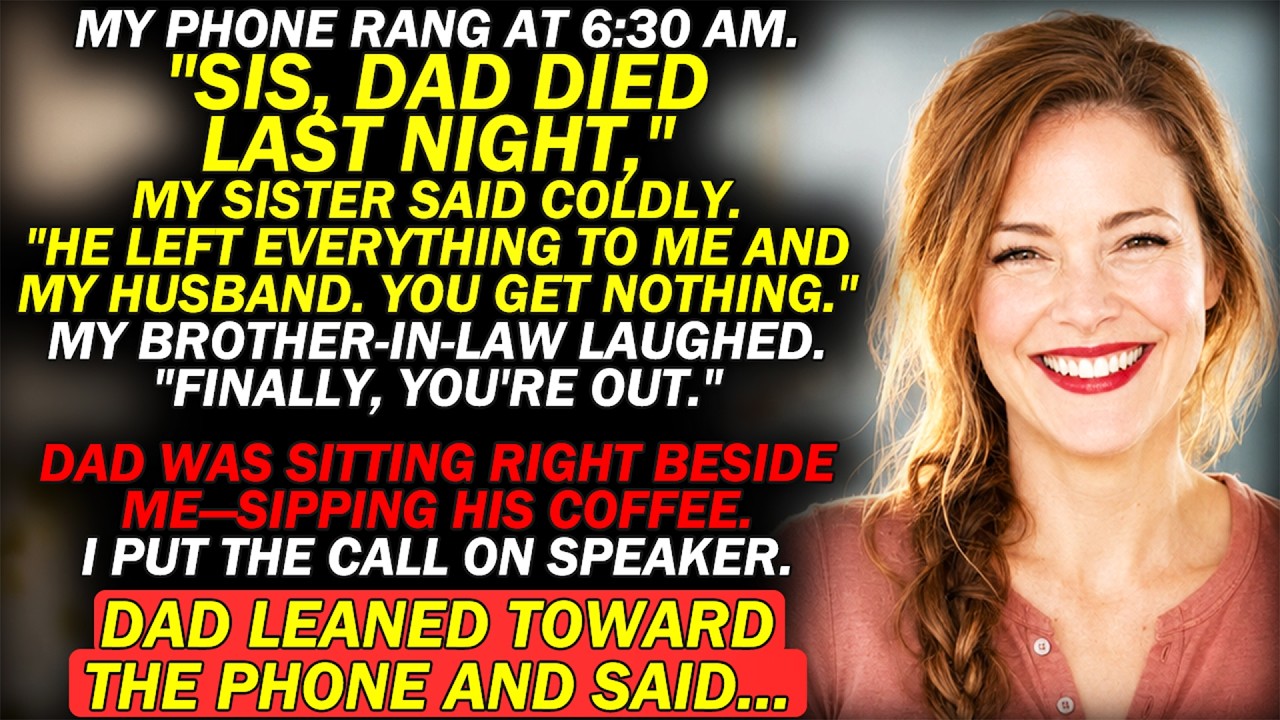
“Dad died last night. He left everything to me and my husband. You get nothing. ” Behind her, my brother-in-law Braden laughed.
“Finally, you’re out. ”
My father set down his coffee, leaned toward the phone, and said something I’m not going to repeat yet. Simona didn’t get to hear it that morning. She’d hear it exactly where she finally did.
But here’s what none of them knew: the funeral they were already counting money over was happening that Sunday. Dad had picked out the flowers himself. Lilies. My mother hated lilies.
He said she wouldn’t mind missing this one. Nine months earlier, in October of 2025, my biggest worry was a night-shift schedule. I’m a registered nurse, working travel contracts out of Columbus, Ohio. Thirteen weeks here, thirteen weeks there.
Travel pay is how a girl from Cedar Falls kills off her nursing school loans before she turns forty. My father thought the whole arrangement was hilarious. “You drive three states to give strangers their pills,” he’d say, “and I can’t get you to change my furnace filter. ”
That was Moses Dawson, seventy-three years old that fall.
Army from 1970 to 1974. He came home, turned wrenches for other people until 1981, then opened Dawson’s Garage on Route 9 and ran it for thirty-six years. He sold it in 2017, retired at sixty-five, and moved exactly nowhere. The same house on Maple Ridge Road he and Mom bought in 1984 and paid off in 2009.
He wasn’t rich. He was paid-off rich. Small-town rich. The kind of rich that doesn’t show up in a man’s shoes but shows up later in a courthouse.
Mom, Carol, died in March of 2023. Dad grieved the way he fixed engines: quietly, daily, without asking anyone to watch. Every Saturday night he wound the little brass clock she kept on the mantel, because Carol always said a stopped clock made a house feel dead. He cooked.
He drove his 1978 F-150 that he’d restored bolt by bolt. He called me every Sunday and I called him. We were fine. Everyone was fine.
Then on a bright October afternoon, my seventy-three-year-old father climbed a ladder to clean his own gutters because asking for help was never going to be his best event. He fell eight feet and landed wrong. Broken right wrist, the kind that needs a small surgery. Plates and pins.
Six to eight weeks of healing. Not a tragedy. An inconvenience with hardware. I was mid-contract in Texas, and I still made it to the hospital in Cedar Falls within forty-eight hours, because that’s what you do.
When I walked into his room, my sister Simone was already there with flowers. Her tears were arranged as carefully as the flowers. Her husband Braden was shaking the surgeon’s hand like he was closing on a duplex. Braden sells mortgages.
He has a voice like warm syrup and a handshake he practices. “You fly back to your patients, Amber,” he told me, squeezing my shoulder. “Family takes care of family. ”
At the time, it sounded like kindness.
It took me months to hear it for what it was: a man assigning himself the keys. I did ask questions before I left. I’m a nurse. Discharge plans are my native language.
I asked to see Dad’s paperwork, his follow-up schedule, his medication list. Braden smiled and said it was all handled, all filed, all at the house. Simone said, “We’ve got this, sweetie. You’re so far away.
”
Dad, doped and cheerful in the bed, gave me a thumbs-up with his good hand. “Go on, kiddo. I’m surrounded by professionals. ”
So I flew back to Texas.
I want to be honest with you about that, because it matters later. I didn’t leave because I didn’t care. I left because the two people standing closest to him kept telling me everything was handled. And one of them had already decided exactly how handled things were about to get.
Dad moved into Simone and Braden’s place that November, fifteen minutes from his own house. “Just a few weeks,” they said, “until the cast comes off. ”
And here is where the first paper appeared, the honest one. His right hand was in a cast.
He couldn’t sign checks. He couldn’t drive. So Braden brought in a notary, and Dad signed a limited power of attorney. Bill paying only, with his clumsy left hand.
I want you to hear me clearly. That document was legal, reasonable, and boring. Your own mother would have signed one. I would have.
That’s what makes this kind of thing work. It never starts with a crime. It starts with a favor. Simone posted a photo that week.
Dad at her kitchen table, soup in front of him. Caption reading, “Blessed to care for my daddy. Family is everything. ” Two hundred likes.
Half of Cedar Falls commented heart emojis. Meanwhile, on a Sunday call, Braden was walking me through their plans and referred to the house on Maple Ridge—the one my parents paid off—as “the asset. ” Dropped casually, the way you’d say “the weather. ” I noticed it.
I even said, “You mean the house? ” And he laughed and said, “Realtor brain, sorry. ”
Dad noticed things too. He told me much later.
He noticed Braden brought the power of attorney papers to his bedside instead of the kitchen table. He noticed the pen was already uncapped. But his wrist ached, the pain pills made everything feel like a matter for tomorrow, and the paper said what it said: “Bills only. ” He read it twice and signed.
It was the last thing they ever showed him before asking him to sign it. Then the wall went up one polite brick at a time. My Sunday calls started landing on Simone instead of Dad. “He’s napping.
He’s tired, hun. I’ll tell him you called. ” Three weeks straight, I didn’t hear my father’s actual voice. His old flip phone broke.
So I bought him a smartphone, set it up myself, loaded my number, and shipped it to Simone’s house. The package went missing. I shipped a second one with tracking. Delivered, said the email.
“Oh, that,” Simone said. “Dad didn’t want it. You know how he is with technology. ”
My father rebuilt a carburetor the year he turned seventy.
He is not afraid of a telephone. I knew something was off. I want that on the record. I asked to talk to him directly.
I offered to schedule a video call. I asked which doctor was following his wrist so I could call the office. Every single time I hit the same soft wall. “He’s resting.
We’ve got it. Why are you being like this? ”
Here’s the thing nobody tells you about situations like ours. When a grown man is legally competent and his caregivers say he’s fine, a daughter two states away has no lever to pull.
There’s no agency you call because your sister keeps answering the phone. I was a nurse under contract, thirteen weeks locked, with loans to pay. And the only two witnesses inside that house kept smiling at me through it. Simone ended one of those calls with a line I’ve never forgotten.
“You chose your career, Amber. Let the people who stayed handle it. ”
I flew home for Christmas anyway. And at that dinner table, my father’s chair had been moved to the corner.
Christmas of 2025. Dad had just turned seventy-four that December, and the cast was off. But something else had been fitted onto him. A smallness.
He sat in the corner of Simone’s living room while she answered questions aimed at him. “Dad, how’s the wrist? ” “It’s healing great, isn’t it, Daddy? ”
He was thinner.
Quieter. His coffee was decaf, “doctor’s orders,” though no doctor of his had ever said so. I got him alone for ten minutes on the back porch, both of us pretending we needed air in thirty-degree weather. He looked at me sideways with the old spark and said, “My checkbook’s been on a diet, kiddo.
”
I asked what he meant. “Statements used to come to the house on Maple Ridge. Now everything was paperless, and the passwords lived with Braden. ” He’d asked to see the accounts twice.
Both times Braden clapped him on the shoulder and said, “That’s what you got me for. ”
I went back inside and asked Simone calmly, in the kitchen, if we could all sit down after the holidays and go over Dad’s finances together. Braden materialized like he’d been summoned. “Family doesn’t need lawyers, Amber.
Unless you’re accusing somebody. ”
Notice the move. I asked about statements. He introduced the word lawyers.
Then Simone started crying right on schedule about everything she does—about how nobody appreciates the person who stayed. And my father, because he is decent, and because decent men make soft hostages, patted my arm and said, “I’m fine, kiddo. Don’t start a war at Christmas. ”
On January sixth, I signed another thirteen-week contract in Texas.
I’ve signed a lot of paperwork in my life. That was the most expensive signature of mine you’ll hear about tonight. By February, the Sunday calls had gone from scripted to screened, and I’d had enough. I took four days off between shifts, told nobody, and flew home.
My little ambush of love. Simone opened her door, surprised, and recovered fast. “Oh no, you just missed him. He’s on an overnight fishing trip with the VFW boys.
Bad timing, sweetie. ”
Fishing in Ohio in February. I drove to Dad’s house on Maple Ridge and stood in the yard a while. Grass gone shaggy under the frost.
Mailbox stuffed. Curtains shut tight. A house holding its breath. On the way out of town, I stopped for gas and ran into Earl Prescott.
My father’s oldest friend, seventy-five years old, ran the Prescott Funeral Home for four decades before his sons took it over. Buried half of Cedar Falls with his own hands and cried at most of them. Earl looked at me strangely. “Moses hasn’t been to a post meeting in three months, honey.
We figured he moved in with you. ”
Not on a fishing trip with them. Not at meetings at all. I called Simone from the gas station lot.
She didn’t even pause. “Oh, it’s not the VFW crowd. It’s his other buddies. You don’t know them.
”
A lie stacked neatly on a lie like cordwood. I flew back to Texas with my stomach in a knot. Three days later, Simone texted me a photo. Dad in an armchair, smiling thinly, holding that day’s mood hostage.
“Dad’s doing great. Stop checking up on us. ”
I stared at that picture a long time. There was a detail in it, small, ordinary, right there in the background, that I wouldn’t understand for another five months.
When I finally did, it changed how I saw every photo she’d ever sent. My contract ended the first week of May 2026, and I came home to Columbus with a plan to drive to Cedar Falls unannounced and refuse to leave without seeing my father. The phone rang before I’d unpacked. June Hetler, a nurse I’d worked med-surg with years ago.
Fifty-eight, sharp as a lancet, the kind of woman who notices everything and forgives most of it. She’d taken a job at a long-term care facility called Crest Haven Manor, out near the Indiana line, a hundred and seventy miles from my kitchen. Her voice was careful. “Amber, there’s a resident here came in back in March.
He asks every nurse on every shift if they know a nurse named Amber. Says she’s his daughter. ”
I couldn’t speak. June kept going, gentle, professional.
“His name is Moses Dawson, honey. Is that your father? ”
I stood in the middle of my kitchen with my keys still in my hand. Nobody had said the words nursing home to me.
Not once. Not in any call, not in any text. As far as I’d been told, my father was eating pot roast fifteen minutes from his own house. June said one more thing before I hung up, and it’s the thing that put me in the car.
“Amber, he doesn’t present like a placement. He presents like somebody misplaced him. ”
I didn’t call Simone. I didn’t call Braden.
There are conversations you have by phone, and there are conversations you have in person, in daylight, with paperwork. I got in the car. Three hours of highway, and I spent every mile of it being a nurse, because being a daughter would have put me in a ditch. Crest Haven Manor sat off a county road behind a sign with two burned-out letters.
Inside, the smell hit first. Cheap disinfectant over something older. A call light blinking down the hall with nobody moving toward it. A television talking to a row of empty chairs.
I counted staff the way I count on every unit I’ve ever walked. One aide for a wing that needed four. The medication cart parked and locked at eleven in the morning, with the nine o’clock meds still signed out as pending. I don’t say any of this to shame the aides.
Understaffed people can’t pour from an empty building. I say it because my father had been living in it for ten weeks while my sister posted about family being everything. He was in a shared room at the end of the east hall, second bed by the window that didn’t open. My father, Moses Dawson, who once carried an engine block across a shop floor out of pure stubbornness, was maybe fifteen pounds lighter, gray stubble on his jaw, wearing a shirt I didn’t recognize that fit him like a borrowed apology.
But his eyes came up when the door opened, and his eyes were his eyes. Sharp. Whole. Present.
He looked at me a long second, and what he said first broke me worse than tears would have. “Took you long enough, kiddo. They told me you knew. Told me you signed off on it.
”
They hadn’t just hidden him from me. They’d hidden me from him. And told each of us the other one had agreed to all of it. We spent an hour untangling seven months of careful lying, and every knot had the same two sets of fingerprints on it.
His flip phone hadn’t broken. Simone took it “to protect him from scam calls. ” My smartphones never reached him—he’d never heard about either one. My letters, and I’d sent four, never made it past whoever collected the mail.
Back in March, Braden told him they needed him out of the house for two weeks. Just two weeks, while they repaired the guest room floor. The two weeks came and went. When Dad pushed, Braden’s answers got shorter.
And then one day, the answers were a hallway at Crest Haven and a roommate named Gus who yelled at the ceiling after dark. Through all of it, they’d told him I knew. That I was too busy. That the nurse couldn’t be bothered with her own father.
He kept a torn corner of an envelope in his wallet with my old cell number on it in pencil, the only number they couldn’t cancel. But the hall phone required staff to dial out, and staff at Crest Haven were a rumor. I did what I do. I asked him the date, the month, the president.
I had him count backward from one hundred by sevens, just to see him roll his eyes at me. “It’s Tuesday. I’m in a purgatory. And your quiz is easier than one of Braden’s mortgage pitches.
”
Sharp as ever. There was nothing wrong with my father’s mind, and that fact was about to matter enormously. Then he glanced at the door, lowered his voice, and said the sentence that turned my worry into something colder. “Kiddo, whatever paper they used to put me in here, I never signed a second one.
”
I walked to the front office with my RN license number ready and my nurse voice on. The administrator was a tired man with a tie the color of oatmeal, and he recited the script he’d been handed. Only the responsible party could authorize a transfer, and the responsible party was Mr. Braden Voss, who held power of attorney.
I asked one question. “Does Mr. Dawson have a diagnosis of cognitive impairment on file? Dementia?
Incapacity? Anything? ”
Silence while he clicked. There wasn’t one, because none exists.
My father was admitted as a voluntary placement on paperwork submitted by his POA, with a vague letter about needing support with daily living. A competent adult is not a package in storage. He can discharge himself. Full stop.
I said it politely, and then, because the tie kept opening and closing his mouth, I added, “Or we can call the long-term care ombudsman together and walk through the intake file page by page. I have the afternoon. ”
It’s remarkable how fast paperwork appears when you offer to read it with a state official. Twenty minutes later, my father sat at that desk and signed his own discharge.
Right-handed. Healed. Unhurried. Letters carved clean, the M leaning left the way it has since 1974.
“First thing I’ve signed in six months,” he said to the room. “And it’s a jailbreak. ”
June hugged him at the door and tucked a sleeve of cookies from the staff room into his jacket like contraband. The facility would notify the POA by certified mail.
The administrator said, “Fine. ” I said, “Mail takes days. ”
On the drive home, somewhere past the county line, Dad watched the fields peel by and said quietly, “They think I’m filed away, kiddo. Let’s not correct them just yet.
”
I set Dad up in my apartment in Columbus. My couch pulled out, his blood pressure pills refilled, real coffee. Caffeinated. Doctor’s orders be damned.
Then we went to a bank branch together, because Moses Dawson was still the account holder of record, and an account holder is entitled to his own statements. The printout was eleven pages. He read them the way he used to read a diagnostic report on a wrecked engine. Slow.
Twice. No cursing. In five months, from November through March, $187,000 had left my father’s accounts. $46,000 of it labeled “care expenses,” for a man eating instant potatoes at Crest Haven.
$89,000 wired to something called BV Capital LLC. You can guess whose initials those are. $52,000 to a loan servicer attached to a condo in Florida that Simone and Braden bought in 2022 at the top of the market. $25,000 remained.
A working man’s whole quiet fortune, gone in a season. And stapled behind the statements, a courtesy copy of something worse: a home equity line of credit application on the Maple Ridge house. $150,000. Pending approval.
Signed “Moses Dawson” on April fourteenth. On April fourteenth, my father was a hundred and seventy miles away, asking nurses if anyone knew his daughter. I called Simone that night. One call.
One chance. And I kept my voice level. “Tell me your side. I’m listening.
”
What she said back told me everything about where her heart had gone. “You were never really in this family, Amber. Don’t you dare lecture the one who stayed. ”
So we stopped asking family for answers.
We hired a woman whose entire job is paperwork. Patricia Whitfield, elder law. Sixty-one years old. Reading glasses on a chain and a handshake like a filing cabinet closing.
Her office smelled like toner and lemon drops. She listened to the whole story without moving, then said the sentence that made my father fall professionally in love. “Documents don’t cry, Mr. Dawson.
That’s why I like them. ”
She moved fast, and completely legally. And I want you to hear the order, because this is the part that protects people. First, Dad signed a notarized revocation of every power of attorney in existence, delivered to the bank, the county recorder, and every institution he’d ever touched.
Second, a signature dispute letter to the HELOC lender, which froze that application where it stood. No money had moved yet, which meant the house was still clean. Third, a report to adult protective services and a fraud affidavit with the bank, both of which start clocks that even a smooth talker can’t stop. Then Patricia laid out the problem.
“Civil recovery, I can get. Criminal intent is harder. He’ll say, ‘Dad authorized everything verbally. ’ These men always say that.
”
And buried in the bank’s file was the thing we didn’t have before. A second power of attorney. Full financial authority. Notarized January twelfth.
Submitted in January. The one Dad never signed. Patricia slid it across the desk. “For criminal charges, it helps enormously if they use a forged instrument again.
Somewhere public. Somewhere witnessed. Fraud in a drawer is a lawsuit. Fraud performed for an audience is a conviction.
”
My father studied that page for a long, quiet minute—the loops of a signature that wasn’t his, over his own name. Then he looked up at me and asked me to bring him his army discharge papers. We drove to Cedar Falls on a Tuesday morning, when Braden would be at his office selling somebody a thirty-year promise. My key still fit the back door of the Maple Ridge house.
Some oversights are gifts. Inside, the air was stale in a way that insulted him. The file drawers in the den hung open, picked over. Mom’s suitcase sat unzipped on the guest bed, with her good jewelry box empty beside it.
And on the mantel, Carol’s little brass clock stood dead at some long-gone afternoon, because no one had wound it in seven months. Dad stood in the middle of his own living room like a man visiting a museum of his life. “Seven months,” he said. “The house doesn’t even smell like mine anymore.
”
Then he went to the bedroom and knelt, slow but steady, and pulled his old army footlocker from under the bed. Still locked. The one thing in that house Braden hadn’t cracked. Because to a man like Braden, an old soldier’s box is furniture.
Inside, in order, squared away like it was 1974: his DD214 discharge papers with his true signature, inked when he was twenty-two. The original deed to the house. His medals wrapped in a handkerchief. And a letter, envelope soft with handling, marked in my mother’s round hand: “For Moses, when I can’t say it myself.
”
He didn’t open that one there. He carried the whole locker to the kitchen, set it on the table where every big decision in our family has ever been made, and laid the forged power of attorney down next to his discharge papers. Then my father went very, very quiet. And I have learned to pay attention when quiet men get quieter.
Two pieces of paper side by side on a kitchen table in the house they were both about to save. Fifty-two years apart. The signature on the DD214, 1974. The M in Moses leaning hard left, like a man walking into wind.
The crossbar of the T in Dawson dragging long past the letter. A tail on it. Always. Ink pressed deep.
He signs like he means it. And then the signature on the second power of attorney, dated January twelfth, 2026. Round. Even.
Polite. “Every letter behaving prettier than I ever wrote in my life,” Dad said, tapping it. “Even before the wrist. ”
But handwriting wasn’t the knife.
The date was the knife. I’d already pulled his medical records. He’d signed a release making me his healthcare contact the day after the jailbreak. And on January twelfth, my father was at the orthopedic clinic from nine in the morning until eleven-thirty, having hardware checked under light sedation, initialed in by a medical assistant at every step.
The notary stamp on that power of attorney said it was executed at 10:15 that same morning, at an office twenty miles from the clinic. A man cannot be sedated in one town and signing in another. The paper didn’t just lie. The paper told on itself.
Dad sat back, and something in his face settled. Grief clocking out, and a decision clocking in. “Dead men don’t sign papers,” he said. I asked him what that meant.
“Their notary friend stamped a ghost, kiddo. So let’s introduce them to a real one. ”
Then he opened my mother’s letter at last, and read it alone by the window. When he came back to the table, he only shared one line with me.
“Don’t you let the quiet ones fool you, and don’t you dare go quiet yourself. ”
The certified letter from Crest Haven landed in the Voss mailbox that Friday, and my phone started detonating before noon. Braden, voicemail one, syrup gone, all vinegar. “You have removed an at-risk senior from a care facility without authorization.
That’s kidnapping. Amber, kidnapping. ” A mortgage broker quoting law is a dog quoting the mailman, but I’ll grant him this: he’d learned the vocabulary. Voicemail three threatened an emergency guardianship petition.
Dad was confused, declining, being manipulated by a daughter after his money. Read that sentence again and appreciate the craftsmanship. Accuse the other side of the exact crime in your own pocket. Patricia was serene.
“Guardianship requires an independent medical evaluation. Your father will pass it like a driving test. ” But she didn’t sugarcoat the rest. “A contested guardianship takes weeks, gets loud, smears everyone.
And here’s the real play: it buys time. Time for a frozen HELOC to thaw if the dispute hiccups. Time to move what’s left. Men like Braden don’t fight to win.
They fight to keep the clock running while the money finds the exits. ”
That night, Simone sent me a single text. No greeting. “Dad will choose us.
He always needs the ones who stay. You’ve got a career and an empty apartment. He’ll figure out which daughter actually built a life around him. ”
I read it to Dad, because we’d agreed: no more secrets managed on his behalf by anyone, ever.
He looked at it, then out the window, then said in the mildest voice you ever heard, “She thinks staying close to a man is the same as standing by him. ”
He handed me back the phone. “Call Earl. Tell him I finally need that favor he’s owed me since 1976.
”
He laid it out at my kitchen table at nine o’clock at night, over decaf he poured himself as a joke. “They need me incapacitated or dead to finish this. Guardianship’s their incapacitated play. Slow.
Public. So let’s give them the other option—the one with better catering. ”
I actually laughed. Then I saw his eyes, and stopped.
He meant it. Let them believe he had died. Not a fake death certificate. Not a false report to any agency.
Not an obituary in any paper. He’d thought about the lines and refused to cross them. No government paper. No insurance.
No cops lied to. Just one phone call, friend to family, and a memorial his buddies throw for him. “Lying to liars isn’t a felony, kiddo. I checked twice.
”
The logic underneath was pure Patricia, even though she’d never touched the theatrics. Greed is a reflex. Tell Simone and Braden the man is gone, and they will not pause to grieve. They will produce that forged will and claim the estate in front of God and everybody, because they cannot afford probate questions later.
Using a forged document in public, out loud, to witnesses—that has an ugly legal name, and it comes with handcuffs. They wouldn’t be trapped by us. They’d be trapped by their own paperwork doing what it was always for. I sat with it, and my old habit spoke first.
The one that thinks I’m responsible for every outcome in every room. “If this goes sideways, you’re the one they’ll call crazy. They’ll use it in the guardianship. ”
He nodded like he’d already been there.
“I’ve been called worse by better. ” Then he smiled, and for a second he was fifty again. “We just need a man the whole town believes. Lucky for us, I know the fella who buried half of it.
”
Earl Prescott listened to the whole plan on his back porch, with a coffee going cold in his hand. When Dad finished, Earl was silent about five seconds, which for Earl is a filibuster. Then: “I’ve buried four mayors and one man I truly didn’t care for. This will be my first rehearsal.
”
That’s how the old guard says yes. Understand who these men are. Earl ran the Prescott Funeral Home for forty years. His word on a passing is gospel in three counties.
His sons run it now, but nobody in Cedar Falls would question Earl Prescott calling with sad news, which is exactly why he’d be the one to make the call. One call. Personal, to Simone. Her father collapsed.
He was gone. Every word deniable as a misunderstanding between old men, and none of it anywhere near official. June’s part was even cleaner. If anyone phoned Crest Haven asking after Moses Dawson, she’d confirm only what was true.
“Mr. Dawson is no longer with us here. ” And let a guilty imagination do the heavy lifting. The VFW would host a memorial gathering that Sunday, organized by his post brothers, the way they’ve done for every one of their own for sixty years.
And Patricia? Patricia would know nothing about any theatrics, officially or actually. She’d simply attend a community memorial as a guest, the way small-town lawyers do, with her briefcase, because she never goes anywhere without it. If certain documents happen to be waved around in public, well, she’d be there with the real ones.
Earl asked Dad one final logistics question. “What flowers? ”
“Lilies,” Dad said. “Carol hated lilies.
She won’t mind missing this one. ”
Now, I know some of you are yelling at your screens right now. Just sue them, Amber. We could have.
We’d have likely won in two years, quietly, in a beige hallway. But my father wanted more than his money back. He wanted his town to see who they were with their own eyes, in real time. If you’ve ever watched a smooth talker fool every room he walks into, you know exactly why.
Thursday, seven in the evening. Earl made the call from his porch, with Dad and me listening on speaker three feet away. My father attending the announcement of his own death with his arms crossed, like a man auditing a repair estimate. Earl’s voice did the thing four decades of practice does.
That soft, settling tone that has carried bad news up a thousand front walks. “Simone, honey, it’s Earl Prescott. It’s about your father. He collapsed this evening.
Sweetheart, I’m so sorry. He’s gone. ”
And then we all heard it. The pause.
Three full seconds. And into that pause, my sister did not say, “Where is he? ” Or “Was he in pain? ” Or “Oh God, not Daddy.
” My sister’s first question, breathed out over what I will swear was relief, was: “Where… where was he staying? Was anything with him? Papers, I mean…
papers, I mean… ”
Dad’s face didn’t move. His hand did. Knuckles widening around his coffee cup.
Just once, then easing. Some griefs a man absorbs standing up. Earl, bless him, never broke stride. The post brothers would handle everything, he said.
A memorial Sunday at the VFW hall. No cost to family. As for papers, well, he supposed some lawyer somewhere had whatever there was. Bait floated gentle as a fly on a stream.
Simone said thank you in a voice already three rooms away, doing math. She did not ask to see her father. She did not ask a single question about him, only about what he’d left behind, as if the man were packaging. We found out later, from phone records, what happened twenty-three minutes after that call ended.
Braden dialed the HELOC lender’s office line at 7:41 at night and left a voicemail asking about disbursement timelines. Grief has a schedule, apparently. His runs on business hours. Which brings us back to where I started.
Friday, 6:30 in the morning. My kitchen in Columbus. Bacon in the pan, and my father across the table stealing it. The phone lit up.
Simone. I put it on speaker and set it between us, next to the coffee. You know the words by now. But hear them again, knowing what I knew.
“Sis, Dad died last night. ” Flat. Not one tear in it. “He left everything to me and my husband.
You get nothing. ”
And Braden, close to the phone, wanting me to hear him. “Finally, you’re out. ”
Understand what that call actually was, because it took me a second.
Even then, she wasn’t notifying me of a death. She was serving me an eviction. From the family. From the estate.
From the story. Before I could ask a single question about paperwork, the claim came first. The claim always comes first with them. My father set down his cup without a sound.
He leaned in toward that phone, close enough for the steam off his coffee to fog the screen, and he said something. Quiet. Level. Final.
You haven’t heard it yet, because Simone didn’t. My thumb was resting on the mute button, and it had been since I answered, because we’d agreed the trap needed two more days in the ground. What he said was for Sunday. She’d hear it standing up, in front of everyone.
I made my voice small and said I needed time, that I’d come Sunday to the memorial. Simone’s last instruction before she hung up, and I quote exactly: “Fine, but don’t you bring some lawyer to a funeral, Amber. Have some class. ”
Understood.
They gave us Saturday, and they spent it exactly like themselves. By nine in the morning, Simone had posted a black-and-white photo of Dad to Facebook. “Rest easy, Daddy. Your girl was with you till the end.
” A heart emoji. Two hundred reactions by lunch. Casseroles pledged in the comments. Candle emojis from women who’d known Carol at church.
“With you till the end. ” The end of what? His checking account. And here’s where I finally understood the photo from February—the one she’d texted with “Stop checking up on us.
” Same armchair. Same wall behind him. And on that wall, a clock reading seven minutes past four. The same seven minutes past four as in the new memorial photo.
And the same shirt on my father in both. Every proof of life she’d ever sent me came from one afternoon. One staged sitting, cropped and reserved for months like leftovers. He’d been gone from that house since March.
Her photographs never knew it. While she posted, Braden worked. A neighbor on Maple Ridge, Dotty Crayons, who’s watched that street for forty years, called me confused. A van in Dad’s driveway.
A man drilling out the locks. Saturday. Before any funeral. Changing the locks on a dead man’s house before they’d even buried him.
Patricia added the timestamp of Dotty’s call to a folder that was getting thick. June reported in, too. Someone had phoned Crest Haven, asking for records for “the estate. ” The estate.
The body wasn’t even cold. Mostly because it was at my kitchen table eating a BLT. Dad took in all of it calmly, then spent the evening polishing his good shoes and hanging his one dark suit on the door. “Every man should look sharp at his own funeral,” he said.
Sunday came. Sixty folding chairs. One closed casket. And my sister walked in wearing brand-new shoes, carrying a folder.
The VFW hall on a Sunday afternoon. Flags at the front. The honor board with its brass names. Sixty folding chairs in rows on an old wood floor that creaks confessions out of everybody.
Earl had dressed the room like the professional he is. A casket at the front. Closed. Borrowed from the showroom floor, and nobody questions a closed casket at a memorial, because nobody wants to.
A photo of Dad in uniform, 1972. Cocky as sunrise. And lilies. God help me.
Lilies everywhere. The whole town came. Post brothers in their caps. Maple Ridge neighbors.
Carol’s church circle with foil-covered dishes for after. Dotty Crayons in her good coat. June slipped in at the back. Patricia sat in the corner, briefcase on her knees like a house cat, bothering no one.
Dad and I were in the storage room behind the stage, through a side door, sightline through the hinge gap, close enough to hear chairs creak. My job was to stand in that dark with my folder of true things and keep my breathing even. I want to be honest. My hands were cold.
His weren’t. Simone entered like a widow in a picture. Black dress with tags freshly off. New shoes.
Tissue at the ready. Crying precisely when observed, and recovering the instant she wasn’t. Braden worked the room in his closer suit, gripping shoulders, accepting condolences like deposits. A folder of his own tucked under one arm.
They took the front row. Of course they took the front row. And at two o’clock, Earl stepped to the little podium, cleared his throat with ceremony, and said the sentence we’d built the whole trap around. “Before we share our memories of Moses, the family has asked to say a few words about his affairs.
”
“His affairs. ” They’d requested it themselves that morning. Lambs volunteering for the spit. Braden took the podium the way he takes everything—like it had been holding his place.
He gripped both sides, bowed his head a beat for effect, and began. “Moses was family, and family honors a man’s wishes. ”
Then he opened the folder and produced it. Cream paper.
Blue backing. A document with weight. “Moses had a will drawn up this past April. In it, he leaves his home on Maple Ridge Road, his accounts, and his truck—everything—to his daughter Simone and to me.
Signed April twentieth, 2026. ”
The room made a sound. Not words. Wood.
Sixty chairs shifting at once as sixty spines straightened. Dotty said the way she says it about late tomatoes and bad men, “Hmph. ” Heads turned toward each other all down the rows, because everyone in that hall had heard Moses Dawson brag about his nurse kid for three decades, and this arithmetic did not add up to the man they knew. Braden should have stopped there.
Braden has never once stopped there in his life. He raised a hand for quiet, found my face in the crowd—I’d slipped out to stand at the back wall minutes before, per the plan—and read the next line slowly, tasting it. “And to my daughter, Amber, I leave nothing, for reasons she knows. ”
For reasons she knows.
He read a dead man’s cruelty to a room full of that dead man’s friends, and he smiled while he did it. And that smile is the most expensive thing that man has ever worn. In the corner, Patricia’s thumbs undid the clasps of her briefcase without hurry. And up at the podium, Earl leaned toward the microphone, gentle as church.
“April twentieth, you said. Strange date for a signature. ”
The side door clicked. I watched sixty people hear it.
Let me hold that door closed one more moment, because you need to know what was on the other side of it the night before. Saturday, near midnight. My kitchen. The plan spread out like an engine gasket set.
My old habit had one last run at us—the voice that says every disaster in every room is mine to prevent. “We can still just hand it all to the police Monday,” I said. “Clean, quiet, no stage. ”
Dad was quiet a while.
When he answered, he wasn’t sharp about it. He was almost gentle. “Simone said, ‘You get nothing. ’ Let’s see what nothing looks like when it stands up and walks.
”
Then he told me the real reason. The one under all the strategy. And I’m going to give it to you the way he gave it to me. “Kiddo, they didn’t steal my savings.
Savings can be rebuilt. I built them once with a wrench. They stole my say. Told the town I needed storing.
Told my own girl I didn’t want her. Told me my own mind couldn’t be trusted. A man’s say is all he’s actually got at seventy-four. And I’m taking mine back in front of everybody they lied to.
”
That was the whole war in one paragraph, standing in my kitchen in his undershirt. So we agreed on the rules of engagement. His rules. No shouting.
No accusations from us. No speeches. I would carry the folder: statements, revocation, medical records, his discharge papers. And we would stand there and let paper do the talking, because paper had been their weapon from the start.
And there is a justice in being beaten by the real thing. Sunday afternoon, 2:17. The hinge gap went bright. My father’s hand turned the knob.
And sixty people were about to attend the shortest resurrection in Ohio history. The side door opened, and my father walked into his own memorial service. Dark suit pressed to a knife’s edge. Shoes like black glass.
The VFW pin on his lapel catching the hall lights. He didn’t hurry. Moses Dawson has never hurried for anyone, and he was not about to start for his own funeral. One measured step, then another, the old floor announcing each one like a drumroll it had been saving up for sixty years.
The room came apart in slow motion. A casserole dish slid off a side table and hit the floor with a crash nobody turned to look at. One of the church women crossed herself twice and sat down hard. Somebody’s oxygen tank whistled.
In the back, June lost the fight entirely and barked one clean laugh before clamping both hands over her mouth. Dotty said loudly, to no one, “Well, I’ll be damned. ” Which, as far as anyone knows, is the first time in her life. Simone did not scream.
Simone stood up, and then simply stopped operating. White as the lilies. Two black tracks of mascara moving south while the rest of her face forgot its lines. And Braden.
Braden froze at that podium with the forged will still raised in his right hand at shoulder height, in full view of sixty witnesses and one lawyer. A salesman photographed mid-pitch by every eye in the room. Dad reached the podium, adjusted the microphone downward with two fingers, the way he used to fine-tune a carburetor. He looked at the casket.
“Nice box, Earl. Little roomy for my taste. ”
Then he turned, found Braden’s eyes, and delivered it mild as morning. “Dead men don’t sign papers, son.
And they surely don’t drink coffee. ”
Braden did what every cornered salesman does. He started selling loudly. “This is a sick joke.
” Braden’s voice cracked across the hall. Syrup boiled off. Nothing left but the burn. “He’s not competent.
Look at him. This is elder confusion. He wandered off from his facility. He’s been manipulated by her.
” And his finger found me at the back wall. “She took him. She’s after the money. This is exactly what the guardianship was for.
”
It’s a remarkable thing, watching a man drown at a podium. Sixty people had just seen my father cross a room like a colonel inspecting a parade ground. And here was Braden explaining that the man was lost and confused. The room did not murmur agreement.
The room went quiet in the specific way an audience does when it has stopped being an audience and started being a jury. Simone lunged the other direction, for sympathy. “Daddy, we thought—Earl said—” And then she spun on Earl, mask slipping sideways. “You lied to me.
You called me. You said… ”
And there it was, in her own voice, in front of everyone. She’d been told her father was dead, and never once asked to see him.
Never called the funeral home. Never asked what happened. Just booked a podium and found a folder. Nobody trapped her into saying it.
Grief that skips the body and goes straight to the paperwork tells its own story. I walked up the center aisle then, unhurried, folder against my chest. And I kept my voice at the level I use for families in waiting rooms. “You were told he collapsed.
You called me at 6:30 the next morning about the will. You never asked to see him. Not once. ”
Behind me, I heard the pastor of Carol’s old church stand, take his coat, and move three rows away from the Voss family pew.
The room was choosing. Then Patricia stood up, buttoned her jacket, and spoke for the first time. “Mr. Voss, may I see that document you just read to the room?
”
What happened next took eleven minutes, and I have never enjoyed paperwork more. Patricia walked to the front table—the one meant for the guest book—and laid out documents one at a time, announcing each in the tone of a woman reading a weather report. One: “Notarized revocation of all powers of attorney, executed in May, on file with the county and every bank that matters. ”
Two: “Orthopedic clinic records, January twelfth.
Mr. Dawson under light sedation, 9:00 a. m. to 11:30, staff initials at every stage.
A power of attorney notarized allegedly that same morning, 10:15, at an office twenty miles away. A man cannot be in sedation in one town and signing in another. ”
Three: “Bank records. $187,000 in five months, including $89,000 to BV Capital LLC.
” She looked up pleasantly. “The B is for Braden. The V, I assume, does not stand for victim. ”
Four: “And a home equity application on the Maple Ridge property, signed April fourteenth, when Mr.
Dawson was residing at Crest Haven Manor, a hundred and seventy miles from the closing pen. ”
Then she turned to the will itself, still in Braden’s hand, dated April twentieth, “when your father-in-law was residing at Crest Haven. Intake logs show he received no visitors that week. So tell the room, Mr.
Voss: who witnessed this will? There are two witness signatures on that document. ”
And one of them belonged to a loan officer from Braden’s own office. And that man was sitting in the fourth row, with a casserole on his knees.
Come to pay respects. He went the color of oatmeal. “You told me it was routine estate stuff, Braden. You said it was a formality.
” His voice cracked in front of everyone. A witness to the forgery, unwitnessing himself live. Braden made his last stand. “Nobody consented to being recorded.
You people set me up. ”
Patricia, mildly: “No one recorded anything, Mr. Voss. You read it into a microphone at a funeral that you scheduled speaking time for.
”
And that is when the hall doors opened, and two deputies from the county sheriff’s office stepped in out of the afternoon light. Exactly on the schedule Patricia had arranged with the fraud unit three days before. Nobody got tackled, and nobody got cuffed in front of the lilies. Real life is quieter than that.
And honestly, quieter is worse. The deputies came up the aisle unhurried, the way men do when the outcome is already filed. And the older one said the sentence that ends a certain kind of man’s whole architecture. “Mr.
Voss, we’d like you to come answer some questions regarding a bank fraud report and some documents. Bank’s already frozen the line of credit and referred it. Won’t take long to start. Bank fraud.
Federal. ”
You could watch it land on Braden and read every stage on his face, because a salesman only has masks, and he went through the whole drawer in ten seconds. Outrage. “This is a family matter.
” The deputies didn’t blink. Charm. “Gentlemen, there’s been a huge misunderstanding. Let’s talk offline.
” Nothing. And then the last mask. The real one. The beggar.
He turned to my father, and his voice did something I’d never heard it do. It went up. “Moses. Moses.
I’m family. I was going to pay it all back. Every cent. It was an investment.
I was growing it for you. For your retirement. ”
My father looked at him the way he used to look at an engine somebody had lied to him about. Calm.
Diagnostic. A little sad at the waste. “You had my checkbook for seven months, son. The only thing you grew was my funeral.
”
The hall did not laugh. It exhaled. Sixty people, one breath. The sound of a town closing a ledger.
Then Simone broke. And I need to tell this part straight, because she’s still my sister. She dropped into the front row chair like her strings were cut. And for one moment—one—the performance stopped, and the actual woman looked out.
“We were drowning, Daddy. ” Barely a voice at all. “The condo, the cards, all of it. Braden said it was temporary.
It was only ever supposed to be temporary. ”
And I believed her. I still do. That’s the tragedy.
It probably did start as temporary, the way a leak starts as a drip. But nobody stays sympathetic for long on that side of the room. And she proved why in the very next breath, wheeling on me with her wet face twisting. “But you made it worse, Amber.
If you’d just stayed out of it, nobody ever had to know. ”
There it is. Not “I’m sorry. ” Not “What did we do?
” Just: we’d have gotten away with it if the family nurse hadn’t checked the chart. I looked at my big sister—the one who taught me to ride a bike, who curled my hair for prom, who called me at 6:30 in the morning to tell me I was nothing. And I gave her the calmest sentence in this whole story. “You called before sunrise to tell me I get nothing.
Sis, I’m the only one leaving this room with everything I walked in with. ”
The deputies moved. Braden went up the aisle between them, still explaining interest rates to men wearing badges. And my father stepped to the microphone one last time.
Put his hand flat on the borrowed casket. And addressed his own funeral. “Folks, I apologize for the dry run. But you needed to see it.
Not because I’m special. Because next time it’s your house. Your kids. Your papers.
Check them while you’re still above ground. ”
The pastor said, “Amen. ” At a memorial for a living man. It remains the proudest church moment of my father’s life.
The parking lot after. Gravel, late sun, two county cars. The deputies were settling Braden into the back of the first one. He was asking about his phone call before the door even shut.
A man already drafting his version. Simone walked to the second car under her own power. Nobody was arresting her that afternoon, but they had questions. And her new shoes kept catching in the gravel.
That expensive click, gone stumbling and arrhythmic. And something about that sound is filed in my memory forever under the word consequences. At the car door, she stopped. And she turned around.
And for the first time that entire day—through the announcement, the will, the resurrection, all of it—my sister looked at our father instead of at what he owned. Dad walked over. Took his time, like always. Stopped about an arm’s length away.
And he didn’t raise his voice, didn’t sharpen it, didn’t perform for the crowd drifting out onto the steps behind us. He simply said to her, at last, out loud, the thing he’d said into a muted phone at my kitchen table on Friday morning at 6:31, with the steam coming off his coffee. “You buried the wrong man, sweetheart. ”
That’s it.
That’s what he’d said with his thumb an inch from my mute button, and what he’d saved two days to deliver in person. Simone’s mouth opened. Whatever was supposed to come out never reported for duty. The deputy closed the door with that soft, terminal government click.
From the other car, through glass, Braden was still going. Muffled. Urgent. “Lawyer.
Misunderstanding. Moses. Moses. ”
I stepped up beside my father and gave Braden back his own words, at the volume you’d use for a toll booth.
“You were right about one thing, Braden. Somebody’s finally out. ”
The cars pulled away. Earl appeared at Dad’s shoulder with two cups of the church lady’s coffee and surveyed the emptying lot with professional satisfaction.
“Best service I ever ran. Ten out of ten. Would bury you again. ”
Dad snorted.
Unpinned the lily boutonniere Earl had insisted on, and laid it on the casket as they wheeled it back to the van. “Give these to somebody who’s actually dead. I’ve got a house to unlock. ”
And that, friends, is how my father attended his own funeral, cleared his own name, and still made it home in time to watch the evening news—which, for once, had nothing on him.
We unlocked Maple Ridge that same evening, with a locksmith of our own choosing, invoice and receipt, because in this family, we keep records now. Dad walked straight past everything Braden’s crew had pawed through. Went to the mantel. And wound my mother’s brass clock first thing, before he’d even taken off the suit.
The tick came back. The house started breathing again. And so, I think, did he. Here’s the ledger, because you’ve earned the numbers.
Braden was charged with two counts of forgery—the power of attorney and the will—plus theft from an elderly person and falsifying a loan application. The state licensing board suspended his mortgage license within the month, and revoked it by fall. Which, in his industry, is a death certificate they don’t hold memorials for. BV Capital LLC was dissolved by the receiver.
Between the bank’s fraud restitution and the clawback from the LLC, my father recovered $141,000 of the $187,000 they took. The HELOC application died frozen. The house was never touched. Patricia moved everything into a living trust with locks on it that Braden couldn’t pick with a law degree—which he also doesn’t have.
Simone took a plea. Her attorney was smart, and her tears were, for once, in front of the right audience. Three years’ probation. Restitution on a schedule.
And three hundred hours of community service, which the judge—who possesses a sense of humor drier than my father’s—assigned her at a nursing home. She empties bedpans on Saturdays, and reads to residents whose families don’t visit. People ask me if I’ve forgiven my sister. I’ll tell you what I told her, through the glass partition at the county probation office, eight weeks later.
She looked smaller at the probation office. No mascara to run. She asked flat, “Did you come to gloat? ”
And I said, “No.
” And meant it. And slid an envelope across to the officer to pass through. A copy of Mom’s letter. The one from the footlocker.
At the bottom, under Mom’s handwriting, Dad had added a line of his own, in pencil. “Your mother said don’t go quiet. That part was for you too. Pay it back, then start over.
—Dad”
Simone read it twice. Something moved in her face that I hadn’t seen since before Braden. And I don’t know what happens to it from here. That’s hers to work out.
What I said through that glass was a boundary, not a bridge. And I gave it to her word for word. “When the restitution’s paid and the counseling’s real, you know my address. Until then, you get exactly what you offered me at 6:30 that morning.
”
She nodded. Understood the terms. First honest transaction we’d had in years. As for the rest of us: Dad’s back at the VFW every Thursday.
And he and Earl started something that’s turned into a small legend in the county. A monthly talk at the post called “Papers While You’re Breathing. ” Two old men, a folding table, free coffee. Teaching people their age how to read a power of attorney, how to spot a signature that’s too pretty, how to make sure the will in the drawer is actually theirs.
Eleven people came the first month. By the third, they were setting up extra chairs. And a woman from two towns over stood up and said the talk had caught her nephew mid-scheme. I took a staff position at a Columbus hospital.
No more thirteen-week states. And every Sunday, I make the two-hour drive, and Dad burns the bacon on purpose, because he claims I like it that way. Turns out presence isn’t a debt you pay off. It’s a habit you keep.
The brass clock ticks on the mantel. And in his wallet, where the torn envelope with my number used to live, my father now keeps one pressed lily. “Best funeral I never had,” he says. My father taught me that the measure of a man was never the number in his account.
It’s whether his say still stands while he’s breathing. And whether the people who love him would rather guard his signature than inherit it. That’s my story. One phone call at 6:30.
One forged signature. And one old soldier who attended his own funeral standing up.