I spent ten days in a coma after a terrible fall down the stairs. When I finally opened my eyes in the hospital, the chair beside my bed was empty. My son was gone. All he left was a crumpled note on the nightstand.
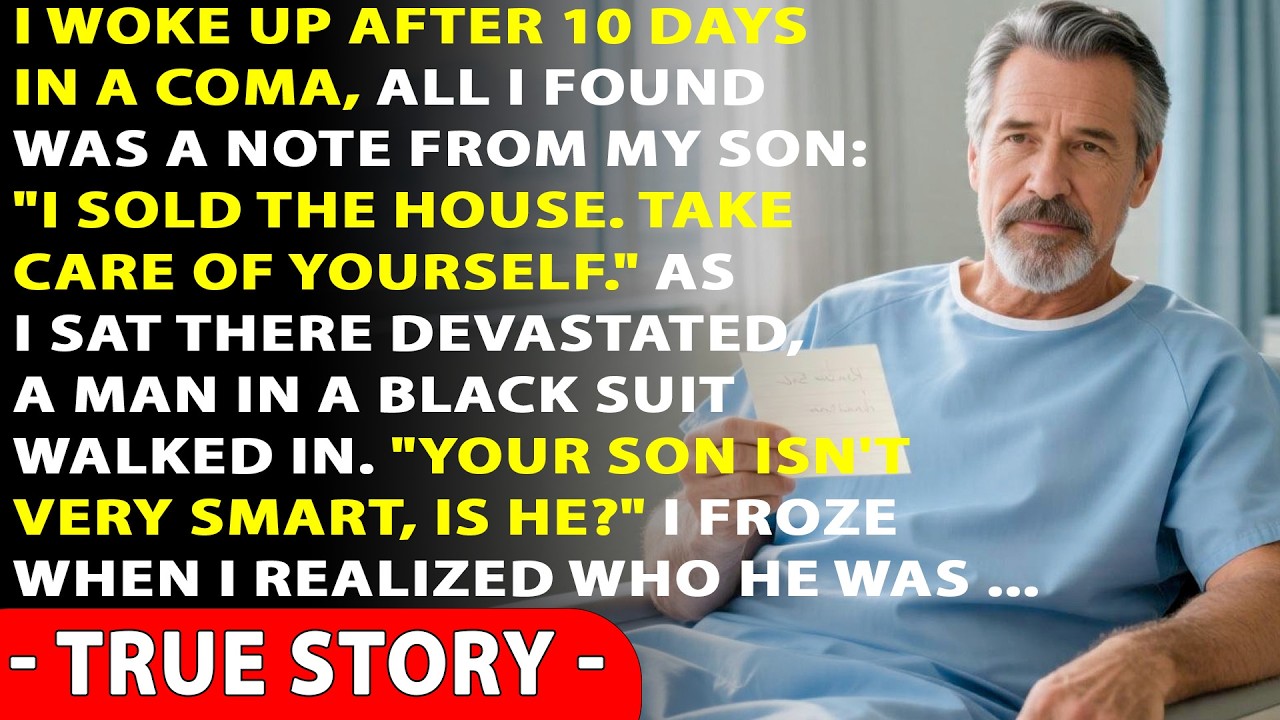
“Dad, I sold the house. You’re nothing but a burden. Figure it out yourself. Don’t call me.
”
I broke down, feeling my whole world collapse. Then three slow knocks came at the door. A man in an expensive suit walked in and said, “Perhaps your son isn’t very smart. ”
I froze when I realized who he was.
The first thing I noticed when I opened my eyes was the smell. Sharp antiseptic mixed with something colder, industrial bleach. It hit the back of my throat before I even understood where I was. The ceiling above me was hard fluorescent white, two long bulbs buzzing with that low, persistent hum.
My body felt like it had been taken apart and put back together by someone who’d never done it before. My chest ached with every breath. My left leg throbbed from hip to heel. An IV line was taped to my wrist.
I turned my head to the left. There was a chair in the corner, one of those hard plastic visitor chairs. It was positioned at just the right angle, just the right distance from the bed for someone to sit and watch over a person lying in it. It was empty.
Something tightened in my chest that had nothing to do with the IV or the aching ribs. I told myself not to read into it. Ryan was probably down the hall getting coffee, talking to the doctor, filling out insurance forms. That was a Ryan thing to do.
Always handling the paperwork, always organized. I’d raised him that way, and I’d been proud of that. But even as I built that story in my head, another part of me, the older, quieter part that had learned not to want too much, already knew. The chair hadn’t been warm in a very long time.
I lay still and let the memories come back in pieces, like broken glass being swept into a pile. I remembered the staircase at my apartment building. I remembered reaching for the railing. I remembered the way it gave, suddenly, like it had been waiting for me to trust it.
I remembered the first impact, the side of my head against the concrete edge of a step. And then nothing. Ten days, the nurse would later tell me. Ten days between that nothing and this ceiling.
I’d worked thirty years in a warehouse on the north side of Charleston, loading and unloading freight in heat that could crack asphalt. I’d walked away from that job with two bad knees, a lower back that complained every morning, and $47,000 in a savings account I’d never touched because I was always saving it for something important. I’d given Ryan everything else. Not in a dramatic way.
I just did what fathers do. I worked the overtime. I skipped the things that weren’t necessary. When Ryan got into college, I sold my truck and bought a cheaper one and didn’t tell him why the money appeared when it did.
When he needed the deposit for his first apartment, it came from a jar I kept behind the canned goods. He never asked about the jar. I didn’t need him to ask. I just needed him to be okay.
So as I lay there staring at that empty chair, I kept rebuilding the story. He’s tired. He’s been here every day. He stepped out five minutes ago.
He’ll walk through that door any second now. That’s when I noticed the piece of paper on the bedside table. It was folded in half, placed beside the plastic water pitcher. Not carefully.
Set down the way you set down something you’re done with. The paper was slightly crumpled, like it had been in a pocket before it ended up here. I recognized the handwriting before I even reached for it. Ryan had always pressed too hard when he wrote.
I used to tease him about it when he was small. “You’re not carving a monument, buddy. It’s just a grocery list. ”
My hand trembled as I reached across and picked it up.
The IV tugged again. I barely felt it. I unfolded the paper slowly, the way you open something when you already suspect what’s inside. My heart was knocking hard against my chest.
The machine beside me picked up the pace. Three sentences. That was all. “Dad, I already sold the house.
You’re nothing but a burden. Figure it out yourself. Don’t call me. ”
I read it once, then again, then a third time, because the words kept sliding off my comprehension.
Nothing but a burden. Thirty years. Two jobs for a stretch of six years when things were tight. The truck I sold.
The jar behind the canned goods. His graduation, when I stood in that crowd with a button-up shirt I’d ironed three times because I wanted to look right for him. Nothing but a burden. The sob that came out of me wasn’t dignified.
It was ugly and raw, and it shook my whole body, and the machine beside me started beeping faster. The door opened. A woman in blue scrubs, middle-aged, a name badge that read Linda, RN. She took one look at me and didn’t ask if I was in pain.
She crossed the room, picked up the box of tissues from the windowsill, and set it on the bed beside my hand. “Is there someone I can call? ” she asked. I looked at the paper still in my hand.
Then I looked at the empty chair. “No,” I said. My voice came out rougher than I expected. “There’s no one.
”
Linda didn’t push. She stood there for a moment, and something in her expression shifted. Not pity exactly, but recognition, like she’d heard those words before. She left quietly.
The door clicked shut. I stared at the ceiling. The fluorescent light buzzed. The machine beeped.
And then, just as the silence became the kind that presses down on you, three knocks landed on the door. Not a nurse’s knock. Three deliberate, unhurried knocks, the kind made by a person who already knows they’re going to come in. The door opened before I could say a word.
He wasn’t a doctor. I knew that the second he stepped into the room. It was the way he moved. Doctors move like they’re solving a problem.
This man moved like he’d already solved it. He was somewhere in his mid-sixties, silver-haired, clean-shaven. The suit was charcoal wool, cut close at the shoulders. His shoes were dark Oxford leather, buffed to a quiet shine.
He carried a black leather briefcase in his left hand. His eyes found me immediately, dark brown, steady. Something passed through them that I couldn’t name. Not pity, not the careful neutrality of a professional.
Something closer to relief, like a man who’d been searching for something for a very long time and had just found it exactly where he hoped it would be. He pulled the visitor’s chair from the corner and set it beside my bed. He sat down, placed the briefcase on the floor, folded his hands in his lap. “Mr.
Carter,” he said. His voice was measured, low. “I’m sorry to intrude. I imagine this is not the morning you’d hoped for.
”
I was still holding the paper. I didn’t bother to hide it. “I don’t know who you are. ”
“No, you wouldn’t.
My name is Harold Bennett. I’m an attorney and the chief administrator of a private estate based here in Charleston. ” He paused just a beat. “I’ve been looking for you for a very long time, Mr.
Carter. ”
I stared at him. “Looking for me? I’m a retired warehouse worker from North Charleston.
I don’t have a will worth reading. I don’t own property anymore, apparently. ” I looked down at the paper in my hand. “There’s nothing to find.
”
Harold Bennett looked at the paper, too. Something shifted in his expression, not surprise, more like a quiet fury held very still. “Perhaps your son isn’t very smart,” he said. I blinked.
The words were so calm, so matter-of-fact. And yet they landed in the center of my chest like a stone dropped into still water. “You don’t know my son,” I said. “No,” Harold agreed.
“But I know what he just did, and I know what he doesn’t know. Those two things are about to become very important. ”
I should have thrown him out. Instead, I found myself watching his hands, still folded neatly in his lap.
No fidgeting. “What do you want? ” I asked. “To tell you the truth,” Harold said.
“All of it. It’s going to take some time. And some of it is going to be difficult to hear. ” He paused.
“But I think you deserve to hear it more than you deserve what’s happened to you this morning. ”
Before I could respond, he asked, “That bracelet you’re wearing, the silver one? ”
My hand moved before my brain caught up, a reflex pulling my wrist slightly toward my chest. I’d worn the bracelet since before I could remember.
It had been on my wrist when the staff at St. Andrews Children’s Home logged me in as a new intake. No one had ever told me where it came from. I’d stopped asking years ago.
I never took it off. “What about it? ” I said. Harold didn’t reach for it.
He just looked at it the way you look at something you’ve been searching for across a great distance. “I’ve seen that bracelet before,” he said quietly. “In photographs. In documents.
In a description written by a forensic archivist who spent fourteen months trying to match a piece of silver jewelry to a family crest. ”
My mouth was dry. “What family? ”
Harold reached down and opened his briefcase.
He drew out a photograph, old enough that the edges had softened and the colors had shifted toward warm sepia. He held it out to me. It was a photograph of a little boy, maybe four or five years old, standing in front of a tall iron gate set into a stone wall. Behind him rose a white three-story house with black shutters and columns across the front.
The little boy was squinting into the sun, smiling. And on his right wrist, clearly visible catching the light, was a silver bracelet. My hand started shaking so badly that the photograph trembled. The bracelet in the photograph was identical to the one on my wrist.
Not similar. Identical. The same narrow gauge, the same small engraved crest, the same slight irregularity on the left side. “That boy,” I said, my voice barely above a whisper.
“Who is that boy? ”
Harold looked at me steadily. “That little boy is you,” he said, “taken in the summer of 1961 in front of your family home. ” He let a beat of silence pass.
“Your real name is not Joseph Carter. ”
The machine beside me beeped. Outside in the hallway, someone laughed at something. A quick, ordinary sound that felt like it was coming from a different planet.
“Then what is it? ” I asked. Harold reached into the briefcase again and removed a thick, official document bound with a dark ribbon. He placed it on the bed beside my hand without opening it.
“Your name is William Ashford,” he said. “And the man standing beside you in that photograph—” he pointed to a tall figure just visible at the edge of the frame, one hand resting on the little boy’s shoulder, “—is your father, Edmund Ashford. He spent the last forty years of his life looking for you. And when he died, he left you everything he had.
”
The room didn’t spin. It just became very, very quiet. I looked down at the document on the bed, at the bracelet on my wrist, at the photograph of a little boy squinting into the sun in front of a house that apparently had his name on it. I don’t know how long I stared at that photograph before I understood what I was actually seeing.
At first my brain looked for the rational explanation. Old photo, similar bracelet. Coincidence. Except it didn’t mean anything.
Except it did. I knew this bracelet the way you know the back of your own hand. I’d worn it for sixty-three years. The bracelet in the photograph had the same imperfection, the same small flaw on the left side where the silver curved just a fraction too tight.
“That’s my bracelet,” I said, my voice like gravel. “That’s exactly my bracelet. ”
“Yes,” Harold said. “It is.
”
“That boy can’t be more than five years old. ”
“Four and a half. The photograph was taken in June of 1961 at the front gate of the family property in the historic district. Your father had just bought you a bicycle for your birthday two months early because he couldn’t wait.
”
Something moved across Harold’s expression. Something old and private and deeply felt. “He was never very good at waiting when it came to you. ”
The words hit me somewhere I wasn’t prepared for.
I swallowed hard. “You keep saying my father,” I managed. “I grew up in an orphanage. I don’t have a father.
”
“You have one,” Harold said firmly. “Or rather, you had one. A very stubborn, very devoted, deeply impossible man who refused to accept what everyone around him kept telling him for sixty-three years. ”
He leaned forward.
“Mr. Carter, what do you know about the name Ashford? ”
“Nothing. It’s a street name.
”
“Ashford Capital Group,” Harold said. “Downtown Charleston, forty-story building on Meeting Street. Glass and steel. The Ashford crest on the lobby floor in black marble.
”
Something flickered at the edge of my memory. I’d driven past that building a hundred times. Everyone in Charleston knew Ashford Capital. Old money.
Real old money. “That’s one of the biggest private equity firms in the state,” I said. “In the southeast,” Harold corrected, without any pride in it, just accuracy. “Founded in 1938 by a man named Edmund Ashford, your paternal grandfather.
Passed to his son, your father, also named Edmund, in 1971. ” He paused. “Your name, your real name, is William Edmund Ashford. You are the only child of Edmund Ashford II and the sole living heir to the Ashford family.
”
The room felt like it had tilted two degrees. Not enough to fall, just enough to make everything feel wrong. “That’s not possible,” I said, my voice cracking. “I’m a warehouse worker.
I drove a forklift for thirty years. I live in a two-bedroom apartment that smells like the neighbors cooking. I am nobody. ”
“Stop.
” Harold’s voice was quiet, but there was steel underneath it. “Don’t reduce yourself to what someone else’s cruelty made you into. You are not nobody. You never were.
And the man who spent sixty-three years refusing to stop looking for you would be very angry to hear you say that. ”
He reached into the briefcase and produced another photograph, this one more recent. A man in his late seventies, sitting behind a large mahogany desk, silver-haired, straight-backed. The jaw, the set of the brow.
The way the corners of his eyes folded. “This is your father, taken about six years before he passed. ”
I took the photograph with both hands. The man in the photograph looked like me.
Older, more worn, but the bones were the same. “He passed away,” I said, my voice breaking. “Two years ago,” Harold said gently. “January 2023.
Heart disease. He was eighty-nine years old. He died in the same house he’d lived in his entire life. The same house you were born in.
”
A sound came out of me that I hadn’t planned. My father had died two years ago. For sixty-three years, while I was driving forklifts and packing lunches and ironing dress shirts for Ryan’s graduation, my father had been alive seventy miles away in the historic district of the same city. “He never found me,” I said.
It wasn’t a question. “No,” Harold said, his voice carrying something that sounded like grief he’d carried long enough that it had become part of him. “He never stopped looking. But no, he never found you.
Not in time. ”
“You said he left me everything. What does everything mean? ”
Harold reached into the briefcase a final time and withdrew a thick, notarized document bound with a dark green ribbon.
He set it on the bed. “It means Ashford Capital Group. It means the family property in the historic district. It means the investments, the trusts, the accounts.
” He looked at me steadily. “It means $950 million, William. All of it. Every cent.
Left to you and only to you. ”
The number landed like a physical weight. I looked down at the crumpled note from Ryan, still half visible on the bedside table. You’re nothing but a burden.
“Tell me about him,” I said, my throat aching. “Please tell me everything. ”
Harold settled back in his chair. “Edmund Ashford was not an easy man.
He was demanding, exacting. But he loved with the same intensity that he brought to everything else. Completely, without reservation. ”
He paused.
“Your mother, Catherine, was a schoolteacher from Beaufort. He proposed three weeks after they met. You were born in September of 1957. Your mother had a difficult delivery.
He told me once that during those hours he’d been more frightened than at any other point in his life, and that when it was over and you were both safe, something in him settled permanently, like a compass finding north. ”
“She passed when I was two,” I said. “My mother. ”
“Yes.
An illness that moved quickly. He was gutted, but he had you. He raised you himself. He read to you every night.
He took you to every baseball game that summer of 1961, even the late ones on weeknights. You used to fall asleep on the drive home, and he’d carry you up to bed rather than wake you. ”
A tear slid down my face. “And then August of 1962,” I said quietly.
Harold’s expression tightened. “Her name was Martha Groves. She’d worked for the family for eleven years, your nanny since birth. Your father trusted her without question.
One afternoon, while he was at a board meeting, she took you from the house. Told the other staff she was bringing you to the park. You never came back. ”
He continued.
“He called the police the same hour. The investigation was extensive. But Martha had been careful. Cash only, a forwarding address that turned out to be an empty lot.
The trail went cold within three days. Everyone told him to accept what had most likely happened. His lawyers advised him to begin estate succession planning. His friends told him that grief needed a resolution to heal.
” Harold looked at me steadily. “He told them all, in language I will not repeat in a hospital room, exactly where they could put that advice. ”
“He kept your room,” Harold said. “Exactly as it was the morning you disappeared.
Your books on the shelf. A drawing you’d made of the two of you still taped to the wall above your desk. Every single week for sixty-three years, I went into that room and placed a fresh flower on your desk. Magnolias mostly.
They grew in the garden, and they were your father’s favorite. ”
My shoulders shook. I broke, not loudly, not dramatically, just completely. Three thousand two hundred and seventy-six Mondays.
Harold had walked into that room and placed a flower on the desk of a child who didn’t know his own name. When I finally pulled myself back together, I looked at Harold with everything I had left. “How did you find me? After all this time, how did you actually find me?
”
Harold’s expression shifted into something more careful. “It starts with a letter,” he said, “delivered to the estate in the spring of 2008. No return address. Written by someone who had spent forty-six years carrying a secret that had become too heavy to die with.
”
“Who? ”
“Martha Groves. Written from a hospice bed in Savannah three weeks before she died. ”
My jaw tightened.
“What did she say? ”
“She confessed everything. She admitted to taking you from the house. She gave the name of the children’s home in North Charleston and the false name she’d registered you under.
Joseph Carter. She said she’d thought about writing that letter for forty years. She said she was afraid of what would happen to her. But she was dying, and dying makes a person recalibrate their priorities.
”
“Did she say why she did it in the first place? ”
Harold nodded slowly. “Money. A man paid her, someone with a business interest in destabilizing the Ashford estate while Edmund had no heir.
We were never able to conclusively identify who. Martha didn’t know his real name, only a cash payment and a phone number that had been disconnected for thirty years. ”
“So you had the letter. But you still couldn’t find me.
”
“The letter gave me the starting point,” Harold said. “St. Andrews Children’s Home, North Charleston, August of 1962. A boy registered as Joseph Carter.
But St. Andrews closed in 1981. Their records had been destroyed in a fire in 1978. There was nothing left on paper.
”
“Then how? ”
“I spent eight years tracking down former staff members. In 2016, I found a woman named Dorothy Reeves. She was eighty-nine years old, living in a care facility outside of Columbia.
She had worked as a junior intake coordinator at St. Andrews from 1960 to 1971. She remembered a child being brought in during the summer of 1962. Not the face.
But she remembered something unusual. The woman who brought the child in was nervous, middle-aged, well-dressed, and insistent about one thing: ‘Don’t take the bracelet off him. Whatever else happens, leave the bracelet. ’”
The air left my lungs.
“Once I had that detail,” Harold said, “I narrowed the search considerably. A man in his late fifties or early sixties, raised in or around North Charleston, with a silver bracelet bearing an unusual crest. It still took three more years. But in February of this year, your name appeared in the Trident Medical Center system.
Emergency admission. Head trauma. Next of kin listed as Ryan Carter. I drove to the hospital that same night.
I saw the bracelet through the glass of the ICU window. And I sat in the parking lot and waited for you to wake up. ”
I exhaled long and unsteady. “She couldn’t even take it off me,” I said roughly.
“Martha. She took everything else, and she couldn’t take the bracelet. ”
“No,” Harold said. “She couldn’t.
And that is why you are sitting here today. ”
I pressed my fingers against my eyes for a moment. When I lowered my hand, Harold was watching me with the careful attention of someone who knew the next part was going to land differently than everything before it. “There’s something else,” he said, his voice shifting.
“Something about Ryan that I haven’t told you yet. ” He reached for his briefcase and set it on his knee. “What I’m about to show you is not the story of a son who panicked. It’s the story of something that was planned.
”
My stomach dropped six inches. “Show me. ”
Harold opened the briefcase with unhurried precision and withdrew a manila folder thick with documents. On the cover in neat black ink, two words: Ryan Carter.
“Let’s start with the money,” he said. He slid a bank statement across to me. I recognized the account number immediately. It was mine.
The $47,000 I’d built over twenty years of double shifts. “Your account shows a zero balance as of March 19th,” Harold said. “Ten days ago, while you were in the ICU. The withdrawals were made in seven separate transactions over five days.
Small enough amounts each time to avoid triggering the bank’s automatic fraud alert. Large enough that the account was emptied within the week. All within a fifteen-mile radius of Ryan’s home address. ”
“He took $47,000 while I was in a coma,” I said flatly.
“Yes. ”
Harold slid the second document across. A real estate transaction record, dated March 18th. Property address: my apartment building on Fernwood Drive, North Charleston.
Sale price $155,000, $70,000 below current market value. Seller: Joseph Carter, represented by Ryan Carter under power of attorney. “A power of attorney is a legal document that requires the signature of the person granting that authority, witnessed and notarized. ” Harold produced the POA document itself, my supposed signature at the bottom.
Beside it, a forensic handwriting analysis report concluding with 94% certainty that the signature was forged. “He forged it, confirmed Harold. “Fabricated the document, found a notary. Forging a power of attorney in South Carolina is a felony.
It carries up to five years in prison. ”
“And the buyer? ” I asked. “Amber Carter.
Your daughter-in-law. Ryan sold your home to his own wife. Using your money as the down payment. The net result is that you woke up from a coma with no home, no savings, and nowhere to go.
”
He reached for the next document. A printed series of text messages, each exchange dated and timestamped. “Amber Carter is a paralegal,” Harold said. “She has working knowledge of property law, estate planning, and financial documentation.
” He pointed to the first message exchange, dated eight months earlier. “This is the beginning of the conversation. ”
I leaned forward and read. “Amber: You need to look at your father’s finances more carefully.
Old men who work that long always have something put away. ”
“Ryan: He’s got some savings. Nothing major. ”
“Amber: It’s not about the amount.
It’s about what you’re entitled to when he’s gone. You’ve been emotionally responsible for him. That counts. Start paying attention.
”
I read the next exchange, then the next. Each one slightly further along the same road. Amber steering, Ryan following. By January they were discussing the apartment’s market value.
By February, Ryan was asking how power of attorney documents worked. “She drove this,” I said, my voice rough and low. “From the beginning, she drove this. ”
“She provided the direction,” Harold said carefully.
“Ryan made the choices. But yes, the architecture of what was done to you financially was built on a foundation that Amber Carter laid brick by brick over the course of eight months. ”
“Is that everything? ” I asked, my voice very quiet, the kind of quiet that has nothing peaceful in it.
Harold reached into the briefcase one final time. He set a USB drive on the table between us. “No,” he said. “It isn’t.
”
Harold picked up the USB drive, crossed to a small desk beneath the window, and opened his laptop. He plugged in the drive. He turned the screen toward me. “Before I show you this, I need to give you some context.
When I discovered that Ryan Carter was employed at Ashford Capital, about four months ago, I hired a private investigator to monitor his activities. The PI flagged something in late February. Ryan had visited your apartment building on two separate occasions within the same week. The second visit was captured on the building’s exterior security camera.
”
He clicked the first file. The footage was grainy but workable. The time stamp read March 10th, 2025, 7:14 p. m.
The angle covered the second-floor landing of my apartment building’s interior stairwell. Ryan walked into frame from the left. He was wearing a gray athletic jacket, dark pants, a baseball cap pulled low. He moved quickly, the walk of a man who knew where he was going and didn’t want to be seen lingering.
He reached the second-floor landing, crouched down beside the stairwell railing. “That railing,” Harold said quietly, “runs along the right side of the first-floor staircase. It’s the one you use every time you climb those stairs. ”
I watched my son unzip the front pocket of his backpack and remove a small screwdriver.
He worked quickly, efficiently. He applied the screwdriver to the base bracket of the railing where the upright post connected to the concrete wall. He didn’t remove the screws entirely. He loosened them enough that the bracket shifted slightly when he tested it with his palm, enough that the railing looked completely normal to anyone walking past, but would give way under any meaningful downward pressure.
He stood. He tested his work one more time, nodded slightly to himself, zipped his backpack, and walked out of frame. The whole thing took four minutes and twenty-three seconds. My hands were gripping the bed rail so hard my knuckles had gone white.
“He knew,” I said, my voice scraped hollow. “He knew about the vertigo. ”
“You’d mentioned it to him multiple times,” Harold said. “You’d asked him twice in the previous month to help you tighten that railing because you’d noticed it was becoming unstable.
He told you he’d get to it. He didn’t get to it. He made it worse. ”
The fury that moved through me was so complete it didn’t feel like anger anymore.
It felt structural, like the ground shifting beneath a building. “Show me the rest,” I said. Harold clicked the second file. Same stairwell.
Different timestamp. March 13th, 2025, 6:47 p. m. Three days after the first footage.
I watched myself walk into frame. It was strange, profoundly and uncomfortably strange, to watch your own body moving through a space three days before your life changed irrevocably. I moved carefully, one hand on the wall, weight shifted slightly inward. I reached the base of the staircase and extended my right hand toward the railing.
Harold stopped the video right there. “I won’t make you watch what comes next. ”
I was grateful for that. I remembered enough.
The railing coming away in my hand. Not gradually. Instantly gone. The support I’d been depending on dissolving in the same moment I’d committed my weight to it.
The world tilting. The concrete edge of the step catching the side of my skull. “What’s the legal designation for what he did? ” I asked.
“In South Carolina, intentionally creating dangerous conditions with knowledge of a specific victim’s vulnerability and with documented financial motive can be charged as reckless endangerment causing great bodily harm,” Harold said. “Depending on the full evidence picture, it could reach as far as attempted murder. ”
“There’s more,” I said. “There’s more,” Harold confirmed.
He reached into the briefcase and withdrew a thick manila envelope with the logo of a national insurance company. “Ryan applied for a life insurance policy. He said the insured party was you. The beneficiary was himself.
He applied for it on February 25th, sixteen days before he loosened that railing. ”
“How much? ”
Harold opened the envelope and placed the policy document face up on the bed. “$750,000.
”
The number sat on the page like a verdict. Ryan had decided that was what my life was worth, and had gone through the administrative process of formalizing that calculation sixteen days before he made sure the railing would fail. “He needed my signature to take out a policy on my life,” I said. “I never signed anything like this.
”
“No. You didn’t. ” Harold produced the signature page. “This is what was submitted to the insurance company as your signature.
” He placed it beside a third sheet, a forensic analysis report concluding that the signature did not match authenticated samples of my handwriting. Confidence level 96. 8%. “Insurance fraud,” I said.
“First-degree insurance fraud in South Carolina carries up to ten years,” Harold said. “Combined with the forged power of attorney, Ryan is looking at multiple felony charges before we’ve even addressed the staircase. Individually, each of these things is serious. Together, they form a pattern.
And patterns are what prosecutors use to establish intent. ”
He reached for the final section of the folder, a printed sequence of text messages spanning from November of last year through early March. I read the early messages I’d already seen. But these continued past where Harold had stopped before.
“Amber, January 14th: The life insurance is the cleanest option. If something happens to him naturally, you collect. No questions. ”
“Ryan: He’s not that old.
He could live another twenty years. ”
“Amber: He won’t if his health keeps declining. You said the vertigo is getting worse. ”
A wave of nausea moved through me so fast I had to press my hand flat against my sternum.
“Ryan, February 3rd: The railing on his staircase is loose. Has been for months. I keep meaning to fix it. ”
“Amber: Don’t.
”
Two words. That was all. Don’t. “And then four days later,” Harold said.
“Amber: Get the policy done this week before anything changes. ”
“Ryan: You think this is actually going to work? ”
“Amber: He uses that railing every single time he goes upstairs. You told me that yourself.
Just make sure it stays the way it is. ”
My vision blurred. Not from tears. From the sheer, nauseating clarity of what I was reading.
This was not panic or desperation or a bad decision made in a crisis. This was a conversation had over dinner tables and in bed at night. They had planned my death the way ordinary people plan a vacation. “She told him not to fix the railing,” I said, my voice barely a whisper.
“She knew. She knew exactly what leaving it loose would do to me, and she told him to leave it. ”
“Yes,” Harold said. “And the insurance policy was her idea.
The text record suggests it originated with her. ”
I set the pages down. My hands were trembling, not with the fine tremor of cold or fatigue, but with the deep, bone-level shaking of someone whose body is trying to process something the mind hasn’t fully accepted yet. “She sat across my dinner table at Christmas two years ago,” I said.
“She brought a pie. I thought she was good for him. I told Ryan I was glad he’d found someone steady. ”
“I know,” Harold said.
And the gentleness in his voice made it worse somehow. I pressed both hands over my face and breathed slow and deliberate. When I lowered my hands, my jaw was set and my eyes were dry and something in my chest had gone very still. “What do we do now?
” I asked. “I can have everything on that table in front of a Charleston PD detective within the hour,” Harold said. “Ryan would be arrested by tonight. Amber likely within forty-eight hours.
” He held my gaze. “That is one option. ”
“What’s the other option? ”
Harold looked at me steadily.
“Ryan works at Ashford Capital. He has worked there for six years, earning a salary from your family’s company, sitting in meetings in a building that bears your father’s name, not knowing any of it. You are the legal owner of that company. You have the right to walk into that building as its rightful head.
If you choose to do that before the police are called, in front of every executive and employee who has watched Ryan Carter build his career on ground that was never his, then Ryan doesn’t just face criminal charges. He faces the complete and public collapse of everything he thought he had, with nowhere to hide and no story left to tell. ”
He paused. “From a legal standpoint, presenting the evidence in that setting before credible witnesses actually strengthens the criminal case.
It creates a documented public record of his response. Prosecutors favor that. It is not justice, William. It is the smarter legal strategy.
”
I reached out and picked up the photograph of Edmund Ashford. “Schedule the board meeting,” I said. “I want every executive in that room. And Harold, not a word to the police until after I walk through those doors.
”
Harold held my gaze for a long moment. Then he nodded once, reached for his phone, and began to dial. I walked out of Trident Medical Center on a Tuesday morning wearing the same clothes I’d been admitted in. A nurse named Linda, the same one who had handed me tissues on the worst morning of my life, had washed and folded them while I was in the ICU.
The morning air hit my face the moment the automatic doors slid open. March in Charleston. Not cold, not warm. I breathed it in slowly, deliberately, the way you breathe when you’ve just been reminded that breathing is not a thing to take for granted.
Harold was waiting beside a black sedan at the curb. He opened the rear door without ceremony. “How are you feeling? ” he asked, like a man who spent ten days in a coma and then spent the next eighteen hours having his entire life explained to him.
“Various,” I said. Harold almost smiled. “That’s fair. ”
The scenery changed as we crossed into the peninsula.
Historic district Charleston, a part of the city I’d driven through a hundred times without ever stopping, always feeling in some vague and unexamined way that it wasn’t meant for me. George turned onto a private lane between two high garden walls. We approached a pair of tall iron gates, black, ornate. A brass plate on the right pillar read simply “Ashford Manor est 1887.
”
The gates opened as we approached. The lane beyond was lined with mature live oaks. At the end of the lane, the house came into view. The manor was three stories, white painted brick, black shutters flanking every window, a wide front portico supported by four fluted columns.
A formal garden stretched across the front, centered on a circular drive and a marble fountain that was running. When I stepped out, I found eight people arranged in two lines flanking the entrance. A woman at the front of the left line stepped forward. “Welcome home, Mr.
Ashford,” she said. “We’ve been waiting a long time for this day. ”
My throat tightened without warning. “Thank you,” I managed.
Harold guided me through the front door into the entrance hall. The first thing I noticed was the floor, black and white marble in a geometric pattern. The second was the photographs. They lined both walls in dark wooden frames, arranged chronologically.
A visual history of the Ashford family spanning more than a century. Edmund as a young man, sharp-eyed. Edmund with a woman I understood without needing to ask was my mother Catherine, laughing at something outside the frame. And then I found it, near the center of the right-hand wall at eye level.
A photograph of a little boy, four or five years old, squinting into the sun, grinning, on his right wrist catching the light, the bracelet. My bracelet. I reached up and pressed my fingertips to the glass very lightly. “He put it there himself,” Harold said from behind me.
“Center of the wall, eye level. He said it was so he’d see it every morning when he came downstairs. He saw it every morning for sixty-three years. ”
I blinked hard against the burning in my eyes.
“Take me upstairs,” I said. “I want to see the rest of it. ”
At the top of the broad, curving staircase, a long hallway stretched in both directions. Harold turned right toward the far end, where the corridor ended at a single door.
A bow of fresh magnolia had been laid across the threshold. Harold stopped in front of the door. “Are you ready? ” he asked.
“Open it,” I said. The hinges didn’t creak. The door swung open smoothly, silently. Someone had oiled those hinges regularly.
Someone had cared about this door for a long time. The scent reached me before my eyes fully adjusted. Old wood and dried paper. Fresh flowers.
Then the room came into focus. It was smaller than I’d imagined. Not a grand nursery, just a child’s bedroom. A single bed against the left wall, neatly made with a navy coverlet.
A wooden bookshelf running floor to ceiling, packed with children’s books. A small desk beneath the window, its surface bare except for a pencil cup, a spelling primer, and placed at the exact center, a single white magnolia blossom in a small glass of water, fully open, completely fresh. And above the desk, taped to the wall with yellowed tape that had been carefully reapplied along the edges, a drawing. Crayon on white paper.
Two figures, one tall, one small, standing side by side in front of a house with four windows and a sun in the corner. Beneath the figures, in the large, uneven lettering of a child who had recently learned to write: “Me and Daddy. ”
My knees went weak so fast I had to put one hand on the doorframe to stay upright. I crossed the threshold slowly and moved to the desk.
I stood in front of that drawing, in front of those two crayon figures. And I understood in a way that bypassed thought entirely that the small figure was me. I had drawn this. My hands had pressed these crayons to this paper.
And he had kept it for sixty-three years. “The flowers,” I said, barely above a whisper. “You placed one every week. ”
“Every Monday morning,” Harold said.
“Your father’s instructions were to keep the room ready, to maintain it as though you might walk through the door any day. I interpreted ‘ready’ to mean alive. A room with fresh flowers in it is alive. A room without them is a museum.
”
“How many times did you walk into this room? ”
“3,276 Mondays, give or take a handful of weeks when illness or travel prevented it, which I made up for the following week. I never missed a month. ”
The sob that moved through me came from somewhere I hadn’t known was there.
Below grief, below loss, below even the anger of the morning. It came from the place where the child lives inside every adult. The place that had spent sixty-three years not knowing it had a father who lit a candle and kept a room ready and never, not once, stopped believing. When I finally lowered my hands, my face was wet and my chest ached with something that was not entirely pain.
I pulled the desk chair out and sat down. “Sit down,” I said to Harold. “Please. ”
He crossed the room and sat on the edge of the bed, the bed I had slept in before everything went wrong.
“You said that Ryan’s actions were planned,” I said. “I need to know what Ryan knew about who I am, about this family, about this house. When did he know? ”
Harold’s expression shifted.
“That,” he said, “is the part of this story that changes everything about how you understand what he did. ”
He reached into the inside pocket of his jacket and removed a single folded sheet. A timeline, printed and annotated in Harold’s neat hand. “Ryan Carter discovered your real identity in January of 2023,” Harold said.
“Two years and three months ago. ” He placed the sheet on the desk in front of me. “And from that day forward, every decision he made was shaped by one question: How do I make sure my father never finds out? ”
The room felt like it had contracted around me.
The faded crayon drawing on the wall suddenly the sharpest thing in my field of vision. “He knew,” I said. The words felt like stones dropping into still water. “He knew who I was.
He sat at my table and called me on my birthday and came to my apartment for Thanksgiving. And he knew. ”
“Yes,” Harold said. “He knew.
”
“Tell me exactly how he found out. ”
“It started with your bracelet. The morning after I first stepped into that untouched childhood bedroom, I did not sleep. When dawn came, Harold was already waiting for me in the study.
He opened the first folder and slid it across to me. Inside was a photograph, a printout slightly grainy, taken from what looked like security camera footage. It showed Ryan, younger looking than I’d seen him recently, standing inside a storage unit, holding something small up toward the light. ”
“Is that your bracelet?
” Harold confirmed. “Or rather, a photograph of it. He took that image on January 14th, 2023. ”
“How did he even find it?
”
“You had it in a tin box in the back of the closet at your North Charleston house. Ryan was helping you sort through some things after you had a mild dizzy spell. Do you remember? You asked him to bring down some old papers.
”
I did remember. The memory surfaced with awful clarity. Me sitting on the couch, head still spinning, telling Ryan which box to grab. I had not thought twice about it.
He was my son. I trusted him. “He found the tin. Inside it was the bracelet and the single photograph of you as a child that Martha had apparently kept and left with you at the orphanage.
He recognized the Ashford family crest engraved on the bracelet. Immediately. He had seen it before. ”
“He’d seen it before,” I repeated.
“Ryan had been working at Ashford Capital Group for four years at that point, a position Amber had specifically encouraged him to pursue after she had researched the firm’s ownership structure and noted the unresolved estate. He was senior vice president of portfolio management. The Ashford family crest appears on the company letterhead, on the lobby wall, on every official document he had handled for four years. He knew exactly what that crest meant.
”
“So he did what a calculating man does,” Harold continued. “He researched quietly, carefully, over several weeks. He cross-referenced the orphanage records with Ashford Capital’s historical filings. He found a reference to Edmund Ashford’s missing son, the open estate, the standing search.
And then he understood. He understood that his own father, the man he called a burden, was the heir to almost a billion dollars. ”
“And instead of coming to you, instead of picking up the phone and saying, ‘Dad, I think you need to hear something,’ he went home that night and told his wife. ”
Harold pulled out a second document, printed text messages.
“The first is dated January 21st, 2023, one week after Ryan photographed the bracelet. ”
I forced myself to read it. “Ryan: Found something. The old man might be worth more than we thought.
A lot more. ”
“Amber: Define a lot more. ”
“Ryan: Try 950 million. ”
“Amber: Are you serious right now?
”
“Ryan: Dead serious. But only if he claims it. We need to make sure he never does. ”
The room tilted.
I gripped the edge of the table, my knuckles going white. My own son. Eight words: We need to make sure he never does. That set into motion everything.
The stolen savings, the forged POA, the sold house, the loosened bolts on a stair railing. “He chose the money,” I said, and my voice broke on the last word. “He chose it over me. ”
Harold reached across the table and covered my hand with his.
“What your son chose, that is on him. What happens next, that is entirely up to you. ”
He reached into the bottom of the folder and set a cream-colored envelope on the table between us. The paper was aged to the color of old honey, and across the front in handwriting I had never seen before were three words: “For my William.
”
“This belonged to your father,” Harold said. “Edmund wrote it in the last week of his life. He asked me to give it to you when you were ready to fight. ”
I stared at that envelope for a long time.
My fingertips hovered above the aged paper, as if the warmth of my father’s handwriting might still be there. “You don’t have to open it right now,” Harold said. “But I need you to understand something. If you want to reclaim what is yours legally, publicly, and permanently, we need to act within the next three weeks.
”
I set the envelope gently to one side, pressing my palm flat against it for just a moment. Then I straightened in my chair. “Tell me everything. ”
Harold pulled a yellow legal pad to the center of the table.
“The DNA results came back forty-eight hours ago from the private laboratory in Columbia. Full genomic match. You are Edmund Ashford’s biological son. That result is notarized, certified, and admissible in any South Carolina court.
The will was filed with Charleston County Probate Court in March 2022, eight months before Edmund passed. It names your biological son, William Edmund Ashford, as sole heir to all personal assets, real property, and controlling interest in Ashford Capital Group. The DNA confirmation triggers immediate activation of the estate transfer. As of forty-eight hours ago, you are the legal owner of Ashford Capital Group, Ashford Manor, and an estate currently valued at $950 million.
”
“And Ryan? ”
“Ryan Carter holds his senior vice president position under a standard employment contract that contains a fraud clause and a morality clause. The moment we present evidence of criminal conduct to the board, that contract is void and he can be removed immediately. No severance.
No appeal period. We have that evidence. The question is how we present it. ”
For the next hour, Harold laid out the architecture of the plan.
The bank statements. The real estate deed in Amber’s name. The forensic handwriting analysis. The USB drive with the security footage of Ryan on that staircase.
The insurance policy with the fraudulent signature. “We do not go to the police first,” Harold explained. “If we go to the police first, Ryan’s attorney files for a stay, freezes the estate proceedings, and we could be tied up in probate court for twelve to eighteen months. While Ryan continues drawing his salary from your company.
We go to the board first. You walk into Ashford Capital as William Ashford, heir and legal owner of controlling interest. You present the DNA confirmation, the will, and the evidence of fraud, in that order, in front of every board member and senior executive simultaneously. Ryan will be in that room.
He attends every Thursday board meeting. ”
“This Thursday,” I said. “This Thursday,” Harold confirmed. “That gives us three days to prepare.
After the board meeting, the Charleston PD White-Collar Crimes Unit will be waiting in the lobby with warrants already in hand. ”
Three days passed like a held breath. Harold had a charcoal suit laid out for me on the morning of Thursday, March 27th. The fabric was fine wool, the color of a storm cloud, and on the breast pocket in silver thread, so small you had to look twice to see it, the Ashford family crest.
“It was your father’s,” Harold said from the doorway. “In the last year of his life, he had it made in the size of a grown man. The son he always pictured coming home. ”
The drive from Ashford Manor to downtown Charleston took twenty-two minutes.
The morning was clean and pale gold. I had driven through this city ten thousand times in my life as Joseph Carter. This was the first time I drove through it as William Ashford. Margaret Holloway, the board member who had been Edmund’s only confidante regarding the search, met us outside the boardroom.
She was a tall woman, silver-haired, sharp-eyed, dressed in charcoal and pearls. When she saw me, she stopped walking. Her eyes went to my face, then to the crest on my pocket. “Mr.
Ashford,” she said, her voice completely steady except for the faintest tremor. “The room is ready. Everyone is inside. ”
The boardroom was long and paneled in dark wood, with a wall of floor-to-ceiling windows overlooking the harbor.
A long expanse of polished walnut surrounded by leather chairs, most of them already occupied. And at the far end of the table, in the chair that faced the door, a man in a charcoal jacket with a blue pocket square was leaning back with the easy posture of someone who believed this room belonged to him. Ryan. He was scrolling through his phone when the door opened.
He looked up with the automatic half-attentive expression of a person expecting a colleague. Then his eyes found me. The phone dropped two inches in his hand. I watched the color leave his face in real time.
I watched his lips part. I watched his eyes dart to Harold, then back to me, then to the crest on my breast pocket. And I saw the exact moment the recognition arrived. “Dad,” he said.
The word came out as barely a sound, cracked and airless. I walked to the head of the table, the opposite end from Ryan, and set both hands flat on the polished walnut surface. I looked at every face in that room one by one. Then I spoke.
“My name is William Edmund Ashford,” I said, and my voice did not shake, “and I am home. ”
Harold began distributing document packets to every seat. Margaret Holloway pressed a single button, and the screen behind me lit up with the first document. The DNA certification.
Then the will, the key clause highlighted in yellow. “My biological son, William Edmund Ashford, as sole heir to all personal assets, real property, and controlling interest in Ashford Capital Group. ”
Ryan shoved back from his chair and stood. “You walk in here with some document and a DNA test, and you think what, that you can just—” he pointed at me, his finger unsteady, “—he’s my father, Joseph Carter.
He worked in a warehouse for forty years. He doesn’t know anything about the third document, please,” I said to Harold. My voice was level. My hands at my sides were balled into fists.
The screen changed. Ryan’s bank records appeared. The seven withdrawals totaling $47,218, each dated during the ten days I lay in a coma. Then the real estate deed.
Then the forensic handwriting analysis of the forged power of attorney. Ryan’s hand came up and covered his mouth. He was breathing hard through his nose, his eyes moving rapidly around the table like a man calculating which exits were still open, finding none. “Ryan,” I spoke his name, and something in my chest tore open when I said it.
Not with anger, but with a grief so enormous I could barely contain it inside my body. “Look at me. ”
He looked at me. His eyes were glassy.
“The fifth document,” Harold said quietly. The screen changed one final time, and the room went absolutely rigid. It was the security footage still from the staircase, timestamped three days before my fall. Ryan, in a gray t-shirt, crouched at the base of the stair railing with a wrench in his hand.
Then Harold advanced to the text message transcript. Two lines highlighted in yellow, projected large enough for every person in the room to read. “Ryan: Try 950 million. ”
“Amber: We need to make sure he never does.
”
Ryan’s legs gave. Not completely. He caught himself on the back of his chair, gripping it with both hands, his whole body shaking. “That railing,” I said, and my voice broke on the word.
“It sent me into a ten-day coma. I woke up alone in a hospital room with a note on the bedside table telling me I was a burden. ” A tear ran down my face. I did not wipe it away.
“You wrote that note, Ryan. You sold my house. You took my savings. And you stood in that stairwell with a wrench and you made a choice.
”
“The Charleston Police Department White-Collar Crimes Unit and the Violent Crimes Division are currently in the lobby of this building,” Harold said. “They have warrants for your arrest. Felony financial exploitation, forgery, property fraud, and one count of reckless endangerment causing grievous bodily harm. A simultaneous warrant is being executed at your home address for Amber Carter.
”
The door at the far end of the boardroom opened. Two officers in plain clothes entered, badges visible. Ryan looked at me one last time. His face had crumpled entirely.
What was left underneath looked almost like a child who knew he had done something that could not be taken back. “Dad,” his voice shattered on the word. “I know,” I said. And I meant it.
The grief, the love that had not died even now, the absolute, heartbroken certainty that what was happening was right. The officers reached him. The door closed behind them. For three full seconds, nobody made a sound.
Then Margaret Holloway cleared her throat. “Ladies and gentlemen, we have just witnessed the presentation of DNA-verified identity documentation, a probate-filed will, and material evidence of multiple felonies committed by a sitting officer of this company. I move that we formally recognize William Edmund Ashford as the legal owner of controlling interest in Ashford Capital Group, effective immediately, pending the completion of estate transfer filings already in progress with Charleston County Probate Court. ”
“Seconded,” said Frank Doyle, a board member for twenty-two years.
Harold leaned toward me. “You need to vote yes. ”
“Yes,” I said. The word came out barely above a whisper, and my voice cracked on it just slightly.
The motion passed seven to zero. Margaret slid a resolution document across the table to me, along with a heavy silver pen. My hand was trembling so badly that Harold placed his hand briefly over mine, steadying it without a word. I signed.
William Edmund Ashford. Harold’s phone buzzed. He glanced at it, then looked at me. “Amber Carter was taken into custody at 9:47 this morning.
No resistance. ” He set the phone face down. “It’s done. ”
I exhaled one long, shuddering breath.
Frank Doyle spoke up from across the table, gruff but not unkind. “Mr. Ashford, I want to say on behalf of this board that we are deeply sorry. We had no knowledge of what Ryan Carter was doing.
Edmund was a good man. He deserved better than this outcome. And so did you. ”
The back of my eyes burned hard.
“Thank you, Frank,” I said, and I meant it down to my bones. Margaret rose and moved to the far end of the room, to a glass door leading to a narrow terrace. “Come. There is something your father used to do after every board meeting.
”
I followed her outside. The March air hit my face, cool and salt-edged. Charleston spread out below us, its rooftops and church steeples and the pale thread of the waterfront glittering in the mid-morning light. “He would stand right here,” Margaret said, positioning herself at the railing, “and he would look at the city for exactly five minutes.
He said it reminded him what the work was for. A man who forgets what he is building toward is just a man who is busy. ”
I gripped the terrace railing with both hands and looked out at the city. My father’s city.
The city I had driven through ten thousand times without knowing it carried my name. And I felt something shift inside me so deep and so final that I knew with absolute certainty that Joseph Carter was gone. Not erased, not forgotten, but finished. I was William Ashford.
When I turned back inside, Harold was waiting by the door. He reached into the inner breast pocket of his jacket and drew out the cream-colored envelope. “Edmund asked me to give you this in a place that was yours,” Harold said. “I think this qualifies.
”
I took the envelope with both hands and pressed it flat against my chest for a moment. “Thank you, Harold,” I said, my voice rough and warm. “For all of it. Every single year of it.
”
Harold’s eyes went bright. He straightened, cleared his throat, and looked somewhere just past my shoulder at the Charleston skyline. “Your father would have been very proud,” he said, and his voice, for the first and only time since I had known him, was not entirely steady. Harold left me alone in Edmund’s study, just as I had asked.
The afternoon light came through the tall windows. The smell of old wood and leather, and something faintly floral that I had come to understand was the residue of sixty-three years of weekly magnolia. I sat down in Edmund’s chair, my father’s chair, high-backed and burgundy, worn smooth at the armrests. I set the cream envelope on the desk in front of me and looked at it for a long time.
Then I opened it. The pages inside were not a single letter. They were many, folded together, each one dated at the top in the same careful slanted hand, each one beginning with the same two words. Dear William.
The first page was dated May 14th, 1963. My sixth birthday. The handwriting was younger, the strokes more urgent. “Dear William, you would have been six today.
I bought a cake anyway, chocolate, because your mother always said you would love chocolate, and I sat with it at the kitchen table for an hour before I could bring myself to put it away. I don’t know where you are. I don’t know if you are warm. I don’t know if someone is reading to you at night or if you cry and nobody comes.
These things live in me like splinters I cannot reach. But I want you to know, wherever you are, that your father is looking. I will not stop. ”
I pressed my fist to my mouth.
My eyes filled so fast the words blurred on the page. “He wrote one every year,” Harold said from the doorway. I had not heard him come back. “Every May 14th.
The last one is dated May 14th, 2022, eight months before he passed. There are sixty-three letters. One for every year I had been gone. ”
I looked down at the stack of pages.
My chest heaved once, hard, involuntary, and then I was crying properly. Not the controlled leaking of earlier, but something real and wrenching. Harold did not tell me to stop. He sat with me, present and steady and quiet.
When I could breathe again, I wiped my face and picked up a page from near the middle of the stack. May 14th, 1989. I would have been thirty-two. “Dear William, I promoted a young attorney today, Harold Bennett.
Sharp mind, loyal heart. I told him about you only a little. He asked if he could help with the search. I told him the search never stops.
He said he understood. I believe he did. ”
“He told you about me in 1989,” I said, looking up at Harold. Harold’s jaw worked briefly.
“He did. I was thirty-one years old. He called me into this office and he showed me the photograph of you as a boy. He said, ‘Harold, I have one task that matters more than every other task in this building combined.
Don’t let me die without finishing it. ’ I told him I wouldn’t. That was thirty-four years ago. ”
“Why?
” I asked. “Why didn’t you ever step back? ”
Harold considered the question with the seriousness it deserved. “Because Edmund never did.
And because some promises are not the kind you can put down. ”
I picked up the last letter. May 14th, 2022. The handwriting was slower here, the strokes less even.
But it was the same man who had written the first line in 1963. “Dear William, I am eighty-nine years old today. So are you. Can you imagine that?
My boy, eighty-nine years old. I don’t know what your face looks like now. I don’t know if you found happiness. I pray you did.
I am leaving everything to you. All of it. Not because of the money. The money is nothing.
It is just numbers. But because this company is the thing I built while I was waiting for you to come home. I built it so that when you returned there would be something worthy of the Ashford name waiting for you. Come home, William.
It is not too late. It was never too late. I love you. I have always loved you.
Your father, Edmund. ”
I set the letter down very carefully. My hands were shaking so hard that the page trembled as I released it. “Harold,” I said, my voice wrecked and quiet and completely honest, “I want to do something for the people who never found their way home.
For the people who woke up in the wrong life and didn’t have a Harold, didn’t have a letter. I want to create a foundation. The Second Chance Foundation. Real support.
Legal aid. Housing. Family reconnection services. Real help.
”
Harold’s expression moved through surprise, then warmth. “Edmund would have loved that,” he said. And this time he did not try to keep his voice steady. “Good.
” I pressed my palms flat on my father’s desk, felt the worn wood solid under my hands. “Then let’s begin. ”
Six months passed. September had come to Charleston slowly, the heat pulling back by degrees, the harbor air turning cleaner and cooler.
I was at my desk, Edmund’s desk, my desk now, reviewing the Second Chance Foundation’s first quarterly report, when Harold knocked twice and entered without waiting. “You need to see something,” he said. He set two items on the desk in front of me. The first was a manila folder.
The second was a plain white envelope, handwritten, with a return address I recognized as the Lieber Correctional Institution in Ridgeville, South Carolina. Ryan’s handwriting. My chest tightened like a fist closing around my heart. I pressed my fingertips to the envelope but did not pick it up.
“What’s in the folder first? ” I said. Harold opened it. “Amber Carter filed for divorce on August 3rd.
The petition was granted on an uncontested basis eleven days ago. Under the terms of the settlement, she retained the Milbrook Drive property, the house purchased with your money, along with all joint bank accounts and Ryan’s personal investment portfolio. Ryan’s attorney attempted to challenge the asset division from his cell. The court dismissed it.
He has nothing, William. Not a dollar. ”
The irony of it was so complete and so savage that I did not know whether to laugh or to grieve. The man who had taken everything from me to give to Amber had been left with nothing by the very same woman.
“She planned that too, didn’t she? ” I said. It was not a question. “From the beginning,” Harold said quietly.
“Her attorney structured the prenuptial agreement to favor her position in the event of Ryan’s criminal conviction. She anticipated it. She is currently living in the Milbrook Drive house. The house you paid for.
”
The anger that rose in me was distant, almost impersonal, the way you feel about a storm that has already passed and cannot be called back. I picked up Ryan’s envelope. The letter inside was two pages, handwritten on lined paper. The penmanship uneven in a way his careful boardroom self would never have allowed.
“Dad, I don’t expect you to forgive me. I’m not sure I deserve to ask for it. But I need you to know that I am sorry. Not because I got caught, not because she left me with nothing, but because of who I chose to be.
You worked forty years in a warehouse. You never asked me for anything. And I looked at you and saw a problem to solve instead of a father to love. That is the thing I will carry for the rest of my life.
I hope the foundation helps people. I hope you are well. Your son, Ryan. ”
I set the letter down.
My eyes were burning, not with rage, not with grief exactly, but with something quieter and more final. The love that had not died even in the boardroom was still there. Reduced, reshaped, carrying scar tissue, but still there. “Harold,” I said, “I’m going to write him back.
”
Harold’s expression shifted, surprised, then something warmer. He reached into his jacket pocket and set a small velvet pouch on the desk between us. “Before you do, there is one more thing. ”
I opened the velvet pouch.
Inside, resting against the dark fabric, was a silver bracelet. Narrow gauge, handcrafted, unmistakably made by the same hand that had made the one on my wrist. Not identical, a companion piece. Where mine bore the Ashford crest on its face, this one bore an inscription along its inner band, six words engraved so small I had to hold it close to the window light to read them.
“Your father had it made in 1961,” Harold said, his voice soft and unhurried. “He wore his half every day until the morning he went into hospice. He asked me to keep the other half until I found you. I have been carrying it for two years and three months.
”
I held the new bracelet beside my own in the window light, one in each hand, and read the inscription on the inside band, slowly, my lips barely moving. “An Ashford is never truly lost. ”
I pressed it against my chest with both hands, my eyes closing, my breath coming in long and unsteady. The bracelet on my wrist had told me who I was for sixty-seven years without my knowing it.
This one, made by a father who had pictured the man his son would grow into, told me something different. It told me he had always believed I was coming home. When I could breathe again, I clasped the completed bracelet onto my wrist. The weight of it was different now.
Heavier, fuller. “Let’s go outside,” Harold said, his voice rough at the edges in a way I had never heard before and found I loved. We went up to the roof of Ashford Manor. The September evening was cooling rapidly, the sky above Charleston going amber and rose and deep blue at the edges, the harbor a strip of hammered silver in the distance.
The live oaks below us moved in the evening wind. I stood at the low wall at the roof’s edge, my wrist resting on the stone, the completed bracelet catching the last of the light. “Harold,” I said, “thank you for every single year of it. ”
He stood beside me, shoulders straight, eyes on the horizon.
And then he exhaled long and slow, the breath of a man who has just set down something he has been carrying for a very long time. “It was the only promise worth keeping,” he said. The sun finished its descent behind the Charleston rooftops. And for the first time in sixty-eight years, I was exactly who I was supposed to be.
If there is one thing this journey taught me, it is this: The truth does not disappear just because someone buries it. I trusted blindly, loved without condition, and paid a price so heavy it nearly broke me. Do not wait until you are lying in a hospital bed reading a note that calls you a burden to understand your own worth. That is the mistake I made.
Do not make it yours. Greed hollows a person out from the inside. Ryan had everything a son could need, and he chose more. Amber calculated every move, and in the end she won nothing worth keeping.
Love outlasts betrayal. Loyalty outlasts time. And an honest life, however small, is worth more than a stolen fortune.