The laughter died so fast that all I could hear was the clink of melting ice against glass. One innocent question about my military call sign turned an ordinary Saturday barbecue into the moment my family’s biggest lie finally started coming apart. My name is Emily Carter. Until that afternoon, I’d spent most of my adult life learning when to keep my mouth shut.
The barbecue was at my Uncle Dave’s ranch house just outside Beavercreek, Ohio, a few miles from Wright-Patterson Air Force Base. He’d retired from 35 years at a GM parts warehouse, and the whole family showed up. Folding lawn chairs scattered across the backyard, little American flags stuck into flower pots, enough burgers and bratwurst on the grill to feed half the county. It felt familiar in all the ways that matter.
Kids chased each other with water guns. My Aunt Linda kept reminding everyone not to leave soda cans on the deck. Someone had country music playing through an old JBL speaker that crackled whenever somebody walked too far from the Bluetooth connection. I hadn’t been home in nearly four years.
Most of that time, I’d been stationed at Eglin Air Force Base in Florida, supporting flight testing programs I rarely talked about. Before that, I’d spent months rotating through assignments connected with the 58th Test Squadron. It wasn’t glamorous. It wasn’t Top Gun.
It was long hours, technical planning meetings, safety reviews, endless checklists, and the understanding that one overlooked detail could cost someone their life. But my family never asked about any of that. To them, I was simply Emily. Quiet Emily.
Book smart Emily. The cousin who never made much noise. Brandon, on the other hand, had everyone’s attention before he’d even stepped out of his pickup truck. “There he is!
” Uncle Dave shouted. “My Marine. ”
Brandon climbed out wearing mirrored sunglasses and a t-shirt with an eagle and an American flag stretched across the chest. He wasn’t a bad-looking guy.
Forty years old now, broad shoulders, loud laugh, always able to fill empty space with another story. Every family has someone like that. Someone who naturally becomes the center of every conversation. He hugged everyone, shook hands with the older men, high-fived the teenagers.
Within five minutes, he was already telling a story about the guys he’d supposedly served with overseas. People leaned in. They always did. I quietly picked up a paper plate and helped Aunt Linda carry bowls of potato salad to the serving table.
She smiled. “Honey, you’re always helping. ”
“I’ve had plenty of practice. ”
She laughed.
“Still working for the Air Force? ”
“Yes, ma’am. ”
“Doing computers or something? ”
I smiled.
“Something like that. ”
It was easier. Trying to explain classified work usually ended with awkward silence anyway. Around 5:00, everyone settled into lawn chairs.
The conversation drifted from gas prices to baseball. Then somehow it landed on military service. Brandon loved this topic. He leaned back with a glass of iced tea.
“You know what? ” he said. “People think military life is all movies and explosions. ”
A few cousins nodded.
He continued. “But once you’ve been there,” he paused dramatically, “you never really come home. ”
My younger cousin Tyler looked impressed. “What was the coolest thing you ever did?
”
Brandon grinned. “Oh, I can’t tell you everything. ”
I nearly smiled into my lemonade. That line sounded familiar.
He’d been using it since he was 25. The difference was that I actually couldn’t tell people everything. Across the patio, Brandon noticed me smiling. “What?
” he asked. “Nothing. ”
“No, seriously. ” He pointed toward me.
“Emily knows. ”
Several people looked my direction. I shrugged. “I don’t know anything.
”
“Oh, come on. ” Brandon laughed. “You worked on base. ”
“I still do.
”
“Right. ” He smirked. “So, what did you actually do? ”
I answered carefully.
“Flight test support. ”
He waved his hand. “Surface work. ”
I suppose that’s one way to describe it.
The teenagers chuckled. Brandon looked pleased. “I always tell people everybody serves differently. ” He turned toward Tyler.
“Some of us kick doors. ” Then he pointed toward me. “Some people answer emails. ”
Everyone laughed.
Even I laughed a little, because honestly, I’d heard worse. My mother caught my eye from across the yard. She knew. She always knew when something bothered me.
I gave her the smallest shake of my head. *I’m fine. Leave it alone. *
Conversation moved on.
Someone started talking about college football. Someone else argued about Ford trucks versus Chevy trucks. Then Brandon’s 13-year-old son Ethan looked at me. He’d been quiet most of the afternoon.
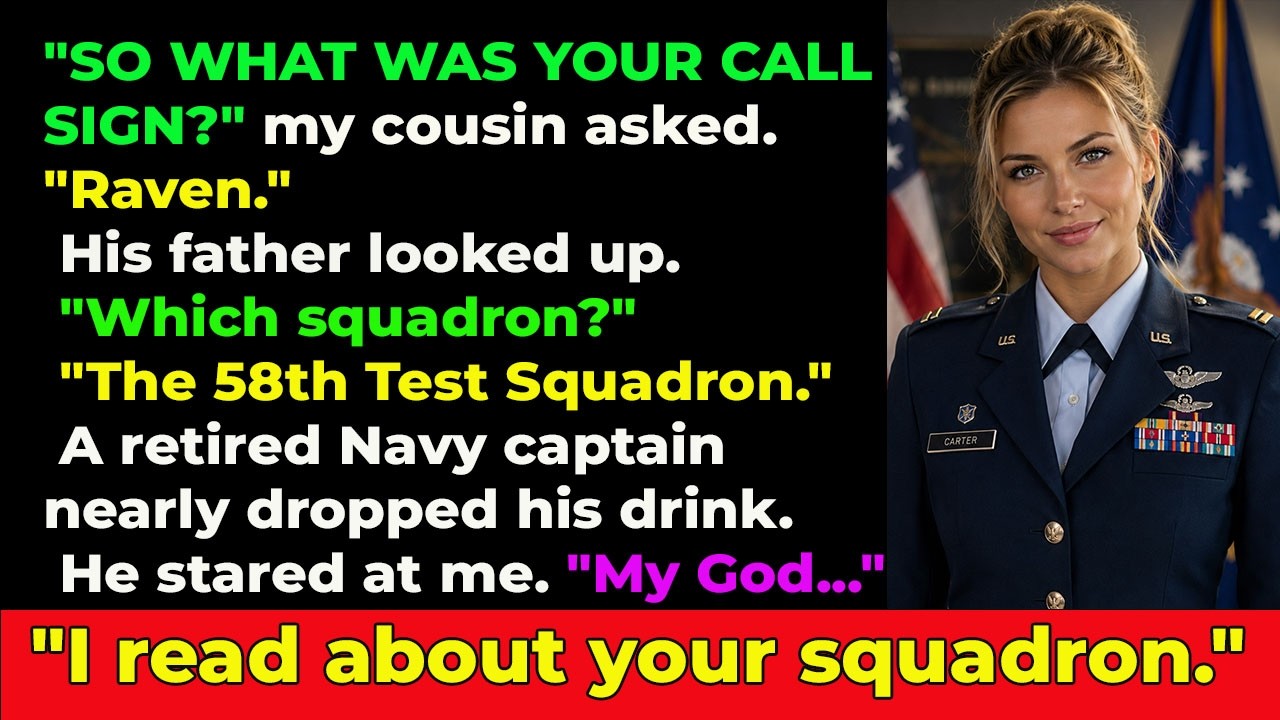
“So,” he hesitated, “what was your call sign? ”
The yard became strangely quiet. I wasn’t sure why. Maybe because nobody expected it.
Maybe because call signs sounded more interesting than potato salad. I answered simply. “Raven. ”
Brandon shrugged.
“Cool. ”
But another voice spoke before anyone else could. “Which squadron? ”
I turned.
It was Brandon’s father, Captain Richard Lawson, retired United States Navy, 72 years old. A quiet man who usually spoke only when he had something worth saying. I’d always respected him. He wasn’t flashy.
He didn’t tell war stories. He mostly listened. “The 58th Test Squadron,” I answered. For a second he didn’t move.
Then the glass of iced tea in his hand slipped just enough that a little spilled onto the deck. “My God. ” His voice had changed. Not louder, just different.
He stared at me as though seeing me for the first time. “I read about your squadron. ”
Nobody said anything. Even the children had stopped playing.
Captain Lawson slowly set his drink on the table. “When were you there? ”
I gave him the years. He nodded almost immediately.
“I remember reading about some of those testing programs. ”
“I can’t discuss specifics. ”
“I know. ” He looked around the yard, then back at me.
“You don’t have to. ”
Brandon laughed awkwardly. “Dad. ”
But his father wasn’t looking at him anymore.
He kept asking me quiet, professional questions. Nothing classified. Nothing inappropriate. Just enough to confirm that I really knew what I was talking about.
Within three minutes, the conversation had completely shifted. The same relatives who had barely asked about my job for years suddenly wanted to know where I’d been stationed, how long I’d served, and whether I’d ever met test pilots. It felt strange. Not satisfying.
Just strange. Brandon sat unusually quiet. For the first time I could remember, nobody was listening to one of his stories. Then Captain Lawson said something that made the hairs stand up on the back of my neck.
He looked directly at Brandon. “You’ve mentioned working alongside Air Force test units before. ”
Brandon nodded too quickly. “Yeah, once or twice.
”
His father’s expression didn’t change. “Interesting. ”
Just one word. *Interesting.
* But something underneath it felt heavy. Years of questions. Years of doubt. Years of keeping silent.
I suddenly realized this wasn’t the first time Captain Lawson had wondered whether his son had stretched the truth. It was simply the first time someone else had unknowingly handed him the missing piece. As the sun dipped lower over the backyard and the laughter slowly returned, I couldn’t shake one thought. Someone in this family had built their reputation on stories.
And for the first time, someone who knew the difference between fact and fiction had been paying attention. I didn’t sleep much that night. Not because anything dramatic had happened. Nobody had yelled.
Nobody had accused anyone of lying. The barbecue ended the same way family gatherings usually did — with leftovers packed into plastic containers, hugs in the driveway, and promises to do this again before Christmas. But Captain Lawson’s face stayed with me during the 40-minute drive back to my mother’s house in Kettering. He hadn’t looked surprised because I’d served with the 58th Test Squadron.
He’d looked surprised because something Brandon had been saying for years suddenly didn’t fit anymore. My mother was already making coffee when I came downstairs the next morning. “You sleep okay? ” she asked.
“Not really. ”
She poured cream into two mugs and slid one across the kitchen table. “You’ve been thinking about yesterday. ”
“I have.
”
She sat across from me. “I’ve known your cousin since the day he was born,” she said carefully. “He’s always liked attention. That’s not a crime.
”
“No. ”
She stirred her coffee. “But sometimes attention becomes a habit. ”
I looked out the window.
The same maple tree I used to climb when I was 10 stood in the backyard. The old wooden swing Dad built before he passed away still hung from one branch, though nobody had used it in years. Funny how some things stayed exactly the same. Others changed so slowly you didn’t notice until decades had passed.
Growing up, Brandon had been everyone’s golden boy. He was four years older than me. He played varsity football. He dated the prettiest girls in high school.
When he enlisted in the Marines after graduation, the family acted like we’d personally sent someone to save America. Grandpa even framed Brandon’s boot camp photo and hung it above the fireplace. There wasn’t a single picture of me anywhere nearby. Not that I cared much at 16.
At least that’s what I told myself. When I earned a scholarship to Ohio State University to study aerospace engineering, Grandpa smiled politely and said, “That’s nice. ” When Brandon came home on leave six months later wearing dress blues, the entire neighborhood was invited over for cake. Different people, different expectations.
That was simply how our family worked. Years later, after college, I accepted a civilian position supporting Air Force testing before eventually becoming an officer. The work wasn’t glamorous. Most days began before sunrise.
Coffee in a travel mug, security checkpoint, morning briefings, weather reports, flight schedules, risk assessments. If someone imagined fighter jets roaring overhead every five minutes, they’d be disappointed. There were plenty of days spent staring at spreadsheets and maintenance reports. But every page mattered.
Every signature mattered. Because eventually someone climbed into an aircraft trusting that every person before them had done their job correctly. I liked that responsibility. I never needed applause for it.
The funny thing was, nobody in my family ever really asked. Every Christmas, someone would eventually turn toward me and ask, “Still in Florida? ” I’d answer, “Yes. ” That was usually the end of the conversation.
Five minutes later, Brandon would be describing another unbelievable military adventure. According to him, he’d advised special operations units, worked alongside intelligence teams, helped coordinate classified missions overseas. Every story somehow became bigger than the last, and somehow everyone believed him. Or maybe they simply wanted to.
Late Monday afternoon, I stopped by Lowe’s to help Mom pick up mulch for her flower beds. As we loaded bags into her SUV, someone called my name. “Emily. ”
I turned.
Captain Richard Lawson stood beside a blue Ford F-150 pushing a shopping cart with two bags of fertilizer. “Captain. ”
He smiled. “Please, Richard.
”
“Old habits. ”
He chuckled. “I understand. ”
After helping him load the fertilizer, he leaned against the truck.
“I hope I didn’t make yesterday uncomfortable. ”
“You didn’t. ”
He looked toward the parking lot before speaking again. “I’ve been thinking.
”
“So have I. ”
“And I owe you an apology. ”
“For what? ”
“For assuming your work wasn’t, well.
” He searched for the word. “Substantial. ”
I laughed. “You sound like you’re writing an evaluation report.
”
“Occupational hazard. ”
“I wasn’t offended. ”
He nodded. Still, he hesitated.
“I should have asked years ago what you actually did. ”
I shrugged. “Most people don’t. ”
There was an awkward silence.
Then he quietly asked, “Can I ask you something? ”
“If I can answer. ”
“When Brandon mentioned working with Air Force testing groups,” he stopped. “Did anything he said sound familiar?
”
I chose my words carefully. “Not really. ”
Richard sighed. “I was afraid you’d say that.
” He rubbed the back of his neck. “You know, when you’ve served long enough, you develop instincts. ”
“I imagine so. ”
“Details matter.
”
“They do. ”
“Dates? Yes. Unit names?
Absolutely. ” He looked down. “For years, I convinced myself maybe I was being overly skeptical. ”
I didn’t respond, because I understood.
Nobody wants to believe their own son has been exaggerating his military service. Finally, he said something that surprised me. “I never confronted him. ”
“Why not?
”
“Because I wanted to be wrong. ”
That sentence stayed with me. Parents aren’t perfect. Sometimes love makes honesty harder instead of easier.
Before we left, Richard shook my hand. “I’m proud of your service. ”
“Thank you. ”
“I should have said that a long time ago.
”
Driving home, I realized those words meant more than I expected. Not because I needed validation, but because they came from someone who understood what quiet service actually looked like. That Friday evening, our family gathered again. Nothing formal.
Just pizza at my Aunt Linda’s house because several cousins were in town. Everything seemed normal until Brandon walked into the living room carrying three boxes from Marion’s Piazza. He immediately launched into another story. “When I was working with special operations…”
I excused myself to grab another soda from the kitchen.
As I rounded the corner, I heard Brandon talking to my younger cousins in the dining room. “Emily? ” he laughed. “She’s smart.
”
Someone asked, “Didn’t she work with fighter jets? ”
“Not really. ” He waved dismissively. “Office support.
”
Another cousin looked confused. “But Grandpa Richard seemed impressed. ”
Brandon snorted. “Dad reads too many military magazines.
”
The teenagers laughed. Then Brandon added something that made me stop walking. “Look, women have important jobs in the military. ” He shrugged.
“But they’re usually not doing the dangerous stuff. ”
One of the boys asked, “So she never flew? ”
“I doubt she ever left an air-conditioned office. ”
More laughter.
I stood there for another few seconds. Not angry, just tired. Twenty years. Twenty years of letting comments slide because keeping peace seemed easier.
I quietly walked back into the living room before anyone noticed I had overheard. Mom looked at me. “You okay? ”
I smiled.
“I’m fine. ”
But I wasn’t. Not because Brandon had insulted me, but because he was teaching another generation that pretending mattered more than truth. As everyone cleaned up after dinner, Aunt Linda mentioned the town’s upcoming Veterans Day ceremony.
“Oh, Brandon’s giving the keynote speech this year,” she said proudly. The room erupted in congratulations. Brandon grinned. “It’ll just be a few remarks.
”
Richard looked down at his paper plate. He didn’t smile. Neither did I. Because for the first time, I found myself wondering something I had never seriously considered before.
What happens when a man who has spent years decorating the truth is finally asked to stand in front of an entire town and tell one more story? I wasn’t looking for revenge. Not yet. But for the first time in my life, I stopped believing silence was the right thing to do.
The Monday after that pizza night, I drove to the Air Force Museum at Wright-Patterson before work. Not because I had business there, but because I needed somewhere quiet to think. The museum had always done that for me. You could walk past aircraft that changed history without hearing anyone brag about themselves.
Every display reminded you that military service was almost never about one person. Engineers, mechanics, pilots, controllers, medics, cooks — everyone played a part. That was the military I knew. Not the version people performed at backyard cookouts.
I bought a coffee from the small cafe inside, found a bench overlooking the restoration hangar, and stared at my cup for almost 20 minutes. Part of me wanted to forget the whole thing. Brandon wasn’t my responsibility. He wasn’t hurting me financially.
He wasn’t threatening my career. If he wanted to spend the rest of his life telling stories that got a little bigger every year, maybe that was between him and his conscience. Then I remembered Ethan. Thirteen years old, watching his father like every word was gospel.
That bothered me more than anything, because lies have a way of becoming family traditions. By lunchtime, I’d made up my mind. I wasn’t going to hunt Brandon down. I wasn’t going to embarrass him.
I just wanted to know the truth. If my instincts were wrong, I’d be relieved. If they weren’t, well, I’d decide what to do after that. That evening after work, I sat at the dining room table with my laptop.
Most military service records aren’t open to the public, but a surprising amount of information is. Promotion announcements, unit newsletters, public award citations, veterans organization biographies, local newspaper articles. Nothing classified. Nothing invasive.
Just information that anyone could verify. I started with something simple. Brandon often said he’d spent nearly two years deployed overseas. His social media photos told a different story.
There were pictures of him coaching Little League during one of those supposed deployments. Another showed him at a county fair in Ohio. The date was clearly visible on the banner behind him. Maybe the timestamps were wrong.
Maybe someone posted them later. So I kept looking. His timeline didn’t make sense. Neither did several schools he claimed to have attended.
He often mentioned advanced training programs. Some of them existed. Some didn’t. One course had been discontinued years before he said he attended it.
Another wasn’t even offered to his occupational specialty. I leaned back in my chair. This wasn’t looking good. Still, I kept telling myself there had to be explanations.
People forget dates. People confuse assignments. Memory isn’t perfect. Mine certainly wasn’t.
The next afternoon, my phone rang while I was leaving work. The caller ID read Richard Lawson. “Hello, Emily. Do you have a few minutes?
”
“I do. ”
“I’m at Dorothy Lane Market. Any chance you could meet me? ”
Twenty minutes later, we were sitting outside with paper cups of coffee.
Richard looked older than he had just a week earlier. Not physically — emotionally. “I’ve been checking a few things myself,” he admitted. I didn’t act surprised.
“I thought you might. ”
He sighed. “I wish I hadn’t. ”
Neither of us spoke for a moment.
Finally, he reached into a Manila folder. “I found Brandon’s old discharge paperwork. ” He slid a photocopy across the table. Certain personal information had been covered with sticky notes.
“I wanted you to see something. ”
I looked at the dates, then the unit designation, then the separation date. My stomach tightened. “This doesn’t match what he’s been saying.
”
Richard nodded once. “It doesn’t. ”
“He told everyone he stayed in another four years. ”
“I know.
”
“He said he trained other units. ”
“I know. ”
“He said —”
“I know. ” His voice cracked on the last words.
For the first time since I’d known him, Richard looked completely defeated. “I kept hoping I had misunderstood. ”
“I’m sorry. ”
“So am I.
” He stared out toward the parking lot. “When Brandon came home after leaving the Marines, he seemed lost. ”
“I remember. ”
“He couldn’t keep a steady job.
”
“I remember that, too. ”
“He was embarrassed. ” Richard folded his hands together. “Then the story started.
A little at first. ” He nodded. “Small exaggerations. ”
I understood exactly what he meant.
Someone compliments your service. You let them assume something that isn’t quite true. Then correcting them becomes harder. Years pass.
The story grows. Eventually you’re trapped inside something you created. Richard looked at me. “I should have stopped it years ago.
”
“You were his father. ”
“Exactly. ” He gave a tired smile. “I wanted to protect him.
”
“I understand. ”
“But protecting him became enabling him. ”
Neither of us enjoyed saying that out loud. Over the next week, I continued checking public information.
Not obsessively. Just carefully. The pattern became impossible to ignore. Awards he’d mentioned couldn’t be found.
Assignments overlapped in impossible ways. One speech he’d given at the local VFW included a rescue mission that closely resembled an article I’d found about another Marine from an entirely different unit. The similarities were too specific to ignore. By Friday afternoon, I closed my laptop.
I didn’t feel victorious. I felt sick. Because this wasn’t just exaggeration anymore. This was an entire identity.
Saturday morning, I stopped by Mom’s house to help clean the gutters. As we worked, she climbed halfway down the ladder and asked quietly, “Have you been looking into Brandon? ”
I paused. “A little.
”
She sighed. “I was afraid of that. ”
“You knew? ”
“I knew something wasn’t right.
” She brushed leaves into a bucket. “But families are complicated. ”
“They are. ”
She looked at me carefully.
“Promise me something. ”
“What? ”
“Don’t become the person who’s obsessed with proving someone wrong. ”
I smiled.
“I won’t. ”
“I mean it. ”
“I know. I raised you better than that.
”
She wasn’t accusing me. She was reminding me who I was. That mattered. Monday morning brought an unexpected surprise.
As I walked into my office, my supervisor waved me toward his door. “Emily, morning. You’ve got a phone call. ”
“For me?
”
“Personal. ”
The caller introduced herself. “My name is Karen Mills. I write for the Dayton Daily News.
”
I frowned. “Okay. ”
“I’m working on a Veterans Day feature highlighting local service members. ”
“Congratulations.
”
She laughed politely. “Actually, your name came up because of another interview. ”
That caught my attention. “What kind of interview?
”
She hesitated. “I’ve received some anonymous information suggesting one of this year’s Veterans Day speakers may have misrepresented portions of his military record. ”
I didn’t say anything. “I understand you’re related.
”
“I am. ”
“I’m not asking you to comment. ”
“Good. ”
“But I wanted to know if you’d be willing to verify your own service record for a separate profile.
”
I leaned back in my chair. “My service record isn’t the story. ”
“Perhaps not. But your background may help readers understand military careers that don’t always make headlines.
”
I thanked her and ended the call. For several minutes, I simply stared at my desk. Anonymous information. It hadn’t come from me.
It hadn’t come from Richard, either. I knew him well enough now to believe that. Someone else had noticed. Someone else had started asking questions.
The issue had grown beyond family gossip. Whether Brandon realized it or not, the thread he’d been pulling for years was finally starting to unravel. And once enough people begin tugging at the same loose thread, sometimes the whole sweater comes apart. By the time Veterans Day arrived, I had almost talked myself out of going.
Every instinct I had told me to stay home. Drive over to Mom’s house. Watch the ceremony on the local news if I really wanted to. Spend that afternoon raking leaves before the first hard freeze.
That sounded a whole lot better than sitting in the middle of a crowd while my cousin stood at a podium telling stories I no longer believed. But Richard called me the night before. “I’m not asking you to do anything,” he said. “I know.
”
“I just think you should be there. ”
His voice sounded tired. Not nervous — resigned. “I’ll come,” I said.
“Thank you. ”
That was all. The ceremony began at 11:00 sharp in the town square in Beaver Creek. The weather couldn’t have been more Midwestern if it tried.
Gray skies, 43 degrees, a steady breeze that carried the smell of coffee from a nearby cafe. The high school marching band was warming up beside city hall. Volunteers from the American Legion handed out small American flags to children. Folding chairs stretched across the lawn, nearly all of them filled with veterans wearing old service caps embroidered with names of ship squadrons and units.
Vietnam, Desert Storm, Iraq, Afghanistan. Every generation seemed to be there. I parked beside the courthouse and walked the last block. Mom spotted me almost immediately.
“You made it. ”
“I almost didn’t. ”
“I’m glad you did. ”
Richard was already seated in the front row.
He looked smaller than I remembered. Not physically — emotionally. He caught my eye and gave a slight nod. Nothing more.
I took a seat three rows behind him. No special attention. Exactly the way I preferred it. The ceremony began with the national anthem, then a prayer, then the mayor welcomed everyone and thanked local veterans for their service.
Everything felt normal. Comforting. Then the mayor smiled toward Brandon. “And now I’d like to introduce this year’s keynote speaker, Marine veteran Brandon Lawson.
”
The applause was warm. Sincere. Brandon walked confidently to the podium wearing a dark blue blazer with several military pins on the lapel. He looked comfortable.
Like he’d done this many times before. Maybe he had. He adjusted the microphone. “Good morning, everyone.
”
More applause. “I’ve been thinking this week about what service really means. ”
It started well. Too well.
He spoke about sacrifice, duty, community. Everything sounded genuine. If I hadn’t known better, I probably would have believed every word. Then he shifted into a personal story.
“There was one night overseas. ”
My stomach tightened. “Our convoy came under heavy fire. ”
I looked toward Richard.
His shoulders slowly dropped. Brandon continued. “We were pinned down for almost two hours. ”
People listened quietly.
Some nodded. A little boy sitting near the front stared at him with wide eyes. Then Brandon described rescuing another Marine under enemy fire. The audience erupted into applause.
I closed my eyes for a moment, because I had already read that story. Not in Brandon’s record. In an article about another Marine from another unit years earlier. Different names.
Same details. Same sequence. Even some of the same phrases. When I opened my eyes again, Richard was standing.
At first, I thought he was simply stretching. Then I realized he wasn’t. He walked slowly toward the stage. The applause faded.
Brandon looked surprised. “Dad. ”
Richard stopped beside the podium. His voice wasn’t loud.
It didn’t need to be. “Son. ”
The entire square became silent. “That mission never happened.
”
You could almost hear people breathing. Brandon forced a laugh. “What are you doing? ”
Richard didn’t answer immediately.
He looked out across the audience. Then back at his son. “I should have spoken years ago. ”
Brandon leaned closer to the microphone.
“Dad, sit down. ”
“No. ” His voice stayed calm. “You deserve the truth.
”
The mayor stepped forward uncertainly. “Captain Lawson. ”
Richard gently raised one hand. “I’ll be brief.
”
No anger. No shouting. Just quiet disappointment. “My son served honorably.
” He looked directly at Brandon. “That was always enough. ”
A long pause. “But somewhere along the way…” Another pause.
“He began telling stories that weren’t his. ”
Nobody moved. Nobody interrupted. Richard continued.
“I kept hoping he’d stop. ” He swallowed. “I kept telling myself it wasn’t my place. ” His eyes became glassy.
“I was wrong. ”
Brandon’s face had turned bright red. “This is ridiculous. ” He laughed nervously.
“My father’s confused. ”
From somewhere behind me, an older veteran spoke up. “What unit was that convoy with? ”
His tone wasn’t hostile.
Just curious. Brandon answered too quickly. “Third Battalion. ”
Another veteran frowned.
“Which regiment? ”
A pause. Brandon hesitated. “I…”
Another voice.
“Who was your commanding officer then? ”
Someone else. “What year? ”
Another.
“Where exactly? ”
Simple questions. Nothing complicated. Questions every veteran could answer about their own service.
Brandon tried. He really did. But every answer created another problem. Dates didn’t fit.
Locations changed. Names became vague. The confidence that had filled the stage only minutes earlier slowly disappeared. I stayed exactly where I was, hands folded in my lap.
I hadn’t spoken a single word. The mayor looked toward me. “Major Carter. ”
Every head turned.
I wished he hadn’t done that. I walked forward slowly. Not because I wanted attention, but because refusing would have looked worse. He quietly asked, “Would you be willing to clarify something?
”
I nodded. “If I can. ”
One of the veterans spoke first. “Is it common for people working around test squadrons to know each other’s assignments?
”
“Sometimes. ”
“What about combat operations? ”
“Those are very different communities. ”
Another question.
“If someone claimed to have worked closely with a unit…”
I answered carefully. “Military records are generally very detailed. Nothing more, nothing less. ”
I refused to accuse Brandon of anything.
I simply answered factual questions. Richard looked relieved. Not happy. Just relieved.
Because the truth no longer depended on emotion. It depended on facts. Brandon suddenly stepped away from the microphone. “This is unbelievable.
” He looked around the crowd. “So, everyone just believes her? ”
“No,” Richard answered softly. “They’re believing evidence.
”
Brandon stared at his father for several seconds. Then he pulled off the microphone, handed it to the mayor, and walked off the stage. No dramatic speech. No angry shouting.
He simply kept walking across the square, through the parking lot, and out of sight. Richard watched him go. Then, without another word, he followed. The ceremony eventually resumed.
The mayor thanked everyone for their patience. The band played “America the Beautiful. ” Children waved little flags again. Life slowly returned to normal.
People came over to shake my hand. Some thanked me. Others simply nodded. A few apologized for assumptions they’d made over the years.
I accepted every kind word, but I didn’t feel victorious. Standing alone near the memorial after the crowd began to leave, I looked at the names engraved in the black granite. Men and women who had served without ever expecting applause. Without inventing stories.
Without needing strangers to admire them. I finally understood something I’d been struggling to put into words. The hardest part of telling the truth isn’t exposing a lie. It’s accepting that the truth may break the people you still love.
And that hurt far more than I ever expected. People think the hard part ends when the truth comes out. It doesn’t. If anything, that’s when the real work begins.
The Monday after Veterans Day, I was back at Wright-Patterson Air Force Base before sunrise. The parking lot was still damp from overnight rain, and the temperature had dropped into the low 30s. I parked in my usual spot, carried my travel mug toward the building, and tried to convince myself that life would settle back into normal. Instead, my phone buzzed before I even reached the security checkpoint.
“Mom? ”
“Morning,” she answered. She didn’t bother with small talk. “Have you looked at Facebook?
”
“I haven’t. ”
“Don’t. ”
That wasn’t encouraging. “I’ll survive.
”
“No,” she said quietly. “Not yet. ”
During my lunch break, curiosity got the better of me. I opened Facebook.
I wished I hadn’t. Someone had posted a shaky cell phone video from the Veterans Day ceremony. It had already been shared hundreds of times around Green County. The comments were exactly what you’d expect.
Some praised Richard for doing the right thing. Others defended Brandon. A few blamed me. “She planned this.
”
“Typical career officer looking down on enlisted people. ”
“Families should keep family business private. ”
One comment actually read, “She couldn’t stand that Brandon got more attention. ”
I laughed.
Not because it was funny, but because it was absurd. If those people had known me at all, they’d know attention was the last thing I wanted. I closed the app and went back to work. Aircraft didn’t care about internet arguments.
Neither did maintenance schedules. That was one thing I loved about my job. Steel, fuel, procedures. Those things stayed honest.
People didn’t always. By Friday evening, the story had reached nearly everyone in the family. Some relatives called. Others didn’t.
My Aunt Linda invited Mom and me over for dinner. When we arrived, the atmosphere felt completely different from the cookout a few months earlier. The television was off. Nobody joked.
Even the grandkids seemed quieter. Halfway through dinner, Uncle Dave cleared his throat. “I suppose we should talk about it. ”
Nobody argued.
My cousin Melissa spoke first. “I still don’t understand why it had to happen publicly. ”
Richard answered before I could. “Because Brandon chose to make it public.
”
Silence. Melissa looked uncomfortable. “He didn’t deserve to be humiliated. ”
Richard slowly folded his napkin.
“No, he made mistakes. ”
“Yes, but he’s still family. ”
Richard nodded. “He always will be.
” His voice softened. “But honoring family doesn’t mean protecting dishonesty. ”
Nobody had a response for that. Later that night, I helped Richard carry leftovers to his truck.
The November wind had picked up. Dry leaves scraped across the driveway. He leaned against the tailgate for a moment. “I owe you another apology.
”
“You don’t owe me anything. ”
“I do. ” He looked toward the street. “When Brandon was little, he’d come home with stories.
”
I smiled faintly. “What kind? ”
“He’d catch the biggest fish. ”
I laughed.
“Of course. ”
“He’d score the winning touchdown. ”
“Naturally. ”
Richard chuckled.
“His stories were harmless. ”
“What changed? ”
“I stopped correcting them. ” He rubbed his hands together against the cold.
“Eventually, he couldn’t tell the difference between making himself interesting and making himself important. ”
I understood exactly what he meant. Some habits grow quietly. You barely notice them until they’re part of someone’s identity.
“I keep wondering,” Richard said, “whether I failed him. ”
I thought about that for a long moment. “I think every parent wonders that sooner or later. ”
He smiled sadly.
“That’s probably true. ”
A few days later, Brandon finally called. I almost didn’t answer, but I did. Neither of us spoke for several seconds.
Finally, he broke the silence. “You happy? ”
“No. ”
He sounded surprised.
“You should be. ”
“I’m not. ”
“You ruined my life. ”
I leaned back in my office chair and looked out the window.
The first snowflakes of the season drifted across the parking lot. “I didn’t ruin your life, Brandon. ”
“You embarrassed me. ”
“I never interrupted your speech.
”
“You didn’t have to. ”
His breathing grew heavier. “You could have defended me. ”
“How?
”
He didn’t answer. “You wanted me to lie? ”
Another long silence. Then, quietly, almost like a different person, he said, “I just wanted somebody on my side.
”
That sentence caught me off guard. For a moment, I stopped seeing the loud cousin who always had another unbelievable story. I saw the insecure young man who had come home years earlier, struggling to figure out who he was after leaving the Marines. “I was on your side,” I said softly.
“You just didn’t notice. ”
He laughed bitterly. “Doesn’t matter now. ”
Then he hung up.
I sat there staring at my phone. Part of me wanted to call him back. Another part knew he wasn’t ready to hear anything else. A week later, I received an envelope in the mail with no return address.
Mom frowned when she handed it to me. “What is it? ”
“No idea. ”
Inside was a single sheet of notebook paper.
The message had been typed. “Traitors come in many uniforms. ”
Nothing else. No signature.
No explanation. Mom looked worried. “You should report that. ”
“I will.
”
The base security office took it seriously. They documented everything. One officer smiled apologetically. “Unfortunately, people get emotional when military service becomes part of public conversations.
”
“I figured. ”
“You okay? ”
“I’ve had worse days. ”
That was true.
Still, seeing anonymous hatred in black and white felt different. For the first time, I wondered whether staying quiet really would have been easier. The answer came unexpectedly. Two weeks before Christmas, Richard asked if I’d meet him for breakfast at Bob Evans.
He was already there when I arrived. Two coffees. One plate of scrambled eggs. One plate of biscuits and gravy.
Very Ohio. He looked healthier than he had in weeks. “How’s Brandon? ” I asked.
“He moved out. ”
I blinked. “Really? ”
“Needed some space.
” Richard stirred his coffee. “He’s seeing a counselor. ”
That surprised me. “I think that’s good.
”
“So do I. ” He smiled for the first time in a while. “You know what he said yesterday? ”
“What?
”
“He admitted he doesn’t even remember when the stories stopped being true. ”
That hit me harder than I expected, because I believed him. Lies told once are choices. Lies repeated for years can become memories.
Richard reached across the table. “I wanted to thank you. ”
“For what? ”
“For refusing to humiliate him.
”
“I wasn’t trying to. ”
“I know. You simply refuse to lie. ” He paused.
“And sometimes that’s the bravest thing a person can do. ”
Driving home after breakfast, I realized something important. The truth hadn’t given me the victory I thought it would. It had cost me sleep, relationships, peace.
But it had also given one man — Richard — the chance to stop carrying a burden he’d lived with for years. Maybe that was enough. Maybe revenge was never supposed to feel like celebration. Maybe sometimes it simply meant ending a lie before it swallowed another generation.
By February, the story had mostly faded from the local news. People had moved on to high school basketball playoffs, a winter storm that closed schools for two days, and the usual conversations about whether spring would ever arrive in Ohio. Life has a way of doing that. Even the biggest moments eventually become yesterday’s headlines.
Mine certainly had. At work, nothing had changed. I still arrived before sunrise most mornings. I still carried the same stainless steel travel mug filled with black coffee.
I still sat through safety briefings, reviewed maintenance reports, and spent hours making sure every detail was exactly where it belonged before anyone took an aircraft into the sky. There was comfort in routine. No applause. No speeches.
Just people quietly doing their jobs. One afternoon, my supervisor stopped by my office. “Emily. ”
“Yes, sir.
”
“You’ve got a visitor downstairs. ”
I frowned. “I wasn’t expecting anyone. ”
“I figured.
” He smiled. “She’s from the Green County Veterans Council. ”
That caught me off guard. I walked downstairs and found a woman about my mother’s age waiting in the lobby.
She introduced herself as Susan Reynolds. “We’re planning this year’s Women Veterans Recognition Luncheon. ”
“Congratulations. ”
She smiled.
“We’d like you to speak. ”
I almost laughed. “I think you’ve got the wrong person. ”
“No.
We’ve got exactly the right person. ”
“I don’t really give speeches. ”
“You don’t have to. ” She handed me a folder.
“We don’t want stories about classified work. ”
“That’s good. ”
“We want honesty. ”
I looked at the invitation.
The luncheon would be held at a community center in Fairborn, just outside Wright-Patterson. About a hundred veterans and their families were expected to attend. “I’ll think about it. ”
She nodded.
“That’s all I’m asking. ”
I almost declined. Standing in front of people had never bothered me professionally. Standing in front of people talking about myself — that was something else entirely.
Mom talked me into it. “You’ve spent your whole life letting louder people tell the story. ” She smiled over her coffee. “Maybe it’s your turn.
”
“I’m not Brandon. ”
“No. ” She reached across the table. “That’s exactly the point.
”
The luncheon took place on a bright Saturday in April. The room smelled like fresh coffee and baked chicken. Round tables filled the hall. Veterans from every branch sat together swapping stories that sounded wonderfully ordinary.
Nobody was trying to impress anyone. One Navy veteran complained about his knees. A retired Army nurse laughed about learning computers after retirement. Two Air Force mechanics debated which pickup truck lasted longer.
Real conversations. Real people. When Susan introduced me, the applause felt warm but brief. Exactly how I liked it.
I stepped to the podium. The microphone squeaked. A few people chuckled. “Well,” I said, “I guess that proves we’re not on television.
”
The room laughed. That helped. I took a breath. “When people hear the words military service, they usually imagine dramatic moments.
” I paused. “My experience was mostly checklists. ”
More laughter. “But those checklists mattered.
”
I told them about early mornings, long hours, working beside mechanics who could hear an engine problem before computers detected it, pilots who thanked maintainers before climbing into the cockpit, civilian employees who quietly kept everything moving. “The best people I served with,” I said, “weren’t interested in being heroes. They were interested in doing today’s job well enough to come back tomorrow and do it again. ”
Heads nodded around the room.
No dramatic pauses. No exaggerated stories. Just the truth. When I finished, the applause lasted longer than I expected.
Not because I’d entertained anyone, but because they’d recognized something familiar. Afterward, people lined up to shake my hand. One Vietnam veteran smiled. “You reminded me of my wife.
”
“How so? ”
“She served 22 years. ” He grinned. “She always said the loudest person in the room usually did the least work.
”
I laughed. “I’ve noticed that once or twice. ”
As the crowd began leaving, Susan walked over. “There’s someone who’d like to speak with you.
”
I turned. Brandon stood near the entrance. He looked different. Not physically.
Quieter. He had lost some weight. His beard was neatly trimmed. His shoulders no longer carried that constant confidence I’d mistaken for strength all those years.
“I’ll leave you two alone,” Susan said. For a moment, neither of us spoke. Finally, Brandon looked down at the floor. “I almost didn’t come.
”
“I figured. ”
“I’ve been sitting in the parking lot for 20 minutes. ”
That sounded believable. “I wasn’t sure you’d want to see me.
”
“I wasn’t sure either. ”
He nodded. “I deserve that. ”
We walked outside together.
The afternoon sun felt warmer than it had any right to in early April. Families loaded leftovers into their cars. Children chased each other across the parking lot. Life kept moving.
Brandon leaned against a light pole. “I’ve been in counseling. ”
“I’m glad. ”
“It turns out,” he laughed softly, “I spent so many years trying to become the man everyone admired.
” He looked at me. “That I stopped appreciating the Marine I actually was. ”
I didn’t interrupt. “My counselor asked me something.
”
“What? ”
“Who were you trying to impress? ” He smiled sadly. “I still don’t know the answer.
Maybe there wasn’t just one. Maybe it started with Grandpa. Maybe it became the family, then neighbors, friends, eventually strangers. The audience changed.
The performance never stopped. ”
“I’m sorry,” he said quietly. Not dramatic. Not rehearsed.
Just honest. “I don’t expect forgiveness. ”
“I know. ”
“I especially don’t expect trust.
”
“That takes time. ”
He nodded. “I lied about things I should have been proud enough not to. ”
“Yes.
”
“And I made you feel small. ”
I looked at him for a long moment. “You didn’t make me feel small. ”
He frowned.
“I let myself feel small because I thought your approval and everyone else’s mattered. ” I smiled gently. “I finally realized it didn’t. ”
For the first time all afternoon, he smiled too.
A real one. Small, tired, but real. “I hope someday I earn back even part of what I lost. ”
“I hope you do.
”
We shook hands. Then, after a brief hesitation, we hugged. Not because everything had been fixed, but because healing usually begins before everything is fixed. A few weeks later, Richard invited the family over for another barbecue.
Same backyard, same grill, same folding chairs. The maple tree had grown a little fuller. The grandchildren were a little taller. Life had quietly continued.
This time, nobody asked about call signs. Nobody exaggerated old stories. Instead, conversations drifted toward grandchildren, fishing trips, aching backs, and whether Cincinnati would finally have a decent baseball season. Honestly, it was the nicest family gathering we’d had in years.
Looking back now, people sometimes ask if exposing the truth was worth it. That’s still a difficult question. The truth cost all of us something. But lies have a habit of sending the bill to the next generation.
Someone eventually has to pay it. I’m grateful it ended with honesty instead of silence. If there’s one thing my years in uniform taught me, it’s that honor doesn’t grow from recognition.
It grows from doing the right thing when almost nobody notices.