My sister stood in the doorway of my son’s empty bedroom and laughed. She said she’d taken the room, sold everything, and gotten a good price. Behind her, my mother chuckled and said, “She’s pregnant, so it’s only fair. ”
My seven-year-old son, Tommy, grabbed a fistful of my shirt and cried into my ribs.
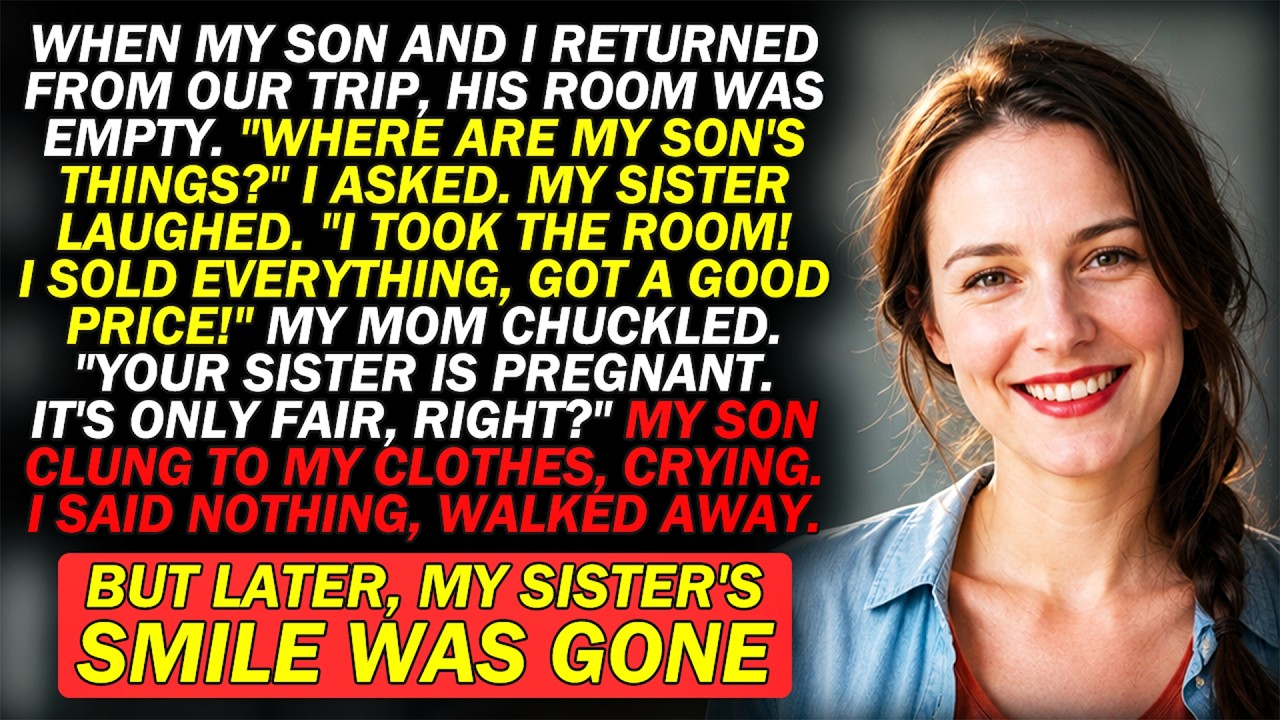
I said nothing. I just took his hand and walked out of my own house. None of them saw the first domino fall. I did.
I pushed it. To tell it right, I have to start with Daniel. My husband was a flight paramedic out of Mesa, Arizona—the kind of man who could splint a fracture in a helicopter at three in the morning and still text me a bad joke before landing. Three years ago, his crew took a transfer flight on a windy night, and the helicopter went down in the desert east of the valley.
He was thirty-three. The life insurance paid off our little three-bedroom house. Most days I stayed on nights in the pediatric intensive care unit because sick kids don’t keep business hours, and neither does grief. Tommy was four when his father died.
He’s seven now. Quiet like Daniel, patient like Daniel, and he built his whole world inside his bedroom. That room was our small museum. Daniel’s flight jacket hung in the closet.
His grandfather’s Hamilton watch sat in a locked cabinet, the initials worn soft on the case back. His toolbox lived under the window, and on the desk sat a half-built wooden sailboat—ribs and keel and one coat of nothing—because Daniel and Tommy had started it together the winter before the crash. They had a deal, those two. They shook on it like businessmen.
The boat would touch water the year Tommy turned eight. After the funeral, Tommy asked me if the deal still counted. I told him yes. We worked on it an hour here, an hour there, sanding what Daniel had cut.
It was the slowest boat ever built in Arizona, and it was the only clock that mattered in our house. Two years ago, my mother Martha had her knee replaced, lost her rental when the rent jumped, and ran out of options. I converted our den into a bedroom and moved her in. She watched Tommy three nights a week while I worked, and I covered her phone bill, her prescriptions, her car insurance, and the gap between her social security and reality.
That arrangement had a name in our family. The name was Rachel. I’ve been the strong one since I was about twelve, when my father’s paychecks got unreliable and somebody had to make sure my younger sister Catherine had lunch money. In my family, being capable is a chronic condition.
There’s no cure. There are only more chores. Catherine is six years younger, twenty-eight, pretty, broke, and permanently owed something by somebody. For me, the rules were granite.
For Catherine, the rules were elastic. I knew that. I’d known it my whole life. I just never guessed how far the elastic could stretch in the six days my back was turned.
Two months before our trip, Catherine’s boyfriend found out about the pregnancy and left the state. She landed on my porch with a duffel bag and an opening offer: “Just a few weeks, Rachel, just until the baby comes. ”
I said no. I saw it coming.
In this house, a few weeks is a unit of forever. I paid the first month on a studio for her near Fiesta Mall instead. My mother didn’t speak to me at dinner for a week. “Your sister is family,” she finally said, like she was correcting my grammar.
I put a lock on the cabinet where the watch and the jacket lived. I priced out changing the front door locks. But a busy schedule and a stomach flu ate the two weeks I had, and my mother lived there. You cannot lock your own mother out of the house she sleeps in.
So the spare cabinet key stayed where our spare keys had always stayed—in the junk drawer by the stove. Every June, Tommy and I drive the six hours to San Diego because there’s a pier there where Daniel proposed to me, and we bring donuts to the water and tell him about our year. This year we were gone six days. We came home on a Sunday afternoon, sunburned and happy, and Tommy ran ahead of me down the hall to his room the way he always does.
Then he stopped in the doorway and didn’t make a sound, which was worse than any scream I’ve heard on any shift. The room was empty. Bunk bed gone. Desk gone.
The toy shelf, the rug, the lamp shaped like a helicopter—gone. The cabinet with the brass lock was gone from the closet, and so was everything it had held. In the corner where the boat had been drying stood a brand-new white crib with the tag still on. My sister came out of my son’s bathroom holding a paint sample card, and she smiled at me.
“Where are my son’s things? ” I asked. Catherine laughed—actually laughed, one hand resting on her belly. “I took the room.
I sold everything. Got a good price. ”
From the kitchen doorway, my mother chuckled, drying her hands on a dish towel like this was a Tuesday. “Your sister is pregnant.
It’s only fair, right? Fair is fair. ”
Tommy grabbed a fistful of my shirt and pressed his face into my ribs. I felt him shaking before I heard him crying.
I looked at my sister’s smile and my mother’s dish towel, and I said one thing—not to them. “Get your backpack, baby. ”
Then I took my son’s hand and walked out of my own house. My mother watched me go with no worry at all on her face.
She thought my silence meant yes. She had a lifetime of evidence. She was wrong by one night. We went next door.
Lauren Reyes has been my neighbor for eight years and my friend for seven and a half of them—a school counselor with a guest room and the good sense not to fill silence with talk. She made Tommy grilled cheese and put on a nature show. He watched whales with wet eyes and asked me questions in a small, flat voice, going down the list of his life. “Is my bike gone?
Is my helicopter lamp gone? Are my dad’s tools gone? ”
I answered honestly because he’d just watched two adults lie with their whole faces, and he needed one who wouldn’t. Then he got to the end of his list.
“We weren’t done building it. ”
That was the whole sentence. He said it flat, like a fact he was checking. Then he turned back to the whales, and I went into Lauren’s kitchen and held on to the counter for a while.
After he fell asleep, I sat up and did what I do at work when a shift goes wrong. I ran the list again slowly, item by item. And partway through, I stopped because I hit a detail with edges on it. The cabinet had a small brass lock, and I had the only key on my ring nearly four hundred miles away in San Diego.
Somebody had gone through the junk drawer, found the spare, and opened that cabinet on purpose. This wasn’t a pregnant woman clearing space in a hurry. Somebody had stood in front of my husband’s things, used a key, and made a decision. Monday morning, I walked back into my kitchen and tried it the family way once, because I needed to know exactly who I was dealing with before I decided what to do.
I kept my voice level, the one I use with frightened parents. I said I wanted two things: a list of every buyer and whatever money was left so I could start buying my son’s life back. Catherine looked at me like I’d asked her to return a borrowed sweater. “It was kid furniture, Rachel.
Half of it was junk. Honestly, you should thank me for decluttering. ”
I asked about the jacket, the watch, the toolbox, the boat. She shrugged.
“Old man stuff. Dead people don’t need storage. ”
My mother came in and started smoothing it over the way other people sweep glass briskly without looking down. She announced Tommy could sleep on the sofa until the baby settled.
“Children adapt. Someday the cousins will laugh about this. ”
I looked at the two of them arranging my son’s childhood like furniture. Then I asked my one real question.
“How much, Kathy? ”
She blinked. “What? ”
“How much did you get for all of it?
”
She did some math in the air, proud of it. “Like nine hundred, maybe a little more. And it’s spent before you ask. Car seat, stroller, the crib.
Babies aren’t free. ”
I nodded and wrote the number on the whiteboard of my mind—nine hundred dollars. Then I told my sister to take her crib and be out of my house by dinner. She went to the studio across town, with my mother trailing her to the car saying this wasn’t over.
They watched me nod and thought they’d won, because nodding quietly is what I’ve always done. They had no idea what I do with numbers. That night, with Tommy asleep in Lauren’s guest room, I opened my sister’s marketplace profile. There it all was.
My son’s bedroom laid out under her smiling profile photo like a garage sale nobody asked me about. Fourteen listings. Bunk bed, $120. Kids desk, $45.
Boy’s bike, $60. A tablet I’d bought him for school, $90. Vintage pilot jacket, $60. Old man’s watch, $75, runs fine—seventy-five dollars for a Hamilton with his great-grandfather’s initials on the case back.
I didn’t throw the laptop. I did what I do at two in the morning when a monitor starts alarming. I got methodical. Screenshot.
Save. Next. Every listing, every timestamp, every chirpy little description she’d typed while I was standing on a pier telling my dead husband our year had been gentle. Then I pulled the folder I never wanted—the insurance inventory I’d made after Daniel died, with photos, serial numbers, the watch appraisal.
I matched every listing against my own records, like reconciling a med. And at the bottom of her profile, I found the fifteenth listing, grayed out and marked sold. My hands went still on the keys. The photo was taken at an angle on our porch.
“Unfinished wood boat craft project, $15. ”
I didn’t click it. Not that night. I couldn’t.
Tuesday, I called the Mesa Police non-emergency line on my lunch break, standing in the hospital parking garage where nobody could hear me say the words out loud. “My sister sold my son’s belongings while we were out of town. ”
The officer was polite and tired. He asked who lived in the home.
I said I owned it. My mother lived with us. My sister did not. He asked if my sister had ever stayed there, had a key, got mail there.
Then he said the words I’d already read about on three legal websites at four in the morning. “Sounds like it might be a civil dispute, ma’am. ”
Here’s the thing about being a nurse. You don’t argue with triage.
So I didn’t cry into the phone, and I didn’t hang up angry. I asked him a question instead. “What would make this a criminal matter and not a civil one? ”
He paused, and his voice changed a little, like a man sitting up straighter.
“Proof of ownership. Proof of value. Proof she had no permission and that she wasn’t a resident with a claim to the property. Documentation, basically.
Most people don’t have it. ”
I looked through the windshield at nothing and thought about the folder on my desktop. “You’ll be hearing from me,” I said. The family heard I’d been asking questions before the police heard anything at all, which tells you something about the speed of guilt.
Wednesday evening, my aunt Deb called—my mother’s younger sister, the keeper of the family group chat and the family version of events. She has a voice like a warm oven and she uses it like a crowbar. “Rachel, honey, whatever this is, family does not call the police on family. ”
I said my son’s dead father’s things had been sold to strangers.
She sighed the way you sigh at a child who won’t share. “Sweetheart, your sister is carrying a baby. You have a whole house. She has nothing.
Fair is fair. ”
There it was—the family motto out of a second mouth, wearing my aunt’s voice this time. Then Deb told me the story as she’d received it. The way she’d heard it, I’d been meaning to clear out that old kid’s furniture anyway, and Catherine had done me a favor managing the sale, and now I was twisting a kindness into a crime because I’d never liked our sister.
I asked who told her that. She said, “Well, your mother, honey, who else? ”
While I’d been screenshotting listings, my mother had been out ahead of me telling the family a story where the woman with the grieving child was the villain. They had the narrative.
I had a folder. Only one of those holds up in a room where the truth matters. And I was done spending time in rooms where it didn’t. The PICU was quiet Thursday night.
Between rounds, I built the binder. I do this for a living—chart so precisely that a stranger can reconstruct a night they never saw. So I charted my sister. Column one: the fourteen listings, screenshots with timestamps, all posted within two days of our leaving.
Column two: my insurance inventory, photo for photo, serial number for serial number. The watch appraisal from a jeweler on Main Street, six hundred dollars, dated two years ago. Column three: the money. Her payment app history was public, buyer’s names, dates, jokey little notes, all six days I was gone, lined up like a confession she’d written herself.
My running total came to about nine hundred forty dollars. Then I did the number that actually mattered—fair market value, off the inventory and the appraisal—and it came to just about two thousand six hundred dollars. Around three in the morning, I messaged the two buyers whose names I could match. One didn’t answer.
The other answered fast, and her message put a chill down the back of my scrubs. “Wait, that stuff was stolen? ”
She’d bought the bike for her grandson. And she had something to tell me about the day she picked it up—something she’d seen in that driveway that made the whole thing worse.
An older man standing in my driveway with Daniel’s toolbox in his arms, asking my sister whose tools these had been. And my sister answering, “Nobody’s. ”
That word did something to me that all fourteen listings hadn’t quite done. Nobody’s.
The buyer gave me the man’s name from the pickup thread—Walt Peterson, retired machinist, East Mesa, paid forty dollars for the toolbox. I got half my story out before he stopped me. “I’ll be there in twenty minutes. ”
He drove to my house in a truck older than me, carried the toolbox up my walk like it was a casket at a military funeral, and set it on my kitchen table.
I tried to hand him his forty dollars, and he looked at the bills like I’d offered him a parking ticket. “A man’s tools belong to his boy,” he said. “That’s not forty dollars, ma’am. That’s a will.
”
Then he opened the lid because he wanted me to see he hadn’t touched anything. And there, folded into quarters under the socket tray, was a piece of graph paper I’d never seen before. Daniel’s handwriting, pencil lines, measurements, a little drawing of a finished sailboat with its sail up, and along the bottom in block letters: Tommy’s boat. He’d drawn out the whole build, start to finish, and filed it where any mechanic would—with the tools.
I wish I could tell you the boy was fine. Here is what fine looked like at our house, where Tommy was camped on an air mattress in my room until I could rebuild his. He wet the bed twice, the first time in over two years, and both times he tried to hide the sheets because he’d decided the way you handle loss is you keep it off the grown-ups. Wednesday, his teacher sent home a note with a drawing from art time.
The assignment had been “my favorite place. ” Tommy had drawn a rectangle, empty, with a small door and nothing in it, and titled it “my room. ” His teacher wanted me to know he’d worked very hard on it and had asked how to spell “empty. ”
I have stood at the bedside of other people’s children on the worst night of their parents’ lives and kept my hands steady.
At two in the morning, holding a wet fitted sheet outside the laundry closet, I was not steady. He appeared in the hallway behind me, small in borrowed pajamas, and asked the question he’d apparently been building all week. “Mom, did dad’s boat get thrown away because of me? Because I went on the trip, too.
”
I got down on the floor of that hallway and held my son while he confessed—actually confessed—to the crime of going to the beach with his mother. My family had done that math in his head. That was the night the last of my hesitation died. Saturday morning, coffee going cold beside the laptop, I finally clicked the fifteenth listing.
Unfinished wood boat craft project, fifteen dollars. Sold. The photo had been taken on our front porch, carelessly, half the frame eaten by glare off the storm door, and the boat sat in the middle of it looking exactly like what it was: ribs and keel and hope. Eleven months of Saturdays, a dead man’s promise half-kept.
No buyer name. Paid cash. Porch pickup while I was gone. The only clue in the whole photograph sat in the corner of the frame, reflected in the glass of the storm door—the tail end of a pickup truck parked at our curb.
A faded copper color, an old tow mirror on the side. That was it. A fifteen-dollar boat and a copper-colored truck, somewhere in a metro area of five million people. I printed the photo anyway and put it in the front pocket of the binder.
Monday morning, eight o’clock, I stood at the window in the Mesa Police records lobby in my scrubs because I’d come straight off shift. The desk officer flipped through my binder for a minute, then picked up a phone. Twenty minutes later, I was across a table from Detective Marisol Alvarez, Property Crimes. She went through the binder without a word for a long time.
Then she tapped the page and asked the questions that decide everything. Did my sister live in the home? No—and I could show the studio lease I’d co-signed across town. Did she have permission?
No. Whose name is on the house? Mine. Who owned the items?
My son and my late husband’s estate, and the inventory and appraisal said so with serial numbers. “People think family theft isn’t theft,” she said. “It’s theft. What you have here is called conversion.
She controlled property that wasn’t hers and sold it. ”
She walked her pen down my valuation page, two thousand six hundred dollars fair market, and said quietly that past one thousand, this was already a felony, and past two thousand, the felony class went up. I watched her write a case number on the cover of my folder like a doctor signing an admission. “You chart like this at work?
” she asked. “Every night,” I said. She almost smiled. Then she warned me, kind but unsentimental.
“I’ll be inviting your sister in for an interview. Doors like this, once you knock, you can’t unknock. ”
I told her I’d stopped believing in that particular door anyway. Catherine got the detective’s phone call on a Thursday, and my family found out what I’d done in under an hour.
My mother didn’t yell. Yelling would have meant treating me like a person she was fighting with. Instead, the house went cold and administrative, and she started speaking to me in memos. “After everything I have done for you,” delivered to the coffee maker.
Then Friday, the actual move, the one my whole life had taught her would work. She stood in the hallway in her robe and announced she could not possibly watch Tommy anymore—not for a daughter who treats family like criminals. Then she closed her door softly, because slammed doors are for amateurs. Understand what that meant in real money and real hours.
Three nights a week, my mother was my childcare. My whole schedule, my night differential, the shape of my job—all of it stood on her being home. I went in Monday and asked for dayshift. The transfer cost me the differential, about four hundred dollars a month.
Lauren took school pickups without being asked twice. I redid my budget at the kitchen table like a woman diffusing her own life. So this is the bill. This is what the last bucket costs.
My safety net had terms and conditions, and the fine print was written in my mother’s handwriting. That weekend, Catherine texted me for the first time since the empty room. No apology. She wanted to talk alone.
We met at a coffee place on Southern, and for forty-five minutes, my sister explained the world to me. She said I had a whole house, a career, a kid who has everything. She had nobody. Kyle’s gone.
Her body aches. And there I was off on a beach vacation while she was homeless—homeless in the studio I was co-signing. Then she said the thing she’d clearly rehearsed, leaning in, sisterly, generous, like she was letting me off some hook. “It’s just stuff, Rachel.
Dead people don’t need stuff. Living babies do. ”
Here’s what I noticed in that booth. She wasn’t lying.
Catherine genuinely could not see a difference between need and right. All her life, the family had one law: whoever needs it most gets it. She hadn’t robbed my son in her mind. She’d executed a policy.
I put my coffee down and asked her one thing. The watch had his great-grandfather’s initials on the back. “What were yours? ”
She stared at me, and then, because pressure always finds her real shape, she dropped the sister voice.
“If you press this, you will lose all of us, the whole family. Think about that. ”
I did think about it right there while she watched me and rubbed her belly like a judge polishing a gavel. She thought it was a threat.
She never understood it was an offer. Alvarez called me on a Tuesday afternoon. The interview had gone about how interviews go when someone believes they’re untouchable. My sister had explained on the record that she’d sold the items and spent the money, but that it wasn’t stealing because it was family.
The case file was going to the county attorney with a recommendation to charge theft by conversion. A week later, Catherine was served a summons, and my phone became a weather event. Cousins I hadn’t heard from since Daniel’s funeral suddenly had strong opinions about loyalty. One from a cousin in Tucson stood out: “Quietly, for what it’s worth, she did the same thing to Grandma’s sewing machine.
Nobody said anything then either. ” And one from my aunt Deb, all bold sincerity—an invitation to Sunday dinner at her house, the whole family. “We are going to talk this out like family. Bring Tommy.
”
I told her not yet. I could hear through the phone how much that answer wasn’t in her script. That same evening, my mother made her last stand at the stove, stirring a pot she had no plans to share, and said without turning around: “Drop it, Rachel. The county, the lawyers, all of it.
She’s your sister. She made one mistake. Fair is——”
I left the kitchen. I’d never walked out of the room while my mother was still correcting me.
My hands shook for ten minutes afterward in my own bedroom, like I’d jumped off something high. Then the shaking stopped, and something else didn’t start. The something else was dread, and it just wasn’t there anymore. The victim statement was waiting for my signature.
Friday morning, I went in to face it. Alvarez laid it on the table in a small interview room and told me plainly what it was and wasn’t. “This makes you the complaining witness, formally on paper. The county decides the charges, not you.
If you want to ask for leniency, you can ask. They listen to victims. But you can’t make this disappear once it’s in the system. Take your time.
”
I didn’t need time to remember. I needed time to choose. I wrote out the facts I knew by heart—dates, items, values, the locked cabinet, the spare key, the porch photo. Then my pen stopped over the signature line.
I sat there and watched my whole quiet life go by. Every fire I’d smothered so the family could stay warm. I thought: if I sign this, I am no longer the strong one. I’m the difficult one.
There’s no road back to the old seat at the old table. Then I thought about a rectangle drawn in crayon with a small door and nothing in it, and how hard my son had worked to spell “empty. ” I signed it. While the county did county things, I spent my weekends knocking on strangers’ doors, buying back my son’s life at retail.
The woman who’d bought the Hamilton listened to the whole story on her doorstep with her hand over her mouth, then went inside and came back with the watch, only taking the seventy-five dollars she’d paid. It ran fine. There was a new scratch across the crystal, thin and diagonal, the kind you feel with a thumbnail forever. I chose to keep it.
Some records should stay legible. The flight jacket had gone to a collector who knew exactly what squadron patches mean and gave it back for his sixty dollars, embarrassed to have it. It came home smelling like somebody else’s cigarettes, which is its own kind of grief. Tommy tried it on anyway.
It swallowed him to the knees. “It still smells wrong,” he said, and wore it through dinner. The bunk bed and the desk, I lost. The buyer was polite and immovable.
A deal’s a deal, and he was legally right, and I wasn’t going to become my sister about it—taking things because my need felt loud. The bike was three owners gone. The tablet wiped and vanished. I kept a tally sheet on the refrigerator: column of found, column of gone.
Tommy checked it every morning like a kid checking a fever chart. And one line stayed blank all through those weeks, the only line he actually asked about. No copper-colored truck. No boat.
Then, on a Wednesday afternoon, I came home early from dayshift and found my sister’s car parked in my driveway. I walked in and found my mother holding the front door open while my sister came down the hall carrying one of my bath towels full of something. My mother said, calm as a crossing guard: “She’s just getting the last of her things from her room. ”
Her room.
One small phrase, and there it was—the whole future my mother was still building in her head, where the charges evaporate, the crib goes back in the corner, and my son grows up as a guest in his own house. I didn’t shout. I stood in the doorway until Catherine put the towel down and left, making sure to slam her car door twice. Then I drove to the hardware store and had every lock in my house rekeyed that same afternoon.
My house. My name. My right. Then I sat at the kitchen table for a long time with a pen and did the thing I’d been circling for weeks.
I wrote out a thirty-day notice for my mother. Formal words, the kind the law asks for. “You can stay with Deb,” I said when I handed her the envelope. “I’ll help you pack.
I’ll help you move. I’ll keep paying for your prescriptions. But you can’t live here anymore. ”
She read it twice.
Her hand started to tremble. For a second, she looked genuinely old, and I made myself watch that and not take the envelope back. “You’re evicting your own mother. ”
“I’m ending an arrangement, Mom.
You ended it first. You just did it in my son’s room. ”
That night, around ten, she knocked on my bedroom door holding two cups of tea. “Let me tell you about my ring,” she said.
I’d seen my mother angry, wounded, righteous, disappointed—usually at me. I had never once seen her do what she did sitting on the edge of my bed that night: speak quietly with her eyes down, like a witness instead of a judge. In 1987, she’d been married eight months. Times were thin.
Her brother Ray got arrested over a truck he shouldn’t have been driving, and bail was more money than anyone had. So her mother went into Martha’s dresser while Martha was at work, took her wedding ring, and sold it to a pawnbroker before supper. Didn’t ask. Told her about it after, at the table, in front of everyone.
And when my mother cried—one time—her mother looked at her and said, “You have a husband. Ray has nothing. Fair is fair. ”
My mother looked at her tea and said, “And she was right, Rachel.
I cried one night, one night, and then I understood what family is. Family is: the strong one carries. I’m not asking you to forgive your sister. I’m asking you to be strong like I was.
”
And that’s when I understood there was no argument I could win here, because she wasn’t defending what they did to me. She was defending what was done to her. “Strong like you,” I asked her, “or free like neither of us? ”
She looked at me for a long moment.
Then she took both teacups and went to bed. By morning, she was telling Deb I’d chosen a watch over my family. The county attorney’s office moved, and the family found out the state was real. Suddenly everyone’s tone changed.
Catherine’s lawyer reached out about what he called a resolution everyone could live with: first-time offender, expecting a baby, the prosecutor open to a deferred path—counseling, restitution, the record wiped clean if she completed it. But given the family circumstances, they wanted to know where the victim stood. A letter from me supporting leniency would carry real weight. Folded around that legal offer came the family’s own package: Catherine would apologize in front of everybody at dinner.
Your mother is willing to put all this behind us. Everything can go back to how it was. Honey, all of it for one signature. I want to be honest with you about that week, because this is the part nobody believes about these stories.
I wanted to sign it. Not for Catherine—for the how it was. Sunday dinners where nobody’s in a courtroom. My mother’s pancakes on Tommy’s birthday.
A family whole around a table, with me back in my old seat. All I had to do was pick up the pen and be the strong one one more time. That’s the trap they build for women like me. The exit is always shaped exactly like the thing you’ve missed the most.
I finally said yes to Deb’s Sunday dinner, and I went alone because whatever was about to happen, Tommy wasn’t going to watch it. Eleven adults, one pot roast, one agenda. There was an empty chair waiting for me next to Catherine, which told me the seating had been discussed. Deb stood up before the salad and said, in her family-meeting voice: “We are not leaving this table until this family is whole again.
”
Then they took turns, and I want you to hear how organized love sounds when it’s aimed at you. “She’s pregnant, Rachel. ” “It’s just stuff, Rachel. Stuff can be replaced.
” “Your father would be ashamed,” from an uncle who hadn’t called me since the funeral. “Think of the baby. ” “Think of your mother’s health. ” “Think of Christmas.
”
I ate slowly. I said almost nothing. I had learned something across that long summer: silence works both directions, and mine had stopped being the agreeable kind. Catherine cried at the exact right moment, on cue, hand on her belly, and said she just wanted her sister back.
Then my mother stood up, and the table went quiet because everyone could feel the closing argument coming. She put her palms flat on the tablecloth and made the offer that had been her whole life’s logic. “I’ll take the blame. I’ll tell the county it was my idea, my permission.
All of it. Put it on me. Just save your sister. ”
My mother offering to lie herself into a courtroom and calling it love, because that’s the only kind she was ever taught.
Every face turned to me. I folded my napkin, thanked Deb for dinner, and said I’d give my answer Thursday at the county attorney’s office. Then I left eleven people sitting in a silence I did not fill. Wednesday night, the night before Thursday, Tommy padded into the kitchen at nine, way past bedtime, with his negotiating face on.
He’d heard more than I thought—kids always have—and he put his cards on the table. “If grandma says sorry, does everything go back? ”
I told him some of it could, and some of it couldn’t. He nodded like a little actuary.
Then he asked the real question, the one he’d been carrying up and down the hallway for days. “Will grandma still make me pancakes? ”
And there it was. Seven years old, and he was already learning the family arithmetic, already measuring how much loss he should quietly eat to keep the warm things coming.
He was bargaining exactly the way I’d bargained my whole life, offering up his own hurt first, hoping the people who caused it would keep loving him at the same price. I saw a twelve-year-old girl standing at a stove making sure her sister had lunch money. And I understood, finally and completely, that this was the inheritance. This was the thing being handed down in my family, wrapped as love.
And I was the one holding it now, deciding whether to pass it to him. I told him the truth. “I don’t know about pancakes, baby. But nobody gets to take your things and call it fair.
Not ever again. And you will never have to earn what’s already yours. ”
He thought about it and went to bed. I sat down and wrote—not the leniency letter.
My victim impact statement. Four short paragraphs, every sentence a fact, not one adjective doing crime. Thursday came. I wore my nurse’s calm.
It has always fit me better than forgiveness. The conference room had a wall clock with a loud second hand. Catherine’s lawyer set out his folders. Catherine sat across from me, pale, no smile anywhere on her now.
Through the interior window, I could see my mother in the hallway chairs, hands around her purse strap like a rosary, with Deb beside her. Her lawyer talked for a while, and he was good, honestly. He said the words “fresh start” and “healing” and “no winners here today. ” He said “family” twice a sentence.
“One signature,” he said, sliding the letter across the table to me. “And this family heals. ”
The deputy county attorney looked at me and asked gently if I understood what was being proposed, and said the office took victims’ wishes seriously in cases like this, and that there was no wrong answer. The second hand went around the clock once while I looked at the yellow tab.
Nobody in that room knew what was in my envelope. My whole family was on the other side of a piece of glass. And for the first time in my life, so was I. I moved the leniency letter aside, squared, unsigned, and set my envelope down in its place.
“No,” I said. “That’s my answer. And I’d like it noted that it comes with no anger attached. ”
Then I opened the envelope and laid out what I’d brought: my victim impact statement and the refrigerator tally, “found” and “gone,” in my own handwriting.
“I’m not here for a pound of flesh,” I told the deputy county attorney. “I’m here for the record. I don’t need my sister in a cell. I’m not asking you to make an example of a pregnant first offender.
I’m asking for exactly three things. The truth, stated in a courtroom, in her own voice. Restitution—all twenty-six hundred dollars of it, at whatever monthly rate she can honestly manage. And a condition that she has no contact with my son unless I am present.
What I will not do is sign a letter that calls this a misunderstanding. It was a decision made with a key, over six days. ”
Her lawyer started to talk and thought better of it. Catherine stared at me, and I watched her run out of scripts in real time.
The sister card, the baby card, the family card—all of them face up on the table already. All of them spent. They brought my mother in then, her last play. She stood behind Catherine’s chair, looked at me the way you look at weather, and said: “Rachel, fair is fair.
”
And after thirty-four years, that sentence finally came to the right address. “You’re right, Mom. Fair is fair. That’s why I’m not signing.
”
The room was very quiet. The deputy slid me a different form—the one acknowledging the victim declined to support diversion—and I signed my name for the second time that summer, in ink that doesn’t come out. Catherine said, low and shaking: “You’re not my sister anymore. ”
My mother said nothing at all, which from her was a scream.
I gathered my envelope, thanked the deputy for his time, and walked out of that building lighter and poorer than I had ever been in my life, both at once. The elevator down felt like a boat leaving a harbor. Two weeks later, on a Tuesday morning, in a small courtroom with more echo than audience, my sister stood next to her lawyer and said the word “guilty” in a voice I’d never heard her use. A voice with no performance left in it.
Her lawyer negotiated a merciful plea: theft entered as a class 6 felony, the kind Arizona lets a judge later reduce to a misdemeanor if she completes everything. Three years of probation, counseling, and restitution—twenty-six hundred dollars payable at seventy-five dollars a month—plus the no-contact order I’d asked for. No jail. I never wanted jail.
The judge asked whether the victim wished to be heard, and I stood up in my clean clothes and read my statement—four short paragraphs about what was taken, what it had been worth on paper, and what it had been worth at two in the morning to a boy who talks to his father’s jacket. About what a locked cabinet and a borrowed key mean about intent. And one sentence at the end I’d rewritten more times than the rest combined: “I’m not here for a pound of flesh. I’m here for the record.
Because my son will someday ask what his mother did, and the record is my answer. ”
Nobody gasped. Real courtrooms don’t gasp. The judge thanked me, accepted the plea, set the terms, and moved to the next case.
And that ordinariness was its own kind of justice. My family’s private law—the one where need beats ownership and the strong one eats the loss—overruled in four unglamorous minutes by the actual kind. Catherine kept her eyes on the table, both hands around her belly, and the smile from the empty room was nowhere in that building. I didn’t stay to watch her cry.
The record didn’t need my eyes on it. My mother moved out right on the thirty-day line, and I kept every promise I’d made. I packed boxes beside her for two days, carefully, her wedding china in double newspaper, and I carried them to Deb’s spare room myself, and I set up her pill organizer on Deb’s windowsill the way she likes it, Sunday on the left. That’s the part people don’t understand about boundaries.
I didn’t stop taking care of my mother. I stopped paying for the privilege of being robbed by her. At the door with the last box in my arms, she tried one final time, quietly, with no audience left to play to. “If you do this, I’ll have nothing left of my family.
Then I’ll be nobody’s mother. ”
I stood there holding her china and heard the sentence underneath the sentence—the one she’d been told at a kitchen table in 1987 and had spent her whole life obeying. “Then I’ll be no one’s inventory either, Mom,” I said. And I put her box in Deb’s hallway.
And I hugged her, because she is my mother and she is also the first casualty of the thing she did to me. Both of those are true at once. Then I drove home to my own house, where every lock answered to one key—mine. The quiet that night was enormous.
Tommy asked if we were sad. I said yes, and that sad was allowed, and we made pancakes anyway. Ours were better. The call came on a Saturday in September, and it started with: “Ma’am, this is Walt.
Don’t get your hopes all the way up. ”
Walt Peterson, it turned out, had never stopped working my case. All those weeks, the retired machinist had been going to swap meets and tool aisles where men like him drink bad coffee, describing a copper-colored pickup with an old tow mirror. And somewhere between a socket set table and a parking lot in Apache Junction, somebody said: “That sounds like Earl’s truck.
”
Earl had bought a fifteen-dollar unfinished boat off a porch in June because his wife thought it would look sweet on the patio with a fern in it. It had sat outside all summer—monsoon rain, hundred-and-ten-degree sun. When I drove out and Earl carried it to my car, apologizing the whole way, I made myself look at it like a nurse and not a widow. The hull had checked and split along one side.
Two ribs had sprung loose. The keel Daniel had shaped with a hand plane was warped like a question mark. Earl wouldn’t take a dime. He looked sick about the whole thing.
I thanked him and drove my husband’s boat home in the passenger seat, belted in, because some things you do without deciding them. Tommy came out front and inspected her, hands behind his back, exactly the way his father used to walk around a helicopter. “We weren’t done building it,” he said at last. And this time, I had an answer that wasn’t grief.
I went inside and came back with a folded piece of graph paper from a toolbox that a stranger’s decency had carried home to us. “Then we’re not done, baby. Dad left us the plans. ”
Three months later, Tommy’s room came back to life one paycheck at a time.
Walls a deep harbor blue. He picked out a new bed himself, with a little astronaut on the headboard. And here is my favorite line item in the whole story: the first seventy-five-dollar restitution check cleared the same week I bought that bed. My sister is furnishing, one month at a time, the room she emptied.
The court calls it restitution. Tommy calls it his astronaut bed. I call it arithmetic, finally running in the right direction. The flight jacket hangs in his closet again.
Three washes in, down to mostly sunshine and a ghost of someone else’s smoke. The Hamilton sits on his dresser, running fine, scratch and all. I never had the crystal polished. Some records should stay legible.
And on the first Saturday in October, on Tommy’s eighth birthday, at the lake park off Power Road, a small wooden sailboat touched water for the first time. New ribs, new planking, and three boards from the original hull that were still true, because we rebuilt her from Daniel’s penciled plans—his cuts and our cuts holding each other up. She sat on the water like she’d been waiting for it. And my son laughed with his whole body, and I let myself hear the promised land—three years late and right on time.
Catherine had her baby in late October, a girl. I mailed a box of diapers to Deb’s address. No note, because my quarrel was never with a baby, and a boundary doesn’t have to be a wall with glass on top. She still tells anyone who will listen that I destroyed the family over furniture.
My mother still lives at Deb’s, still believes what 1987 taught her, still tells the story with herself as the reasonable one. I hear the family repeats it at dinners I’m not at—“fair is fair,” passed around that table like gravy. The chain didn’t break everywhere. It just doesn’t run through my house anymore.
Sundays now, it’s two plates. Three, when Lauren wanders over with something she pretends is leftover. And nobody at my table has ever once told my son what he does or doesn’t need. He sleeps through the night again.
Took a while. Took the room coming back board by board, check by check. My mother taught me “fair is fair. ” And she was right.
She just never expected me to do the math. And the boat? Turns out we weren’t done building. We were just done building with them.
Here is the one thing I know now that I didn’t know in June: a family that only calls you strong while you’re carrying them will call you cruel the day you set the weight down. And setting it down in front of your child may be the most loving thing your hands ever do. That’s my story.
One empty room, fourteen screenshots, two signatures I can never take back, and a little wooden boat that finally touched water.