A heavy hand landed on my shoulder just as I reached the check-in counter. “Ma’am, please come with me. ”
I turned to find a grim-faced airport security officer. My heart dropped.
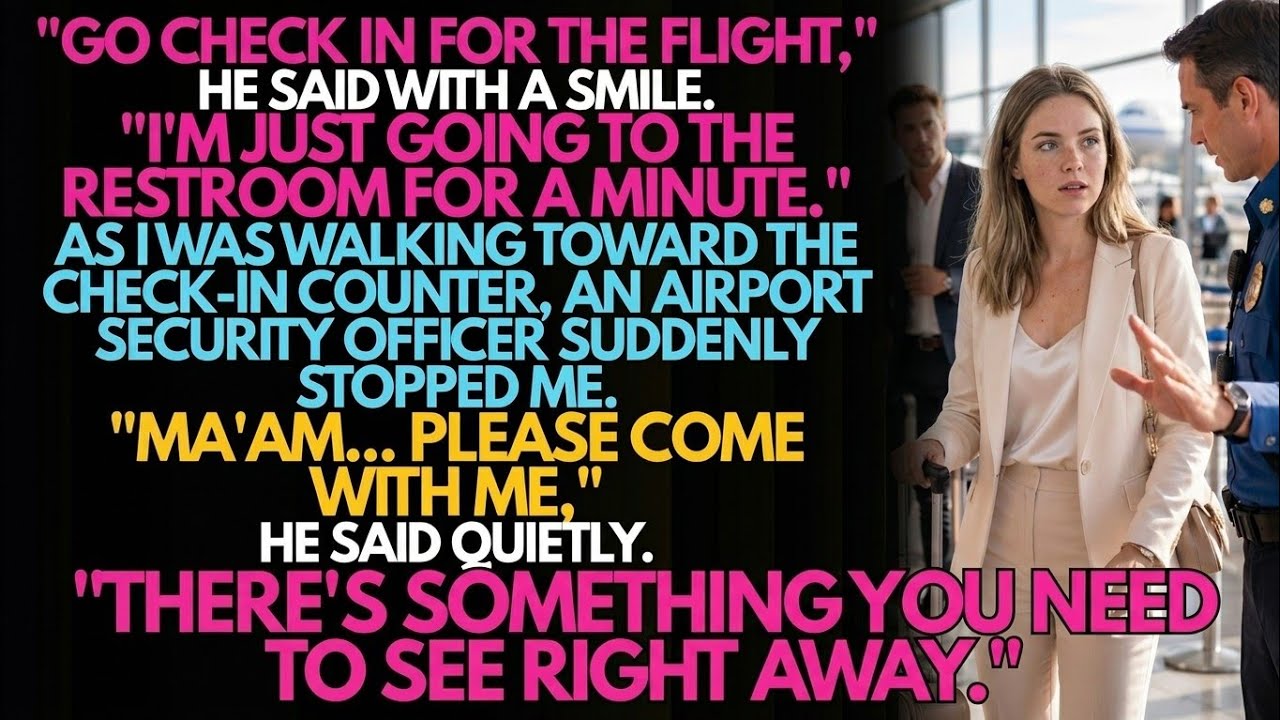
“My husband just stepped into the restroom,” I stammered, holding up our passports. “He’ll be right back. ”
“Your husband isn’t in the restroom, ma’am. Please leave your bags and follow me.
”
Mark had kissed my cheek and vanished into the crowd only minutes earlier. We were supposed to be flying to London for our fifth anniversary trip, a surprise he’d spent six months planning. Now I was being led into a small, windowless room that smelled of floor cleaner, with two plainclothes officers sitting across from me. “Where is Mark?
” I demanded. The lead officer turned a computer monitor toward me. A security video played. I watched my husband walk past the restroom entrance, pull a black jacket from his carry-on, and slip it over his shirt.
He approached a different gate at the far end of the terminal, handed a crisp blue passport to an agent, and walked down the jetway. “That flight left for Dubai six minutes ago,” the officer said flatly. “He checked in under the name Julian Vance. ”
I shook my head.
“No. That’s impossible. He just gave me our passports. ”
“He gave you your passport and a dummy document,” she corrected.
She pulled up a bank ledger. “An hour before you arrived, your joint savings, checking, and investment accounts were emptied completely. Liquidated and transferred to an untraceable account in the Cayman Islands. Your credit cards were maxed out to pay for his first-class ticket under his new name.
”
He hadn’t just left me at the airport. He had erased our entire life while I stood in line holding a useless piece of paper. The ride back to our house felt like a nightmare I couldn’t wake from. Two local detectives followed me down the quiet, tree-lined streets of our neighborhood.
I kept looking at the empty passenger seat where Mark had sat laughing just hours before. When I unlocked the front door, the silence was deafening. The house looked pristine, almost staged for sale. But as I walked through the rooms, the horror deepened.
Mark’s clothes were gone from the closet. His watches, his laptop, even his favorite books had vanished. He had spent weeks systematically packing his life away while I was at work, leaving behind only my belongings to maintain the illusion. In his locked home office, the detectives forced open a heavy mahogany desk drawer.
Inside, nestled beneath old tax filings, was a folder labeled with my name. It didn’t contain love notes or financial security. It contained loan documents. Dozens of them.
Over the past three years, Mark had forged my signature on personal guarantees, taking out over $600,000 in high-interest business loans to keep his failing logistics firm afloat. He hadn’t just abandoned me. He had carefully orchestrated my complete financial ruin. I collapsed onto the desk chair, staring at my signature forged on paper after paper, realizing I had been living with a monster.
The anger didn’t hit right away. It started as a cold, sharp focus in the middle of my chest. While the detectives took notes in the hallway, I sat alone on the floor of our bedroom, surrounded by the three suitcases Mark had forced me to pack the night before. He’d insisted on double-checking my bags, claiming he just wanted to make sure I didn’t forget anything for the cool European evenings.
I pulled open my carry-on and began dumping its contents onto the rug. Beneath my sweaters, at the very bottom of the bag, sat Mark’s old leather dopp kit—an item he’d supposedly packed in his own luggage. My fingers traced the worn leather until I felt something hard. A small lump tucked deep inside the silk lining.
I tore the fabric and found a brushed aluminum USB flash drive. He had made a mistake. In his rush to finalize his escape, he’d misplaced his physical backup drive, mistaking my bag for his. I called my closest friend, Maya, an IT systems auditor.
She arrived within twenty minutes. Sitting at my kitchen table with a pot of black coffee between us, she plugged the drive into an air-gapped laptop. It was encrypted with a 256-bit key, but Mark had used a variation of his first dog’s name combined with our wedding anniversary date—a password I knew by heart. When the drive unlocked, my breath hitched.
Spread across dozens of organized folders was a master digital ledger. It contained every transaction, every shell company registration, and every offshore account he’d opened in Panama and the Cayman Islands under his new identity, Julian Vance. It even contained the direct login tokens and phone numbers for his offshore private bankers. Mark thought he’d left me helpless.
He didn’t know he’d handed me the keys to his entire secret empire. By seven the next morning, I wasn’t weeping in bed. I was sitting in a high-rise office overlooking downtown Sacramento, across from David Ross, a federal forensic accountant and former prosecutor. Maya sat beside me, her laptop open, displaying the decrypted files from Mark’s USB drive.
David leaned over the desk, his eyes widening as he scrolled through the master ledger. “This isn’t just a paper trail, Mallory,” he said, turning the screen toward his associate. “This is an absolute blueprint of his entire money laundering network. He left you the exact account numbers, SWIFT codes, and corporate registration seals.
”
Instead of rushing to file a standard civil lawsuit that would alert Mark, David contacted federal authorities and initiated an emergency international legal maneuver known as a Mareva injunction. Armed with direct proof that the offshore funds in Panama were derived from forged domestic loans and stolen joint assets, federal prosecutors filed ex parte freeze orders across three international jurisdictions. Within four hours, every single offshore bank account registered to Julian Vance was completely locked down. Mark was sitting on a beach somewhere, completely unaware that his millions were frozen solid.
But we needed him to expose himself further to secure criminal extradition. Under David’s guidance, I executed the final step of our trap. I logged into our old empty joint banking portal and initiated a public, low-priority legal hold notification on our domestic properties. To Mark, who was monitoring my actions remotely through his phone, it looked like I was desperately trying to liquidate our remaining assets to pay his debts.
I left a digital paper trail so obvious it practically begged him to log into his primary Panamanian server to move his capital one last time before I could touch it. The bait was in the water. Now we waited. At 11:42 p.
m. , my phone buzzed on the desk in David Ross’s office. The caller ID displayed an unknown international number with a Panamanian country code. Federal agents in the room signaled for me to answer, hitting the recording button on their equipment.
I swiped the screen and brought the phone to my ear. “What did you do, Mallory? ” Mark’s voice exploded through the speaker, devoid of his usual calm charm. He sounded breathless, frantic.
“What the hell did you do to my accounts? ”
I took a slow, deep breath, leaning back in my chair. “Hello, Mark. How is Dubai?
Or should I say Panama? ”
“Don’t play games with me,” he screamed, his voice cracking. “I tried to transfer funds to my local credit line and the server kicked me out. The bank manager told me my credentials have been suspended under an international court order.
How did you even find those accounts? ”
“You were always so meticulous, Mark,” I said calmly, my voice steady and unwavering. “Except when you double-checked my carry-on bag at the house. You left your leather dopp kit inside my suitcase.
The one with the aluminum USB drive. ”
There was a long, suffocating silence on the line. I could hear his rapid breathing as the realization hit him like a physical blow. “Mark, Julian Vance doesn’t exist anymore,” I continued, letting every word sink in.
“Every single dollar you stole from our joint accounts, every loan you forged in my name, it’s all frozen. Federal prosecutors have the master ledger, the forged signatures, and the offshore wire receipts. ”
“Mallory, please,” his tone shifted instantly, turning into that sickeningly desperate, synthetic sympathy he used whenever he got caught in a lie. “We can work this out.
I did this for us. To give us a fresh start. ”
“Look out your hotel window, Mark,” I interrupted coldly. “There are four Panamanian federal officers standing in the lobby right now with an extradition warrant.
Goodbye, Mark. ”
I hung up before he could reply, leaving him in total silence. Mark was extradited three weeks later, brought back in handcuffs to face federal charges of bank fraud, identity theft, and grand larceny. The frozen offshore assets were recovered through court restitution, fully clearing the forged debts in my name and securing my financial independence forever.
Standing in my quiet home a few months later, looking out at the morning sun, I realized something fundamental had changed. The woman who stood terrified at that airport counter, the woman who believed her life was over when her husband walked away, was gone. In her place was someone who had discovered her own strength, her own resilience, and her own power to fight back.
Betrayal is a terrible thing, but it taught me that I am capable of building a better life entirely on my own terms.