The coffee cup slipped from my hand before I even understood what I was hearing. It hit the floor and shattered, sending dark liquid across my sneakers while two nurses at the station kept talking in low, casual voices about an empty slot on Dr. Patterson’s surgery schedule. A patient named Laura Brown had never shown up for her pancreatic cancer operation.
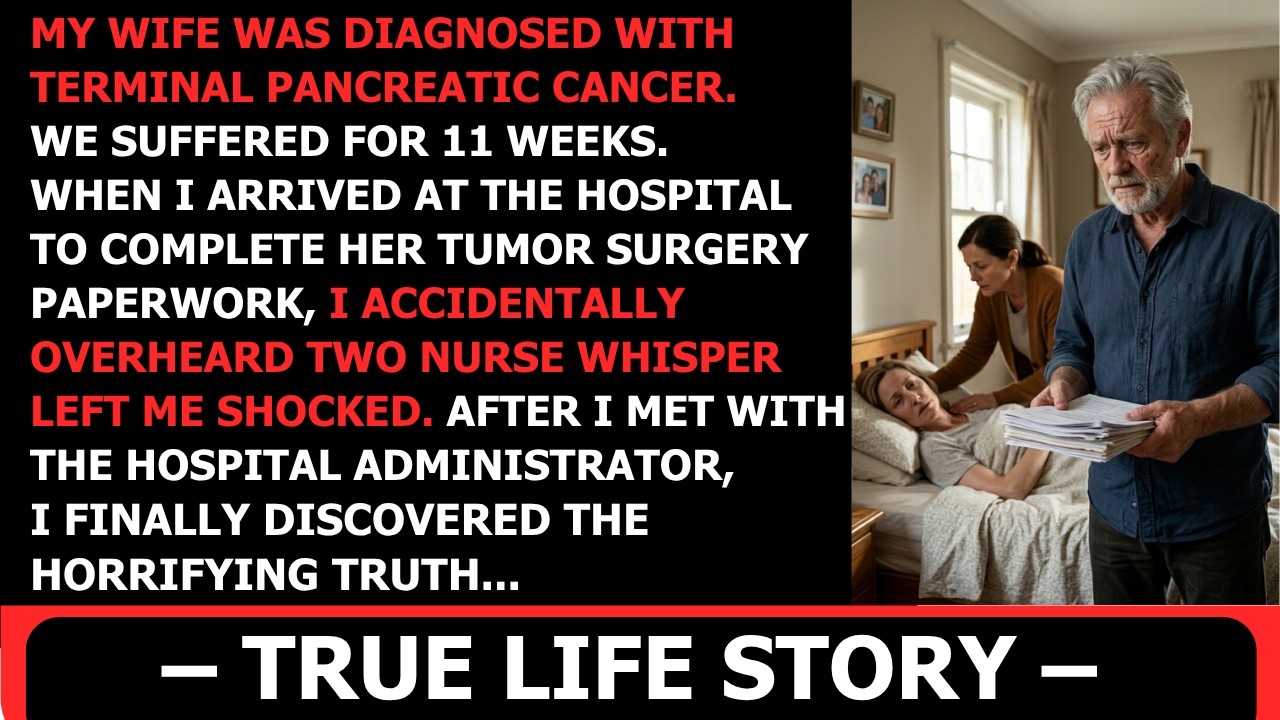
Every part of my body went cold. I gripped the edge of the counter and told them I was Laura Brown’s husband. I had come early that morning to finish her admission paperwork. My wife was lying at home right now, waiting for me to come back and bring her here—waiting for her chance to be saved.
The younger nurse frowned and searched the hospital’s central database. After a long silence, she looked at me with something close to pity. She said the main system had no record of any appointment for my wife under that name. Dr.
Patterson had never scheduled her. The system had never received her paperwork at all. My hearing faded. The hallway sounds disappeared, and I stood there like a stranger in my own body.
For eleven weeks we had been living under the shadow of a terminal cancer diagnosis. I had watched my wife waste away day by day, believing we were counting down her final months. And now the hospital was telling me none of it existed? I ran out of the building and collapsed into my truck, my hands shaking too violently to get the key into the ignition.
The eleven weeks replayed behind my eyes like a horror film I couldn’t escape. It had all started on a gloomy Tuesday. Laura collapsed in the kitchen while making dinner. In the emergency room, a doctor pointed to a shadow on her CT scan and spoke a single word that crushed our world: tumor.
He scheduled a biopsy and told us to return in three days for the results. Those three days became the longest of my life. When the results came back, Carol was the one who brought them. Carol Baker was my sister-in-law, the widow of my late brother.
Throughout those terrifying weeks she had been our only support. She came over every day with trays of hot food. She cleaned the house. She stayed up through the night watching over Laura so I could sleep.
She sent me long messages telling me to stay strong. I had cried from gratitude more than once, believing she was our guardian angel sent to carry us through the darkness. Now, standing in the hospital hallway, the nurse’s words kept echoing: no record. No name.
No appointment. I drove home with my mind drowning in questions. When I pushed open the front door, the smell of chicken soup hit me. I found Carol sitting beside Laura’s bed, feeding her spoonful after spoonful.
She looked up with warm, sympathetic eyes, told me to rest, and said she had everything under control. A cold chill ran down my spine. If the hospital had no record of Laura, then where had the thick medical file with the specialist’s signature come from? Who had been the first person to bring it into our home?
Carol. She had volunteered to pick up the test results that day. She had been the one who embraced Laura in tears and delivered the diagnosis of terminal pancreatic cancer. I stared at her back as she walked into the living room, and her devotion suddenly felt terrifyingly unnatural.
I had never questioned her. I had trusted her completely because she was family. I went to my desk, opened the drawer, and pulled out the medical file sealed in a plastic sleeve. I turned the pages until I reached the hospital’s official seal.
Something about the font looked wrong. I couldn’t stay in that house. I grabbed the file and drove back through the rain, heading not for the emergency department but for the hospital administrator’s office on the top floor. I pushed the door open without an appointment and slammed the file onto his desk.
The administrator saw the fury on my face, saw the blood still seeping from the wounds on my knuckles, and didn’t refuse. He put on his glasses, entered the file number into his computer, and began to read. His expression changed from calm to serious. Then his face went pale.
He locked the door, sat back down, and told me the hospital had never admitted any patient named Laura Brown for pancreatic cancer surgery. The red seal on the document was forged using sophisticated printing technology. The doctor’s signatures were fake. Even the font didn’t match the hospital’s official formatting.
My knees gave out. I collapsed into the leather chair as the truth crushed into me. The diagnosis letter was a forgery. My wife had never had terminal cancer.
She had never been dying. For eleven weeks we had been trapped inside a cruel deception, and I had watched the woman I loved fade because of a lie. I walked out of the administrator’s office with my body drained. In the lobby, I stared at the envelope that had originally contained the forged file.
Then I noticed a tiny detail I had missed before: a faint barcode in the corner. It didn’t belong to the hospital. It belonged to an online office printing service. That night I couldn’t sleep.
At four in the morning I sat on the floor of my study under the lonely glow of a desk lamp, spreading every forged document across the desk. Beside them lay my phone, open to Carol’s text messages. I read every message she had sent over the past eleven weeks, and the pattern became horrifyingly clear. She asked about Laura’s symptoms in detail every single night.
She constantly reminded me to make sure Laura took the specific vitamin pills she had brought over, claiming they helped relieve pain in terminal cancer patients. She had personally picked up the medical file. She had personally brought those pills every day. Laura hadn’t been declining because of a tumor.
She had been declining because of the pills and the soup Carol brought into our home. The guardian angel had been a devil all along. I grabbed my phone and called Dr. Jennifer Roberts, a toxicology expert and an old college classmate of mine, even though it was the middle of the night.
When she answered, I told her Laura’s life depended on her examining a sample of medication and a set of medical records. She told me to bring everything to her private lab immediately. I slipped into Laura’s bedroom and carefully removed several of the vitamin pills from the bottle Carol had brought. I looked at my wife’s sleeping face, hollow from being poisoned day after day, and swore whoever had done this would pay.
I spent three hours waiting outside Jennifer’s laboratory. When dawn broke and the door finally opened, Jennifer’s face was pale. She pulled me inside and locked the door behind us. Using her credentials, she had accessed St.
Jude Hospital’s original database and located Laura’s genuine medical records. The tumor was completely benign, in a location where it could be safely removed through routine surgery. Laura had never had terminal cancer. Then she handed me the toxicology report on the pills.
They weren’t vitamins. They were a neurological suppressant designed to weaken the entire body—to create symptoms identical to a terminal cancer patient wasting away. The purchase requests had been signed under the identity of an independent medical assistant. The name on every forged document delivered to my home: Carol Baker.
I wanted to race home and strangle her with my bare hands. Jennifer grabbed my arm. If I confronted Carol now, she would destroy every piece of evidence and vanish. We needed a plan.
We needed to catch her in the place where she believed she was safest. I took a long breath and let my hatred harden into something cold. I would build a trap and let her walk into it. The next morning, I found Carol in the kitchen chopping meat to make porridge for Laura.
She looked up, smiled warmly, and asked where I had been so early. I forced myself to speak in a weary voice and told her I had come from the hospital to ask about the surgery. Dr. Patterson wanted every family member present on Monday morning to sign the final consent forms.
I told her I needed her there because she understood Laura’s condition better than anyone. For a brief moment, her hand froze over the knife. Then she quickly regained her composure, walked over, and placed a warm hand on my arm. She promised she would be there to support both of us.
The sweetness made me physically sick. I nodded and walked into Laura’s bedroom, where I sat beside my wife and whispered that she only needed to hold on a little longer. The truth was about to come out. There would be no real surgery on Monday morning.
That would be the day Carol Baker faced judgment. Monday came. The air in the hospital conference room was heavy enough to suffocate. Carol walked in wearing an elegant coat, carrying an expensive handbag, radiating the same confidence she always carried.
She sat down across from me and the hospital administrator, and the door was locked from the outside. Then Jennifer Roberts stepped out from behind the curtain, placing two thick files on the table. One held Laura’s genuine medical records showing a benign tumor. The other held the toxicology report on the vitamins Carol had delivered to my home.
The smile froze on Carol’s face. I stood up and hurled the forged medical file at her. Papers exploded into the air and drifted onto the floor. I demanded to know why she had forged the records.
I demanded to know why she had poisoned my wife. Carol’s face lost its color. She stammered denials, insisting I had lost my mind from worry. She turned to the administrator looking for sympathy, but he only stared back in silent disgust.
Jennifer played the recorded call with the online printing company and the purchase records for the neurological suppressant, all bearing Carol’s name. Every escape route vanished. Carol’s body began trembling. She collapsed into the chair, her saintly mask crumbling into the desperation of a trapped animal.
Then she let out a bitter laugh and raised her head, her eyes blazing with jealousy and hatred. She confessed to everything. She said she had loved me for years, even before my brother died. She hated Laura and couldn’t bear watching me love my wife every day.
She wanted Laura to disappear slowly, so no one would ever become suspicious. She wanted to take Laura’s place and become the only woman by my side. I didn’t say another word to her. I pressed the call button.
The door swung open, and two security officers entered with uniformed police. They took Carol into custody, and the cold handcuffs snapped shut around her wrists. As she was being led down the corridor past Laura’s room, the door suddenly burst open from the inside. Laura stood there.
Her body was frail beneath the oversized hospital gown, her skin still pale from the toxic drugs, but her eyes burned with a determination I had never seen before. I rushed to support her, but she gently raised her hand. She wanted to face this herself. Laura stared at the handcuffs around Carol’s wrists, then looked up at the fake tears running down her sister-in-law’s cheeks.
Her voice was hoarse but unwavering: “You were cruel enough to condemn my life to hell for eleven weeks just so you could take my place as his wife. ”
Carol lowered her head. She couldn’t look at the woman she had betrayed. The police escorted her away until she disappeared around the corner of the hallway, her dragging footsteps fading into silence.
Laura turned to me. The strength she had shown vanished, and she collapsed into my arms, bursting into tears. I held her tightly and felt her tears soaking through my shoulder. Our worst nightmare had truly come to an end.
A few hours later, Laura was taken into the operating room for her real surgery. The real Dr. Patterson shook my hand and smiled reassuringly. While I was packing Laura’s belongings from her old room, I found a small envelope tucked beneath her pillow.
It was an old handwritten letter from Carol to Laura, written a year earlier. It wasn’t a threat—it was a confession filled with jealousy, admitting that she had always envied the happy life Laura and I shared. Her twisted obsession had taken root long before any of this began. I burned the letter to ashes in a hospital trash bin.
I wanted every trace of that hatred gone from our lives forever. Three weeks later, Laura was discharged. The surgery to remove her benign tumor was a complete success. Once she stopped taking the poison, her health recovered remarkably.
The color returned to her face, and the radiant smile I loved had finally come back. We held a small celebration beneath the old oak tree behind our house—the same place where we had once stood counting down what we thought were the last moments of her life. I held Laura’s warm hand and felt the strong pulse of life flowing through her again. We had walked through the shadow of death and reclaimed the life that had almost been stolen from us.
I learned a lesson that would stay with me forever. The deepest betrayal almost always comes from the people we trust the most. Blind trust, without verification, becomes the greatest weapon an evil person can use against you. Trust should be examined regularly, just like the foundation of a house after a storm.
Never hand someone else the keys to your life. Never allow another person to write the ending of your story. Stay alert and protect the people you love from those who hide behind perfect masks.