The first thing I noticed when I opened my eyes was the smell. Antiseptic, industrial bleach, cold and unforgiving. Then the ceiling, a hard fluorescent white, with two bulbs buzzing overhead. My body felt like it had been taken apart and put back together by someone who had never done it before.
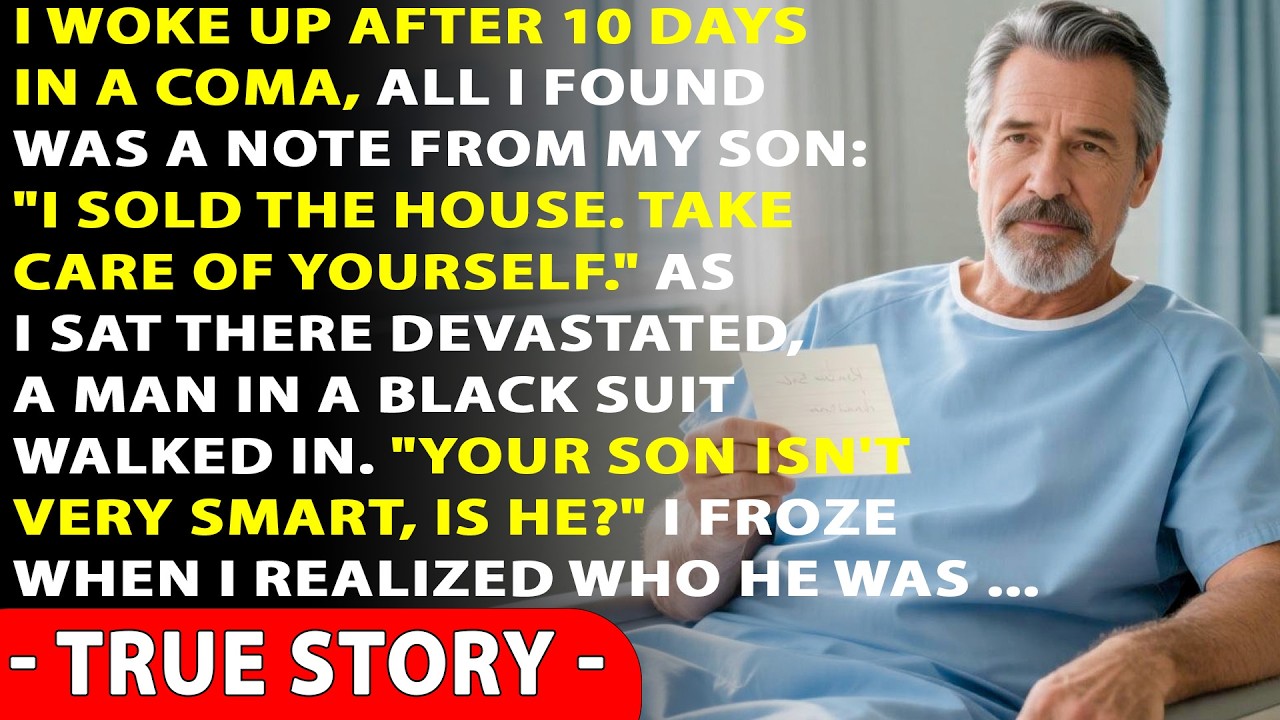
I turned my head to the left. There was a chair in the corner, positioned just right for someone to sit and watch over a person lying in a bed. It was empty. I told myself not to read into it.
Ryan was probably down the hall getting coffee, talking to the doctor, filling out insurance forms. That was a Ryan thing to do. But some older, quieter part of me already knew: the chair hadn’t been warm in a very long time. I lay still and let the memories come back in pieces.
The staircase at my apartment building. Reaching for the railing. The way it gave, suddenly, like it had been waiting for me to trust it. The side of my head against the concrete edge of a step.
A sound like static filling the world. And then nothing. Ten days of nothing. I had worked thirty years in a warehouse, walked away with two bad knees and $47,000 in savings I never touched.
I gave Ryan everything else. I sold my truck so he could go to college. I kept a jar behind the canned goods for his first apartment deposit. I didn’t need him to ask.
I just needed him to be okay. So as I lay there staring at that empty chair, I kept rebuilding the story. He’s tired. He stepped out five minutes ago.
He’ll walk through that door any second. That’s when I noticed the piece of paper on the bedside table. Folded in half, set down beside the plastic water pitcher. The way you set down something you’re done with.
I recognized the handwriting before I even reached for it. Ryan always pressed too hard when he wrote. My hand trembled as I unfolded it. Three sentences.
“Dad, I sold the house. You’re nothing but a burden. Figure it out yourself. Don’t call me.
”
I read it once, then again, then a third time because the words kept sliding off my comprehension. Nothing but a burden. Thirty years. The truck I sold.
The jar behind the canned goods. His graduation, when I stood in that crowd with a shirt I’d ironed three times. The sob that came out of me wasn’t dignified. It was ugly and raw, and it shook my whole body.
The machine beside me started beeping faster, like it was panicking on my behalf. The door opened. A nurse in blue scrubs, name badge reading Linda RN. She crossed the room, picked up the box of tissues from the windowsill, and set it on the bed beside my hand.
“Is there someone I can call? ” she asked. I looked at the paper still in my hand. “No,” I said.
“There’s no one. ”
She left quietly. The door clicked shut. I was alone with a crumpled piece of paper, and sixty-seven years of a life that felt like it had been built on sand.
Then three knocks landed on the door. Not tentative, not quick. Three deliberate, unhurried knocks, the kind made by a person who already knows they’re going to come in. He wasn’t a doctor.
I knew that the second he stepped into the room. Not because of the suit, though it was charcoal wool, the kind that costs more than most people’s monthly rent. It was the way he moved. Doctors move like they’re solving a problem.
This man moved like he’d already solved it. He pulled the visitor’s chair from the corner and set it beside my bed. He sat down, placed a black leather briefcase on the floor, folded his hands in his lap, and looked at me the way you look at someone you’ve been waiting on. “Mr.
Carter,” he said, “I’m sorry to intrude. I imagine this is not the morning you’d hoped for. ”
“I don’t know who you are,” I said. “No, you wouldn’t.
My name is Harold Bennett. I’m an attorney and the chief administrator of a private estate based here in Charleston. ” He paused. “I’ve been looking for you for a very long time, Mr.
Carter. ”
I stared at him. “I’m a retired warehouse worker. I don’t own property anymore, apparently.
” I looked down at the paper in my hand. “There’s nothing to find. ”
Harold looked at the paper, too. Something shifted in his expression.
Not surprise. More like a quiet fury held very still. “Perhaps your son isn’t very smart,” he said. “You don’t know my son.
”
“No. But I know what he just did, and I know what he doesn’t know. Those two things are about to become very important. ”
I should have pressed the call button.
Instead, I found myself watching his hands, still folded neatly in his lap. No fidgeting, no tells. This man had sat in hard conversations before. “What do you want?
” I asked. “To tell you the truth. All of it. It’s going to take some time, and some of it is going to be difficult to hear.
”
He looked at my right wrist. “That bracelet you’re wearing, the silver one? ”
My hand moved before my brain caught up, pulling my wrist toward my chest. I’d worn the bracelet since before I could remember.
I never took it off. “What about it? ” I said. “I’ve seen that bracelet before,” Harold said quietly.
“In photographs. In documents. In a description written by a forensic archivist who spent fourteen months trying to match a piece of silver jewelry to a family crest. ”
My mouth was dry.
“What family? ”
Harold opened the briefcase and drew out a photograph, old enough that the edges had softened. It was a picture of a little boy, maybe four or five years old, standing in front of a tall iron gate set into a stone wall. Behind it rose a white three-story house with black shutters and columns across the front.
The little boy was squinting into the sun, grinning. On his right wrist, clearly visible, a silver bracelet. Identical to mine. “That little boy,” Harold said, “is you.
Taken in the summer of 1961 in front of your family home. ” He let a beat of silence pass. “Your real name is not Joseph Carter. ”
“Then what is it?
”
“Your name is William Ashford. And the man standing beside you in that photograph, the one you share the same jaw with, is your father, Edmund Ashford. He spent the last forty years of his life looking for you. And when he died, he left you everything he had.
”
I stared at the photograph. My hands were shaking so badly I had to set it down on the bed before I dropped it. “You keep saying my father,” I managed. “I grew up in an orphanage.
I don’t have a father. ”
“You have one,” Harold said firmly. “Or rather, you had one. A very stubborn, very devoted man who refused to accept what everyone around him kept telling him for sixty-three years.
”
He told me about Ashford Capital Group, the forty-story building on Meeting Street, the Asheford crest in black marble on the lobby floor. Founded in 1938 by my grandfather. Passed to my father in 1971. “Your name, your real name, is William Edmund Ashford.
You are the only child of Edmund Ashford II and the sole living heir to the Ashford family. ”
The room felt like it had tilted two degrees. “That’s not possible,” I said, my voice cracking. “I’m a warehouse worker.
I drove a forklift for thirty years. I am nobody. ”
“Stop,” Harold said quietly, steel underneath. “Don’t reduce yourself to what someone else’s cruelty made you into.
You are not nobody. You never were. And the man who spent sixty-three years refusing to stop looking for you would be very angry to hear you say that. ”
He reached into the briefcase and produced another photograph.
A man in his late seventies, silver-haired, straight-backed, behind a large mahogany desk. The jaw, the set of the brow, the way the corners of his eyes folded. The man in the photograph looked like me. “He passed away two years ago,” Harold said gently.
“January 2023. Heart disease. He was eighty-nine years old. He died in the same house you were born in.
”
My father had died two years ago. While I was driving forklifts and ironing shirts for Ryan’s graduation, my father had been alive seventy miles away, in the same city. “You said he left me everything,” I said, pulling my voice back under control. “What does everything mean?
”
Harold reached into the briefcase a final time and withdrew a document bound with a dark ribbon. “It means Ashford Capital Group. It means the family property in the historic district. It means the investments, the trusts, the accounts.
” He looked at me steadily. “It means $950 million, William. All of it. Every cent.
Left to you and only to you. ”
Then he showed me the letter. Martha Groves, my nanny, had written it from a hospice bed in Savannah, three weeks before she died in 2008. She confessed to taking me from the house in August of 1962, to registering me under a false name at St.
Andrews Children’s Home. She said a man had paid her, someone with a business interest in destabilizing the Ashford estate while Edmund had no heir. She didn’t know his real name. The trail had gone cold until Harold found Dorothy Reeves, a former intake coordinator at St.
Andrews, who remembered the nervous woman insisting, “Don’t take the bracelet off him. Whatever else happens, leave the bracelet. ” That detail narrowed the search. In February of this year, my name appeared in the hospital system after my fall.
Harold drove to the hospital that same night, saw the bracelet through the glass of the ICU window, and waited for me to wake up. I pressed my fingers against my eyes, steadying myself. When I lowered my hand, Harold was watching me with the careful attention of someone who knew the next part would land differently. “There’s something else,” he said.
“Something about Ryan that I haven’t told you yet. ”
He reached for his briefcase and set it on his knee. “What I’m about to show you is not the story of a son who panicked. It’s the story of something that was planned.
”
Harold spread documents across the bed. My bank statement, showing a zero balance as of March 19th, withdrawn in small amounts over five days while I was in the ICU. A real estate transaction record, dated March 18th, selling my apartment building for $70,000 below market value. The buyer: Amber Carter.
My daughter-in-law. The forged power of attorney, with a forensic handwriting analysis confirming ninety-four percent certainty the signature was not mine. Then the text messages, recovered through a legal preservation order. Amber steering, Ryan following, the language shifting from vague resentment to specific planning over the course of eight months.
By February, they were discussing how power of attorney documents worked. Then the USB drive. Harold turned his laptop toward me. Security footage from my building’s stairwell, timestamped March 10th.
Ryan, in a gray athletic jacket and a baseball cap, crouching beside the railing with a screwdriver. Loosening the screws just enough that the railing would give way under pressure. “He knew about the vertigo,” Harold said. “You’d asked him twice to help you tighten that railing.
He told you he’d get to it. He didn’t. He made it worse. ”
And then the final piece.
An insurance policy. Ryan had applied for it sixteen days before he loosened the railing. The insured: me. The beneficiary: himself.
$750,000. The signature on the application was forged with 96. 8 percent certainty. “Individually, each of these things is serious,” Harold said.
“Together, they form a pattern. And patterns are what prosecutors use to establish intent. ”
I looked at the pages, then at the photograph of my father. “Schedule the board meeting,” I said.
“I want every executive in that room. And Harold, not a word to the police until after I walked through those doors. ”
Three days later, I walked out of Trident Medical Center in the suit my father had made for me, the Ashford crest embroidered on the breast pocket. George drove us through North Charleston first, past the warehouse district, the diner on Rivers Avenue, the landscape of a life I’d built without knowing it wasn’t mine.
Then the historic district, through tall iron gates bearing the Ashford crest. The manor rose ahead, three stories of white painted brick, black shutters, columns that had stood longer than my grandparents had been alive. Eight staff members lined the entrance. A woman stepped forward with the bearing of someone who had run a large household for decades.
“Welcome home, Mr. Ashford,” she said. “We’ve been waiting a long time for this day. ”
Inside, photographs lined the entrance hall walls.
I moved slowly until I found it, at eye level: a photograph of a little boy in the garden, squinting into the sun, my bracelet catching the light. “He put it there himself,” Harold said. “Center of the wall. He said it was so he’d see it every morning when he came downstairs.
He saw it every morning for sixty-three years. ”
At the top of the stairs, a bowl of fresh magnolia had been laid across the threshold. Harold opened the door. The room was small, a child’s bedroom, with a single bed, a bookshelf packed with children’s books, a desk beneath the window.
Above the desk, taped to the wall with yellowed tape, a crayon drawing on white paper. Two figures, one tall, one small, standing in front of a house with four windows. Beneath them, in the large, uneven lettering of a child: “Me and Daddy. ”
My knees went weak.
I had drawn this. And he had kept it for sixty-three years. “The flowers,” I said, barely above a whisper. “I placed one every Monday morning for thirty-four years,” Harold said.
“Your father’s instructions were to keep the room ready. I interpreted ready to mean alive. A room with fresh flowers in it is alive. A room without them is a museum.
”
I sat down in the chair that had once been mine. “You said Ryan’s actions were planned,” I said. “I need to know what Ryan knew about who I am. When did he know?
”
Harold unfolded a sheet of paper. “January of 2023. Two years and three months ago. Ryan discovered your real identity.
And from that day forward, every decision he made was shaped by one question: how do I make sure my father never finds out? ”
He knew. He sat at my table, called me on my birthday, came to my apartment for Thanksgiving. And he knew.
Harold walked me through it. Ryan had found the tin box in my closet, the bracelet, the photograph. He recognized the Ashford crest from the company letterhead. He went home and told his wife.
The first text message, dated January 21st, 2023: “The old man might be worth more than we thought. ” Amber: “Try 950 million. ” Ryan: “We need to make sure he never does. ”
Then Harold placed a cream-colored envelope on the table.
“This belonged to your father,” he said. “Edmund wrote it in the last week of his life. He asked me to give it to you when you were ready to fight. ”
The board meeting was three days later.
Margaret Holloway met us in the corridor. “Edmund talked about you for years,” she said quietly. “He never stopped believing. ”
I walked to the head of the table, the opposite end from Ryan.
I set both hands flat on the polished walnut surface. “My name,” I said, and my voice did not shake, “is William Edmund Ashford. And I am home. ”
Harold distributed the document packets.
The DNA certification, red-stamped and notarized. Edmund Ashford’s will, the key clause enlarged: my biological son, William Edmund Ashford, sole heir to all personal assets, real property, and controlling interest in Ashford Capital Group. Ryan shoved back from his chair. “You walk in here with some document and a DNA test and you think what?
That you can just—he’s my father, Joseph Carter. He worked in a warehouse for forty years. ”
“The third document, please,” I said to Harold. The bank records.
The seven withdrawals. The real estate deed with Amber Carter as buyer. The forensic analysis of the forged POA. Then the still frame from the security footage, Ryan crouched at the base of the stair railing with a wrench.
And the text message transcript projected large enough for everyone to read: “We need to make sure he never does. ”
Ryan’s leg gave out. He caught himself on the back of his chair, his whole body shaking. “That railing sent me into a ten-day coma,” I said, my voice breaking.
“I woke up alone with a note telling me I was a burden. You wrote that note, Ryan. You sold my house. You took my savings.
And you made a choice. ”
Harold’s voice was quiet and absolute. “The Charleston Police Department is currently in the lobby. They have warrants for your arrest.
”
The door opened. Two officers in plain clothes entered. Ryan looked at me, his face crumpled. “Dad,” he said, his voice shattering.
“I know,” I said. And I meant it. The officers reached him and led him out. Margaret Holloway moved a motion to formally recognize me as the legal owner of controlling interest.
It passed seven to zero. I signed my name for the first time: William Edmund Ashford. Later, Harold handed me the cream-colored envelope. I sat in my father’s chair, in his study, and opened it.
Inside were not one letter, but many, folded together, each page dated at the top. The first was dated May 14th, 1963. My sixth birthday. “Dear William, you would have been six today.
I bought a cake anyway, chocolate, because your mother always said you would love chocolate. I want you to know that your father is looking. I will not stop. ”
He wrote one every year.
Sixty-three letters, one for every year I had been gone. The last was dated May 14th, 2022, eight months before he passed. “I am leaving everything to you. Not because of the money.
The money is nothing. But because this company is the thing I built while I was waiting for you to come home. Come home, William. It is not too late.
It was never too late. I love you. I have always loved you. ”
I sat with my father’s letters until the afternoon light turned amber.
Then I told Harold I wanted to create a foundation. The Second Chance Foundation. Real support, legal aid, housing, family reconnection services. For the people who never found their way home.
Six months passed. September came to Charleston. Harold set two items on my desk. A manila folder and a white envelope with a return address from the Lee Correctional Institution.
Ryan’s handwriting. “Amber Carter filed for divorce on August 3rd,” Harold said. “Under the settlement, she retained the house purchased with your money, along with all joint accounts and Ryan’s personal investment portfolio. He has nothing, William.
Not a dollar. ”
The irony was so complete I didn’t know whether to laugh or grieve. The woman Ryan had chosen had taken everything from him, too. I picked up Ryan’s letter.
It was two pages, handwritten, the penmanship uneven. “Dad, I don’t expect you to forgive me. But I need you to know that I am sorry. Not because I got caught, not because she left me with nothing, but because of who I chose to be.
You worked forty years in a warehouse. You never asked me for anything. And I looked at you and saw a problem to solve instead of a father to love. ”
I set the letter down.
The love that had not died even in the boardroom was still there, carrying scar tissue, but still there. “I’m going to write him back,” I said. Harold reached into his pocket and set a small velvet pouch on the desk. Inside was a silver bracelet, narrow-gauged, handmade, unmistakably a companion piece to my own.
On the inside band, six words engraved so small I had to hold it close to the light: “An Ashford is never truly lost. ”
“Your father had it made in 1961,” Harold said, his voice soft. “He wore his half every day. He asked me to keep the other half until I found you.
I have been carrying it for two years and three months. ”
I clasped it onto my wrist. The weight was different now. Heavier, fuller.
We went up to the roof of Ashford Manor. The September sky turned amber and rose and deep blue, the harbor a strip of hammered silver. I stood at the low wall, my wrist resting on the stone, the completed bracelet catching the last of the light. “Thank you for every single year of it,” I said.
Harold exhaled long and slow, the breath of a man who has just set down something heavy. “It was the only promise worth keeping. ”
The sun finished its descent behind the Charleston rooftops.
For the first time in sixty-eight years, I was exactly who I was supposed to be.