The box was not heavy. That was the first thing I noticed when I picked it up from the passenger seat of Ethan’s truck that morning. Thirty-five years of work, and the evidence that would end everything, fit inside a cardboard box I could lift with one hand. I carried it through the front entrance of Hayes Freight Solutions and took the elevator to the second floor.
My ribs still ached when I breathed too deeply, a reminder of what had put me in Cedar Sinai for the better part of three months. The doctor had warned me about pushing too hard too soon. I told him I appreciated his concern. Then I asked Ethan to bring me my suit.
The conference room door was closed when I reached it. Through the narrow window beside the frame, I could see Audrey standing at the head of the table, a presentation slide glowing blue behind her. She was wearing the gray blazer I had bought her for her thirtieth birthday. I pushed the door open and stepped inside.
The room went still. The color left her face the way water drains from a glass, completely and all at once. “Dad,” she finally said, her voice cracking on the word like old wood giving way. “You should be resting.
” I walked to the center of the table and set the box down. “I’ve been resting long enough,” I said. But I’m getting ahead of myself. To understand what was in the box, you need to go back to a Friday morning in September when everything I had spent my life building nearly came apart on a stretch of the 10 freeway.
I started Hayes Freight Solutions in 1987 with a single truck, a used Peterbilt 389, navy blue, with a crack in the passenger-side mirror I never got around to fixing. I was thirty-one years old, had four hundred dollars in my checking account, and a wife named Margaret who believed in me with a certainty I had never quite managed to feel about myself. She was right. It took fifteen years, but Hayes Freight grew from one truck to twenty, then to a hundred, then to the 230 vehicles that rolled out of our Commerce yard every week by the time Audrey joined the company after business school.
We had a reputation for showing up on time and delivering what we promised. Margaret didn’t live to see most of it. She passed away in the spring of 2003, when Audrey was eleven. Ovarian cancer.
The doctors gave her eight months; she lasted fourteen, because that was who she was, stubborn in the best possible way. The morning after her funeral, I sat at the kitchen table with Audrey across from me. She was still wearing her black dress. Her eyes were red and swollen, and she kept folding and unfolding a paper napkin in her hands.
“Are we going to be okay? ” she asked. I stared at the window above the sink and told myself I was not going to fall apart in front of my daughter. “Yes,” I said.
“We’re going to be okay. ” I kept that promise for twenty-two years. The morning of the accident was ordinary in all the ways that matter. I merged onto the 10 heading east just after 7:40.
I never saw the truck coming. It hit the rear driver’s side of my truck with enough force to send me across two lanes. When I came to a stop against the concrete divider, my chest felt like something inside it had been rearranged. Three broken ribs, a head injury the doctors called mild, though nothing about the headaches felt mild to me.
The truck that hit me was gone by the time the first patrol car arrived. At Cedar Sinai, they put me in room 412. The attending physician, a careful man named Dr. Harmon, explained that the rib fractures would heal on their own.
I asked the nurse to call my daughter, Audrey. What I didn’t know then was that by the time Audrey arrived at my bedside, someone else had already been there first. Victor Langford was sitting in the chair beside my bed when I opened my eyes the next morning. He was dressed the way he always dressed, dark slacks, a collared shirt, a jacket that probably cost more than my first truck payment.
He smiled when he saw I was awake. “Walter,” he said, “you gave everyone quite a scare. ” My chest tightened, and not from the broken ribs. “Victor,” I said.
“How did you know which room I was in? ” He lifted one hand in a small, easy gesture. “I still have a few friends in this building. Word travels.
”
I studied his face while he talked. Victor Langford had always been good at this, the warm tone, the reasonable words, the way he made a conversation feel like a favor he was doing you. I had seen it six years ago across a conference table in my own building, when he had come in with a purchase offer and a smile just like this one. He had offered 40% below market value.
I had turned him down. “If there’s anything you need,” he said as he stood to leave, “the offer stands, Walter. It always has. ” He meant the other offer, the one I had refused in 2017.
I heard it underneath every word. After he left, I couldn’t stop turning one question over in my mind: how had Victor Langford known which room I was in before my own daughter had been called? Audrey arrived at 2:30 that afternoon. She crossed the room in four quick steps and bent to press her cheek against mine, careful not to put any weight on my chest.
“Dad,” she said, and her voice broke. She told me she would take care of everything, the company, the contracts, anything that needed handling. “You don’t need to worry about any of it,” she said. She had brought paperwork.
She had come prepared. Looking back now, I understand what I missed in that moment. I was too busy being grateful to notice that she had not asked me what I needed. She had told me what she was going to do.
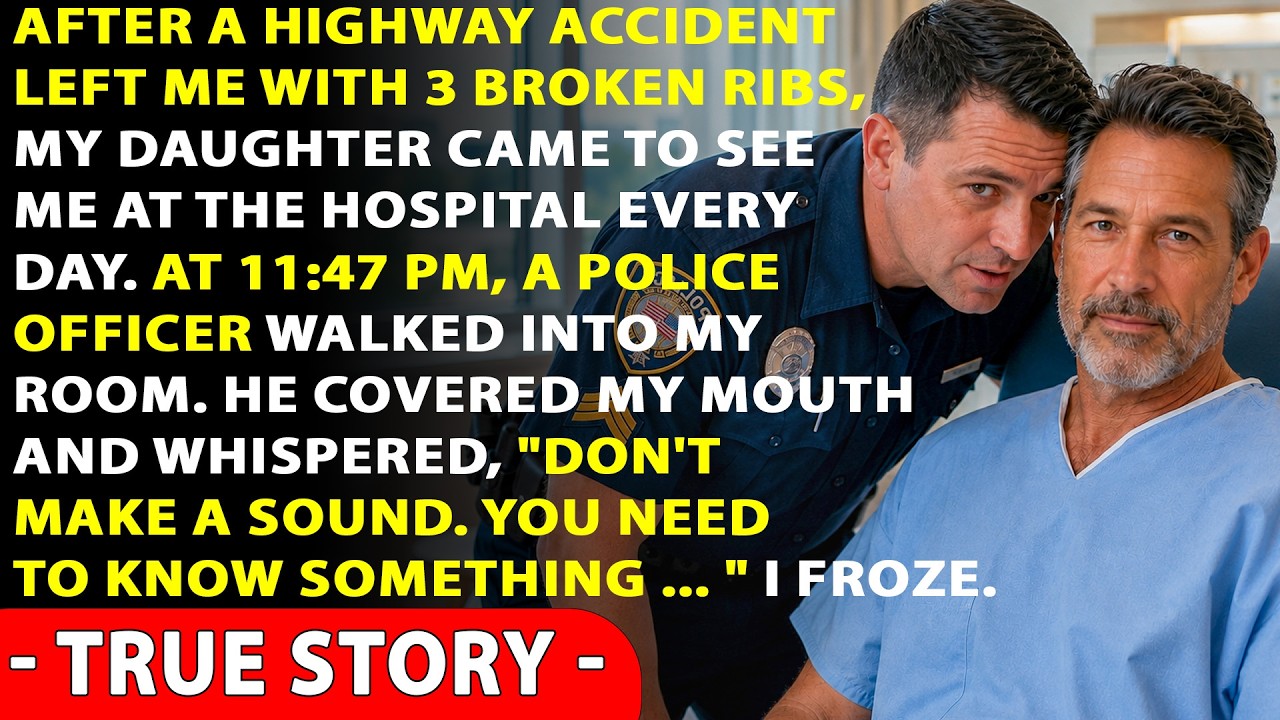
On the fifth night, I couldn’t sleep. It was 11:47 by the clock on the wall when I heard the door. Not a knock. This was slower, deliberate.
The door swung inward without a sound. A broad-shouldered man in a dark blue LAPD uniform stepped inside, paused, then turned and locked the door behind him. He crossed the room in eight steps and leaned over the bed. His hand came down over my mouth before I could draw a full breath.
“Don’t make a sound,” he said, just above a whisper. “I’m not here to hurt you, Mr. Hayes. I need you to listen to me.
” I grabbed his wrist with both hands, not to fight him off, but because it was what a frightened man would do, and I needed him to believe I was frightened. I was not frightened. I was watching. “My name is Daniel Cross,” he said.
“I’m with LAPD Commercial Transport Division. Your daughter is not managing your company, Mr. Hayes. She is dismantling it.
” He told me Audrey had been redirecting freight contracts to outside operators connected to a private investment group. But as he spoke, his eyes swept the room in a way that told me more than his words. He was looking for something. The nightstand, the closet, the tray table.
He had not come here to warn me. He had come here to find something. He searched the drawer, the closet, my jacket pockets, my phone. He found nothing.
The one place that mattered, he never checked. Three days before the accident, I had noticed something wrong in the routing data for our September freight schedule. I had learned a long time ago that when something in your own company doesn’t add up, you don’t wait to find out why. You copy the data, you put it somewhere safe, and you figure out the rest later.
I had copied everything onto a small drive. And I had given that drive to Marcus Reed, my chief accountant of twenty-two years, the morning before the accident, with instructions to keep it somewhere only he knew about. After Cross left, I called Marcus. “The drive is safe,” he said.
“Don’t move it. Don’t tell anyone. ” And then: “Starting tomorrow, I need you to watch everything. ”
The next morning, Audrey brought me coffee from the place on Wilshire and Robertson, the one with the green awning I had been stopping at for twenty years.
Dark roast, no sugar, a splash of whole milk. She had remembered. Of course she had remembered. She told me she had spoken with our operations manager about handling the Pacific Southwest contracts.
Then, in a tone so casual it almost slipped past me, she said she had been talking to some of the regional partners about restructuring a few of the smaller shipping lanes. “Just streamlining, nothing major. ” But I knew every lane we ran, every contract we held. The lanes she was referring to were not small.
They were the backbone of our California-to-New York corridor, the contracts that kept 230 trucks moving and 340 employees paid. “Which lanes? ” I asked. She smiled.
“Just the secondary connectors. I’ll put together a summary for you to review when you’re feeling better. ”
I nodded and let it go, because that was what a tired, injured man who trusted his daughter completely would do. But I have thought a great deal since about the particular blindness that love produces.
Margaret used to say that the most dangerous thing about love was how reasonable it made unreasonable faith feel. I had thirty-nine years of evidence when it came to Audrey. I remembered the morning she was born. I remembered teaching her to ride a bicycle in the parking lot of our church.
I remembered the year after Margaret died, when Audrey was twelve and started making lists, grocery lists, chore lists, lists of things that needed fixing around the house. She had been trying to take care of me even then. How do you weigh that against a set of suspicious numbers and a freight schedule? How do you hold those two things in your mind at the same time and decide which one is real?
After she left, Marcus called from his office line, which he only used when he did not want the call logged. “Something is wrong with the September numbers,” he said. “Not wrong like a data entry error. Wrong like someone went in and changed them after the fact.
Fourteen routing changes. All of them in the last ten days. ” He paused. “The authorization codes on every single one of them belong to Audrey.
”
I knew what I had to do. The question was how, without letting anyone know I had started. I called Ethan Cole, a retired FMCSA inspector and the only man I trusted the way you trust a brother. “I need you to pull the freight records for September,” I said.
“Cross-reference them against the actual delivery confirmations and tell me where the numbers stop matching. ” He was quiet for a beat. “You know what you’re describing. And you know who you’re describing it about.
” “I know,” I said. “That’s why I’m calling you. ” “Give me forty-eight hours,” he said. When Audrey arrived at three o’clock, I was sitting up in bed with a crossword puzzle I had not made any progress on and a half-eaten cup of pudding on the tray table, the kind of thing a man asks for when he is not thinking clearly about nutrition or dignity.
She walked me through her restructuring plan, pointing at her laptop screen. The San Bernardino connector, the Central Valley feeders. She said it easily, without hesitation. “Nothing that touches the main corridors.
” But the San Bernardino connector and the Central Valley feeders were not secondary. They were the arteries that fed the main corridors. Without them, the core routes would lose 20% of their incoming volume within sixty days. She either did not know that, which was impossible given her MBA and four years in the company, or she was counting on me not knowing it.
I rubbed my eyes with the back of my hand. “Sounds like you’ve got it under control,” I said. She smiled, warm, relieved. “I do.
You just focus on getting better. ” I looked back at the crossword. Seven across: a word for betrayal, six letters. I already knew the answer.
I just wasn’t ready to write it in yet. That evening, Ethan called back earlier than I expected. “Walter,” he said, his voice flat, “I found the name of the company that owns the truck that hit you. ” He told me it was Sierra Pacific Transport LLC, registered in Nevada, a shell company.
The beneficial owner, traced through two layers of nominee directors and a Delaware holding company, was a trust administered on behalf of Audrey Christine Hayes. I pressed the phone against my ear and kept very still. The room did not spin. It felt like the opposite, like everything went very quiet and very small, and I was sitting in the center of it with a phone in my hand and three cracked ribs and the sudden, absolute understanding that the person I had built everything for had put me in this bed.
I built a case from there. Ethan traced the financial records. The money moving through the falsified shipments did not go directly to Victor Langford. It passed through three intermediate entities before reaching Langford Capital Group.
One of those entities was a charitable organization called the California Senior Assistance Fund, whose listed director was Deputy Chief Everett Shaw of the Los Angeles Police Department. Cross ran surveillance on Marcus. I had to get Marcus out of the building before she made a formal accusation against him. “Get to Ethan today,” I said.
“Drive to Sacramento if you have to. ”
Sophie Mercer, a twenty-nine-year-old logistics coordinator, came forward through Marcus. She was scared. Really scared.
Audrey had called her into her office and told her there were changes to the manifest documentation process. New formatting requirements. The template changed cargo description fields. Industrial cleaning supplies became general freight.
Chemical compounds became equipment components. Hazardous material classifications were removed entirely. Sophie had kept copies of everything, the original manifests, the revised ones, the emails from Audrey with the instructions. She photographed them on her personal phone.
She recorded herself going through the filing process in the storage room, where there were no security cameras. She recorded forty-seven shipments over six weeks. And then, through Helen Vance, the elder-law attorney Ethan found me, I learned that Audrey had filed a petition for conservatorship of my estate, supported by a medical assessment from Dr. Harmon describing me as cognitively compromised.
Dr. Harmon, who had been careful and patient and thorough. Ethan called with the financial trace results. “Eighty thousand dollars,” he said.
“Transferred in two installments from a holding account connected to one of Langford Capital Group’s subsidiary entities into a personal account belonging to Dr. Harmon. The first payment was made three weeks before your accident, Walter. The second was made four days after you were admitted.
” He was paid before the accident. The medical assessment was not improvised. It was planned. Victor Langford did not react to my accident.
He engineered it, and then built the medical documentation around it while I was still in surgery. Ethan found more. Cross, the officer who had searched my room, had been on Langford’s payroll since before the fraud began. Three payments, sixty-two thousand dollars over eighteen months, routed through the same intermediate account structure.
Cross had been part of the original architecture. When Langford learned the conservatorship petition was being challenged, he started moving assets. Ethan urged me to contact the FBI. “Make the call,” I said.
What happened next reached me secondhand, through phone calls and text messages. Cross walked into the FBI office in Los Angeles and told them everything. He described the payment, his role in the operation, running surveillance, ensuring citations were directed away from the trucks running the falsified manifests, deleting the camera footage at the intersection on the morning of my accident. He talked for two hours.
He knew what it looked like when a principal decided to sever a connection, and he had decided that his only remaining asset was accuracy. Sophie Mercer walked into the same federal building the next morning. She had almost left twice. She thought about her father, who had driven a truck across California for twenty-two years, and she deleted the message she had started composing to Marcus telling him she could not do it.
She walked through the door. She set her phone on the table between her and Special Agent Rebecca Okafor, containing three months of evidence. “I just want this to stop,” she said. The day of the shareholder meeting arrived.
Ethan picked me up at the hospital in his truck. I dressed slowly, carefully, in the navy suit I had worn the morning I had signed Hayes Freight’s first major carrier contract. The nurse who brought my discharge paperwork saw me standing beside the bed and stopped. “You have somewhere to be,” she said.
“I do,” I said. I carried the cardboard box into the conference room and set it down. I did not rush. I opened the box and began placing documents on the surface, one at a time.
The electronic logging device data from twenty-three vehicles showing stops at locations not in any client contract. The corporate registration for Sierra Pacific Transport. The email chain between Audrey and a senior associate of Langford Capital Group. The financial transfer records showing the eighty thousand dollars paid to Dr.
Harmon. The record of sixty-two thousand dollars paid to Officer Daniel Cross. I looked at the board. I looked at the senior managers.
Then I looked at Audrey. She was looking at me. Her eyes were wet, not streaming, just quietly and completely full. One tear moved down her left cheek.
“You didn’t build this company,” I said. “You only used it. ”
The conference room door opened. Special Agent Rebecca Okafor walked in with two federal agents behind her.
“Ms. Hayes, I have a federal warrant for your arrest. Please step away from the chair. ” Audrey did not argue.
She simply let go of the chair, took one step back, and stood there, smaller somehow than she had seemed ten minutes ago. Victor Langford was arrested at LAX, at the boarding gate, with a business-class ticket to Zurich. He had waited six years for the right moment. He had simply waited a little too long.
Later, Rebecca told me what Audrey had said before her attorney arrived. Victor Langford had first approached her at a logistics association dinner in the spring. She had not known who he was, not the name, not the history with me, not the failed acquisition offer. He had been patient.
He had asked nothing of her for nearly a year. Then he had begun with suggestions, with questions about which shipping lanes generated the least margin. She had answered because she trusted him. By the time she understood what the questions were building toward, she had already provided enough information to implicate herself.
She tried to stop, twice. The first time he reminded her of conversations she had already had with his associates. The second time he told her that if she withdrew, her father would be the one investigators looked at first. He had isolated her from everyone who might have told her differently.
“That does not excuse what she did,” Rebecca said, “but it is the context. ” I knew the context. I had been building toward it for three months. The answer to whether she had walked in willingly or been maneuvered there was both, and neither.
The truth lived in the complicated territory between those two things. That did not make it easier. If anything, it made it harder. She asked about me, Rebecca said.
“She asked whether you were all right. Whether you had come out of this okay. ” I pressed the back of my hand against my mouth for a moment. “What did you tell her?
” I asked. “I told her you were standing up. That seemed like the most accurate thing I could say. ”
Ethan was waiting in the truck with the engine running and the heater on.
He handed me a cup of coffee from the place on Wilshire without saying anything. I wrapped both hands around it and watched Los Angeles move past the window. We drove for a long time without talking. Some things do not need words between people who have known each other long enough.
Six months is not a long time. It is also not a short one. By June of 2024, Hayes Freight Solutions was still standing. The federal investigation took four months.
Marcus Reed was still in his office, and he never once mentioned what it had cost him to carry those records. Sophie Mercer had been promoted to director of compliance. She had redesigned the entire manifest documentation process. She had also framed the original falsified manifest and hung it on the wall of her office, not as a trophy, as a reminder.
Ethan had joined the company’s advisory board. We started a foundation to help small businesses fight dishonest freight practices. On a Thursday morning in June, my assistant placed an envelope on my desk. Inside was a single sheet of paper, folded once.
Two words, handwritten. “I’m sorry. ” I recognized the handwriting before I recognized what I was feeling. The particular way Audrey formed her lowercase letters, the slight leftward lean, the way the r in sorry curved upward at the end, like it was reaching for something.
I folded the letter carefully and opened the drawer of my desk. In the back left corner, where I had kept it for thirty-nine years, was the photograph of Audrey at eight years old, sitting in the cab of the 1987 Peterbilt, grinning at the camera with both hands on the steering wheel and her feet not quite reaching the pedals. I placed the letter beside the photograph. Then I closed the drawer.
Outside the window, the yard was full. 230 trucks, engines starting one by one. The particular sound of a freight operation coming to life in the morning. Honest work.
Honest routes. Honest people doing what they had always done. I had built it once. I had kept it.
That was enough.