The first time my father called me a traitor, the Great Hall of the Pentagon smelled like floor wax, burnt coffee, and rain trapped in a hundred wool uniforms. Fear makes strange things sharp. The fluorescent lights. The scrape of a chair.
The tiny crack of skin beside my thumbnail where I had picked at it during the flight home. And my father’s voice: “Take her insignia. ”
General Harris Cain did not say my name. He did not call me his daughter.
He stood beneath the row of service flags with three decades of authority on his shoulders and looked at me as if I were something contaminated. I had returned from an overseas operation thirty-six hours earlier. Five Americans were dead. A weapons depot had been destroyed.
Intelligence had leaked before the operation, and someone had built a trail that pointed directly at me. I knew none of that when I walked into the hall. I only knew I had been ordered to appear in dress uniform and answer questions. My father stepped down from the podium before anyone could stop him.
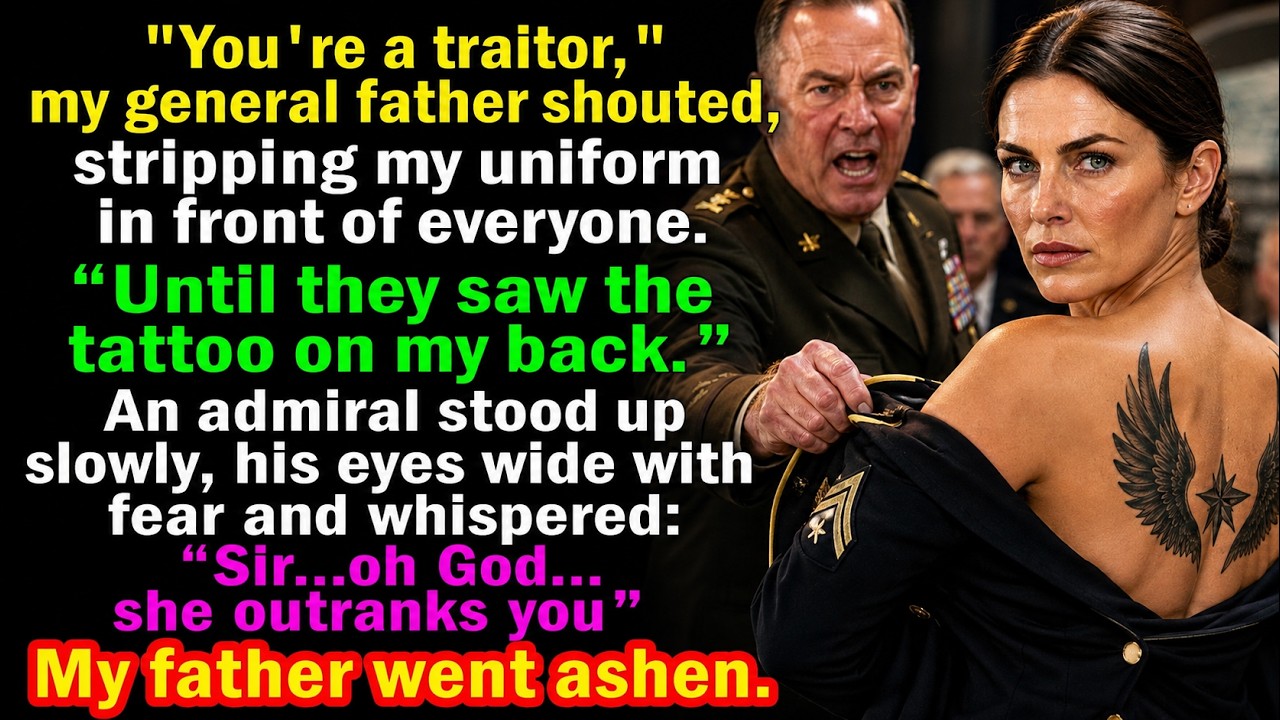
His face was red, not with grief, but with the kind of rage that comes when a man believes humiliation has entered his house. “You dishonored this uniform,” he said. Then he reached for my shoulder. The first rank tab tore free with a dry ripping sound.
No one moved. The second came off harder. His fingers caught the seam of my jacket, and the fabric split across my upper back. “You think classified orders protect you?
Five soldiers are dead because somebody sold them out. ”
I looked straight ahead. That made him angrier. People often mistake silence for surrender.
My father had been doing that my entire life. He yanked again. The tear widened. This time, the room saw the edge of the mark beneath my uniform—a black wing curving over one shoulder blade, silver ink crossing toward the center of my back.
Someone whispered, “No. ”
My father’s hand froze. I could have covered it. I could have explained.
I could have begged him to stop. Instead, I unclipped what remained of the jacket and slipped it from my shoulders. The hall went quiet in a different way. Across my back was the full Orion insignia—two dark wings surrounding a single silver star.
It wasn’t a unit patch. It wasn’t an award. It was a credential from a compartmented program that officially hadn’t existed for years. Most people in the room had never seen it.
The few who had didn’t look at me the same way again. My father swallowed, then pride rescued him from uncertainty. “Military police—arrest her. ”
Nobody moved.
Admiral Thomas Rowe stood slowly. He was the most senior officer present, a man famous for speaking as if every word cost him money. His eyes moved from my father to the mark on my back. “General, stop.
”
“That’s an army matter. ”
“No, it isn’t. That insignia places her under special national command authority. If it’s authentic, your jurisdiction ended the moment you touched her.
”
My father stared at him. Rowe looked at me once more. “Sir, operationally, she outranks this proceeding. ”
I watched the color leave my father’s face.
I was escorted to a secure isolation suite in the Pentagon’s restricted wing—not a jail cell, as everyone kept saying. The distinction felt academic. The room had no window, no clock, and a steel bench bolted to the wall. When the door sealed, I sat down and listened to the ventilation hum.
For the first time that day, nobody was watching my face. My hands began to shake. Not much. Just enough that I tucked them beneath my thighs until it passed.
People assume training removes fear. It doesn’t. Training gives fear a place to stand while you do the next necessary thing. I had learned that at nineteen.
I grew up in a house where achievement was treated like rent. You paid it, and no one thanked you for keeping the lights on. My father believed love made people soft. He never said that directly, but children are excellent students of what is missing.
When I was eight, he taught me how to stand at attention before he taught me how to ride a bicycle without training wheels. When I brought home a perfect report card, he looked at it over dinner and said, “Good. Maintain it. ”
My mother died when I was eleven.
After that, the house became quieter and more organized. Her yellow mug disappeared from the kitchen. Her coats were boxed within a week. My father replaced grief with schedules.
At thirteen, I won a statewide marksmanship competition. He was deployed and mailed me a note three weeks later. “Expected. Keep improving.
”
I carried that note in my wallet for six years. I don’t know why. Maybe children can make a meal out of almost any crumb. At my academy graduation, there was an empty seat beside the aisle with his name taped to it.
A storm delayed his flight, or a briefing ran long, or someone important needed him somewhere else. I heard three different explanations. I stopped asking which one was true. That evening, I ate takeout noodles alone in my apartment while my dress shoes sat by the door and rain clicked against the window unit.
The next morning, I signed paperwork for a special assessment program at Fort Bragg. The recruiter told me, “If you’re selected, parts of your life will disappear. ”
I almost laughed. Parts of my life had been disappearing for years.
Orion didn’t make me strong. It gave structure to strength I’d already been forced to build. The training was cold mornings, wet socks, four hours of sleep, and instructors who cared less about how fast you moved than whether you still made good decisions when your body wanted to quit. I was never the loudest person in a room.
Orion taught me I didn’t need to be. During my first live operation, a team leader named Reyes watched me hold position for nearly six hours in freezing rain because moving two feet would have exposed three other people. Afterward, sitting on ammunition crates drinking coffee that tasted like metal, he said, “You get very quiet when things go bad. ”
I thought he was criticizing.
He shook his head. “No. Keep that. ”
That was how I got the call sign Valkyrie.
Not because I was fearless. Because when everyone else’s pulse went up, mine seemed to disappear. Years later, Orion was officially dissolved after an operation involving an international weapons network and people too senior to prosecute publicly. Files vanished into restricted archives.
Personnel were reassigned. Names were buried. But a small number of us remained under dormant authority for threats that couldn’t pass through normal channels. My father never knew.
He knew I served. He knew I deployed. He knew enough to be proud at formal dinners and distant everywhere else. He never knew where I went when my records went blank.
Now that blank space was being used against me. The isolation room door opened three hours after the hearing. Admiral Rowe entered alone, carrying a tablet and two cups of coffee. He placed one beside me.
I didn’t touch it. “You have a problem,” he said. “I noticed. ”
His mouth almost moved toward a smile, then stopped.
“Your father believes you leaked intelligence that compromised the operation. Your access credentials appear in a restricted depot forty-eight hours before the explosion. You were off the official grid for thirty-six hours afterward. And half the building just learned you belong to a program they were told no longer exists.
”
“Appears,” I said. He studied me. “You hear one word in all of that? It’s the only word that matters.
”
I finally lifted the coffee. It was already cooling. Rowe sat across from me. “If the evidence is real, I’ll hand you over myself.
Understood? ”
“If it’s not, somebody has enough access to fabricate military records at multiple levels. ”
“Yes. ”
“And you think that person is inside this building?
”
“I think they wanted my father to accuse me publicly. ”
“Why? ”
“Because a quiet investigation can change direction. Public shame creates momentum.
Once people are emotionally invested in a traitor, evidence becomes decoration. ”
He looked at me for a long time. Then he said, “Who do you trust? ”
“One lawyer.
”
Ethan Cole arrived an hour later, wearing a wrinkled suit and carrying the same leather folder he’d used ten years earlier when Orion still existed on paper. He looked older. His eyes didn’t. “Attorney-client privilege,” he said before sitting.
“Everyone out. ”
Rowe actually obeyed. Ethan waited for the door to seal, then looked at my borrowed coat and the torn collar underneath it. “Your father?
”
“Yes. ”
He nodded once—not with surprise, but with recognition. “Tell me what they say you did. ”
I gave him the timeline.
He listened without interrupting. When I finished, he opened the leather folder and pulled out a thin gray notebook stamped with a faded Orion crest. My handwriting was inside. I hadn’t seen it in a decade.
On one page I’d underlined a contractor’s name twice: Calder Logistics. Beside it I’d written, “Impossible badge movement, 8 minutes, opposite doors. ”
Ethan tapped the line. “Your old contingency journal was preserved under litigation hold.
The same contractor serviced the depot that exploded last week. ”
The room became very still. “That network died,” I said. “No,” Ethan replied.
By sunrise, Ethan had found the first hard fracture in the case. The access logs showed my credential entering two secured doors ninety meters apart, six minutes before I supposedly entered the depot. The doors couldn’t both have opened—one magnetic seal had been disabled for maintenance. The computer said it opened.
The hardware said it didn’t. Then came the video. It showed me walking through the depot corridor in a dark cap, turning my face directly toward the camera. The image was clean enough to frighten anyone who wanted an easy answer.
But Ethan’s forensic analyst found that the footage had been re-encoded. The shadows changed direction between frames. The audio track repeated the same distant forklift sound every eleven seconds. It was synthetic.
Before we could present that, the video leaked to the press. My academy photograph appeared beside the words “armed and dangerous. ” A news anchor called me a former black program operative suspected of killing five Americans. I watched without sound.
The strangest part was seeing a younger version of myself smiling in the photograph. I remembered that day. A friend had made me laugh five seconds before the picture was taken. Now millions of strangers were studying that smile for evidence of evil.
“If you’ve ever spent years trying to earn love from someone determined not to give it,” I told Ethan quietly, “you learn something useful. ”
He looked up. “What? ”
“You stop confusing being understood with being safe.
”
That was the emotional low point for me—not the accusation, not the confinement. It was realizing my father had watched the same video and accepted it before asking me a single question. Rowe came in twenty minutes later. “General Harris wants you transferred to Army CID.
”
“Of course he does. ”
“He says keeping you here makes him look compromised. ”
“Does it? ”
Rowe’s eyes hardened.
“It makes me look careful. ”
I stood. “Then be careful for seventy-two more hours. ”
“What happens in seventy-two hours?
”
“Either I prove who did this, or they build something even you can’t ignore. ”
He should have refused. Instead, he gave Ethan temporary authority to preserve logs from three systems and ordered my transfer delayed. That bought us time.
It also told the real traitor I was still dangerous. The second fracture came from a midnight authorization issued two days before the mission. It carried my father’s digital countersignature. Routine logistics request.
Maintenance override. Nothing dramatic. Except the authorization had been inserted into a batch at the end of one of his briefings—exactly when he approved administrative items without reading each one. The person who submitted it was Colonel Nathan Marwick.
My father’s aide. His friend of twenty years. The man who had stood behind him in the Great Hall while my uniform was torn. I remembered Marwick’s face that night.
Not angry. Interested. There is a difference. Ethan traced payments from shell companies connected to Calder Logistics into accounts controlled by subcontractors Marwick had approved.
Small enough individually to disappear inside legitimate procurement. Together, they formed a pattern. Rowe stared at the report for a full minute. “Your father won’t accept this.
”
“I know. ”
“He trusts Marwick more than almost anyone. ”
“I know. ”
“Does that bother you?
”
I looked at the cold coffee between us. “It used to. ”
We didn’t confront Marwick. We baited him.
Ethan created a false after-action addendum claiming that one surviving inventory record from the destroyed depot had been recovered. The document contained a checksum error only someone involved in the sabotage would recognize as dangerous. Opening it would trigger a silent trace. We placed it in a restricted secondary system and waited.
Twenty-seven minutes later, the receiver pinged once, then twice. Marwick had opened it from a terminal in my father’s wing. He copied it to an encrypted drive. That should have been enough to detain him.
It wasn’t enough for me. People like Marwick survive because institutions punish the obvious act and leave the architecture untouched. I wanted the architecture. That night, Ethan found a hidden directory tied to an old code name from Orion’s final operation: Project Lamia.
Ten years earlier, Lamia had been the internal name for a weapons smuggling network that moved advanced military hardware through private contractors and foreign intermediaries. Orion had intercepted one shipment and exposed part of the chain. Two senior officers retired early. One disappeared.
The money vanished. The case was sealed. Now the same shell companies were appearing around the destroyed depot, and Marwick was sitting at the center. The next hearing was smaller.
My father sat across the table with Marwick behind him. The room smelled of old paper and stale coffee. Someone had lowered the blinds even though it was raining outside. My father didn’t look at me when I entered.
He spent twenty minutes describing my pattern of secrecy as if secrecy hadn’t been required by the country he served. Marwick nodded at all the right places. When my father finished, I asked permission to speak. Rowe granted it.
I turned to Marwick. “Colonel, do you remember Lisabeth? ”
His face changed for less than a second. That was enough.
Lisabeth was the Eastern European depot where Orion had intercepted the Lamia shipment ten years earlier. Conventional personnel had never been briefed on the code name. Marwick said, “That operation is classified. ”
Rowe leaned forward.
My father looked over his shoulder. I asked, “How do you know? ”
Marwick’s mouth opened. Nothing came out.
He recovered quickly. “She’s baiting me. ”
“Yes,” I said. “And you answered.
”
My father slammed his palm against the table. “That’s enough. You will not accuse an officer with decades of honorable service because he recognizes a name. ”
I looked at him.
He was shaking—not from certainty, but from the first arrival of doubt. “Dad,” I said, “I’ve accused him of nothing you can’t verify. ”
He flinched at the word “Dad” more than he had at “traitor. ”
After the hearing, he came to see me through a glass partition.
No stars around him. No staff. Just a tired man in a uniform that suddenly looked too heavy. “You’re destroying this family,” he said.
I almost smiled, but there was nothing funny in it. “Family has been quiet for years. ”
“I pushed you because I wanted you strong. ”
“No.
You pushed because my success made you feel successful. ”
His jaw tightened. “That’s unfair. ”
“It’s accurate.
”
He looked away. That was when I understood something I’d spent half my life avoiding. My father did love me. But he loved control more.
And love that must always win is not safety. He offered to help me if I confessed to mishandling classified material. He said he could protect me from prison. He said we could preserve what remained of the family name.
I let him finish, then I said, “You’re still asking me to carry your fear. ”
His eyes met mine. “I won’t. ”
I walked out before he could answer.
That was the last time I wanted his approval. The final proof came forty-eight hours into Rowe’s seventy-two-hour window. Ethan obtained a mirror of the depot’s quarantined server and found a one-second gap in the keystore audit. One second sounds meaningless until you understand secure systems.
A console administrator with physical access can do a great deal in one second if the process is prepared. The deleted line contained a device fingerprint. That fingerprint matched a portable encryption unit assigned to Marwick’s office. More importantly, the unit had communicated with an out-of-band vendor channel using a token reported stolen six months earlier.
Inside the payload was a salt string Orion had seen before. Lamia. Same actor. Same vanity signature.
We had the technical link. Then Ethan found the money. Then the courier manifests. Then the recordings.
Marwick had been rebuilding the network for years through legitimate procurement channels, using officials who rarely understood the whole picture. Some were bribed. Some were threatened. Some simply signed what appeared in front of them.
One of those signatures belonged to my father. I stared at the screen until the letters blurred. There were multiple authorizations, not one. Some were routine approvals manipulated through his queue.
Two were not. Two included warning annotations that should have made any careful officer stop. He approved them anyway. We brought the evidence to Rowe.
He read it, then closed the folder. “We arrest Marwick now. ”
“No,” I said. Rowe’s eyes narrowed.
“We let him believe the bait failed. ”
“Why? ”
“Because he’ll try to clean the final ledger. ”
Ethan understood first.
“If he touches it, we get the rest of the network. ”
Rowe hated the plan. That was one reason I trusted it. We seeded a message suggesting the forensic review had cleared the decoy file and that I would be transferred before dawn.
At 2:14 a. m. , Marwick entered a restricted archive suite using emergency authority tied to my father’s office. He accessed the Lamia ledger.
He began deleting names. He didn’t know the archive had been mirrored. He didn’t know Rowe was watching from a command center two floors away. He didn’t know the terminal camera had been redirected to a sealed evidentiary system.
He did exactly what loud men do when quiet people stop reacting. He assumed he’d won. At 2:19 a. m.
, military police entered the archive suite. Marwick didn’t resist at first. He asked who had authorized the arrest. When Rowe stepped through the doorway, Marwick’s face changed.
Then he saw me behind him. His hands began to tremble. “You,” he said. I said nothing.
He started talking. He called me unstable, vindictive, a disgraced operative manufacturing a conspiracy to save herself. The more he spoke, the smaller he sounded. Ethan placed a tablet on the table and played the recording of Marwick deleting the ledger.
Then he displayed the device fingerprint. Then the payments. Then the vendor token. Each piece removed another place for Marwick to stand.
Finally, he looked toward my father, who had been summoned by Rowe and was standing near the wall. “Harris,” Marwick said, “tell them you approved those shipments. ”
My father didn’t answer. That was the second reveal.
Marwick hadn’t merely framed me. He had built his defense around my father. The final hearing began at nine that morning. No press.
No speeches. Just senior officers, legal counsel, investigators, and the people whose names appeared in the recovered ledger. I entered wearing a plain service uniform with new insignia pinned where my father had torn the old ones away. The stitching beneath one shoulder was still visible.
I left it that way. Rowe opened the session. Ethan presented the evidence in order. No dramatic music, no raised voices, just facts.
Synthetic video. Impossible badge movements. Manipulated timestamps. Financial transfers.
The Lamia salt string. Marwick’s device in the keystore breach. His access to the bait file. His attempt to delete the final ledger.
By the time Ethan finished, Marwick wasn’t looking at anyone. His right hand kept rubbing the same spot on his trouser seam. Then my father’s name appeared on the screen. The room shifted.
General Harris stood. “This is fabricated. ” But the sentence sounded old. Used up.
Ethan enlarged the authorizations. My father stared at his own signatures. One minute passed. Maybe two.
Then he sat back down. “I knew there were irregularities,” he said. Nobody spoke. His voice dropped.
“Marwick told me they were part of a compartmented procurement channel. He said questioning it would expose operations above my clearance. Later, he showed me reports claiming Ursula had been compromised. ”
He looked at me for the first time.
“They threatened an investigation into decisions I made years ago. They said my career would end. My name would be destroyed. ”
I waited.
He swallowed. “I chose not to look closer. ”
No grand confession. No excuse big enough to fill the room.
Just one quiet sentence that explained years of damage. I chose not to look closer. I thought about my graduation seat. My mother’s yellow mug disappearing.
The note in my wallet. Expected. Keep improving. I thought about every time I’d worked harder because I believed excellence could finally make someone see me.
Then I realized the cruelest truth was also the most freeing. My father hadn’t failed to see me because I wasn’t impressive enough. He’d failed because looking closely had always frightened him. Rowe ordered Marwick into custody.
Several other officers were removed from duty pending investigation. The Lamia network would take months to dismantle—maybe years. Then Rowe turned to me. “Commander Ursula Kaine, the findings clear you of the allegations before this panel.
Your access is restored. Your service record will reflect full exoneration. ”
I nodded. “Thank you, Admiral.
”
That was all I said. I had imagined clearing my name would feel like a door bursting open. It felt more like setting down a bag I’d carried so long I’d forgotten it was heavy. After the room emptied, my father remained seated.
His shoulders had collapsed inward. He looked older than he had the night before. I started toward the door. “Ursa.
”
I stopped. “I’m sorry. ” His voice cracked on the last word. I looked back.
For once, he wasn’t asking me to protect him. Maybe that was why I could answer honestly. “They threatened you,” I said. “They manipulated you.
But you still made choices. ”
He nodded. “I know. ”
“I can understand what happened without pretending it didn’t hurt me.
”
He lowered his eyes. “I know. ”
I left him there. The next morning, he asked to see me again.
He was in civilian clothes when I entered the small conference room. His uniform had been removed pending retirement proceedings. Without stars and ribbons, he looked like the man he might have been if the army hadn’t become his entire language. He stood when I came in.
“I don’t expect forgiveness,” he said. “Good. ”
He almost smiled. Then his face folded slightly.
“I thought strength meant never letting anyone see uncertainty. That’s what I taught you. I was wrong. ”
I believed him.
But belief is not the same as repair. He told me he’d spent the night thinking about my mother, about the way she used to tell him he treated the house like a command post, about the graduation he missed, about the note he sent after my competition. “I don’t even remember writing it,” he said. “I do.
”
That hurt him. I could see it. For years, I’d wanted him to feel what I felt. Standing there, I learned that his pain didn’t return my childhood to me.
Revenge is often disappointing that way. So I didn’t punish him. I also didn’t rescue him. “I hope you learn how to live without the family name doing all your talking,” I said.
He nodded. “And I hope you forgive yourself someday, because I’m done carrying that part for you. ”
I walked out before either of us could turn it into something easier than the truth. Six months later, I resigned my commission.
People assumed the scandal drove me out. It didn’t. The scandal showed me what I didn’t want to stay for. I’d spent fifteen years becoming useful in emergencies.
I knew how to survive rooms where one wrong choice could cost lives. But there were thousands of veterans fighting quieter emergencies with no classified team coming to help them. People discharged after injuries. Families buried in paperwork.
Former operators who could plan a mission across three borders but couldn’t convince an agency to return a phone call. I started a small nonprofit in Virginia. The office was a converted warehouse with uneven heat and a coffee machine that leaked if you filled it past the fourth line. I loved it.
There were no flags in my office. No medals. Just photographs of people we’d helped and a corkboard full of handwritten notes. One said, “You answered when nobody else did.
”
That meant more to me than most decorations I’d received. On rainy mornings, I came in early and listened to water tap against the high windows while I reviewed case files. One afternoon, Admiral Rowe appeared in the doorway carrying two coffees. “You’re difficult to find,” he said.
“I’m listed on the website. ”
“Yes. Very covert. ”
I smiled.
He sat across from me and looked around the room. Then his expression changed. “Orion is being reactivated under new oversight. ”
I said nothing.
“We want you to command it. ”
There had been a time when those words would have hit every hungry place inside me. Command. Recognition.
Proof that the years had meant something. Now I looked at the corkboard behind him. A photograph showed a former medic standing beside his daughter at a college orientation. We’d helped restore benefits that had been delayed for almost two years.
I already knew my answer. “Thank you, but no. ”
Rowe nodded as if he’d expected it. “You sure?
”
“Yes. ”
“Why? ”
I looked down at my hands. For the first time in my adult life, there were no fresh cuts from gear, no calluses from a rifle sling, no classified schedule waiting in my pocket.
“I spent a long time believing my value came from how much I could endure without being seen,” I said. “I don’t believe that anymore. ”
Rowe leaned back. Then he smiled.
“Good. ”
He left the offer open anyway. I never accepted it. Sometimes people ask whether I forgave my father.
I don’t have a clean answer. We speak occasionally. He asks how the organization is doing. He sends money anonymously, even though I always know it’s from him.
Once, on my birthday, he called and didn’t mention the army at all. That was new. Forgiveness, I learned, is not a ceremony. It’s not one conversation where the music swells and everyone becomes better.
Sometimes it’s just distance without hatred. Sometimes it’s letting another person carry the consequences of what they chose. And sometimes it’s realizing you no longer need the apology you once thought would save you. My father mistook my silence for weakness because he thought strength always announced itself.
Marwick made the same mistake. So did the people who built false evidence, leaked my face to the world, and waited for me to panic. They expected noise. They expected pleading.
They expected me to fight for their permission to be believed. I did none of that. I watched. I remembered.
I prepared. And when the time came, I placed the truth on the table and let it speak in a voice louder than mine ever needed to be. For years, I thought strength meant standing still while someone hurt you and proving you could take it. I was wrong.
Strength is knowing what deserves your endurance and what deserves your absence. It is understanding that peace is not the reward people give you after they finally admit you were right. Peace is what begins when you stop handing them the authority to define you. The night my father tore the insignia from my uniform, I thought he was stripping away everything I’d earned.
He wasn’t. He was only tearing cloth. The rest had already become part of me.
And no rank, no accusation, no family name, and no room full of powerful people could take it back.