The coffee smelled wrong before it tasted wrong. Bitter, but not the burnt kind of bitter. Grainy underneath, like something had been ground fine and stirred into the bottom of the cup. I held it in both hands and watched my mother watch me.
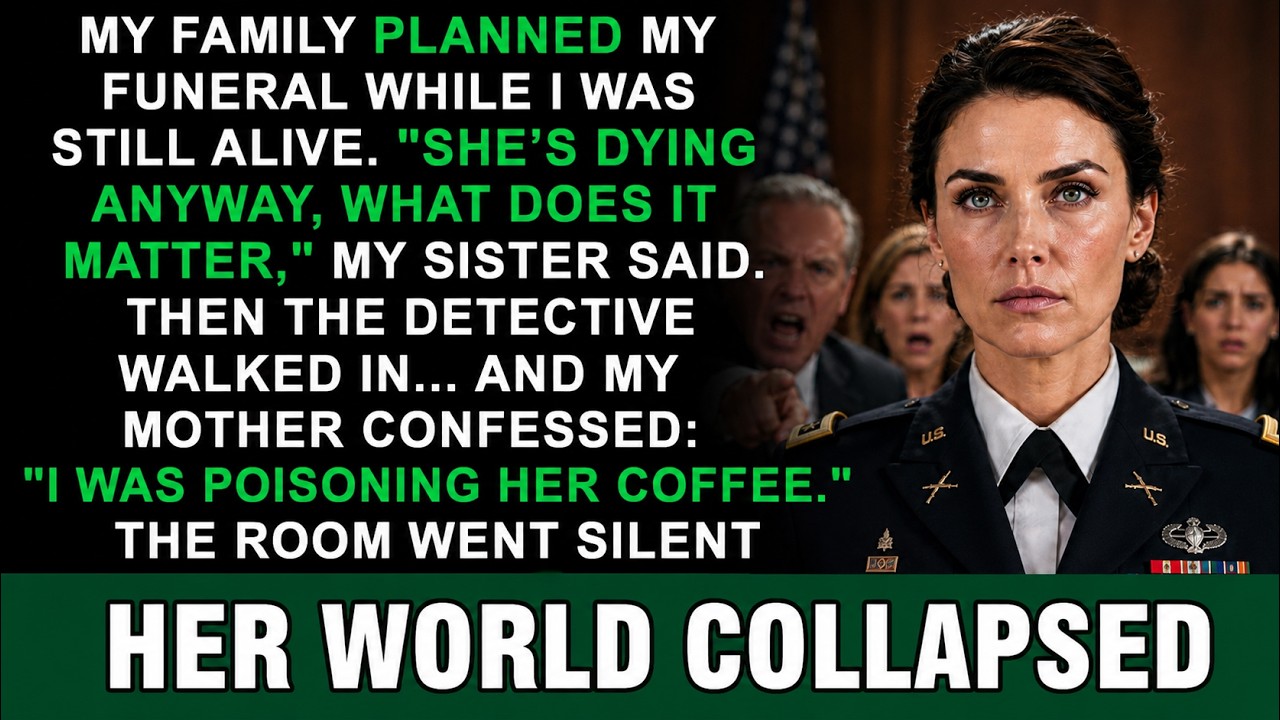
Her fingers weren’t shaking anymore. They had gone still in a way that made the back of my neck go cold. The same cold I used to feel kneeling in front of a device wired to something I couldn’t see yet. Three days earlier, I had walked through that front door in my dress uniform, and my father had looked at me the way a man looks at a bill he thought he’d already paid off.
My mother’s face went the color of old paper. My sister Alana grabbed her fiancé’s hand so hard her knuckles turned white. Nobody said, “Welcome home. ” Nobody said, “Thank God.
”
What I saw, clear as a muzzle flash at night, was disappointment. Plain, unguarded, gone in half a second. But I’d spent a career learning to notice things people only show for half a second. So I gave them something else to look at instead.
I told them I was dying. Eight months, maybe less. A lie built entirely out of the shape their faces made when they saw me alive. For one half of one second, before anyone remembered to cry, I watched every one of them smile.
My father had no idea what he had just started. None of them did. They thought they were closing out an account. What they didn’t understand is that I don’t build anything—not a plan, not a position, not a life—without a contingency stacked three deep behind it.
That’s not a personality trait. That’s something the army put into my hands and never once let me forget. And by the time I was finished with that house, they were going to understand exactly what it meant that I had never forgotten it either. I grew up in a home where love ran on a ledger.
My father priced everything before he felt anything. What a thing cost. What it earned. What it was worth keeping around.
I learned early that I sat somewhere near the bottom of that ledger. Below my sister’s dance recital. Below my mother’s church socials. Below whatever small emergency was loudest that week.
I learned it in the quiet ways nobody else in the house would have thought to notice. A science fair ribbon that never made it to the refrigerator door. A birthday dinner that turned halfway through the cake into a conversation about Alana’s new boyfriend. The night I made varsity and came home to an empty kitchen because everyone had already left to celebrate somebody else’s good news.
There was a specific afternoon I still remember with total clarity. The smell of cut grass through an open window. My father’s voice on the phone in the next room, laughing at something my sister had done. A laugh he had never once used on me.
I stood in the hallway holding a report card with three A’s on it and understood the way you understand weather that it wasn’t going anywhere near that refrigerator door either. I didn’t cry. I folded it in half and put it in a drawer. That was the day I stopped waiting for the phone call that said, “We’re proud of you.
” Not out of anger. Out of arithmetic. I ran the numbers on what that house was ever going to give me, and the number came back zero. And once I accepted the number, it stopped being able to hurt me the way it used to.
There was another memory I carried longer than I wanted to. I was twelve, and I’d spent three weeks building a model bridge for a school engineering contest. Gluing balsa wood joints at the kitchen table every night after homework. My father walked past it the morning of the contest, coffee in hand, and asked if I’d remembered to take out the recycling.
Not a question about the bridge. Not even a glance at it. Just the recycling. I took first place that afternoon.
Nobody in my family asked how it went, because nobody in my family had asked what it was in the first place. I came home and set the trophy on the shelf in my room, where it stayed for six years, facing a wall nobody else ever looked at. I enlisted the week I turned eighteen. And it wasn’t for glory.
And it wasn’t for a flag on a wall. It was for distance. For a place where the rules were written down and actually followed. Where what you were worth got measured by what you could do under pressure, instead of what you could do for someone else’s ego at a dinner table.
My father called it a waste of a college fund he’d never actually saved for me in the first place. My mother cried at the bus station, but it was the kind of crying that’s really about how it will look to the neighbors, not the kind that costs anything. I didn’t look back, and I didn’t send postcards asking to be missed. I built something instead.
Quietly, one qualification at a time. The way you build anything that eventually has to hold real weight. A rank. A record.
A reputation that had nothing to do with anyone’s approval but my own—and the approval of the people standing next to me when things went wrong. Explosive ordnance disposal does not forgive impatience, and it does not forgive ego, and it will kill you cleanly for either one. You learn to breathe through your hands. You learn that panic is a decision.
The same as calm is a decision, and only one of those decisions lets you walk back to the truck afterward. I spent a deployment on my knees four feet from devices engineered specifically to erase me, moving one wire at a time, because the alternative to moving slowly was never moving again. My team chief, First Sergeant Cruz, used to say I had the stillest hands he’d ever watched work a device. He didn’t mean it as a compliment about my fingers.
He meant it as a fact about my nervous system. “Marsh doesn’t get rattled,” I heard him tell a visiting colonel once through the thin wall of a command tent, not knowing I could hear every word. “Marsh gets quiet. That’s worse for the other guy.
”
I never told him I’d heard it. I carried it with me instead. The way you carry the one piece of gear you trust completely. There was a morning outside Kandahar I still think about.
Heat coming up off the ground in visible waves. The metallic taste of dust that never fully left your mouth. A device buried under a doorway two local families were still using to get water. Cruz stood twenty meters back with a radio in his hand and didn’t say a word the entire time, because he’d learned that talking to me while I worked only slowed my hands down.
I remember the exact moment I found the secondary trigger wired underneath the obvious one—built specifically to kill whoever thought they’d already won. I remember thinking calmly, almost gently, “Of course there’s a second one. People who build traps for a living never build just one. ”
There was another day closer to the end of that deployment when a young corporal froze halfway through his first solo approach on a device buried under a market stall.
I walked out to him without being asked, knelt beside him in the dust, and talked him through it in a voice so flat and even that he told me afterward it was the only thing that had kept his hands from shaking. Cruz watched the whole thing from behind the cordon and never mentioned it again. But two weeks later, my name went up for an early promotion board, and his signature was on the recommendation. That’s the thing nobody in my family ever understood about the version of me that came home.
Somewhere out there, people had trusted me with their lives on the strength of nothing but how I behaved under pressure. My own family trusted me with nothing at all. Not even the truth about what I actually did for a living, because they’d stopped asking questions about me around the same time I stopped expecting them to. That was nothing compared to a kitchen table, a coffee cup, and four people I used to call family.
A device wants to kill you cleanly in one motion, and it doesn’t pretend to love you first. A family wants to profit from your death slowly, in installments, while calling it grief. That night, from the couch where I was pretending to sleep, I heard the whole plan laid out like a quarterly budget in the next room. My father’s voice, flat and business-like.
“The policy pays out in months, not years, if we move now. ”
My mother’s voice, already spending it. “Four hundred thousand, maybe more with the accidental rider. ”
Derek talking about a truck he’d already picked the color for.
Alana talking about a wedding fully funded by my funeral. I lay there in the dark and listened to my own death get itemized like a grocery list. Line by line. And I understood the way you understand a live wire the second before your fingers close on it.
That I wasn’t looking at grief in that kitchen. I was looking at a business plan. And I was the collateral. I decided that night that I wasn’t going to run from that house.
I was going to let them build their entire plan out in the open, brick by brick, in front of me. And then I was going to make sure it collapsed on top of every one of them—with a paper trail wide enough for a courtroom to walk straight through without needing my testimony to fill in a single gap. The first escalation stayed private. My father asked me to sign a little paperwork, his reading glasses perched low, his hands trembling just enough to look sincere instead of greedy.
I let mine shake too, on purpose, and signed without reading it properly. What I signed, I found out later, was a hundred-thousand-dollar loan against my own life insurance policy—built on forged access to an account he had no legal right to touch. The second escalation happened in front of three people at once. My mother’s funeral binder open on the kitchen table like she’d been reviewing it over lunch.
The cheapest casket circled twice in blue pen. A column of numbers labeled “what’s left after expenses. ” Her handwriting as neat as a grocery list. I stood in the doorway and said nothing.
I filed it away the way you log a serial number before you ever touch the device it’s attached to. The third escalation had a taste to it. A cup of coffee offered by hands that had never once in my life offered me anything without wanting something back. Grainy at the bottom.
Bitter in a way that had nothing to do with the roast. I didn’t accuse anyone. I didn’t raise my voice or spill a single drop where she could see it happen. I poured it out the moment she left the room, sealed the residue in a bag, and drove it across town to a lab with a chain of custody form already filled out in my head.
Because evidence that isn’t documented the second you find it stops being evidence at all. It just becomes a story nobody has to believe. The fourth escalation arrived in broad daylight in the form of a black SUV and two men in suits that cost more than my father’s monthly mortgage. Walking up the driveway with the kind of stride that expects the whole world to step aside.
My father owed money to people who didn’t send letters. He owed it because he had already spent, in his head, every dollar he thought was coming from my death. And the men collecting weren’t interested in whether his son was actually dying or simply late. There was a fifth pressure, one I hadn’t planned for and had to absorb on the fly.
The way you absorb any variable a plan didn’t account for. My father, worried I might live long enough to change my mind about the money, asked me to sign a do-not-resuscitate order one evening at the kitchen table. His voice gentle in a way that almost fooled me, even though I knew exactly what it was. I signed it.
But not the version he thought he was handing me. I’d prepared my own copy earlier that week—identical on its face, quietly useless in every way that mattered. He never checked. He never once thought to check, because in his mind, I had already stopped being a person capable of outmaneuvering him.
I had become a number waiting to finalize. There was a sixth pressure that told me everything I needed to know about how far they’d go. My mother came to me one afternoon with a soft voice and an offer to organize my medications. Lining up empty vitamin bottles I’d labeled to look like prescriptions, sorting them into neat rows like she was doing something tender.
I let her. I photographed every bottle, every label, every count before and after. Because I understood that if anything in those rows ever changed without my knowledge, I would need proof of exactly what had been there to begin with. She squeezed my shoulder afterward and told me, “That’s what family does.
They take care of each other. ”
I said, “Thank you. ” I meant something entirely different by it than she thought I did. Each time the pressure in that house went up a level, I got quieter.
Not weaker. Quieter the way a device goes quiet in the second before you know exactly which wire has to come first. I built the trap the same way I’d once been trained to build a clearance plan. Multiple approach vectors converging on a single point in time, with witnesses who had no idea they were about to become part of the same operation.
A hospice coordinator, invited under the plain and technically true premise of guiding a difficult family conversation. An insurance fraud investigator, invited because a policy genuinely needed auditing. A detective parked two blocks away with a wire already taped under my shirt and a team ready to move on a single word spoken into a hidden microphone. And arriving at the exact worst possible moment for my father—because I had spent two weeks quietly learning when his creditors expected payment—the men he owed money to walked straight into a house that was already full of law enforcement he didn’t know was there yet.
Sunday afternoon, the coordinator asked her intake questions in a soft, professional voice, and my family performed grief so convincingly that I almost believed, for one disorienting second, that they meant it. Then the investigator arrived and opened a folder on the coffee table and asked my father very calmly to explain a two a. m. login to a portal he claimed he’d never touched in his life.
He talked. That was always going to be his undoing. My father never learned the one lesson I’d learned for free in a war zone. Silence protects you, and explanation buries you a shovel full at a time.
He explained the timestamps. He explained the forged medical language on the loan application. He explained, without meaning to, exactly how the fraud had been assembled. Piece by piece.
The same patient way I’d once been trained to take apart something built to kill me. My sister broke first, blurting out that they’d needed the money because I was dying anyway, so what did it matter? The room went still in a new way. Not the tension of a secret being kept, but the specific silence of a family accidentally testifying against itself in real time, with two professional witnesses taking notes.
My mother went next. And it wasn’t dramatic. It was worse than dramatic. She said quietly, almost proudly, that she’d been putting something in my coffee to help me rest through the pain.
The coordinator’s pen stopped moving on the page. The investigator looked up from her folder for the first time since she’d sat down. That was the moment. Not a shout.
Not a confrontation across the table. Just one sentence delivered by the person who was supposed to protect me before anyone else in the world did, in front of two professionals who would later swear to every syllable of it under oath. I said only this: “You should have checked whether the man you were poisoning still had his training. ”
The front door opened before she could answer.
Detective Reyes walked in with three officers behind him. Moving the way people move when they’ve rehearsed an entrance a hundred times, and already know exactly where every exit in the house leads and who’s standing at each one. My mother was arrested for attempted poisoning and denied bail. A judge doesn’t gamble twice with someone who has already tried it once.
My father was charged with insurance fraud and identity theft. The forged documents laid out on the same table where he’d once asked me to sign away my own future for “family paperwork. ” His reading glasses still sitting beside them like they belong to someone else. My sister and her fiancé were charged with conspiracy.
Their own text messages—discussions about ways to shorten the timeline—read back to them in an interview room neither of them had ever imagined sitting inside. Out on the curb, the men my father owed money to were taken down by officers running a routine check. One outstanding warrant unraveling a debt he had planned all along to pay off with my death. Out on the driveway, while the technicians moved through the house with cameras and evidence bags, I stood beside Detective Reyes and watched my father sit on the porch steps in handcuffs, staring at nothing.
He looked up at me once. I didn’t look away, and I didn’t say anything either. There are moments that don’t need a line of dialogue to land. That was one of them.
Cruz called me that night, having heard secondhand through a mutual friend from the unit. All he said was, “Stillest hands I ever saw, Marsh. Guess that never changed. ”
I told him it hadn’t.
He told me to come visit before I disappeared into paperwork for the next six months. I told him I would. And for the first time since I’d walked through my parents’ front door, I actually meant something I said out loud. The second reveal came days later.
Quietly, in a lawyer’s office instead of a courtroom, without a single raised voice to announce it. My real discharge paperwork. My real medical file. Clean.
Cancer-free. Exactly what it had always been. My actual promotion—the one I’d tried to tell them about the night I walked through that door, before the word cancer swallowed every other word I might have said. Three hundred thousand dollars they never once got their hands on, because I had moved it the same week I decided to let them build an entire fantasy on top of my death instead of a welcome home.
I walked out of that house for the last time on a Sunday evening. The sky doing that slow orange thing it does right before it finally gives up on the day. Nobody followed me down the driveway. Nobody called my name from the porch.
I got in my car, drove across town to a penthouse none of them had ever known existed, and sat out on the balcony until the city lights came up one by one. Not like an ending, but like a countdown finally running in the right direction. Toward something that was, for the first time in my life, entirely mine. In the weeks that followed, I found a therapist who specialized in family betrayal.
A woman with a calm office and a way of listening that didn’t rush toward comfort before I was ready for it. I told her I didn’t know how to feel. Relieved that I’d stopped them before it went further. Guilty for the lie I’d told first.
Angry at what they’d been willing to do. And grieving underneath all of it for a family that had maybe never existed the way I wanted it to. She told me that trauma doesn’t arrive in one clean emotion. She told me healing wasn’t about making the feelings disappear, but about learning to carry them without letting them steer.
I kept going back week after week, because for once in my life, I was building something that wasn’t a contingency plan. I was building a way to actually live in the quiet afterward. Cruz visited that spring, and we sat on the balcony with two beers and didn’t talk about the case at all. The way we used to sit outside the wire after a long day and just let the silence do the talking.
Eventually, I told him about the dream I kept having. The one where I walked through that same front door and they were happy to see me. No lie required. No plan necessary.
He didn’t tell me it was foolish to want that. He told me wanting your family to love you doesn’t make you weak. That it’s wired into people whether they like it or not. And that just because mine hadn’t managed it didn’t mean something was broken in me.
Then he told me about his own father. A man he still sometimes found himself hoping had changed, even all these years later, even knowing better. We didn’t say much else. We didn’t need to.
For years, I believed love in that house was something I had to earn by being smaller, quieter, less trouble than whoever else was at the table that night. What my father never understood is that the very thing he dismissed—my training, my discipline, the stillness he mistook for weakness—was the exact thing that would one day dismantle everything he’d built on the assumption that I would always be too weak, too grateful, or too dead to stop him. Some people mistake your silence for surrender. It rarely is.
More often, it’s simply the sound of someone building something they haven’t shown you yet. The quiet ones aren’t always losing. Sometimes they’re the only ones in the room who were actually counting the whole time.