The hospital corridor smelled of bleach and stale coffee, with something sharper underneath—fear, maybe. Mercy West’s fluorescent lights hummed a low, anxious note that seemed to vibrate in my bones. Nurses hurried past in squeaky shoes, avoiding eye contact. No one looks at you in a place like that.
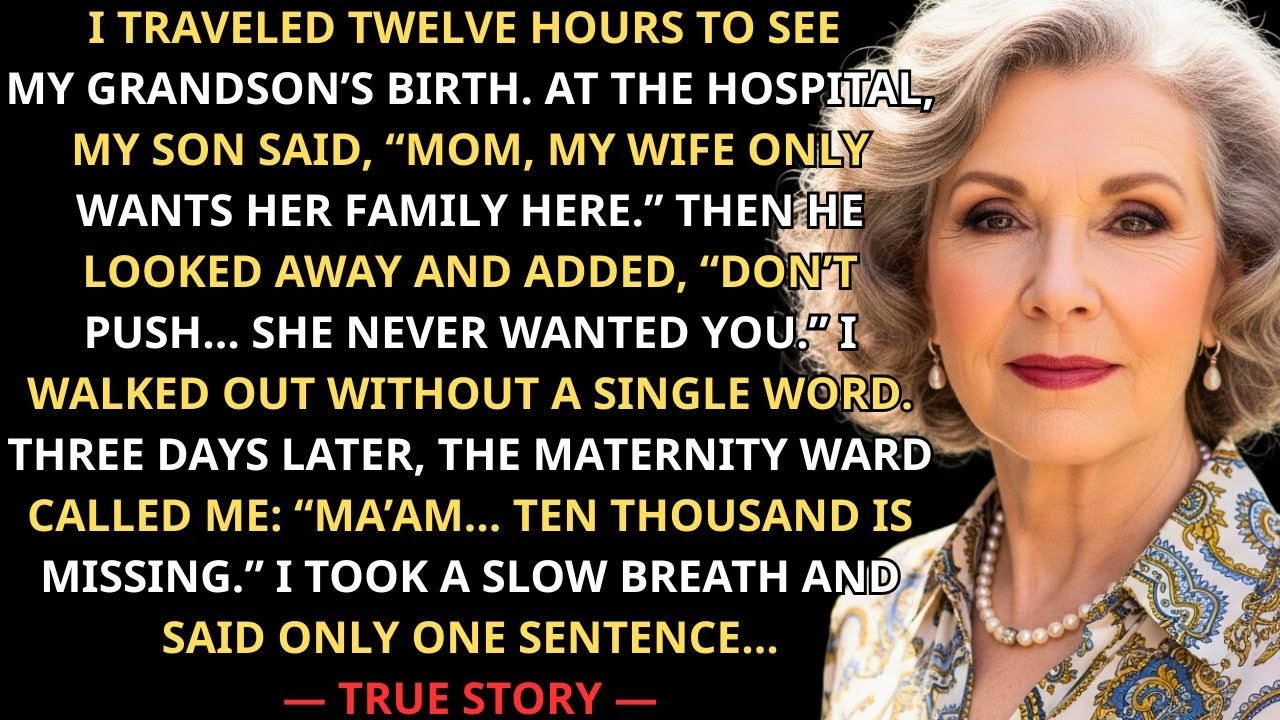
My son David stood three feet away, a stranger wearing the face of the boy I raised. His voice was unnaturally low, almost ashamed. “Mom, she just wants her family here. ”
I searched his eyes, the same hazel eyes I’d watched open for the first time thirty-five years ago in a small Ohio hospital room.
Those eyes, which once looked at me like I was the center of the universe, now darted nervously toward the closed door of room 308. A pink and blue wreath hung on the knob. “David,” I whispered, my voice raw from the eight-hour train ride. “I *am* family.
”
He flinched. “You know what I mean? *Her* family. Her mother is in there with her.
” He shifted in his expensive Chicago suit. “Look, she’s just… she’s not comfortable. Sophia has never really understood you. ”
The world didn’t stop.
It became painfully, terribly sharp. I could hear a nurse’s pen clicking down the hall. I could see a scuff mark on David’s polished shoe. And I understood that the cruelest words aren’t shouted.
They’re delivered in a quiet, reasonable tone that slices you in two while strangers walk past. There was nothing else to say. I had sat on an Amtrak train for eight hours, clutching a small, soft yellow blanket I’d knitted myself—my fingers aching from three months of work, weaving a prayer for this child into every stitch. I’d imagined David’s face lighting up.
I’d imagined holding my grandson, smelling his skin, that perfect powdery scent of new life. I never imagined being treated like an intruder. From behind the closed door, a cry erupted. Thin and fragile, it pierced the wood and went straight into my chest.
My grandson was crying, and I was on the wrong side of the door. My mind flashed back. David, three years old, terrified of thunder. It was always me who stumbled out of bed, lifted him from his crib, and held him against my chest until his sobs quieted.
The fevers, the midnight ER trips, the skinned knees, the broken arm from the oak tree. The endless, thankless, beautiful work of being his mother. And now that same boy was shielding the world from me. “Don’t insist, Mom.
Please. ” His voice was pleading now, which was somehow worse. He wanted me to make this easy. He wanted me to absorb his rejection and disappear quietly.
I clutched the strap of my worn leather handbag, the one my own mother had given me when I turned thirty. “For all the important moments,” she’d said. It was with me when Thomas died. It was with me at David’s graduation.
And it was with me now. I nodded once, a slow, deliberate motion. I swallowed the acid in my throat. I would not cry.
“Congratulations on your son, David. ”
I did not say goodbye. I just turned and walked away. Each step down that endless corridor was a betrayal.
I passed other doors with wreaths, heard the murmur of happy families. A silver-haired grandmother beamed at me as she carried a baby carrier toward the elevators. I couldn’t smile back. The automatic doors slid open with a hiss, releasing me into the brutal cold of a Chicago February night.
The wind off Lake Michigan stole my breath. Taxis rushed past. I stood on the sidewalk, a sixty-three-year-old woman from a small town in Ohio, completely alone in a city of millions. I hailed a taxi and gave the driver the address of a cheap motel I’d passed on the way in.
The room smelled of cigarette smoke and industrial cleaner. The bedspread was a nauseating orange and brown. I sat on the edge of the stiff mattress, my cooler bag of frozen casseroles at my feet. And only then did I allow myself to break.
I wept as I hadn’t wept since the day Thomas died. For the wasted journey, for the eight hours of hope curdled into sour reality. For the yellow blanket that would never touch my grandson’s skin. For the casseroles that would thaw and spoil.
But most of all, I cried for David. The boy who loved my cooking. The teenager who held me at his father’s funeral. The young man who promised he’d always take care of me.
Where had he gone? I slept fitfully. At five in the morning, I gave up. I showered, dressed carefully in the dark blue knit dress I’d saved for this trip, and applied my makeup.
My mother taught me that dignity was a choice, especially when your heart is breaking. I spent the day as a ghost, walking unfamiliar streets. I watched families ice skate in Millennium Park. I saw grandmothers holding tiny hands.
I bought a coffee I didn’t drink and a pastry that tasted like cardboard. At four in the afternoon, I went to Union Station. The train ride home was the inverse of the journey there. The hope was gone, replaced by a hollow ache.
I didn’t see the frozen landscape passing by. I saw only my own reflection in the dark glass. A tired, pale woman. I wondered if David had even noticed I was gone.
A small, cold part of me knew he hadn’t. I arrived in Columbus at two in the morning and drove the dark, empty highways home. When I opened my front door, the silence was absolute. Before, it was peaceful.
Now it was empty. I dropped my suitcase by the door. I put the cooler bag on the counter and methodically scraped each thawed casserole into the garbage disposal. The grinding motor was obscenely loud in the quiet house.
I made a fresh pot of coffee and sat at the old wooden table—the table where David had done his homework, the table where Thomas and I had paid bills and dreamed of retirement. It was there, in the quiet dawn of my Ohio kitchen, that my phone rang. An unknown number. Chicago.
My heart gave a painful leap. *David. He’s sorry. He’s calling to apologize.
*
“Hello? ”
“Is this Mrs. Eleanor Vance? ”
The voice was female, crisp, utterly devoid of emotion.
“My name is Trisha. I’m calling from the billing and collections department at Mercy West Hospital. ”
My blood turned to ice. “We are processing the discharge paperwork for Sophia Marino Vance, and there is a significant outstanding balance.
The insurance covered the standard delivery, but not the private suite, the after-hours consultations, or the additional neonatal monitoring. The remaining balance is $12,500. ”
The sum hung in the air. Astronomical.
Absurd. “I… I don’t understand. Why are you calling *me*? ”
“Your son, Mr.
David Vance, listed you as the primary financial guarantor for any and all charges not covered by his insurance. ”
I stopped breathing. Not an emergency contact. Not a backup.
The *primary financial guarantor*. He hadn’t wanted me in the room. He hadn’t wanted me in the hospital. He hadn’t even wanted me in the city.
But he had wanted my money. The nest egg I’d scraped together from twenty years of double shifts at the diner and shelving books at the library. The money from selling Thomas’s garage. The money that was supposed to be my security.
“Mrs. Vance, are you there? We need to arrange a payment schedule. Can you make a deposit this week?
Otherwise, the account will be moved to formal collections, which could negatively impact your son’s credit. ”
I looked at my hands resting on the old wooden table. Swollen knuckles. Rough skin.
The hands that had scoured pots at the diner. The hands that had carried stacks of books. The hands that had held my dying husband. The hands that had knitted a yellow blanket still folded in my suitcase.
I thought of David’s embarrassed, shifty eyes in that hospital corridor. *She’s not comfortable. She’s never understood you. *
He had known, even as he said it, that my name was on a piece of paper committing me to a debt I couldn’t afford—for a family that found me substandard.
A feeling rose in me, hot and clear. It was not anger. It was clarity. A sharp, bright snap of a chain that had been pulling me underwater for years.
“Ma’am? ” The voice was impatient now. I took a deep breath. When I spoke, my voice was not the trembling whisper of the woman in that motel.
It was calm. Steady. “I’m afraid you have the wrong number. ”
There was a pause.
“I’m sorry, ma’am. This is the number provided by Mr. Vance. ”
“Then Mr.
Vance has made a mistake. I am not related to that account. I do not have a son in Chicago. ”
“But ma’am, our records clearly state—”
“Your records are incorrect.
Good day. ”
I pressed end and placed the phone face down on the table. My heart was hammering like a bird trapped in my chest. Tears burned again, but they were different now.
Not tears of pain. Tears of release. I got up, walked to my living room, and sat in the worn armchair Thomas had bought me. The sun was rising, painting the wall in streaks of pale gold.
The house was still silent. But for the first time in my life, I felt an exhilarating, terrifying peace. I had chosen myself. There are memories we keep like photographs, polished and perfect.
David, born in a July heatwave. Thomas, my husband, his hands permanently stained with engine grease, holding his newborn son with a tenderness that made my chest ache. It was a good life, a simple life. Not rich, but full of love.
Then when David was sixteen, the world tilted. Thomas was working under a vintage Mustang when an aneurysm took him. Instant. No warning.
No goodbye. He was forty-two. We were left, David and I, in the echoing silence of a house suddenly too large. I sold the garage—I didn’t know the first thing about carburetors.
David was shattered, forced to become the man of the house overnight. “I’ll take care of you, Mom,” he promised, his teenage shoulders stiff. “I’ll get a good job. I’ll make you proud.
”
I took a job at the twenty-four-hour diner. I took a second, quieter job at the library. Every dollar I saved went into an account for his education. And he did it—full scholarship to Ohio State for engineering.
He was going to build bridges, he told me. Connect people. Two months after graduation, he got the offer. A prestigious firm in Chicago.
More money than Thomas and I had ever made in a year combined. The first six months were fine. He called every Sunday. Then he met Sophia.
A marketing executive, ambitious, polished, from a wealthy family. I saw her over a crackling video call. She smiled, but it was a quick, appraising smile—the kind that registers and dismisses you in the same instant. The calls became shorter.
Less frequent. Then came the wedding. A lavish affair at a country club. I was not seated in the front row with the family.
I was in the seventh row, behind a large floral arrangement. I watched my son get married from behind a spray of white orchids. During the reception, Sophia’s mother glided over. “Eleanor, so lovely you could make it.
David is just so *grounded*. It’s charming where he comes from. ”
I smiled and said nothing. The distance became a chasm.
I found out about the pregnancy on Instagram. A professional photo of Sophia holding tiny shoes. “Baby Vance, arriving February. ”
“Honey, you’re having a baby.
”
“Oh, yeah,” he said, like an afterthought. “We were going to tell you. Things have just been crazy. ”
I knitted the yellow blanket.
I sent a package with my mother’s silver rattle. I never received a thank-you note. When I asked, David sighed. “Mom, Sophia is really tired.
She’s very specific about the baby’s aesthetic. She appreciates the thought, though. ”
*Aesthetic. * My mother’s silver rattle wasn’t part of her aesthetic.
When I asked about coming for the birth, the panic in his voice was immediate. “Mom, it’s not a good time. Sophia wants it to be calm. Just her and her mom.
”
“But I’m your mom, David. ”
“Please don’t make this difficult. ”
And I, like a fool, had agreed. “Just call me when he’s born,” I said.
“I’ll be on the next train. ”
He never called. I found out about Noah’s birth the same way I found out about the pregnancy. Instagram.
A picture of a tiny, wrinkled fist. “He’s here. Noah Vance. ”
I called, furious and heartbroken.
“Why, David? Why wouldn’t you call me? ”
“We’ve just been so busy, Mom. Please don’t be upset.
”
I booked my train ticket anyway. I packed the yellow blanket and the casseroles, still believing the boy I raised was in there somewhere. I walked into that hospital full of desperate, stupid hope—only to be turned away in the hallway. Three days after the call from the hospital, my phone rang again.
It was David. I let it go to voicemail. A text: *Mom, call me. It’s an emergency.
*
Another: *Why aren’t you answering? The hospital called again. *
Another: *Mom, this isn’t funny. I need you to fix this.
Sophia is hysterical. *
*Fix this. * Not “I’m sorry. ” Not “How could I have done this to you?
” But *fix this. *
The texts escalated. *I can’t believe you’re doing this to me. After everything, Sophia was right about you.
You always have to make everything about you. You’re selfish. *
Selfish. The word vibrated on the small screen.
The woman who had given up her life for him. The woman who had worked her fingers raw. *Selfish. *
That night, an email arrived.
Subject line: “You are ruining us. ” It was a long, rambling tirade about how stressed they were, how Sophia was suffering from the trauma of childbirth, how the bill was a clerical error, how my “stunt” with the billing department was childish and cruel. “You have no idea what it’s like,” he wrote. “We are trying to build a family, and you are actively trying to sabotage it.
Is your pride more important than your family? Than your grandson? ”
I read the email three times. The old Eleanor would have caved.
She would have called, crying, apologizing. She would have drained her savings account. But the old Eleanor was gone. She had died in a cheap motel room in Chicago.
I typed a single reply. *Dear David,*
*You are correct. I am your mother—which is why I find it so strange that you did not call me when my grandson was born. I found out on Instagram.
*
*I am your mother. Yet you sat me in the seventh row at your wedding. *
*I am your mother. Yet you told me I was not welcome at the hospital while your wife’s mother held my grandson.
*
*You are my son. Yet you listed me as a financial guarantor for a $12,500 bill without my knowledge—even as you were telling me I was not family enough to be in the room. *
*You are right. Family is supposed to help each other.
But respect is a two-way street. You cannot treat me like a stranger when it’s convenient and like a bank when it’s not. *
*My dignity is not for sale. I will not be paying the bill.
*
*Do not contact me again. *
I hit send. I blocked his number, his email, Sophia on Instagram. I unplugged the phone from the wall.
And for the first time in thirty-five years, I went to bed and slept for ten straight hours. A year passed. A year of profound, healing silence. I did not know if they had paid the bill.
I did not know my grandson. I grieved for David as if he had died—because in a way, he had. But I was rebuilding. I reconnected with friends.
I joined a book club. I started gardening. I retiled my bathroom with the money I would have spent visiting Chicago. I was no longer David’s mother.
I was Eleanor. And Eleanor was enough. Then one Tuesday, the phone rang. A local Columbus area code.
“Mrs. Vance, my name is Mark. I’m a case manager with Franklin County Child Services. We have a child in our temporary care.
His name is Noah Vance. He’s fourteen months old. ”
My blood ran cold again, but for a different reason. “His parents were found in a distressed situation.
They were evicted from their apartment in Chicago six weeks ago. They’ve been living in a motel here in Columbus. Your son lost his job some time ago. Your daughter-in-law, Sophia, is unwell—she’s been admitted for psychiatric evaluation.
Postpartum depression that escalated into a severe anxiety disorder. David is overwhelmed and unable to care for the child. He listed you as his only family. ”
*Only family.
* How the tables had turned. “Where is he? ” I asked. I met my grandson for the first time in a sterile room with brightly colored foam mats on the floor.
He was small for his age, with huge, terrified hazel eyes. My son’s eyes. He wasn’t crying. He was just watching, silent.
In the hallway, I saw David. He looked like a ghost—thin, unshaven, hollow-eyed. When he saw me, he crumpled. He fell against the wall and sobbed, his body shaking.
I did not go to him. Not yet. I walked into the room and knelt on the foam mat. Noah watched me, his thumb in his mouth.
“Hello, Noah,” I said softly. “I’m your grandma. I’m Eleanor. ”
I didn’t reach for him.
I just sat there. I took the old, worn leather purse from my shoulder—the one I’d carried that night at the hospital. I unzipped it. The yellow blanket was still folded small at the bottom.
I had never been able to throw it away. I laid it on the mat between us. Noah stared at it. He crawled forward, hesitant.
He touched the yarn, his tiny fingers feeling the soft texture. Then he looked up at me, a long, searching look. I held out my arms. He hesitated.
Then he crawled into my lap, burying his face in my chest. I wrapped my arms around him, and this time, I was the one crying. It was not a simple reunion. It was not a happy ending.
It was a new beginning, and it was hard. David and Noah moved in with me. David got a job at a local engineering firm—a fraction of his Chicago salary, but it was a start. Sophia stayed in treatment for two months.
When she came out, she was a different woman. Quieter. Fragile. Finally honest.
She sat at my kitchen table one evening—the same table where I had received the hospital call. “I was so jealous of you,” she whispered, twisting a napkin in her hands. “David adored you. He talked about you like you were a saint.
And my mother always made me feel like I wasn’t good enough. I was terrified I wouldn’t be enough for him. And you—you were the measuring stick I could never live up to. So I pushed you away.
”
“You almost destroyed him,” I said, not unkindly, but firm. “I almost destroyed us all,” she agreed, tears rolling down her face. “I’m so sorry, Eleanor. ”
I learned that forgiveness is not a single event.
It is a daily practice. David and I had to rebuild thirty-five years of trust. He had to learn that my love was not an obligation. And I had to learn that his respect was not a given.
But the real lesson, the one that settled deep in my bones, was about me. I had spent my life believing that being a good mother meant endless, silent sacrifice. I thought my value was measured by how much I could give, how much I could endure. I was wrong.
My value was in my own dignity. True love does not demand that you erase yourself. By saying no, I had done more than refuse a bill. I had reclaimed my life.
I had taught my son, in the most painful way possible, that I was a person—not just a resource. Today, Noah—now three—runs into my room and jumps on the bed, his laughter filling the house. David and Sophia have their own apartment now, just ten minutes away. They are rebuilding.
They are fragile, but they are trying. I am still Eleanor. I am still a mother, but I am also finally a grandmother. I am no longer an intruder.
No longer a financial guarantor. I am a presence. I am respected.
And I am here—not because I was needed, but because I chose to be.