I stared at the screen from the passenger seat of my mother’s rental car, my coffee untouched. 38 missed calls from my husband. 38 calls in less than 12 hours from the same man who, the night before, had looked me straight in the eyes and said, “Absolutely not. Your mom isn’t my responsibility.
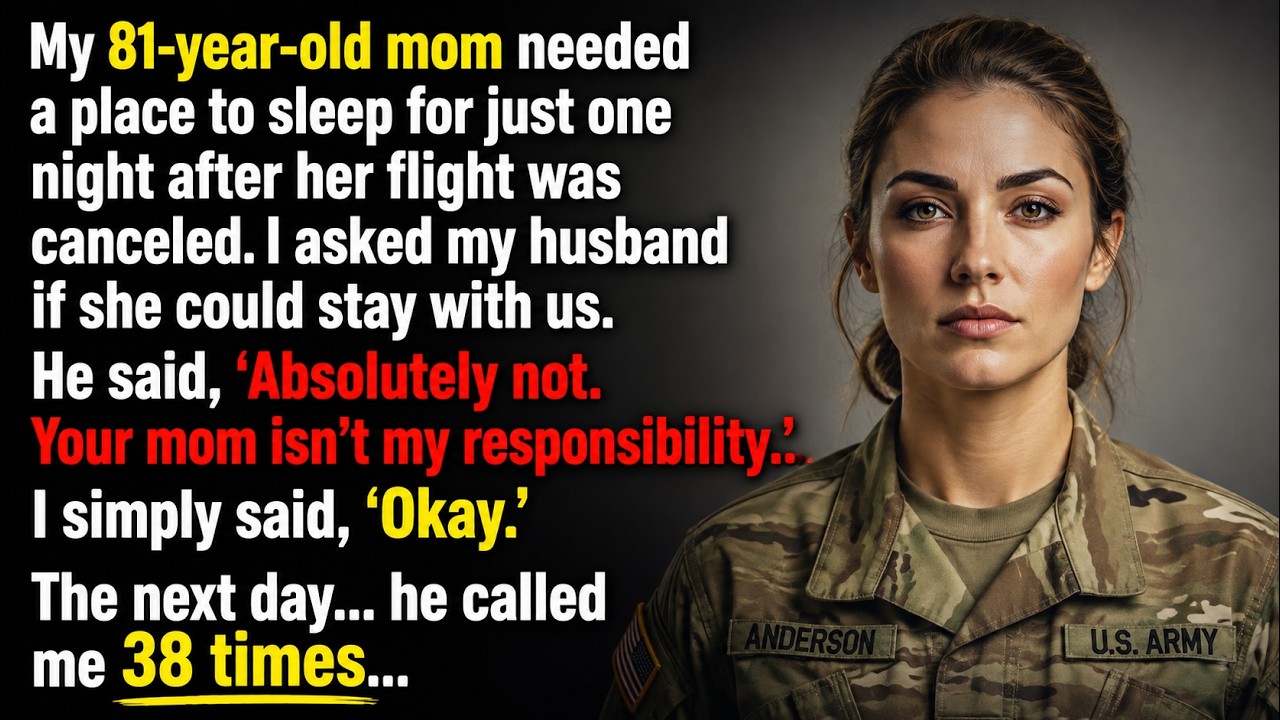
Figure it out. ”
I didn’t call him back. Not yet. Because 24 hours earlier, I had still believed I was married to a man who understood what family meant.
My name is Emily Carter. At 34, I was an Army captain stationed at Fort Liberty in North Carolina. My life was built around schedules, responsibility, and keeping my word. After years of service, I had learned to stay calm when other people panicked.
But nothing prepared me for the night my 81-year-old mother called me from an airport bench and quietly said, “Honey, I don’t know where I’m going to sleep tonight. ”
Her flight had been canceled due to severe thunderstorms. The airline put her on standby for the next afternoon, but every affordable hotel near the airport was either full or priced outrageously for one night. My mother hated asking for help.
She was the kind of woman who would carry a grocery bag with a broken handle all the way home rather than admit she needed another one. So when she called, I knew she was scared. “Mom, stay where you are,” I said. “I’ll figure it out.
”
“I don’t want to bother you. ”
“You’re not bothering me. ”
I was already reaching for my keys. Our house was less than an hour from the airport.
I would pick her up, bring her home, make her something warm to eat, and let her sleep in the guest room. One night. That was all. On the drive, I called my husband, David.
He answered after three rings. “Hey,” he said. “Mom’s flight was canceled. She’s stranded at the airport.
I’m going to pick her up and bring her home for the night. I’ll take her back in the morning. ”
There was a pause. Then he said, “No.
”
I almost laughed, thinking I had misunderstood him. “No, David. It’s one night. ”
“She’s 81.
”
“I know how old she is, Emily. ”
His voice was flat. No concern about the weather, no question about her safety, no hesitation. Just irritation.
I tightened my grip on the steering wheel. “She has nowhere to go. ”
“That’s not my problem. ”
I pulled into a gas station and parked.
“Excuse me? ”
He sighed. “Your mom isn’t my responsibility. If she needs somewhere to stay, figure it out.
”
For several seconds I couldn’t speak. I thought about the guest room upstairs, the clean sheets, the extra blankets in the hall closet. My mother had never once asked David for money or special treatment. “David,” I said quietly, “I’m not asking you to take care of her.
I’m asking if an 81-year-old woman can sleep in our guest room for one night. ”
“Absolutely not. ”
Something inside me went very still. I could have argued.
I could have reminded him that when his mother needed help last winter, I drove two hours after a 12-hour duty day to take her to an appointment. I could have reminded him that I had helped pay for repairs at his mother’s house without ever asking whose responsibility it was. But I didn’t. I simply said, “Okay.
”
He seemed almost surprised by how quickly I gave in. “Good,” he said. “I’ve got work early tomorrow. ” Then he hung up.
I sat there for another minute. The world moved around me. A truck rumbled past. Everything looked ordinary.
But my marriage suddenly didn’t. I drove to the airport and found my mother sitting beside two suitcases, wearing a cardigan over her blouse. She looked exhausted. When she saw me, she smiled.
“You came. ”
Of course I came. She studied my face. “Did David mind?
”
I forced a small smile. “He’s tired. It’s fine. ”
I didn’t tell her what he had said.
I didn’t want her carrying the weight of his rejection on top of everything else. At the hotel, I paid for the room, carried her bags upstairs, and made sure she had water and her medication beside the bed. She touched my hand. “I’m sorry, sweetheart.
”
“For what? ”
“For causing trouble. ”
I sat beside her. “Mom, you are not trouble.
”
Her eyes filled with tears. I hugged her. That night I barely slept. Not because I was angry, but because I was thinking about every time I had said yes when I wanted to say no.
Every time I had defended David. Every time I had told myself that marriage meant making sacrifices. By morning, I understood something I had been avoiding for a long time. Sacrifice was not the problem.
One-sided sacrifice was. At 7:12 a. m. , my phone began vibrating.
David. I ignored it. It rang again and again. By the time I looked at the screen, there were 38 missed calls.
Then a text appeared: “Emily, please call me. I need you. ”
I read it twice. The woman who had spent the night making sure her 81-year-old mother had a safe place to sleep suddenly felt very calm.
Because whatever had happened at home, David was no longer calling to tell me my mother wasn’t his responsibility. He was calling because he needed something from me. And for the first time in our marriage, I wasn’t sure I was going to give it to him. I let the phone ring one more time before answering.
“Hello. ”
David didn’t say hello. “Emily, where are you? ”
I looked through the hotel window at the parking lot below.
My mother was sitting at the small table near the window, slowly stirring sugar into her coffee. “I’m with Mom. ”
“I know that. I mean, where exactly?
”
“Why? ”
He exhaled sharply. “Because I need you to come home. ”
I almost smiled.
Last night he had made it very clear that my mother had no place in our home. Now he wanted me there. “What happened? ”
“My mom has a problem.
”
“Linda? ”
“Yes. There’s water everywhere. A pipe burst overnight.
The downstairs ceiling is damaged and the plumber says they have to shut everything off. ”
“Is your mom okay? ”
“She’s fine. She’s staying with a neighbor right now.
”
“That’s good. I need her to stay with us. Just for a few days, maybe a week. Until the repairs are finished.
”
I stared at the phone. There was something almost surreal about hearing those words. A few hours earlier he had told me my mother wasn’t his responsibility. Now his 80-year-old mother needed our guest room.
“David,” I said carefully, “didn’t you tell me yesterday that my mom wasn’t your responsibility? ”
Silence. “Then this is different. ”
“How?
My mom has nowhere to go. ”
“So did mine. ”
“That’s not fair. ”
I felt something tighten in my chest.
“Fair? Yes. ”
“You’re twisting my words. ”
“I’m not twisting anything.
I’m repeating what you said. ”
He became defensive. “I was stressed yesterday. So was Mom.
”
“She was at a hotel because you told me she couldn’t stay at our house. That doesn’t mean I don’t care about her. ”
I looked down at my hands. In the army, you couldn’t afford to let anger make decisions for you.
So I asked the question that mattered. “If Linda needs a place to stay, how long do you think she’ll need it? ”
“I don’t know. A few days.
”
“Okay. ”
His voice immediately softened. “Thank you. ”
“But I need to understand something first.
Are you asking me to agree because you think we’re partners, or because you expect me to solve this? ”
He didn’t answer. Finally, he said, “Emily, I just need you to help. ”
I closed my eyes.
There it was. The word I had heard throughout our marriage. Help. I had helped with his mother.
I had helped with his debts. I had helped when his car broke down. I had helped when he changed jobs. I had helped when my military schedule became difficult and still found a way to keep our household running.
But whenever I needed something from him, there was always a reason it was inconvenient. “Where is Linda now? ” I asked. “At the Hampton Inn near her house.
”
“Then she’s safe. For now. Let’s take this one step at a time. ”
David became impatient.
“I don’t have time for this, Emily. ”
I almost laughed. “You called me 38 times. ”
“Because you weren’t answering.
”
I looked toward my mother. She gave me a questioning expression. I lowered my voice. “David, what exactly do you need from me?
”
“I need you to come home and help me figure out what we’re going to do. ”
“What does that mean? ”
“It means I need my wife. ”
The words landed strangely.
My wife. Last night, I had been his wife when he told me to figure out my mother’s problem alone. This morning, suddenly being his wife meant something different. I looked at my mother.
She had heard enough to understand. She quietly mouthed, “Don’t fight. ” I nodded. Then I said to David, “I’ll come home after I take Mom to the airport.
”
He sighed with relief. “Okay. ”
“But Linda isn’t moving into our house until we talk. ”
“What?
”
“I said we talk first. ”
“Emily, this is my mother. ”
“I know. ”
“And she’s 80 years old.
”
“I know. ”
“So? ”
“So was my mother last night. ”
He went quiet.
I could hear his breathing through the phone. Then he said, “You’re punishing me. ”
“No, David, I’m not punishing you. I’m asking you to think about what happened.
”
“I already said I was stressed. ”
“And I heard you. ”
“I said I’m sorry. ”
“You haven’t said that.
”
Another silence. Then very quietly he said, “Fine. I’m sorry. ”
I knew immediately that he didn’t mean it.
Not yet. He was saying it because he wanted the problem solved. Still, I didn’t argue. “I’ll see you this afternoon.
”
When I ended the call, my mother looked at me. “You don’t have to go home because he wants you to. ”
“I know. ”
“Then why are you going?
”
I thought about it. “Because I need to understand what’s really happening. ”
She studied me for a moment. Then she said something I hadn’t expected.
“Your husband sounded frightened. ”
“He is. ”
“Why? ”
“I don’t know.
”
She took a sip of coffee. “Then find out before you decide what to do. ”
Those words stayed with me. After taking Mom to the airport, I drove home.
The house looked exactly as I had left it. Same porch, same flower pot beside the front door, same photograph of David and me from our wedding sitting on the entry table. But when I walked inside, everything felt unfamiliar. David was waiting in the kitchen.
He looked exhausted. His shirt was wrinkled, and there were dark circles beneath his eyes. “Where have you been? ”
“I know.
I put my keys on the counter. How bad is the damage at Linda’s? ”
He hesitated. “Bad.
I don’t know yet who’s paying for it. ”
“Who is paying for it? ”
Another pause. “Insurance, probably.
”
He looked away. And that was when I noticed something. A stack of unopened envelopes sat beside the coffee maker. Bills.
Several of them. I recognized the logo of one credit card company, then another, then a personal loan statement. I looked at David. He followed my eyes.
“Those aren’t important. ”
“Then why are they here? ”
“They came this week. ”
“How much do you owe?
”
He frowned. “That’s none of your business. ”
The words hit harder than I expected. I stared at him.
“My husband’s debt isn’t my business? ”
He rubbed his forehead. “That’s not what I meant. ”
But I knew it was.
He walked over to the counter and picked up one of the envelopes. He quickly took it from my hand when I reached for it. “Emily, I can handle it. ”
I looked at him for a long moment.
Then I remembered the 38 calls. I remembered his panic. I remembered his mother’s flooded house. And suddenly the pieces were beginning to fit together.
This wasn’t just about where Linda would sleep. Something else was wrong. Something much bigger. And I had a feeling David had been hoping I would never ask the right question.
That evening I realized the problem wasn’t Linda’s flooded house. It wasn’t even the stack of unpaid bills sitting beside our coffee maker. The real problem was that my husband had been living a second life financially, and I had been the last person to know about it. David spent the rest of the afternoon trying to convince me everything was manageable.
“It’s temporary,” he said. We were sitting across from each other at the kitchen table. “How temporary? A few months?
How much debt? ”
He looked at the floor. “I don’t know exactly. ”
“David.
”
He rubbed both hands over his face. “About 48,000. ”
I stared at him. “48,000 dollars?
”
“Maybe a little more. ”
My stomach tightened. “Credit cards? ”
“Some.
”
“Personal loans? ”
“Yes. ”
“Anything else? ”
He didn’t answer.
That silence told me there was more. I leaned back in my chair. “How long have you known about this? ”
“It’s not that simple.
”
“No, it isn’t. You’ve been hiding almost 50,000 dollars of debt from me. ”
“I was trying to fix it before you found out. ”
“Why?
”
“Because I knew you’d worry. ”
I almost laughed. “You didn’t want me to worry. You wanted me not to know.
”
He looked away. “What did you spend it on? ”
David’s jaw tightened. “Things.
”
“What things? ”
“Living expenses. Some repairs. A few bad decisions.
”
“A few? ”
He didn’t answer. I thought about our household budget. The mortgage was current.
Utilities were current. Our insurance was current. I had always assumed David was managing his side of the finances responsibly. Then another thought came to me.
“Have you been using money from our joint account to make those payments? ”
He looked at me. “Only for a little while. ”
But that was enough.
My heart sank. “How much? ”
He finally admitted it. “About 12,000.
”
I pushed my chair away from the table. For a moment I couldn’t speak. Not because $12,000 was going to ruin me. What hurt was the betrayal.
He had taken money from our shared household without telling me while telling me that my mother’s emergency wasn’t his responsibility. I stood. “Where are you going? ”
“To look at our accounts.
”
“You don’t trust me. ”
I turned around. “Do you trust me? ”
He looked confused.
“What? Do you trust me? ”
“Of course. ”
“Then why did you hide this?
”
He had no answer. That night I sat at the dining room table with my laptop open. I downloaded statements: credit card statements, bank statements, loan records. I went through every transaction carefully.
At first I expected to find only debt. Instead I found something much more painful. For almost a year David had been spending hundreds of dollars a month on things he had never discussed with me. Expensive dinners, weekend trips, online purchases, a new television, concert tickets, a private golf membership.
None of those things were wrong by themselves, but together they told a story. David had been spending as if we had more money than we did. And when the bills came due, he had quietly relied on my income to keep everything afloat. I kept scrolling.
Then I found a payment to an account I didn’t recognize. The next morning I called the bank. It was a personal line of credit in David’s name. The address attached to it was ours.
When David came home from work I asked him about it. “What is this? ”
He froze. “Where did you see that?
”
“On our financial records. ”
“You went through my accounts. ”
“I went through our accounts. ”
He pulled out a chair.
“Emily, I was going to tell you when I got it under control. ”
“You’ve been saying that for a year. ”
He looked embarrassed, then angry. “You don’t understand what it’s like.
”
I stared at him. “What it’s like? ”
“To feel like you’re always behind. ”
I softened slightly.
“I would have helped you. ”
“No, you would have judged me. ”
“I’ve never judged you for struggling. ”
“You would have.
”
“Then you should have given me the chance to prove you wrong. ”
He went quiet. I sat down again. “I need you to tell me everything.
”
He hesitated. Then he finally admitted the part he had been avoiding. He had taken out the personal loan because he had fallen behind on several credit cards. He had used part of it to cover payments, creating a cycle where one debt was paying another.
And now he was close to the limit. “That’s why you called me 38 times,” I said. He looked at me. “I called because I was scared.
Because of Linda, partly. ”
“What does that mean? ”
He swallowed. “The insurance deductible for her house is more than I expected.
”
“How much? ”
“$8,000. ”
I closed my eyes. There it was.
The reason. He wasn’t simply worried about where his mother would stay. He needed money. My money.
And suddenly his refusal the night before looked different. Maybe he had been angry because he knew he might need me the next morning. Maybe he had convinced himself that my family was my responsibility because he wanted his family to remain his priority. Either way, something had become painfully clear.
He expected my resources to be available when his family needed them, but my mother was somehow an inconvenience. I looked at him. “Did you ever plan to tell me about the debt? ”
“Yes.
”
“When? ”
“I don’t know. ”
I nodded slowly. Then I said the words that frightened him more than any argument could have.
“I’m separating our finances. ”
His face changed. “What? ”
“You heard me.
”
“You’re going to punish me because I made mistakes. ”
“No. I closed the laptop. I’m stopping you from making your mistakes my responsibility.
”
He stood. “Emily, we’re married. What’s mine is yours. ”
I looked directly at him.
“Then why wasn’t my mother yours when she needed one night? ”
He said nothing. The kitchen became completely silent. I didn’t raise my voice.
I didn’t threaten divorce. I didn’t insult him. I simply began moving my money into an account only I could access and contacted a financial counselor through a military family support program. That was the moment my revenge truly began.
Not because I wanted to hurt David, but because I was finally removing the one thing he had counted on without realizing it: my unconditional rescue. And there was one more thing I needed to know. The next morning, I found an email on our shared computer. It was from David to his brother.
The subject line read, “Don’t worry, Emily won’t leave. ”
I opened it. And after reading the first few sentences, I understood just how badly my husband had misunderstood me. He had written about his debts, the repairs at Linda’s house, and the possibility that I might finally become angry.
Then came the sentence that stayed with me. “Don’t worry, Emily won’t leave. She’d never do that to me. ”
I closed the laptop.
For years I had thought loyalty was one of my strengths. That morning I realized David had mistaken it for a weakness. I didn’t confront him immediately. When emotions are high, don’t make decisions simply because someone expects an immediate response.
So I made coffee. I took a shower. I put on my uniform. And I went to work.
At lunch, I called the financial counselor available through the military installation. I explained the situation without exaggerating anything. She listened. Then she asked me a question.
“Are you trying to save your marriage? ”
I hesitated. “Yes. ”
“Then the first thing you need to save is yourself.
”
I wrote that down. Not because it sounded dramatic, but because it made sense. That afternoon I returned home. David was sitting at the kitchen table.
He looked nervous. “You’ve been avoiding me. ”
“I’ve been working. ”
“You saw the email.
”
I stopped. “So you know. ”
He looked down. “I was frustrated.
”
“You told your brother I wouldn’t leave. ”
“I didn’t mean it like that. ”
“How did you mean it? ”
He couldn’t answer.
I put my bag down. “You’ve spent months making decisions because you believed I’d always clean up the consequences. ”
“That’s not fair. ”
“I was scared.
So was my mother. ”
His face tightened. “I already apologized for that. ”
“No, David.
You apologized because you needed something from me. ”
He shook his head. “That isn’t true. ”
“Then tell me what you were thinking when you told me my 81-year-old mother wasn’t your responsibility.
”
He stared at the floor. “I was angry. Not at her. At myself.
”
“Why? ”
He took a long breath. “Because everything seems easier for you. ”
I almost laughed.
“Easier? ”
“You have your career. Your benefits. You’re disciplined.
You always know what to do. ”
I stared at him. “You think my life is easy? You’ve watched me leave before sunrise for years.
You’ve watched me miss birthdays, holidays, family dinners because of duty. You’ve seen me come home exhausted and still make sure the bills were paid. ”
“I know. ”
“Then why are you competing with me instead of standing beside me?
”
His eyes filled with tears. “I don’t know. ”
That was the first honest answer he had given me in days. I sat down.
He sat across from me. For the first time, the anger between us gave way to something more complicated. Pain. David told me he had started feeling inadequate years earlier.
Every time I received a promotion, he felt proud for about five minutes, then insecure. Every time someone thanked me for my service, he wondered why nobody thanked him. Every time I handled a crisis calmly, he felt like he was failing. Instead of admitting those feelings, he became resentful.
And resentment left alone long enough turned into cruelty. “I thought if I made you feel like you weren’t needed,” he said, “I’d feel less useless. ”
I looked at him. “That is one of the saddest things you’ve ever said to me.
”
“I know. ”
“But it doesn’t excuse what you did. ”
“I know. And it doesn’t excuse what you said about Mom.
”
“I know. ”
Silence settled over the room. Then he asked, “What happens now? ”
I looked at him.
“Now we stop pretending. ”
I opened a folder and placed it on the table. Inside were the financial statements, the debt totals, and the information from the counselor. “I’ve separated my personal finances from yours.
”
His eyes widened. “You did what? ”
“I protected my accounts. ”
“You don’t trust me.
”
“Not with money right now. ”
He looked hurt. “I’m your husband. ”
“And you’re responsible for rebuilding that trust.
”
He pushed the folder away. “You’re punishing me. ”
“No. I kept my voice calm.
I’m allowing you to experience the consequences of decisions you made without me. ”
He looked at me for a long moment. Then he said, “What about Mom? Linda?
”
“She’s still your mother. She needs a place to stay. ”
He nodded. “And you’re going to help her?
”
“Will you help? ”
I thought about it. Then I said, “Yes. ”
His eyebrows lifted.
“Really? ”
“Yes. But not the way we used to. ”
“What does that mean?
”
“It means we make a plan. We find out what insurance covers. We talk to the contractor. We look at temporary housing.
We don’t put everything on a credit card and pretend the problem disappeared. ”
He nodded slowly. “And the money? ”
“I won’t give you money to hide the problem.
But if there’s a legitimate emergency, we handle it together transparently. ”
For the first time, David seemed to understand the difference. I wasn’t abandoning him. I was refusing to enable him.
That evening we visited Linda. Her house was a mess. Fans were running to dry the floors. Furniture had been moved into the garage, and the smell of wet drywall filled the air.
Linda looked embarrassed when she saw me. “Emily, I’m so sorry. ”
“You don’t have to apologize. ”
She glanced at David.
“He told me what happened. I know what he said about your mother. ”
I froze. David looked uncomfortable.
Linda continued. “I told him he was wrong. ”
David looked down. Linda squeezed my hand.
“Your mother is family. ”
Those words nearly broke me because they were exactly what I had wanted to hear from my husband. Not because my mother needed to be his responsibility, but because compassion shouldn’t require a legal obligation. When we left Linda’s house, David walked beside me in silence.
Finally, he said, “Are you leaving me? ”
I stopped. “I haven’t decided. ”
His face fell.
“I love you. ”
“I believe you. ”
“Then why doesn’t that feel like enough? ”
“Because love without respect eventually becomes another kind of loneliness.
”
He looked away. I touched his arm. “If you want this marriage, David, I need to see change. ”
“What kind?
”
“Real change. ”
He nodded. “I’ll do it. ”
I looked at him.
“For once, don’t promise me. ”
“Then what? ”
“Show me. ”
That night I returned home alone.
My mother called before I went to bed. She asked how things were. I told her the truth. “We’re not fixed.
”
She was quiet. Then she said, “Good. ”
I smiled. “Good.
Sometimes you shouldn’t fix something until you understand why it broke. ”
But the next morning, my mother called again. Her voice sounded different, more serious. “Emily,” she said, “there’s something I should have told you about David.
”
I sat upright. “What? ”
She took a breath. “I knew something was wrong long before you did.
”
I sat upright in bed. “What do you mean you knew something was wrong? ”
“I didn’t know about the debt. Not specifically.
But I knew David was unhappy. ”
“How long? ”
“Almost a year. ”
I felt my chest tighten.
“Mom, why didn’t you tell me? ”
“Because I didn’t want to become the reason you questioned your marriage. I’ve watched you your whole life, Emily. I know how seriously you take your commitments.
Once you decide someone is your family, you will walk through fire for them. ”
I smiled sadly. “That sounds like a compliment. ”
“It is.
But sometimes a good quality can hurt you when you don’t know where to draw the line. ”
I sat there silently. Then Mom said something I hadn’t expected. “David wasn’t always like this.
I remember when he was different. ”
She was right. When David and I first married, he had been thoughtful with her. He remembered her birthday.
He brought her favorite coffee when we visited. Once when her car wouldn’t start during a winter storm, he drove nearly an hour to pick her up. “He cared about me,” she said. “He did.
That’s why I didn’t want to believe what I was seeing. ”
“What were you seeing? ”
“He became irritated whenever you talked about helping me. He would smile when you were around, but afterward, when you weren’t looking, he would sigh.
Once I told him I could pay you back for the money you spent helping me with the roof. He said, ‘That’s not necessary. ‘ And then he told me you already had enough responsibilities. ”
My mother had carried that sentence alone for months.
“Why didn’t you tell me? ”
“Because I was afraid you’d confront him. And then he would know I had been talking about him. ”
I sighed.
“Mom, you were protecting me. ”
“I was trying to. But I don’t want to protect you from the truth anymore. ”
That sentence stayed with me.
For years I had thought protecting someone meant keeping painful information away from them. Maybe sometimes protection meant helping them see clearly. That afternoon I asked David to meet me at a quiet diner near the base. He arrived early.
He looked tired. When he saw me, he stood. “Hey. ”
“Hey.
”
We sat across from each other. I didn’t order anything. “Mom told me she knew you were unhappy. ”
David’s expression changed.
“She told you? ”
“Yes. ”
He looked down. “I didn’t want her involved.
”
“She was involved because you made her part of our marriage when you told me my mother wasn’t your responsibility. ”
He nodded. “I know. ”
I studied him.
“Were you angry at Mom? ”
“No. ”
“At my mother? ”
“No.
”
“At me? ”
“Yes. ”
“Why didn’t you tell me? ”
He gave a bitter little laugh.
“Because I was ashamed. ”
“Of what? ”
“Of feeling jealous of your life. You served your country.
People respected you. You had discipline. You had a purpose. And I felt like I was just standing next to you.
I told myself you were too independent, too focused on your family, too involved with your career. Anything was easier than admitting I was insecure. ”
I sat quietly. There it was.
The ugly truth underneath all the arguments. His behavior wasn’t justified. But now I understood it. Understanding someone doesn’t mean excusing them.
That’s something I had learned the hard way. “I need you to understand something,” I said. “My mother isn’t competing with you. My military career isn’t competing with you.
And my independence isn’t an insult to you. If you ever feel that way again, you tell me. You don’t punish me for it. ”
“I won’t.
”
“You can’t promise that. ”
He looked at me. “Then I’ll prove it. ”
For the first time, I believed he might.
Not completely, but enough to leave the door open. We finished our coffee and walked outside. Before we reached the car, David stopped. “I want to apologize to your mom.
”
“Why? ”
“Because she didn’t deserve what I said. And I want to apologize to you. When your mother called that night, you were trying to help an 81-year-old woman who was stranded after a canceled flight.
You asked me for one night. And I made you feel like you were asking for something unreasonable. ”
I said nothing. “I was cruel.
I was selfish. And when my mother needed help the next day, I expected you to forget everything. I understand why you didn’t. ”
That was the first apology that didn’t make me angry because he wasn’t asking me to comfort him.
He wasn’t saying I’m sorry you felt hurt. He was saying I was wrong. That mattered. Still, forgiveness wasn’t automatic.
Trust wasn’t automatic. A marriage couldn’t be repaired by one conversation in a diner. So I told him exactly that. “I forgive you for what you said.
But forgiveness doesn’t erase consequences. We still need financial counseling. We need separate accounts for personal spending. And if either of us is struggling, we talk before making financial decisions.
And my mother will always be welcome in my life. ”
He smiled faintly. “She should be. ”
I studied his face.
“Do you mean that? ”
“I do. ”
A week later, David came to my mother’s house. He brought flowers.
Mom opened the door. She looked at him for a long moment. “Can I come in? ” he asked.
She stepped aside. He entered. Then he stood in front of her and said something I will never forget. “Margaret, I was wrong.
You needed help and I made you feel unwanted. You didn’t deserve that. ”
Mom looked at him. Then she said, “No, I didn’t.
”
He nodded. “I know. ”
She eventually hugged him. It wasn’t a movie-style embrace.
There were no tears or dramatic speeches. Just two people standing in a quiet living room choosing to take one small step toward something better. Later that evening, Mom called me into the kitchen. “You love him,” she said.
I nodded. “I do. And I love myself, too. ”
She smiled.
“Good. ”
That was the lesson I had needed to learn. Marriage wasn’t supposed to require me to disappear. Loyalty wasn’t supposed to mean tolerating disrespect.
And boundaries weren’t punishments. They were instructions for how people were allowed to treat you. David and I still had work to do, but for the first time, we were doing it honestly. Then one evening, several months later, I found myself standing in our kitchen with my mother beside me.
David walked through the front door carrying two grocery bags. He looked at Mom and smiled. “I got the coffee you like. ”
Mom laughed.
“You remembered. ”
I watched them. And I realized something had changed. Not because David had become perfect, but because he had finally stopped expecting love to mean being rescued.
He had learned to stand beside me instead. And strangely enough, the greatest revenge I could have taken on the man who once told me to figure it out wasn’t destroying his life. It was refusing to let his worst moment become the definition of our entire marriage. Six months after the night my mother was stranded at the airport, I was sitting at our kitchen table when my phone showed an old photograph.
It was a picture of Mom asleep in the hotel room that night, wrapped in a blanket with her suitcase beside the bed. I had taken it without waking her. She looked peaceful, safe. And I remembered how different I had felt when I took that picture.
Back then, I thought my marriage might be over. Now, I wasn’t so sure. David walked into the kitchen carrying two cups of coffee. “Your mom’s coffee,” he said, placing one in front of me.
“No sugar, just a little cream. ”
I smiled. “You remembered. ”
“I remember a lot more now.
”
He sat across from me. For a moment, neither of us spoke. Then he said, “Do you ever think about that night? ”
I knew exactly which night he meant.
“The airport. ”
He nodded. “And the 38 calls. ”
I smiled faintly.
“I think about them more than you realize. ”
He lowered his eyes. “I still hate that I called you that many times. ”
“Why?
”
“Because now I understand what it looked like. Like I suddenly needed the woman I had just told to figure everything out herself. ”
I didn’t correct him, because that was exactly what happened. He leaned back.
“I was terrified. I thought if you didn’t come home, everything would fall apart. ”
I looked at him. “Maybe that’s what finally made you understand.
”
He nodded. “I had gotten used to you catching everything. When something broke, you fixed it. When someone needed help, you handled it.
When we had a financial problem, you found a solution. When my mother needed something, you showed up. And I thought that was just who you were. ”
I said, “It is part of who I am.
”
“I know. ”
“But it doesn’t mean people are entitled to it. ”
He nodded. “That took me a long time to understand.
”
Our marriage had changed in ways I hadn’t expected. Not dramatically. There wasn’t some perfect morning when everything became wonderful. Instead, there were small changes.
David began checking the budget before making purchases. He stopped hiding bills. We met with the financial counselor every month until the debt was under control. We created an emergency fund.
We agreed that major financial decisions required both of us to know what was happening. And when either of our parents needed help, we talked about it together. Not your family, my family, but our family. That distinction mattered.
A few months after the airport incident, my mother came to stay with us for a long weekend. When she arrived, David carried her suitcase upstairs. Mom protested. “I can carry that.
”
“I know,” he said. “Let me anyway. ”
I watched from the hallway. She smiled.
“Thank you. ”
He nodded. Then he looked at me. “I put fresh sheets on the guest bed.
”
That night the three of us ate dinner together. Nothing fancy: roast chicken, mashed potatoes, green beans. Mom told stories from when I was little. David laughed at one about me trying to salute a mailman because I thought every man in uniform was a soldier.
I laughed so hard I nearly spilled my water. For the first time in a long time, our house felt like home again. Not because we had forgotten what happened, because we hadn’t. The memory remained.
The lesson remained. And the boundaries remained. Later that night, after Mom went upstairs, David and I stood together in the kitchen. He said, “I need to ask you something.
”
“What? ”
“Do you trust me again? ”
I thought carefully before answering. “More than I did.
”
He smiled. “That’s something. ”
“Yes, but not completely. Trust takes time.
”
He nodded. “I understand. ”
I reached for his hand. “And I trust myself more now.
”
He looked at me. “What does that mean? ”
“It means I know I can love you without losing myself. ”
He squeezed my hand.
“I don’t want you to lose yourself. ”
“I know. ”
That was the difference. Once I had believed a good wife was someone who absorbed every problem, softened every conflict, and made everyone comfortable.
Now I understood something different. A good marriage wasn’t built on one person constantly making themselves smaller. It was built on two people willing to grow. The next morning Mom came downstairs.
David was already making breakfast. He looked over his shoulder. “Morning, Margaret. ”
“Morning.
Pancakes? ” She smiled. “Only if you don’t burn them,” she said. He laughed.
“No promises. ”
I stood in the doorway watching them. And suddenly I remembered that phone screen. 38 missed calls.
At the time, those calls had felt like proof that my husband finally understood how much he needed me. But now I saw them differently. They weren’t the victory. The victory wasn’t making him panic.
It wasn’t making him feel guilty. It wasn’t watching him struggle without my help. The real victory was much quieter. It was learning that I could say no.
It was learning that boundaries didn’t make me selfish. It was learning that protecting my mother didn’t make me a bad wife. And it was learning that forgiveness could exist without pretending the hurt never happened. One afternoon Mom and I sat together on the porch.
She looked at me and said, “Are you happy? ”
I smiled. “Yes, really. ”
She nodded.
“Then I’m happy. ”
I looked toward the kitchen window. David was inside washing dishes. I said, “You know, Mom, I used to think revenge meant making someone regret hurting you.
”
She smiled. “And now? ”
“Now I think revenge is sometimes becoming so strong and clear-minded that the person who hurt you no longer controls your peace. ”
She nodded slowly.
“That sounds wiser. ”
“I’ve had a good teacher. ”
She laughed. Then she reached over and squeezed my hand.
You can love your family without allowing anyone to mistreat you. You can support your spouse without surrendering your boundaries. You can forgive someone without immediately trusting them again. And you can choose reconciliation without pretending nothing happened.
Most importantly, never confuse being needed with being respected. A person can depend on you and still fail to appreciate you. Real love is different. Real love doesn’t ask you to abandon the people you love.
It doesn’t make compassion a competition. And it doesn’t say, “That’s your family, not mine,” when someone vulnerable needs help. Sometimes the strongest thing you can say is simply, “Okay. ” Not because you’ve surrendered, but because you’re finally ready to stop arguing with someone who has already shown you who they are.
And sometimes after the anger fades, that one quiet word becomes the beginning of a much healthier life. Because sometimes the greatest revenge isn’t hurting someone back. It’s finding your peace again.
And refusing to lose yourself for anyone.