There’s a particular quiet that settles into a house on a Sunday afternoon. The chair is empty. The phone doesn’t ring the way it used to. Somewhere between the wedding and this moment, something shifted, and you’re not entirely sure what.
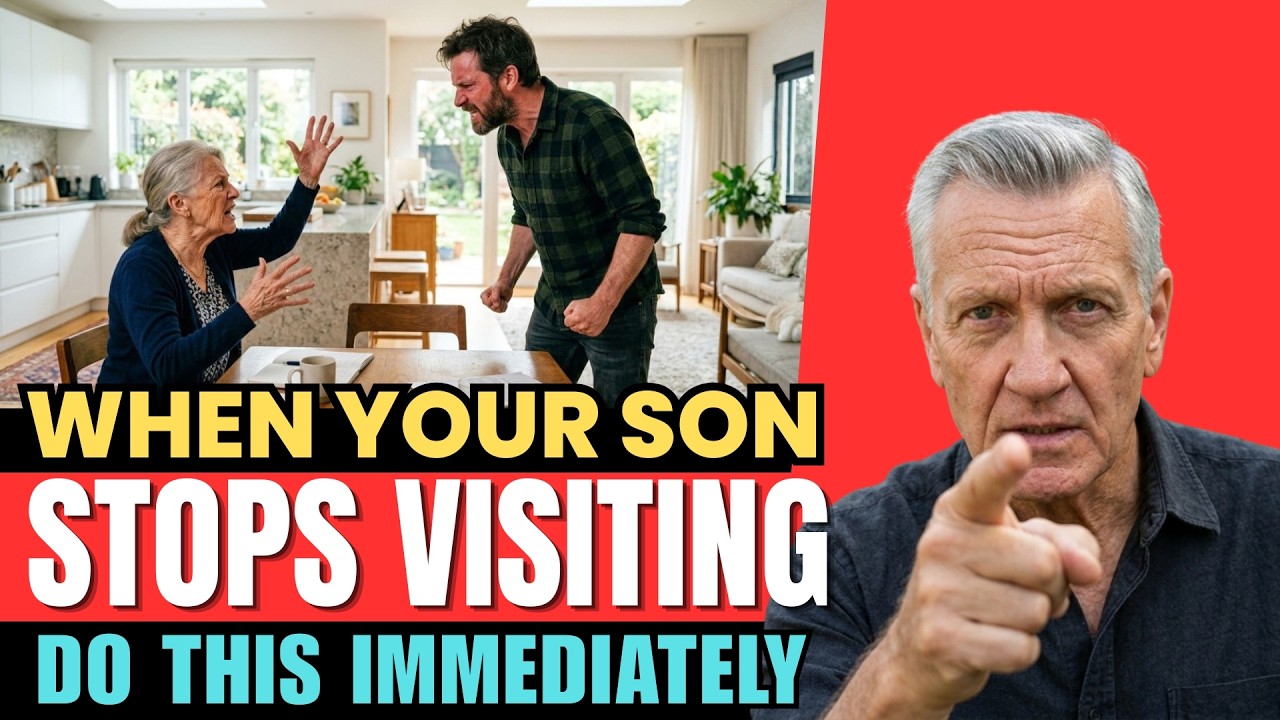
If that quiet sounds familiar, know this: you are not being dramatic. What you’re feeling isn’t weakness, and it isn’t something to just push aside and get over. The grief of losing closeness with a child you raised—a child who is still alive, still out there—is one of the loneliest feelings a parent can carry. I’ve been a psychologist for over 40 years.
I’ve sat across from hundreds of parents, most of them mothers, but fathers too, carrying that exact grief. Almost every single one started with the same question: “What did I do wrong? ”
I’m going to answer that honestly. Not to assign blame, to you or to your son, but to give you something more valuable: understanding.
Once you understand what is actually happening psychologically, developmentally, relationally, you stop reacting from pain and start responding with wisdom. That shift is where the door back to your son begins to open. Here are five reasons married sons pull away from their parents. For each, I’ll give you a concrete strategy.
Stay with me until the fifth—in my experience, it’s the one most parents never see coming, and often the one that matters most. First, a frame. When your son got married, his attachment system reorganized. That sounds academic, so let me simplify.
From the time he was born, you were his primary bond—his safe harbor, the person his nervous system was wired to return to. Then he fell in love, and that primary bond slowly, naturally, necessarily began to transfer. Erik Erikson called this one of the central tasks of early adulthood: building intimate partnership. It is a task, a healthy one.
Your son isn’t abandoning you. He is building something. Those two things—building something new and abandoning what came before—are not the same. They can feel the same from where you stand, but they are fundamentally different.
There’s also a cultural gap. Many of you were raised in a time where family came first, always. Sunday dinner wasn’t optional. Calling your mother wasn’t a choice.
Your son was raised in a different America, one that tells young people: “Build your own life. Establish your own home. Make your own rules. ” Neither generation is wrong, but the gap between what you expected and what he was taught to do has a cost.
Right now, you may be the one paying it. Let’s look at what’s actually driving the distance. Reason one: his wife’s family has a different gravity. Your son and his wife have, on average, 50 to 80 discretionary hours a month—time left after work, sleep, errands, and running a household.
Two families are making a claim on that time: yours and hers. Add holidays, birthdays, and the occasional crisis, and what you’re looking at isn’t a loyalty test. It’s a math problem. In many marriages, the gravitational pull of the wife’s family tends to be stronger in the early years.
Not because she loves her family more, but because the home they’re building is emotionally organized around her comfort and belonging. That’s not a conspiracy. It’s how most young households work. The mistake many parents make is interpreting the division of time as a message about love.
“If he really cared, he’d find a way. We gave him everything. The least he could do is show up on holidays. ” I understand why it feels that way, but that framing turns a scheduling problem into a moral failure, and it pushes him further away.
What actually works: make your home the low-pressure option. When every visit comes loaded with unspoken expectation—“We haven’t seen you in three weeks. You know we’re not getting any younger. Your father misses you, even though he won’t say it”—his nervous system begins to associate coming home with emotional labor.
People avoid what feels like labor. Remove the weight. Replace obligation language with genuine invitation. Not, “You should come this Sunday,” but “We’d love to see you whenever it works.
” That isn’t passive. It’s strategic. The family that feels easiest to be around gets the most time. Reason two: you may be competing with his wife without realizing it.
This is the reason most parents resist the hardest, not because it isn’t true, but because it doesn’t feel true from the inside. There’s a dynamic in family psychology called triangulation. In the context of a mother, a son, and a daughter-in-law, it looks like this: two people pulling on one person in opposite directions, and that person gradually retreating from both to find peace. Most parents who fall into this pattern aren’t doing it consciously.
They aren’t trying to compete. They’re simply expressing love in the only language they know. But here’s what that love can sound like to a daughter-in-law. A comment about the way she keeps the house.
A comparison, even a gentle one, to how things were done before. A phrase as innocent as, “He never used to like that. ” Or, “That’s not how we did it in this family. ”
These aren’t attacks, but they land as territorial claims.
When a wife feels that her home, her choices, or her husband are being subtly evaluated, she pulls back. And when she pulls back, he follows. Not because she’s controlling him, but because he’s trying to preserve the peace of the home he’s building with her. Here’s the strategy that changes this dynamic more powerfully than anything I’ve seen in 40 years: stop trying to win your son.
Start trying to win his wife. Not insincerely. Genuinely invest in that relationship. Ask about her interests.
Learn what she cares about. Find something real you appreciate about her and say it—not to be strategic, but because it’s true, and because you’ve been withholding it out of quiet competition. She is not the enemy. She is the keeper of the home your son lives in.
When she feels safe with you, genuinely safe, the door opens. Reason three: your visits feel like an emotional obligation, not a joy. Sit with this question before you answer: the last few times your son visited, how did those visits end? Did he leave relaxed, having genuinely enjoyed himself?
Or did he leave tense, slightly relieved, already bracing for the next time? One of the most common and most painful patterns I see: parents who love their children deeply, whose homes are full of love, and whose visits have still become events their children dread. Not because of anything catastrophic, but because of accumulation. The quiet guilt trip when he gets up to leave early.
The question that isn’t really a question: “So you won’t be here for Easter again this year? ” The advice about his job, his weight, his finances—offered with love, received as judgment. The remark about how little they hear from him anymore, delivered just as he’s putting on his coat. Each of these, alone, is small.
Together, they create what I call the grievance gap—the distance between what you feel you’re owed as a parent and what he feels he’s able to give as an adult son. When that gap is visible in every interaction, visits begin to feel like a toll booth. He pays the toll, then he leaves. The strategy: the best 90 minutes rule.
The next time he visits, commit to making it extraordinary, not in length but in quality. Feed him something he loves. Ask about something he’s excited about. Don’t bring up frequency.
Don’t mention how long it’s been. Don’t give advice unless asked. And end it—warmly, early, before the tension has a chance to arrive. Leave him thinking, “That was actually really good.
”
That thought is more powerful than any guilt trip ever written. People return to places that feel good. Right now, your job is to make sure your home is one of those places. Reason four: he set a boundary and you didn’t hear it.
Boundaries are not walls. A boundary is a communication: “This is where I end and you begin. This is what I need to feel safe in this relationship. ” Healthy adults set them.
Healthy relationships honor them. But here’s what I’ve observed repeatedly in parents of adult children, especially parents of sons: a remarkable inability to hear the boundary when it’s being set. Not out of cruelty, out of love. Because when you love someone deeply, their limit can feel like rejection.
And rejection is painful, and painful things are sometimes easier to dismiss than to sit with. So he says quietly, “Mom, I’d prefer if you didn’t comment on my diet. ” And the next visit, you comment on his diet. Not because you forgot, but because you didn’t register it as a real limit.
You registered it as sensitivity, as something he’d get over, as something that didn’t apply in the context of a mother’s concern. He registered it as evidence that you don’t listen. Unheard boundaries don’t disappear. They calcify.
They become the invisible architecture of the distance between you. The strategy: replay and respect. Think back over the last three or four interactions with your son. Did he say anything that functioned as a request for you to stop, to back off, or to do something differently?
Write it down if you need to. Then, the next time you speak to him, name it. Not dramatically. Simply: “I’ve been thinking about what you said a few weeks ago.
I think I didn’t take it seriously enough. I’m going to do better. ”
That sentence, offered without defensiveness, can do more to reopen a closed door than months of overtures. What it communicates is the rarest thing in any relationship: “I hear you.
And you matter enough for me to change. ”
Reason five: he doesn’t know how to be a husband and your little boy. Of all five reasons, this is the one I’ve watched do the most quiet, consistent damage. And it’s the hardest to talk about because it comes directly from love.
When your son was small, you had a name for him—maybe you still use it. A nickname that carries the whole weight of his childhood in a single syllable. When you look at him, this grown man with a mortgage and a wife and responsibilities, sometimes you still see the boy. The one who needed you.
The one who came to you when he was hurt. The one who was, for a time, entirely yours. That memory is sacred. I’m not asking you to let go of it.
But consider what happens when a man who is working hard to establish himself as a husband, as the head of a household, as an adult, walks into a space where he is still treated as a child. Where conversations begin with, “Are you eating enough? ” Where achievements are met with, “That’s wonderful, honey,” in a tone that lands like a pat on the head. Where his opinions are tolerated rather than genuinely considered.
He doesn’t know how to be both things at once. And when the pressure to be your little boy conflicts with his need to feel like a man, he chooses the role his daily life requires—the one that makes him feel capable, respected, and whole. And he does that increasingly somewhere else. Here’s what brings him back.
See the man, not the boy you raised. Ask him what he thinks about something that actually matters—his field, the state of the country, a decision you’re facing. Then listen, not to indulge him, but because his perspective has genuine value, and somewhere deep in him he’s waiting for you to recognize that. Update your language about him.
Talk about his life as it is now, not as it was. His current work. His current interests. His current self.
The greatest gift you can give a grown son is the experience of being truly seen—not remembered, but seen by the parent who has known him longest. That gift is irreplaceable. No one else can give it. Not his wife, not his friends, not his colleagues.
Only you. When he feels it, when he walks out of a conversation with you thinking, “She really gets who I am now,” he will come back. Home is not a place. Home is the feeling of being known.
Notice what all five reasons have in common. None of them are about your son not loving you. Every single one is about friction—friction that built up slowly, quietly, in the space between what you needed and what he could give. Friction can be reduced.
But it requires something that doesn’t come easily after a lifetime of being the parent. It requires you to move first. Not because you were wrong, not as an admission of failure, but because you are, in this moment, the wiser person. And wisdom acts.
Viktor Frankl, a man who understood suffering more deeply than almost anyone, wrote that we cannot always choose our circumstances, but we can always choose how we respond to them. You can’t control how often your son visits. You can’t control the gravitational pull of his wife’s family or the way marriage has reorganized his priorities. What you can control is the quality of what he finds when he returns.
Here’s my request. Take the five reasons you’ve heard today. Identify just one that felt most true, most familiar, most uncomfortable to sit with. That one is your starting point.
Don’t try to fix everything. Don’t have a long conversation. Don’t present him with an apology that turns into a list of grievances. Just pick one thing.
Practice it for 60 days. Watch what shifts. Change in family relationships is almost never dramatic. It is quiet.
It is gradual. It is the accumulated weight of a hundred small moments that each say, in their own way: “I am learning. I am trying. You matter to me enough for me to change.
”
About that empty chair, that quiet house. It is not a symbol of loss. Not yet. Not while he is still alive and you are still here and the possibility of closeness still exists.
That chair is an open door. The pain you feel when you look at it is love with nowhere to go. And love with nowhere to go is not a weakness. It is a resource.
It is the energy that, properly directed, can rebuild what distance has worn down. You are not powerless. You are not disposable. You are not a chapter of his life that is simply over.
You are a parent learning, perhaps for the first time, what it means to love an adult son on adult terms—to love him not as the child who needed you, but as the man who is still becoming. To hold space for him without filling it with expectation. That is harder than anything you did when he was small. And it is more important.
If something here hit close to home, don’t defend against it. Just sit with it. The discomfort you feel is not a sign that you’re a bad parent. It is the sound of a bridge being built.
Keep the door open.