I woke up to the smell of antiseptic and the hum of fluorescent lights, my body feeling like it had been taken apart by someone who had never done it before. Ten days I’d been under, lost in a coma after a fall down the stairs. Ten days of nothing. And when I finally opened my eyes, the chair beside my bed was empty.
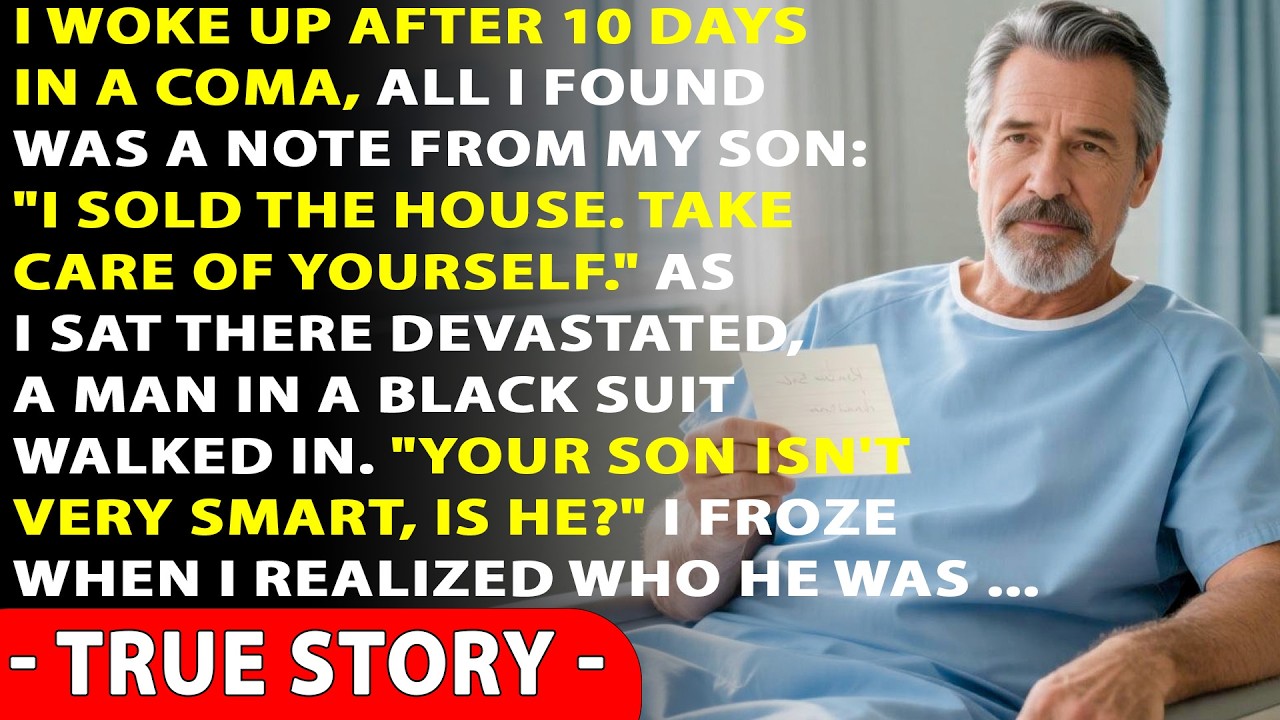
I told myself Ryan was down the hall, getting coffee, handling the paperwork like he always did. Then I saw the note on the nightstand. It was crumpled, like it had been shoved in a pocket before being abandoned here. I unfolded it with trembling hands.
Three sentences. *Dad, I sold the house. You’re nothing but a burden. Figure it out yourself.
Don’t call me. *
Thirty years of double shifts at the warehouse. Two jobs for a stretch when things were tight. The truck I sold for his college, the money jar behind the canned goods.
I’d given him everything I had, and he’d called it a burden. The sob that tore out of me was ugly, raw, and I didn’t care. A nurse named Linda came in, saw the paper in my hand, and asked if there was someone she could call. I couldn’t even answer her properly.
There was no one. Then three deliberate knocks landed on the door. A man in a charcoal suit walked in, silver-haired, with the calm authority of a man who had solved a problem long ago. He introduced himself as Harold Bennett, an attorney.
He said he’d been looking for me for a very long time. “Perhaps your son isn’t very smart,” he said, glancing at the note. He told me things that made no sense. He showed me an old photograph of a little boy standing in front of a grand house, a silver bracelet on his wrist.
The same bracelet I’d worn my entire life, the one nobody could explain, the one with the strange crest I’d never been able to identify. “That little boy is you,” he said. “Your real name is William Ashford. ”
I wasn’t the son of nobody.
I was the only child of Edmund Ashford, a man who had spent sixty-three years looking for me. My father had left me everything. The company, the estate, the fortune. Nine hundred and fifty million dollars.
Harold walked me through the rest of it slowly. My father had died two years ago, never knowing I was alive. He’d kept my room exactly as I left it, fresh flowers placed on the desk every single week. He wrote me a letter every birthday, sixty-three in total, sealed in a cream envelope.
And then Harold opened the manila folder. He showed me Ryan’s bank records first. The withdrawals from my savings account, seven transactions that emptied it while I lay helpless in that hospital bed. Then the real estate deed, selling my home to his own wife.
Then the forged signature on a power of attorney document. The rage came next. The cameras caught it all. Ryan had loosened the bolts on the stair rail in my building.
He knew about my vertigo. He was the one who made my fall possible. And the insurance policy, $750,000, applied for just weeks before my accident. With my signature that wasn’t mine.
Harold showed me the text messages. Amber, his wife, pushing him, planning it all. “He won’t if his health keeps declining. ” “The railing is loose.
” “Don’t. ” He stood in the stairwell with a wrench and he made a choice. I sat there in that quiet study, in the house my father had waiting for me, holding a letter written in the last week of Edmund’s life. For my William.
And I understood then what I needed to do. Three days later, I walked into the Ashford Capital boardroom wearing my father’s suit, the family crest embroidered on the pocket. My son sat at the far end of the table. The color drained from his face when he saw me.
“My name is William Edmund Ashford,” I said. “And I am home. ”
The board went silent. The DNA certification came first.
Then the will. Then the evidence of what he had done. The money he’d stolen. The house he’d sold.
The forgery. The security footage of him loosening the rail. And the text messages, projected large enough for every person in the room to read. Ryan stood, shaking, protesting, performing confusion.
Harold told him to sit down. The Charleston police were waiting in the lobby with warrants. Ryan looked at me one last time, his face collapsed into something I hadn’t seen since he was a child. “Dad,” he said, his voice breaking.
“I know,” I told him. The officers led him out. Amber was arrested at the house she’d taken from me the same morning. The board voted to recognize me as the rightful owner, seven to zero.
Margaret Holloway, who had known my father for decades, signed the resolution and slid it across the table. I stood on the terrace afterward, looking out at the city my father built, wearing the suit he’d made for me. I was still standing. That evening, Harold gave me the cream envelope.
Inside were sixty-three letters, one for every birthday I’d been gone. My father’s handwriting, growing older with each page. The last one, dated months before his death, ended with the words: *Come home, William. It is not too late.
It was never too late. *
I founded the Second Chance Foundation to help people who had lost their way home. Amber divorced Ryan and took everything he had left. Ryan wrote me from prison.
He didn’t ask for forgiveness. He just wanted me to know he was sorry for who he’d become. And then Harold placed a small velvet pouch in my hands. Inside was a second bracelet, a companion to the one I’d worn all my life.
Engraved on the inside band were six words my father had commissioned in 1961, the year he bought me my first bike. *An Ashford is never truly lost. *
I clasped it onto my wrist and stood on the roof of Ashford Manor as the sun set over the harbor.
For the first time in sixty-eight years, I was exactly who I was supposed to be.