“Don’t contact me again. ”
I read it a third time. Then a tenth. Then I lost count.
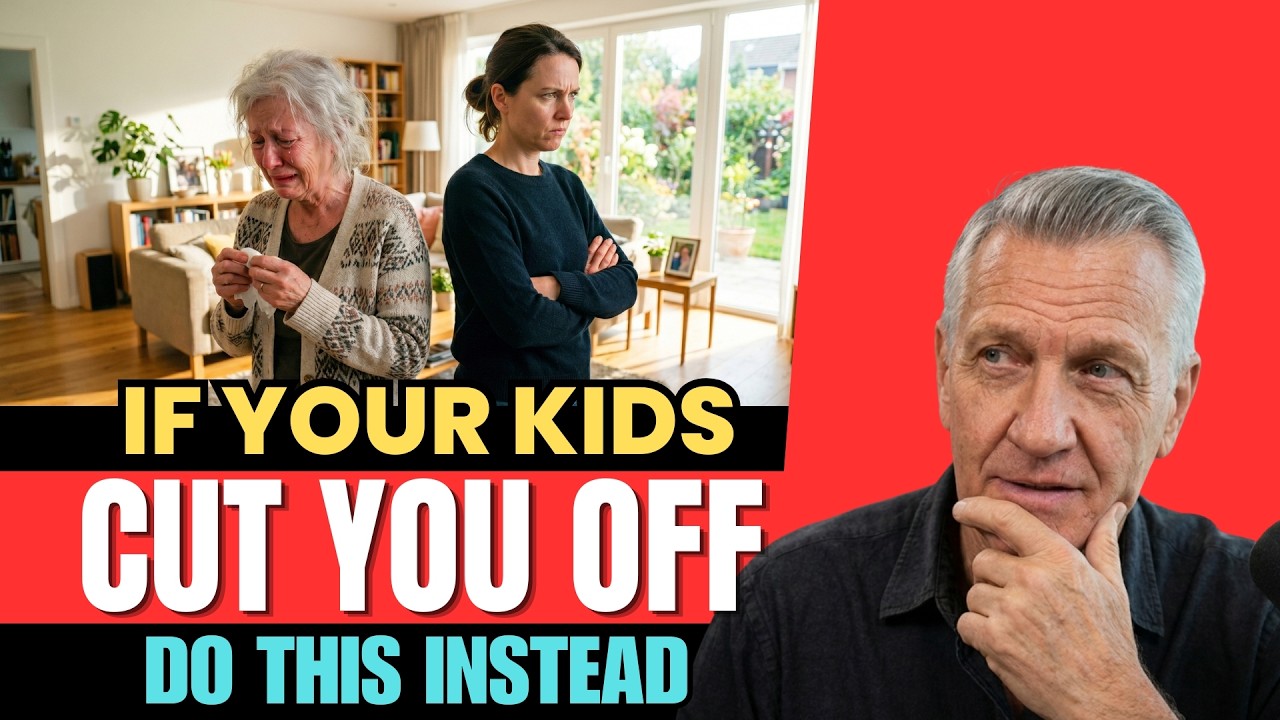
Five words from my own child—the one I stayed up with through fevers, drove to soccer practice and school plays, walked across graduation stages for. The one I would have stepped in front of a moving car for. And now, silence. If you’re sitting where I was, staring at that message on your phone, I want you to hear something before anything else: you are not crazy.
You are not a monster. And you are absolutely not alone. I’ve been a clinical psychologist for over forty years. I’ve sat across from parents in their sixties and seventies—people who built their lives around their families and still found themselves trying to understand how it came to this.
I’m not here to assign blame or take sides. I’m here to give you six honest, concrete things you can do starting today to survive this. And maybe, over time, give that relationship its best chance at healing. But first, I need to give you some context that might make you feel better, not worse.
Family estrangement is far more common than most people realize. Research suggests roughly one in four American adults is estranged from at least one family member—and in many of those cases, it involves a parent and an adult child. This isn’t a new problem, but people over sixty were never taught how to talk about it. In our generation, family problems stayed inside the family.
You didn’t air your grief at the neighborhood barbecue. You didn’t call a hotline. So millions of parents are carrying this pain alone. Here’s the other thing I want you to understand: estrangement is not a life sentence.
It is not a final verdict on who you are as a parent. Relationships, even deeply fractured ones, can heal—I’ve seen it many times. But here’s what nobody tells you: the way you behave in the first ninety days after estrangement is declared has an enormous impact on whether healing becomes possible. Which brings me to step one.
When your child says, “Don’t contact me again,” everything in you wants to fix it immediately. You want to call. You want to explain. You want to send one more text—the right text, the one that finally makes them understand.
You want to drive to their house, call their sibling, their spouse, their old college friend. Anyone who might carry a message back. I understand. I genuinely do.
But every single one of those impulses, if you act on them, will make things worse. Here’s why. When your child made that declaration, they were telling you something: they need distance in order to feel safe. Whether or not you agree with their reasons—and you may not—that’s what they communicated.
When you immediately pursue them with calls, texts, showing up, recruiting family members as messengers, you’re sending a clear signal: your boundaries don’t matter to me. And every time that signal is sent, it hardens their resolve. It confirms the very thing that may have driven this decision. There’s also something happening in your own brain working against you.
When we’re in gut-level grief, the emotional centers of the brain hijack the rational ones. Psychologists call this an amygdala hijack. You are not thinking clearly. You can’t yet.
So here is my prescription: the thirty-day intentional silence. Not giving up. Not surrendering. Not agreeing that everything said about you was right.
Thirty days of not initiating contact. Thirty days of sitting with discomfort instead of acting out of panic. Silence in this moment is not abandonment. Silence is oxygen.
It gives your child room to breathe. And it gives you the space to start doing the work that actually matters—which is what the next five steps are about. I know this is the hardest thing I could ask of you. I know every day will feel like a year.
But trust me: the message you do not send right now may be the most powerful one you ever write. Now for step two, and I want to be clear that this isn’t about blame. I’m not going to tell you everything is your fault—I don’t believe that, and it’s almost never that simple. But if there is any chance this relationship heals, if there’s even a possibility that one day your child’s door opens again, it will require you to do something most people in pain refuse to do: look honestly in the mirror.
Sit quietly today or tomorrow and ask yourself three questions. Question one: What did my child tell me more than once bothered them that I dismissed? Not what you think they should have been bothered by. What did they say?
Did they say they felt criticized? Controlled? Like their choices were never good enough? What did you hear and choose not to take seriously?
Question two: Did I love my child the way they needed to be loved, or the way I knew how? There’s a difference between intending to love someone and landing love in a way they can receive it. Many of us were raised where love meant sacrifice, provision, discipline, structure. And we gave our children all of those things genuinely, from the heart.
But some children need something different: to be seen, to have their inner world acknowledged, to feel that who they are is valued—not just what they do. If your love never quite reached them the way you intended, that doesn’t make you a bad parent. But it’s worth sitting with. Question three: What role did my own unhealed wounds play in how I raised my child?
This is the deepest question. Most of us carry things from our childhoods—wounds we were never given the tools to process, patterns we absorbed without knowing it. The critical father, the anxious mother, the household where emotions weren’t safe. Without meaning to, we sometimes pass those patterns forward.
I’m not asking you to condemn yourself. I’m asking you to see it. Because the moment you can see it clearly, without flinching, is the moment it loses some of its power. Now, I know some of you are thinking: sometimes adult children estrange their parents for unfair reasons.
Sometimes the grievances are exaggerated. Sometimes there are outside influences—a partner, a therapist with an agenda, a self-help book misapplied. That may be true for you. I don’t know.
But step two is not the place to evaluate that. Step two is the place to find whatever your part is, however small, and own it fully. Everything else can be addressed later. Step three is one of the most consistently powerful tools I know for processing profound grief—and it’s remarkably simple: write a letter.
Not to send. Not yet. Maybe not ever. Just write.
Here’s what the neuroscience tells us. When we externalize pain—when we take what’s living inside our chests and put it into words on a page—something measurable happens in the brain. The emotional centers quiet down slightly. The rational, reflective part of the brain begins to come back online.
We gain, even just a little, distance between the emotion and the action. Here’s what I want you to do. First draft: write everything. Don’t censor yourself.
Say what you’re angry about. Say what you’re heartbroken about. Say what you wish had been different. Let it be messy.
Let it be unfair. Let it be one hundred percent emotionally true. Then write a second draft. Take out every sentence that assigns blame.
Take out every “you always” and “you never. ” Take out every line that asks them to see your perspective before acknowledging theirs. A different letter will begin to emerge. Consider ending it this way: “I love you, not because of what you do or who you become or whether you ever speak to me again.
I love you because you are my child, and that doesn’t change. I am doing the work of understanding. I am here whenever and if ever you’re ready—not to argue, not to revisit old pain. Just here.
”
Put that letter somewhere safe. Don’t send it yet. Keep it. Read it when you feel the urge to reach out impulsively.
Let it remind you of who you are working to become. Step four: get help. I want to speak directly to your generation for a moment. You were raised to handle things internally, to keep family business private, to be strong, to not burden others, to push through.
There’s real honor in that. But no one processes something this painful entirely on their own. The grief of estrangement is not a cold you can sleep off. It lives in your body.
It distorts your thinking. It isolates you. And left completely unaddressed, it can literally take years off your life. So, three specific options.
Option one: individual therapy, ideally with someone who specializes in family estrangement or adult parent-child relationships. This isn’t crisis therapy—it’s a thinking partnership. Someone whose job is to help you understand what happened, process the grief, and build the insight that makes reconciliation possible. Your primary care physician can make referrals, and Psychology Today’s website has a therapist finder that lets you filter by specialty.
Option two: support groups. There are communities, online and in person, specifically for parents of estranged adult children. These groups can be life-changing—not because they give you strategies, but because they give you something more important: the experience of being fully understood. You don’t have to explain the whole story.
Everyone already knows. Option three: guided self-work. If therapy isn’t accessible right now, there are solid workbooks and structured journaling programs designed specifically for this kind of grief. They aren’t substitutes for professional support, but they’re real tools.
One note of caution: be careful of the friends, family members, or online communities that respond to your pain by saying, “Your child is terrible. You did nothing wrong. You don’t need to change anything. ” I know that’s what part of you wants to hear.
But that kind of unconditional validation, without reflection, without growth, is not support. It’s a very comfortable trap. Step five might surprise you: rebuild your life. I mean that seriously, and I mean it fully.
Reconnect with the friendships you let drift. Pursue the interests that got set aside when the kids were young and never picked back up. Volunteer. Create something.
Travel somewhere you’ve always wanted to go. Take care of your body. Walk. Eat well.
Sleep. Here’s why, and I want to be honest because this might feel like I’m asking you to move on. I’m not. One of the most common underlying reasons adult children estrange from parents is that they feel, consciously or not, suffocated.
Enmeshed. Like they carry the weight of their parents’ emotional world. Like their separateness—their right to make their own choices, live their own lives—was never quite accepted. When you have a full life—genuine purpose, real relationships, things that matter beyond your child—two things happen.
First, you become less desperate. And desperation, as loving as it is at its root, pushes people away. Second, you become more interesting, more real, more like a person they might one day choose to be in relationship with, rather than someone they feel obligated to manage. I’ve watched this play out more times than I can count.
The parents who heal their estrangements are almost never the ones who spent those years waiting by the phone. They’re the ones who did something remarkable with the time they were given. Your life is not over because your child isn’t in it right now. Your life is still yours.
And the person you become in this chapter—the depth, the wisdom, the hard-won peace—that person may be exactly who your child needs to meet. Step six: at some point—and this moment is different for everyone, there’s no perfect timeline—you’ll feel ready to reach out. Not from panic. Not from desperation.
From a place of centeredness and genuine love. When that moment comes, do it correctly, because there’s an enormous difference between leaving a door open and standing in the doorway refusing to let it close. Here’s what reaching out the right way looks like. One message.
Short. No pressure. No expectation of a response. Something like: “I’ve been spending a lot of time thinking and doing some real reflection.
I love you. Without conditions. Without an agenda. I respect where you are.
I’m here whenever and if ever you’re ready. You don’t need to respond to this. ”
Then stop. Do not follow up with, “I just wanted to make sure you got my message.
” Do not ask a sibling to check if they read it. Do not send a card two weeks later to reinforce it. One message. Then silence.
Because silence in this moment is the loudest possible signal of respect. Now, about the long game. Some reconciliations happen in a year. Some take five.
Some take ten or more. I’ve seen parents reconnect with estranged children at the birth of a grandchild, at a sibling’s wedding, during a health crisis that made old grievances feel suddenly smaller. Life creates openings, especially as people age and confront their own mortality. But here’s the key: every day you live with dignity is a day you build the case for reconciliation.
Every day you grow—genuinely grow, not perform growth—is a day you become someone your child might someday consider approaching. And every day you reach out when they’ve asked you not to is a day you make that possibility a little more distant. Here are three things to never do, and I want to be direct. Do not issue ultimatums.
“If you don’t respond by Christmas, I’m done trying. ” Ultimatums tell the other person your love was conditional all along. Do not recruit others as messengers. Using your other children, mutual friends, or relatives as go-betweens puts them in an impossible position and often backfires badly.
Do not go public with your pain. I know social media can feel like a place to find community, but posting about your estrangement—even vaguely, even sympathetically—will almost certainly reach your child. And it will close doors that might otherwise have opened. The long game is quiet.
It is patient. It is hard. But it is the only game worth playing. Let me bring this home.
Here are the six things we covered today. One: stop, and do not pursue. Two: look honestly in the mirror. Three: write the letter you won’t send yet.
Four: get professional or community support. Five: rebuild your own life fully and genuinely. Six: when the time is right, leave the door open the right way. I want to close with something I mean with everything I have.
The fact that you’re still trying to understand—that you’re willing to ask hard questions about yourself in the middle of your own grief—tells me something. It tells me you’re not the kind of parent who gives up. It tells me you love your child more than you need to be right. Estrangement is not the final chapter of your story as a parent.
For many people I’ve worked with personally, it became the beginning of the most honest, most courageous, most healing chapter of the whole relationship. I can’t promise you that will happen. No one can. But I can tell you this: how you walk through it matters.
Walk it with honesty. Walk it with grace. Walk it with the kind of love that doesn’t need anything back. And whatever happens, you will be able to look at yourself in the mirror and know—I did this right.
That is not a small thing.