Fear has a specific taste. For sixty-eight years, I thought it tasted like cold metal, or the bitter tang of medicine in a hospital room. I was wrong. That Tuesday afternoon, standing in the kitchen of the home I had scrubbed, polished, and loved for four decades, I learned the truth.
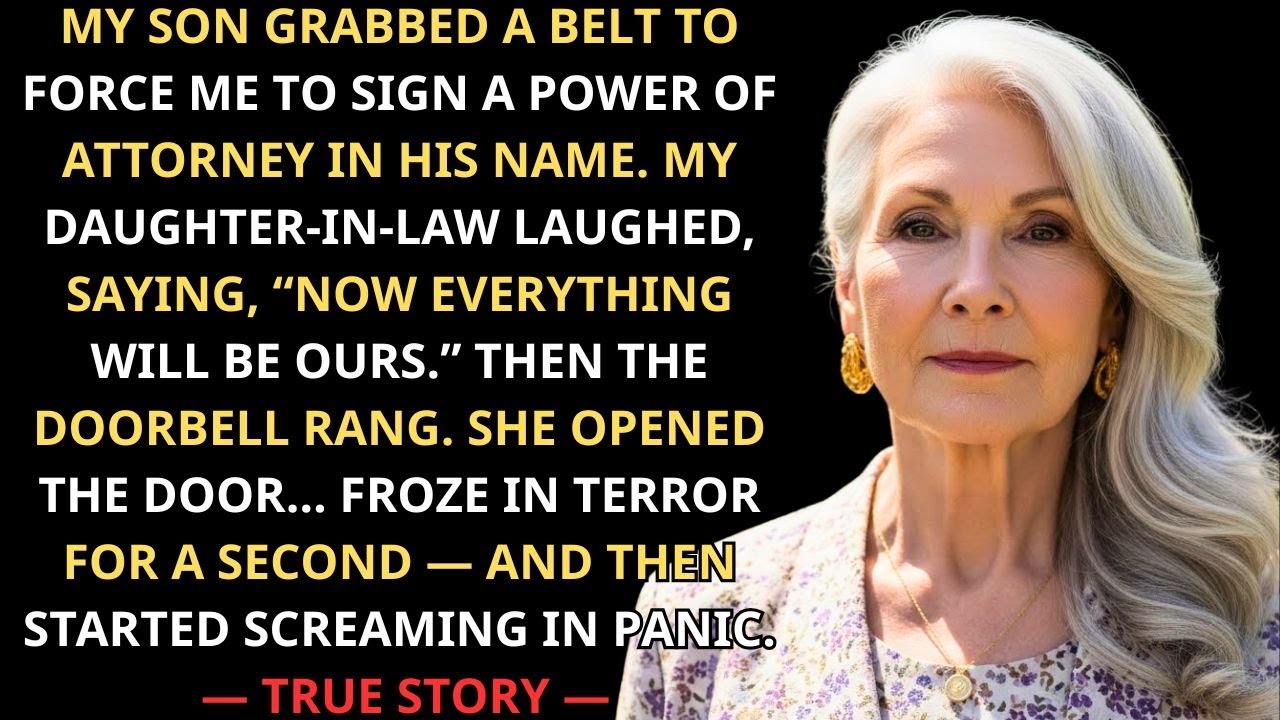
Fear tastes like copper. It tastes like blood biting the inside of your cheek as you force yourself not to scream. My name is Elara Vance. I am a retired literature professor, a widow, and a woman who once believed that a mother’s love was a shield strong enough to deflect any arrow, even those fired by her own flesh and blood.
I believed that if you poured enough kindness into a child, they would grow up to be a vessel of light. I was naive. This is not a confession of a crime, but a confession of a blindness so profound it almost cost me my soul. There are certain agonies we hide, not out of cowardice, but because speaking them aloud requires acknowledging that the life we thought we built was nothing more than a castle made of sand, waiting for the tide.
It began on a humid afternoon in late September in Savannah, Georgia. The air outside was thick with the scent of magnolia and approaching rain. I was making tea, Earl Grey, the way my late husband Silas used to like it. The rhythmic clinking of the spoon against the china was the only sound until the front door slammed.
It wasn’t a normal closing of a door. It was a declaration. The footsteps that followed were heavy, hurried, and unmistakably familiar. They belonged to Julian, my only son.
At thirty-four, Julian still walked with the heavy-footed entitlement of a teenager who assumes the world will move out of his way. “Mom, we need to settle this now. ”
His voice drifted in from the living room, stripping the peace from the air. It sounded different that day.
Harder, like stone grinding against stone. I set the kettle down, my hands trembling slightly. Not from age, but from an instinct I had been suppressing for months. Julian stood in the center of the living room, his shirt unbuttoned at the collar, sweat glistening on his forehead.
His eyes, usually a soft hazel like his father’s, were dark, dilated with adrenaline and something I refused to name. Behind him stood Serena, his wife. She was leaning against the doorframe, checking her nails, wearing that perpetual smirk that suggested she knew a joke the rest of the world was too stupid to understand. “Good afternoon, Elara,” Serena said.
Her voice was syrupy, a southern drawl that felt manufactured. I didn’t answer her. My chest tightened. “Sit down, Mother,” Julian said.
He didn’t ask. He commanded. It was the voice of a stranger wearing my son’s face. I sat in the wingback chair by the fireplace, the same chair where I had nursed him through chickenpox, where I had read him The Great Gatsby, where I had taught him that a gentleman never raises his voice to a lady.
Serena turned the deadbolt on the front door. The metallic click echoed through the high ceilings like a gunshot. Julian reached into his leather satchel and pulled out a thick document bound with a metal clip. He tossed it onto the mahogany coffee table.
It landed with a heavy thud. “It’s the power of attorney,” he said, his voice devoid of emotion. “And the deed transfer. You’re going to sign them today.
”
I stared at the papers. The words swam before my vision. “Why, Julian? I’m perfectly capable of managing my own affairs.
”
Julian let out a short, sharp laugh that held no humor. “Capable? Mom, look at you. You’re pushing seventy.
This house is a money pit. The roof needs repairs. The garden is overgrown. And you’re here all alone, rattling around like a ghost.
You can’t handle it. Serena and I, we’re doing this for you. We’ll manage the assets, sell this place, and get you into that nice assisted living facility in Charleston. ”
My heart began to beat in a slow, heavy rhythm, a funeral drum in my chest.
“This house is not a money pit, Julian. This house is my life. Silas and I bought this place when it was a ruin. We restored it with our own hands.
I am not going to a facility. ”
Serena pushed herself off the doorframe and walked closer, her heels clicking on the hardwood floors. “Oh, Elara, don’t be difficult. It’s embarrassing, really, holding on to the past like this.
It’s selfish. Julian needs the capital to invest in his firm. Think about your legacy. Do you want to be the reason your son fails?
”
Julian walked toward the mantle where I kept the family portraits. He picked up a silver-framed photo of Silas taken just months before his heart gave out ten years ago. Silas looked strong, kind, his arm draped protectively around my shoulders. “Do you think Dad would want to see you like this?
” Julian asked. “Stubborn, senile, holding me back? ”
Tears pricked my eyes, hot and stinging. “Your father would want me to retain my dignity, Julian.
And he would be heartbroken to see you speaking to me this way. ”
Julian slammed the photo face down on the mantle. The glass cracked. The sound shattered the last remnants of my denial.
“Sign the papers, Mom. ”
“No. ”
The word came out before I could think. It was small, but it was made of iron.
And then the atmosphere shifted from tense to terrifying. Julian began to unbuckle his belt. It was a reflex, perhaps, a gesture of frustration from a man who had never been told no. But as the leather slid through the loops with a serpentine hiss, I saw a flash of violence in his eyes that froze my blood.
He wrapped the thick leather strap around his hand, his knuckles turning white. “I’m going to ask you one last time,” he whispered, leaning in so close I could smell the stale bourbon on his breath. “Are you going to sign, or do we have to do this the hard way? ”
I looked at the belt.
Then I looked at my son. In his face, I searched for the toddler who used to bring me dandelions. The boy who cried when his goldfish died. He was gone.
In his place was a man consumed by greed and manipulated by the woman standing behind him, clapping slowly. “Bravo,” Serena mocked. “Look at that. The matriarch has a spine after all.
”
Julian raised his hand. I closed my eyes, bracing for the impact, bracing for the end of my world. Ding-dong. The sound of the doorbell was jarring, cheerful, utterly out of place.
Julian froze. His arm hung in the air, the belt dangling like a dead snake. “Who is that? ” Serena hissed.
“I don’t know,” I whispered, my voice trembling. Ding-dong, ding-dong. The ringing was insistent, authoritative. “Get the door, Serena,” Julian commanded, lowering his hand but not dropping the belt.
“Get rid of them. ”
Serena smoothed her dress and walked to the door, composing her face into a mask of polite annoyance. She opened it a crack. “Can I help you?
”
Then she gasped and stumbled back. The door was pushed open firmly. “Good afternoon, ma’am. We have a report of a disturbance at this address.
”
Two men stepped into my foyer. One was Officer Harrison, a man I had known since he was a crossing guard at the elementary school. The other was Elias Thorne, my attorney and lifelong friend, wearing a linen suit that looked as sharp as his intellect. Julian dropped the belt.
It hit the floor with a dull thud. “Elias,” Julian stammered, the color draining from his face. “What are you doing here? ”
“I’m here to ensure your mother is not being coerced,” Elias said, his voice calm but cold as a glacier.
“And Officer Harrison is here to ensure she remains physically safe. We received a distress signal. ”
“Distress signal? ” Serena shrieked.
“This is ridiculous. We’re having a family discussion. ”
“I didn’t make a call,” I said, confused. Elias walked over to me, stepping over the belt on the floor as if it were trash.
He crouched down, taking my cold hands in his warm ones. “I know you didn’t, Elara. But the neighbors did. Mrs.
Gable next door heard shouting. And frankly, I’ve been worried about you for months. ”
In that moment, the dam broke. I looked at Elias, then at the officer, and finally at my son, who now looked like a frightened child caught in a lie.
I realized I had been saved. But to understand the magnitude of this rescue, you must understand how a woman like me, educated, strong, independent, could end up trembling in her own living room before her own child. It didn’t happen overnight. A tragedy like this is never an explosion.
It is erosion. It is the slow wearing away of boundaries in the name of love. When Julian was born, I was twenty-eight. Silas and I had tried for years to have a child.
When Julian finally arrived, he was our miracle. We wrapped him in cotton and adoration. “He’s going to do great things, Elara,” Silas would say, watching Julian sleep. “He’s going to have the life we never did.
”
We raised him with kindness. We shielded him from the harshness of the world. If he forgot his homework, I drove it to school. If he broke a neighbor’s window, Silas paid for it and apologized so Julian wouldn’t have to face the anger.
We thought we were protecting him. We didn’t realize we were crippling him. We taught him that consequences were things that happened to other people, not to him. Julian was charming.
He had a smile that could disarm a firing squad. He coasted through school on charisma and average grades. He went to college to study architecture, funded entirely by our savings. He talked about building skyscrapers, about changing skylines, but he never liked the math, the grit, the late nights.
He liked the idea of being an architect, not the work. When Silas died, Julian was twenty-four. It was a massive heart attack. Quick, brutal.
I remember standing in the hospital corridor, the fluorescent lights humming overhead, feeling like half of my body had been amputated. Julian arrived late. He had been at a party. He smelled of smoke and cheap cologne.
“Mom,” he said, hugging me stiffly. “What are we going to do about the money? ”
That was his first question. Not “How are you?
” Not “I miss him. ” Just the money. I brushed it aside, attributing it to shock. Grief makes people say strange things.
I told myself I was wrong. In the years that followed, Julian drifted. He started businesses that failed. He needed investments from me.
First five thousand, then ten. I always gave it. I was the grieving widow trying to keep her son close, the only piece of Silas I had left. Then he met Serena.
She was beautiful in a sharp, angular way. She worked in marketing, or so she said. She looked at our house, at the antiques, at the land, not with appreciation, but with appraisal. She calculated the value of everything she touched.
They got married in a ceremony I paid for. It cost forty thousand dollars. Julian insisted on it. “We need to make a statement, Mom.
”
The statement was that I was an ATM and they were the cardholders. Six months ago, the real nightmare began. Julian and Serena came to me with a story about mold in their apartment, about health risks. “Just for a few weeks, Mom,” Julian said.
“Until we find a new place. ”
I agreed. I was lonely. The house was big.
I thought it would be nice to have life in the halls again. But weeks turned into months. They took over the master suite, my room, the room I had shared with Silas. “You should take the guest room downstairs, Elara,” Serena suggested.
“It’s better for your knees. ”
I moved. I shrank. I made myself smaller to make room for them.
Then came the requests for the power of attorney. “Just to help you with the bills, Mom. You’re forgetting things. Remember, you lost your keys last week.
”
Gaslighting is a subtle poison. You don’t taste it until you’re already choking. I started to doubt my own mind. Maybe I was getting old.
Maybe I did need help. But I wasn’t senile. I found the bank statements in the trash. They were siphoning money.
Thousands of dollars spent on designer clothes, leased luxury cars, trips to vineyards. When I confronted them, they exploded. That was the first time I saw the rage, the entitlement. And that brings us back to the living room, to the belt, to the moment I almost lost everything.
Officer Harrison stepped forward, his hand resting near his utility belt. “Mr. Vance, Mrs. Vance, I’m going to need you to step away from Elara.
Now. ”
Julian tried to laugh, but it came out as a dry choke. “Officer, this is a misunderstanding. We were just passionate.
My mother is confusing things. She’s not well. ”
Elias stepped in, his voice cutting through the air like a scalpel. “I have her medical records right here, Julian.
Her latest cognitive exam was last week. She scored perfect marks. She is of sound mind. And I have the draft of the power of attorney you tried to force her to sign.
This is coercion. This is elder abuse. ”
Serena’s face went pale. “We didn’t force anyone.
We were trying to help her. ”
Officer Harrison looked at the cracked photo frame on the mantle. He looked at the belt on the floor. “That doesn’t look like help, ma’am.
That looks like a threat. ”
Elias turned to me. “Elara, you have a choice. We can file a report right now.
We can have them removed. ”
I looked at my son. He was trembling now, not from rage, but from fear. The bully had been confronted.
“Mom, please,” he whispered. “Don’t do this. ”
I thought about Silas. I thought about the little boy with the dandelions.
Then I looked at the man who had been ready to strike me. I realized that saving him meant stopping him. “I want them to leave,” I said, my voice steady. “I want them out of my house tonight.
”
“But we have nowhere to go,” Serena screeched. “That is not my concern. You have burned this bridge. ”
Officer Harrison escorted them upstairs to pack a bag.
They were given thirty minutes. I sat in the living room with Elias, sipping the tea that had gone cold, listening to the sounds of their angry packing, the thud of suitcases, the muffled cursing. When they came downstairs, Julian stopped in front of me. “You’re ruining my life,” he spat.
“No, Julian,” I said softly. “I am refusing to let you ruin mine. And perhaps by doing so, I am finally teaching you how to build your own. ”
They left.
The door closed. The silence that returned to the house was not heavy. It was clean. It was the silence of a storm that has passed.
The next few months were a legal war. Elias was brilliant. We revoked every access they had. We changed the locks.
We filed a restraining order. I learned that Julian had taken out a second mortgage on the house by forging my signature on a digital document. The bank threatened foreclosure. I fought.
I sold my jewelry. I sold the antique collection Silas and I had built. I liquidated my retirement fund. I saved the house, but just barely.
I was left with almost nothing but the walls around me and my dignity. But I was free. Or so I thought. A year passed.
I heard rumors. Serena had left Julian when the money ran out. She moved to Atlanta, looking for a richer target. Julian was living in a studio apartment on the outskirts of town, working at a hardware store.
I missed him. It is a terrible thing to miss someone who hurt you. It is phantom limb pain. You reach for them and remember they are gone, and then you remember why they are gone.
One rainy afternoon, a letter arrived. No return address. I opened it. It was a photograph.
A grainy ultrasound picture. And a note. “Her name is Lily. She was born yesterday.
She has your nose. ”
There was no signature, but I knew. I sat on my porch and wept. A granddaughter.
A life I was connected to, yet completely separated from. I didn’t call. I didn’t write. Elias advised against it.
“He’s trying to manipulate you again, using the child as bait. ”
I knew Elias was right. But a grandmother’s heart is a traitorous thing. Two more years passed.
The silence hardened. I filled my days with book clubs, with gardening, with volunteering at the library. I built a life that was full, but the center was hollow. Then came the call.
It was late, past midnight. The phone rang, shrill and alarming. “Mom. ”
The voice was broken, unrecognizable.
“Julian? ”
“She took her. Serena, she took Lily. ”
My heart stopped.
“What do you mean? ”
“She came back. She said she wanted to see Lily. I let her.
I thought… I thought she had changed. But she took her. She’s getting on a plane to France.
Mom, she’s going to live with some guy she met online. She’s taking my daughter. I can’t stop her. I don’t have the money for a lawyer.
I don’t have anything. ”
He was sobbing. Deep, gut-wrenching sobs. “Please, Mom.
I know I don’t deserve anything. I know I’m garbage. But Lily, she’s innocent. Don’t let her lose her dad.
Please. ”
I stood there in the dark hallway. I remembered the belt. I remembered the stolen money.
I remembered the cruelty. But then I remembered the dragon. There is a story I used to teach my students. Beowulf.
The dragon sleeps on his gold until a thief wakes him. But the real dragon is not the monster. It is the resentment we hoard. If I did nothing, I would be hoarding my righteousness, my justice, while an innocent child paid the price.
Justice without mercy is just revenge. “I’ll call Elias,” I said. We met at the airport. Elias, me, and police officers.
We had the custody papers, the court orders that Elias had miraculously pushed through in hours, calling in every favor he had owed in thirty years of practice. We found Serena at the international gate. She looked glamorous, holding a toddler who looked bewildered and tired. When she saw us, she tried to run.
But there was nowhere to go. The confrontation was short. The police intervened. Custody had not been established for her to leave the country.
It was technically kidnapping. Serena was furious, screaming obscenities as they led her away for questioning. And then there was Julian. He stood by the gate, looking older than his years, his clothes worn, his hands shaking.
Lily, the little girl with curly hair and Silas’s hazel eyes, looked at him and cried out, “Daddy! ”
Julian fell to his knees. He embraced his daughter as if she were oxygen and he had been holding his breath for years. I stood back, watching.
Elias put a hand on my shoulder. “You did a good thing, Elara. ”
I looked at my son. He looked up at me over Lily’s shoulder.
His face was wet with tears. In his eyes, the arrogance was gone. The greed was gone. There was only gratitude and shame.
“Thank you,” he mouthed. I nodded. I didn’t hug him. Not yet.
Trust is a building that must be constructed brick by brick, and he had burned the foundation. The road to reconciliation was long. It was not a movie ending. I did not let Julian move back in.
That was my boundary. I helped him get a lawyer for the custody battle, but I made him pay me back. Every cent. He kept his job at the hardware store.
He took extra shifts. He moved into a small, clean apartment. He started coming for Sunday dinner. At first, it was awkward.
We talked about the weather, about Lily’s preschool. One Sunday, while Lily was chasing butterflies in the garden, the same garden I had refused to let die, Julian set his teacup down. “Mom,” he said. “Yes?
”
“I remember the belt. ”
The air in the kitchen went still. “I remember it every day,” he continued, looking at his hands. “I see it in my nightmares.
I almost hit you. My own mother. I was a monster. ”
“You were lost, Julian.
And you were cruel. ”
“I was. And ‘I’m sorry’ doesn’t cover it. I know that.
I will spend the rest of my life trying to make sure Lily never sees that side of me. That she never meets the man I was that day. ”
I looked at him. I saw the gray hairs at his temples.
I saw the calluses on his hands from working manual labor. Hands that had once been too soft to hold a hammer. He had changed. Not because I saved him, but because I had let him fall.
I had let him hit the bottom so he could find out what ground he stood on. I reached across the table and covered his hand with mine. “You are not that man anymore, Julian. That man is gone.
You killed him the day you decided to be a father to Lily. ”
He squeezed my hand, and for the first time in years, the grip was gentle. Time has a way of smoothing the sharpest rocks. Today I am seventy-five.
The house is still mine. It is old and it creaks, but it is filled with laughter again. Lily is seven. She runs through the halls where the ghosts used to be.
Serena drifted away, ending up in another state, another life. She visits Lily occasionally, supervised, but she is a visitor in her daughter’s life, not an anchor. Julian is an architect again. He started small, designing renovations, humble additions.
He learned that you cannot build a skyscraper if you don’t respect the dirt you build it on. He treats me with a reverence that borders on devotion. But we both know the truth. We know the darkness that lives in the human heart.
We know that love is not just soft words and hugs. Sometimes love is a locked door. Sometimes love is saying no. Sometimes love is calling the police on your own child to save his soul.
I sit on my porch now, watching the sunset paint the Georgia sky in purples and golds. I sip my Earl Grey. I taste the bergamot, the warmth. I no longer taste the copper of fear.
If there is one thing I want you to take from my story, it is this. Do not set yourself on fire to keep others warm, even if those others are your children. Because once you burn to ash, you can help no one. Dignity is not a gift you give to others.
It is a possession you defend. And sometimes, the most profound act of love is to refuse to be a victim, thereby forcing those you love to finally, truly become adults.