She sat across from me in my office, seventy-three years old, sharp mind, strong hands, and she said something I’ve heard hundreds of times. “My son is just so busy. He has a big job, two kids. I understand.
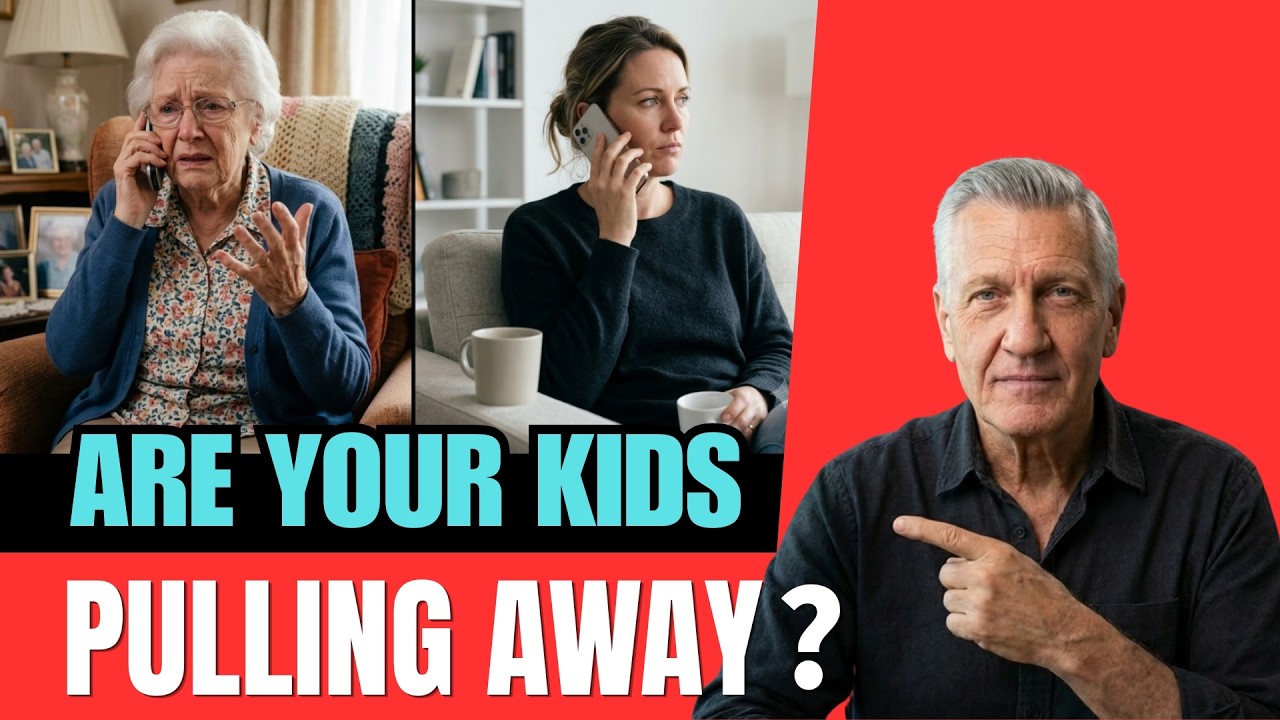
”
Then her voice dropped almost to a whisper. “But sometimes I wonder if busy is just the word he uses so neither of us has to say what’s really happening. ”
That quiet, aching question is one of the most common things I hear from parents over sixty. And I want you to know something right now.
If you have ever asked yourself that same question, you are not paranoid. You are not needy. You are observant. After more than forty years of working with families, I can tell you this: busy and distant look almost exactly the same from the outside.
The missed calls. The short texts. The empty chair at Thanksgiving. On the surface, the picture is identical.
But underneath, these are two entirely different realities. Confusing one for the other can trap you in years of unnecessary pain, waiting for something that may not be coming, or pushing away someone who actually wants to be close. So today, I want to walk you through six clear, observable differences between a child who is genuinely busy and one who is emotionally distant. Not theories.
Not guesswork. Real behavioral patterns I’ve seen repeat across thousands of families. Let me share a little context first. I’ve spent over four decades as a clinical psychologist specializing in family dynamics, particularly the relationship between aging parents and their adult children.
I’ve sat with mothers who haven’t heard from their daughters in years. I’ve sat with fathers who didn’t even know their grandchild’s middle name. And I’ve also sat with adult children who are overwhelmed, exhausted, drowning in responsibilities, who genuinely love their parents but couldn’t find the hours in the day. I’ve seen both sides.
And what I’ve learned is this. There’s something I call the availability illusion. When someone is absent and they give you a reasonable explanation—work, kids, distance, schedules—your mind accepts it. The explanation makes sense, so you stop looking deeper.
But sometimes that reasonable explanation is a curtain, and behind it is something very different. Today, I’m going to help you see behind that curtain gently, clearly, and without blame. These six differences are based on observable behavior—things you can actually see, hear, and verify. Let’s begin.
The first difference, and one you can notice immediately, is how your child responds when you invite them to something. A busy child says no and then offers an alternative. You say, “Can you come for dinner on Saturday? ” And they say, “Saturday won’t work, but how about the following weekend?
I can come Sunday afternoon. ” The door closes, but a window opens. There is a counteroffer. A signal that says, “I can’t make this one, but I still want to see you.
”
A distant child says no and leaves it open-ended. Permanently open-ended. “I’ll try. Let me see.
I’ll check my schedule and get back to you. ” And then, nothing. No follow-up. No counteroffer.
Just vagueness that eventually dissolves into silence. In both cases, the immediate answer is no. That’s why it’s so confusing. But the architecture of the no is completely different.
I call this the difference between rejection with replacement and rejection with vagueness. One is a scheduling conflict. The other is an exit strategy that never announces itself. So here’s your takeaway.
Don’t listen to the reason. Listen for the counteroffer. If the counteroffer is there, even a small one, the connection is alive. If it’s consistently absent, that silence is speaking.
The second difference is about the content of your communication. Not how often they call, but what’s inside the call when it happens. A busy child’s messages are short, but warm. They might only have two minutes, but in those two minutes they ask how you’re feeling.
They mention something small. “Mom, I tried that soup recipe you sent. ” They text a photo of the kids at the park. Brief, yes.
Rushed, maybe. But there’s warmth in it. There’s a thread of connection, even when it’s thin. A distant child’s messages are purely transactional.
They contact you when something is needed—a document, a piece of information, a logistical question about the house, an update they’re obligated to share. There’s no curiosity about your life. No “how are you really doing. ” No spontaneous sharing.
It’s efficient. It’s polite. And it’s hollow. In psychology, we draw a clear line between transactional contact and relational contact.
Transactional contact serves a function. Relational contact serves the relationship itself. Attachment theory tells us that a securely attached person maintains what we call emotional check-ins—small spontaneous moments of connection, even under extreme pressure. It’s like a heartbeat.
It doesn’t stop just because life gets hard. It might slow down, but it keeps going. When the heartbeat disappears entirely, when every interaction becomes purely functional, that’s not busyness. That’s withdrawal.
The third difference is perhaps the most revealing and the most painful to observe. It’s what happens when you’re sick or hurt or you need help. A busy child may not be able to get on a plane the next morning. They may live three states away.
They may have a job that doesn’t allow sudden absences. But their response is immediate. They call within hours. They ask detailed questions.
They start problem-solving. “Can Mrs. Henderson next door check on you tonight? I’m going to call your doctor in the morning.
I’ll be there Friday. Can you hold on until then? ” The distance is physical, but the urgency is emotional, and you can feel it. A distant child responds slowly, minimally, sometimes not at all until a sibling reaches out and says, “Hey, Mom is in the hospital.
” And even then, the response is measured, careful, almost cautious, like they’re calculating how much involvement is required rather than how much is needed. I call this the crisis responsiveness test. In forty years of practice, I have never seen a more reliable indicator of where you truly stand in someone’s emotional world. Because when crisis hits, the mask comes off.
Busyness can explain a missed birthday call. It cannot explain a two-day delay when your parent is in the emergency room. Now, hear me carefully. I’m not saying your child is a bad person if their response is slow.
There may be deep, complicated reasons. But I am saying, notice it. Don’t explain it away. Let the pattern speak.
The fourth difference is more subtle, and it requires you to pay attention to the edges of things. Every person carries a narrative about their life—who they are, where they came from, who matters to them. We share this narrative constantly with co-workers, friends, neighbors, even strangers. “My mom makes the best pie.
My dad taught me how to fix things. I need to call my folks this weekend. ”
A busy child keeps you in their story. You appear in their conversations with others, naturally, casually, affectionately.
Their spouse mentions you. Their children talk about grandma and grandpa with familiarity because you are talked about in that home. You are woven into the fabric of their daily life, even when you’re not physically present. A distant child slowly, quietly edits you out.
You don’t come up in conversations. Their friends may not know much about you. Their children might feel like you’re a stranger, not because you haven’t tried, but because you simply aren’t mentioned. You exist in their life the way a storage unit exists—technically there, occasionally accessed, but not part of the living space.
I call this the difference between narrative inclusion and narrative erasure. This isn’t always deliberate. Sometimes it happens gradually, unconsciously. But the effect is the same.
When someone stops telling stories about you, they’ve begun the process of living without you. You may not be able to observe this directly, but there are signs. How do your grandchildren greet you? With warmth and familiarity, or with the polite awkwardness of meeting someone they’ve only heard about?
How does your child’s partner talk about you? These are windows into whether you still live inside the narrative or outside it. The fifth difference goes straight to the emotional core, and for many of you, this may be the one that hits closest to home. When you say to a busy child, “I miss you.
I wish we could talk more,” something happens inside them. They feel a pang of guilt. They pause. They say, “I know, Mom.
I’m sorry. I’m going to try to do better. ” They may not change overnight, but the guilt itself is a sign. It means the bond is still alive.
It means your words still reach something inside them. When you say the same thing to a distant child, “I miss you,” the reaction is different. There might be silence. A change of subject.
A clipped “Okay. ” Or worse, irritation—a sigh, a feeling that you are being unreasonable, that your loneliness is a burden, that expressing your need is somehow an act of aggression. This is the difference between a guilt response and an irritation response. And that difference tells you almost everything you need to know.
Guilt means the door is still open. The connection is strained, stretched thin, maybe neglected, but it’s alive. Your words land on fertile ground. Irritation means a wall has been built.
Your emotional expression doesn’t create connection. It creates pressure. And when someone experiences your love as pressure, that tells you something profound about where the relationship stands. The great psychologist Erik Erikson spoke about the final stage of human development—what he called integrity versus despair.
At this stage of life, one of our deepest needs is to know that we mattered. That our love landed somewhere. That our presence in someone’s life made a difference. And the way your child responds to your vulnerability is the mirror that reflects whether they still hold space for you.
I know that’s hard to hear. But I believe you deserve the truth. The truth, even when it’s painful, is always more useful than a comfortable lie. The sixth and final difference is the one most of you have probably already noticed, because it’s the most visible.
Holidays. Birthdays. Mother’s Day. Father’s Day.
Anniversaries. These are what I call emotional anchor points—dates on the calendar that carry symbolic weight far beyond the day itself. A busy child may not make it home for Thanksgiving. The flight might be too expensive.
The kids might have school. Work might be impossible to leave. But they acknowledge the day. They call.
Not a two-word text at eleven at night. A real call. Or a long, thoughtful message. Or a card that arrives in the mail.
Maybe late, maybe imperfect, but intentional. They are saying, “I can’t be there in body, but I am there in spirit. You are not forgotten. ”
A distant child treats holidays like an obligation, or forgets them entirely.
A generic “Happy Mother’s Day” text that could have been sent to anyone. A belated message that feels like it was prompted by guilt rather than love. Or silence. Just silence.
I call this ritual maintenance. Every relationship has rituals—small, repeated acts that say, “This matters to me. ” When someone maintains those rituals even under pressure, they’re investing in the relationship. When someone lets them fade, they’re letting the relationship fade with them.
Please, I want to be very clear. This isn’t about gifts. It’s not about grand gestures. It’s about acknowledgement.
It’s about the difference between “I remembered you” and “I forgot or chose not to. ”
So, six differences. Six patterns. Six windows into a truth that many of you have been circling for years without quite being able to name.
Now I want to be very honest with you. This video was not designed to give you a label to paste onto your child. It’s not a scorecard. Life is more complicated than that, and people are more layered than any list can capture.
But what I hope this video gives you is something I call the clarity gift. It’s the ability to stop guessing. To stop oscillating between hope and hurt. To look at the evidence calmly, without panic, and say, “Okay, I think I understand what’s actually happening here.
”
Because once you have that clarity, you can finally respond in a way that actually makes sense. If your child is genuinely busy, then your job is patience, grace, understanding. Don’t guilt-trip them. Don’t keep score.
Trust that the connection is there even when the calendar doesn’t cooperate. Your patience will be remembered. Your grace will be repaid. If your child is genuinely distant, then your job is different.
Your job is to stop chasing. To stop waiting by the phone. To invest in your own life—your friendships, your health, your interests, your joy. Leave the door open, always, but do not stand in the doorway waiting.
That doorway should not become your entire life. You deserve to know the truth. Not because the truth is always comfortable, but because the truth sets you free. It frees you from the exhausting cycle of wondering.
And in that freedom, you’ll find something remarkable—the ability to focus on what you can control, which is the quality of your own life. That is not giving up. That is wisdom. And after sixty, seventy, eighty years on this earth, wisdom is what you’ve earned.
Before you go, I’d genuinely love to hear from you. Which of these six differences did you recognize? Was there a moment where you thought, “That’s exactly what’s happening in my family”? Leave a comment below.
You don’t have to share details. Even a number is enough. Because when you name something, it loses its power over you. Remember, understanding the difference between busy and distant doesn’t mean you love your child any less.
It means you love yourself enough to see clearly.