The ring on my finger suddenly felt like a shackle. Julian was stroking my calloused hand, gazing at me with that rehearsed devotion, while in the same breath he whispered in French to his parents, “That gun-toting woman is desperate for affection and completely predictable. An uneducated gold mine. She’ll blindly sign over that commercial property.
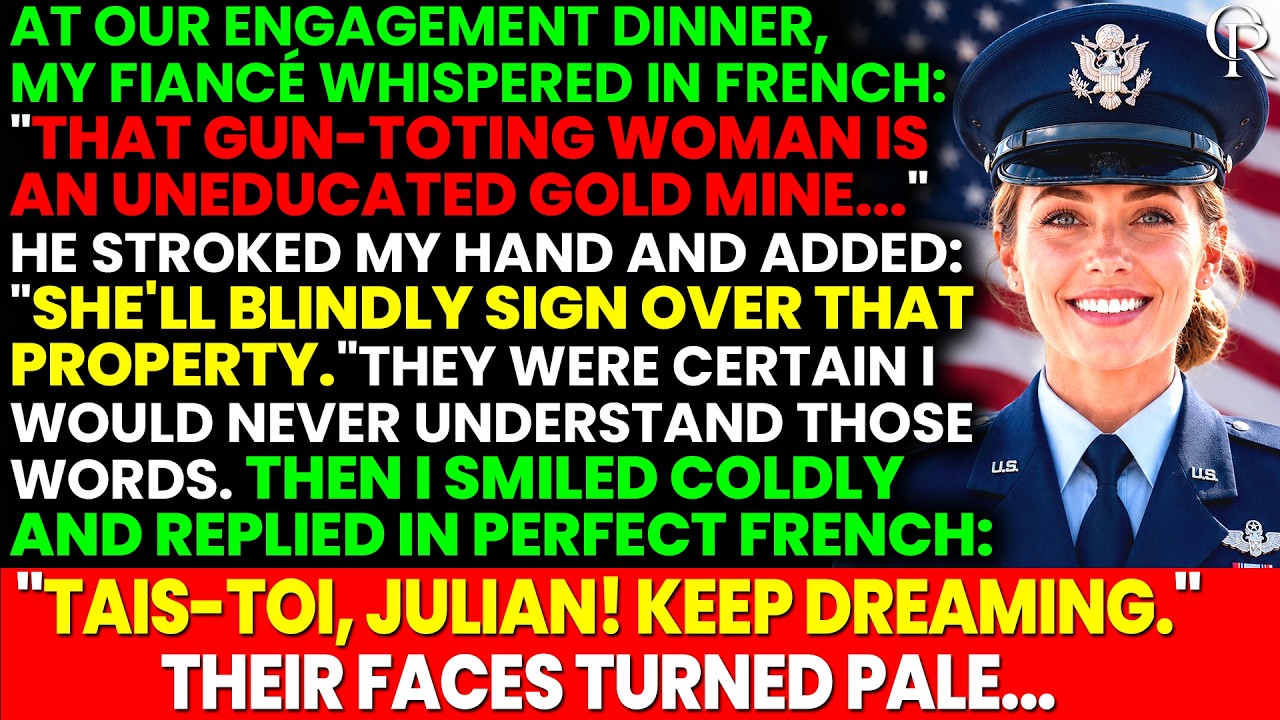
”
I sat frozen. The medals on my Air Force dress uniform felt like a clown costume. Humiliation crushed my chest, but worse was watching my baby sister Molly smile innocently across the table, oblivious. I didn’t scream.
I slowly set my fork down, my face perfectly still, and hid a cold, razor-thin smile. Julian planned to steal my fifteen million dollars in commercial property behind a mask of love. He had no idea that his fiancée had spent four years running covert intelligence operations in France. The evening had started beautifully.
I had pulled every string in my military network to book Lewis, a secluded restaurant on the quietest street in Washington DC. Candlelight caught the bronze and silver of my uniform as I straightened the napkins myself. Not for me—for Molly. I had raised her since our mother passed.
Every deployment, every frozen night in a foxhole, I carried her face in my chest pocket like a prayer I never said out loud. Across from me, Camille, Julian’s younger sister, fidgeted with her napkin, her eyes darting everywhere except toward mine. Jean-Luc lifted the bottle I had selected—a locally aged vintage from a private cellar—and held it suspended in midair as though it had personally offended him. “Donna, is this the Bordeaux you chose?
” His thick French accent dripped with authority. “In France, we would never serve this with foie gras. ”
He set the bottle down with a deliberate thud. Béatrice tilted her head, her gaze sliding from my calloused trigger hand to my face with undisguised revulsion.
“And you work in the military, Donna? ” she asked, though she already knew. “Air Force,” I said. “Air Force,” she repeated, curling her tongue around the words as though they were dirt.
“Rolling around in mud and shooting guns. How very practical. ”
At the far end of the table, Julian smiled warmly at Molly. “Don’t worry, the dessert here is much better than the company,” he whispered, making her laugh entirely unaware that his mother had just reduced my career to a punchline.
Then the French came. A switch flipped. They began speaking exclusively in French, treating me as furniture, a deaf, dumb object occupying space at their table. Béatrice’s eyes swept over Molly’s dress, a floral piece my sister had saved two months of her student budget to buy.
“Pretty for off the rack,” she murmured in French to her husband. A verdict delivered with the casual cruelty of someone swatting a fly. In the candlelight, I watched Camille’s knuckles go white around her water glass. This woman knew exactly what her family was doing.
She had been trained into silence by a father who once locked her in a cellar for two days when she was fourteen because she tried to tell a teacher about his first financial fraud. Jean-Luc had taught Camille the cost of honesty before she was old enough to drive. I let the contempt pass through me. Across the table, Molly was radiant, laughing at one of Julian’s practiced jokes.
That single image—the uncomplicated joy flooding my sister’s eyes—was enough to compensate for every poisoned compliment this arrogant family had lobbed across the foie gras. What none of them knew was that I could hear and understand every single word of French they had spoken since the appetizers arrived. Four years of covert NATO intelligence work in the suburbs of Paris and the back streets of Lyon had given me flawless French. I had kept it silent because on American military bases nobody cared if you could conjugate French verbs.
That skill had been useless until tonight. I reached for my wine, took a slow sip, and continued listening. Halfway through the main course, Philippe Laroche, the family’s slick legal adviser, tilted his head toward a framed family photograph I had placed on the table as a centerpiece. In the photo, Molly held the oak box I had carved for her.
I made that box during freezing nights in Iraq using a military combat knife to shape every groove, every curve, pouring my love for my sister into the only material I could find at a forward operating base. Philippe’s half-smile curled as he murmured in French, his voice dripping with amusement. “She probably picked up scraps from some military junkyard. Soldiers are crude, zero taste.
They just glue waste together and delude themselves into calling it art. ”
He was mocking the box I carved for my sister. He was grinding my love beneath his designer shoe and calling it garbage. Beside him, Béatrice covered her mouth, stifling a laugh.
Jean-Luc nodded with the satisfied expression of a man watching servants clean his floor. Camille stared at her plate, her breathing shallow, her fork motionless. I set my fork down slowly, deliberately, on the porcelain. The silence that wrapped around me was terrifying.
If anyone at that table truly understood what an Air Force Lieutenant Colonel looks like before she moves, they would have recognized that quiet clink of metal on ceramic as the sound of tectonic plates beginning to shift. But they didn’t understand. They never did. At the adjacent table, General Robert Hayes, my commanding officer and the evening’s guest of honor, paused his wine glass mid-sip.
His steady eyes scanned the French contingent, then settled on me. A nod, invisible to everyone else. Absolute in its meaning. *I see what they are doing.
And I see you holding the line. *
“You know,” I said slowly in English, spreading my napkin across my lap, “I’ve always believed that what a person crafts with their own sacrifice reveals their character far more clearly than anything expensive they can buy. Wouldn’t you agree, Philippe? ”
Philippe blinked.
A micro-freeze barely a quarter second, but I caught it—the instinctive flinch of a man who suddenly realizes the walls might have ears. “Of course,” he said, recovering quickly. “Naturally. ”
“Good,” I replied, my voice perfectly even, “because I would truly hate for anyone at this table to think I can’t tell the difference between genuine devotion and a pile of flashy but cheap jewelry.
”
I let the sentence hover, long enough to plant a seed of unease. He didn’t know what I had just said beneath the surface. He didn’t know that I had heard every filthy word he had whispered about my sister’s box. But the grenade was now sitting under his chair, and the pin was in my pocket.
The dinner should have ended there. It didn’t. Twenty minutes after dessert was cleared, the real darkness crawled into the open. Béatrice leaned toward Julian and asked in a tone as casual as discussing the weather, “Are the papers ready?
”
Julian nodded without looking up from his espresso. “They should be ready by next week, I think. ”
I maintained my expression at perfect neutral. Then Jean-Luc leaned back in his chair, swirled his cognac, and delivered the sentence that turned my stomach inside out.
“This military woman is too desperate for affection and uneducated. A gold mine. How pathetic. ”
At the far end of the table, Béatrice smiled with the satisfaction of a predator watching the trap close.
Julian laughed—a low, ugly sound buried in his throat. “That’s exactly why this plan will work,” he said in French, glancing at his father with conspiratorial ease. “She’s so lonely in the military, she’ll blindly sign over that commercial property. Very predictable.
”
And then, like a professional actor switching scenes mid-take, he turned to me. His face transformed in a heartbeat. The smirk vanished. In its place, warmth, tenderness, rehearsed devotion.
He reached across the table and gently took my hand. “I am so lucky to have you, Donna,” he whispered in English, his eyes glistening with manufactured love. At that exact moment, Camille’s fork hit the table, the sharp metallic sound slicing through the quiet like a gunshot. She recoiled from my gaze, her entire body trembling with guilt and terror.
Julian’s head snapped toward his sister, his eyes firing a white-hot warning shot. Jean-Luc’s jaw tightened with fury at Camille for nearly exposing the performance. Every cell in my body screamed. The rage erupted like a volcano pressing against a sealed crater, demanding that I stand and destroy Jean-Luc in his own language right there at the table.
But I didn’t move. If I exploded now, I would become the hysterical woman who shattered the engagement party. I would hand them the perfect excuse to play the victim. Julian would shake his head sadly and tell Molly, “Your sister has issues.
” Jean-Luc would sigh and say, “We tried. ” Béatrice would dab her dry eyes and whisper, “Such a shame. ”
No. I would not give them the satisfaction of a public meltdown on their terms.
I smiled. I signaled the waiter. I paid the check. Every gesture controlled, every breath measured, tactical breathing—four counts in, four counts out.
The same technique that kept me alive when bullets cracked the air above my head in the desert. Philippe watched me with a faint self-satisfied smirk, convinced the evening had been a flawless success. He had no idea that every word he and his clients had spoken in French was now permanently filed inside the mind of a trained intelligence operative. That night I sat alone in the cabin of my military jeep, the engine off, the parking lot empty.
My phone screen lit up with a message from Molly. *I’m so happy you finally found a safe harbor. Julian is wonderful. He really loves you, sis.
*
I stared at those innocent words. Tears pressed against the edges of my eyes. The greatest fear of my life was never the bullets at the front line. It was the thought of my baby sister being hurt.
But I didn’t cry. The iron discipline of a lieutenant colonel crushed those tears and converted them into a flame that burned clean, bright, and furious. I grabbed the phone and dialed Grant Ferris, my old intelligence partner from the NATO years. “Grant, activate your corporate forensics team.
I need to know what financial black hole the Marchetti family is hiding. ”
My voice didn’t waver. It was a command—the same tone I used when issuing final operational orders. They thought they could set a trap for an intelligence officer’s property.
They had picked the wrong target. The next morning, I called Julian. “Sweetheart, why don’t we have Jean-Luc, Béatrice, and everyone move into the estate for the rest of the week? Let them really feel our life together.
”
My voice was warm, eager, perfectly naive. They believed the hardest part was behind them. They thought the only thing left was a few pieces of paper. They had no idea that I was the one casting the net.
For the entire week that followed, I performed flawlessly—a role I could have rehearsed for a lifetime. The obedient prey they needed. I let Béatrice teach me how to hold a teacup like a proper lady, her bony fingers repositioning mine with the condescension of a queen correcting a servant. I nodded along as Philippe paraded his hollow legal expertise.
I smiled. I submitted. But my eyes, sharp as a hawk tracking movement across an open field, recorded every gesture, every whispered aside, every crack in their performance. Camille was unraveling.
Each day I watched the guilt eat deeper into her. She would linger near the garden where Molly was cheerfully arranging sample wedding bouquets, her eyes filling with tears she could never fully blink away. My sister, innocent, trusting, laughing, was assembling flowers for a wedding built on fraud, and Camille knew it. Late one afternoon, Camille finally moved.
She approached Molly with hesitant steps, her mouth opening, the first syllable of a warning forming on her lips. She was going to tell her. For one fragile second, the coward was about to become brave. But Philippe materialized from the hallway shadows like a predator who had been watching the whole time.
He seized Camille’s wrist and yanked her into a dim corridor alcove, his grip hard enough to leave a red mark. He leaned in close, his lips nearly touching her ear, and hissed in French. “Want to end up on the street, you wretch? You open your mouth and you destroy everything this family has built.
Understand? ”
Camille crumpled. Her body folded inward like a child absorbing a blow she had learned was easier to take than to fight. She nodded, and Philippe released her wrist with a shove that sent her stumbling into the wall.
This was the Marchetti method of family governance. Not love, not loyalty, but terror. Speak and you will be destroyed. Camille had learned that lesson at fourteen in a locked cellar.
Philippe was simply reminding her that nothing had changed. From the second-floor balcony, hidden in the evening shadow, I witnessed the entire scene. Every syllable of Philippe’s French threat. Every flinch of Camille’s body.
I stood motionless, my hands resting on the iron railing, and I let the information settle into the operational file building inside my mind. Camille was not my enemy. She was a hostage—terrified, guilty, and one final push away from detonating the entire Marchetti conspiracy from the inside. I filed that knowledge under leverage.
Thursday evening, the first week of hosting the Marchettis at my estate, Grant sat across from me, his face lit only by the encrypted monitor screen. He didn’t believe in preamble. “Donna, I’ve been in this business long enough to smell rot through concrete. This one is filthy.
Jean-Luc’s shipping empire is a shell. Bankrupt. They filed for restructuring two years ago and never came up for air. Tax debts in the tens of millions of euros.
Seizure orders piled on properties across Normandy. ”
He scrolled through financial filings, his jaw set tight. “Julian is facing a serious civil lawsuit in France—a collapsed business venture, a thinly disguised fraud scheme that dragged down a group of investors with him. And your friend Philippe Laurent?
Internationally disbarred last year. Fraud. The man drafting your family trust no longer has a legal license to practice anywhere on the planet. ”
I sat motionless, my fist clenched until the knuckles turned white.
Every suspicion confirmed. The aristocratic dinner, the rehearsed charm, the vintage cognac—all of it was set dressing for a dying empire’s last desperate act. Jean-Luc had not raised a toast to my engagement. He had raised a toast to the fifteen million dollar lifeline sitting across the table in a military uniform.
“There’s more,” Grant continued, his tone taut as a tripwire. “The trust fund they keep mentioning—if they convince you to put your commercial property into a joint trust structured through offshore accounts—that is liquidity. That is cross-collateral. That is the only card keeping their entire fantasy empire from collapsing.
Your land is not a gift. It is the last oxygen tank for a family that is already drowning. ”
The disgusting truth seeped into my bones. They did not fly six thousand miles for love.
They came because I own the one thing their survival depends on. Through the wall, I heard Julian pacing frantically in the next room. He was on the phone, his voice trembling as he begged a creditor in French. “Please give me one more month.
I will have the money. ”
Pathetic. Desperate. Terrified not of losing me, but of losing his luxury and facing a prison cell.
The man who had called me predictable was sweating through his shirt at midnight, groveling to strangers for a deadline extension. The pain of betrayal had fully evaporated. What remained was the cold, crystalline focus of a commander staring at a confirmed target. I looked at Grant.
“Pull everything. Every filing, every lien, every court document. I want the full financial autopsy of the Marchetti family translated, notarized, and stamped before the rehearsal dinner. ”
Grant nodded once.
No questions, no hesitation. That was the difference between a brother forged in combat and a family forged in greed. Sunday morning, Philippe finally cast his lure. He sat at the estate’s dining table with the self-important posture of a man who had never lost a negotiation to a woman in uniform.
The trust fund draft was spread before me—thirty pages of dense legal language, decorative clauses about estate planning and long-term asset protection layered over the real architecture like silk curtains draped over a steel trap. “This is a wonderful opportunity for you, Donna,” he explained, each word coded in condescension. “A family trust that will protect your assets for generations. We’ve generously structured this to integrate your properties into a shared European framework.
”
Behind Philippe, Jean-Luc stood by the window with his arms folded, watching me the way a fisherman watches a trout circle the hook. Béatrice sat in the corner armchair, sipping tea, her posture rigid with anticipation. They had mapped my psychological profile—lonely, desperate for acceptance, too blunt-minded to read fine print—and designed every word of Philippe’s presentation to exploit it. I furrowed my brow, rubbed my temples, flipped through the pages with the confused, overwhelmed expression of a woman drowning in terminology.
“I’m clueless about these fancy trust funds,” I said, my voice hesitant, carefully calibrated. “So many confusing terms: offshore structuring, beneficial ownership, collateral integration. Philippe, this is way over my head. ”
I paused, looked up with wide, helpless eyes.
“Could I possibly send this to my family lawyer for a second look? I just want to make sure I understand before I commit to something this important. ”
The triumphant gleam that shot through Jean-Luc’s and Philippe’s eyes was identical. The synchronized flash of predators who believed the prey had swallowed the hook.
“Of course,” Philippe replied magnanimously, spreading his hands with the generosity of a man who had already won. “Take all the time you need. ”
That night, I drove the trust fund documents to Roger Callahan’s office, a former JAG prosecutor whose legal instincts were honed on military fraud cases across three continents. Roger read contracts the way snipers read wind patterns.
He scanned the pages in silence, the stillness in his office thickening with each turned page, until he slammed his hand flat on the desk. “This is not a family gift, Donna,” Roger said, his voice flat and cold as a steel blade. “This is an offshore cross-collateralization agreement. They’ve structured this trust to convert your entire commercial real estate portfolio into the primary collateral guarantee for Jean-Luc’s European corporate entity.
When his company defaults—and according to Grant’s evidence, that default is imminent—French creditors will have the legal right to immediately seize and foreclose on your property. No appeal, no recourse. You’re not creating a trust fund. You’re volunteering your blood and sweat to pay off the debts of foreign con artists.
”
The words landed like artillery shells in a silent field. I leaned back in my chair, let the silence hold for three seconds, then spoke. “Roger, I don’t want to just refuse. I want to convert this entire fraud file into criminal assets.
”
Roger looked at me over the rim of his reading glasses. A thin, sharp smile appeared—the expression of a hunter who had just been told to stop tracking and start killing. “You understand what that means? ” he said.
“It means we translate, notarize, and certify every document Grant pulled from Europe. It means we prepare a counter-dossier that proves intent to commit international fraud. It means when they sit down expecting a signature, they receive a prosecution exhibit. ”
“Do it,” I said.
Every evening in the days that followed, Roger worked beside me in the study, assembling the truth into an irrefutable dossier. European seizure orders. Civil lawsuit filings. Philippe’s international disbarment records.
Hidden clauses from the trust fund decoded and annotated. Every document translated by certified interpreters, notarized, stamped with the cold finality of steel on wax. And every morning I smiled at Jean-Luc over breakfast. I let Béatrice adjust the collar of my blouse with her imperious, manicured fingers.
I let Julian hold my hand and gaze at me with his manufactured tenderness. Philippe strutted through my estate like a man who had already won the war, reviewing wine selections for the rehearsal dinner with the casual authority of someone spending another person’s money. I cast the final lure on a Tuesday afternoon. “Julian,” I said, touching his arm with practiced warmth, “I’ve been thinking.
What if we sign the trust documents publicly at the rehearsal dinner in front of all our guests as a celebration of our families uniting? ”
Julian’s eyes widened, not with suspicion, but with barely contained euphoria. Within minutes, the three of them were huddled in the library speaking rapid French. “She wants to sign publicly,” Philippe whispered, his voice thick with disbelief at their own luck.
“In front of forty witnesses. This eliminates any future claim of coercion. It’s perfect. ”
That evening, I caught Jean-Luc and Béatrice in the wine cellar—my wine cellar—popping open a bottle of my champagne to celebrate their premature victory.
They were toasting with wine they had stolen from the woman they were robbing. The arrogance was so complete, it had become a kind of blindness. I found Molly in the garden surrounded by sample centerpieces. White roses, lilies, expensive, conventional, predictable—exactly the aesthetic Béatrice had dictated.
“Molly,” I said, kneeling beside her, “change all the decorations to wildflowers. ”
My sister looked up, confused but intrigued. “Wildflowers like daisies and thistle. All of them.
Every table. Every vase. ”
Molly grinned, thrilled by the rebellion against Béatrice’s rigid taste. She didn’t understand the symbolism.
Not yet. Wildflowers—untamed, free, fiercely resilient, growing from any soil without permission. That was my message. A silent declaration of liberation only I would recognize until the moment it mattered.
Roger arrived at midnight with the completed dossier in a leather portfolio. He set it on my desk with the gravity of a man delivering a verdict. “Everything is here,” he said. “Certified translations, notarized financial records, Philippe’s disbarment confirmation, the cross-collateralization analysis with annotated intent to defraud markers.
And one more thing. ”
He slid a sealed envelope across the desk. “A formal notice of trespass. If you want them off your property after the reveal, this gives the sheriff immediate authority to arrest them.
”
I placed my palm flat on the portfolio. Beneath my hand lay the complete destruction of the Marchetti family’s lie—every fraudulent clause, every hidden debt, every arrogant assumption that a woman in combat boots could not possibly read a contract. I thought about Jean-Luc drinking my champagne. I thought about Béatrice correcting my teacup grip.
I thought about Philippe mocking my sister’s oak box. I thought about Julian whispering *predictable* in French while holding my hand in English. Tomorrow night, forty of the most influential people I knew would be seated at tables decorated with wildflowers. The Marchettis would walk in expecting a signature.
They would leave with nothing but the sound of their own empire crashing down around them. The rehearsal dinner glowed beneath an open sky. Forty guests—military officers, business associates, old friends—sat around tables draped in white linen, each centerpiece bursting with wild daisies and thistle. Béatrice stared at the wildflowers when she arrived, her lip curling with displeasure, but she said nothing.
Tonight was too important for arguments about decor. Tonight the gold mine was signing. General Robert Hayes occupied the seat of honor in his full dress uniform, the constellation of stars on his shoulders gleaming under the string lights. Jean-Luc stood at the head of the table, radiating the composed authority of a patriarch about to close the deal of his life.
He smiled at me—a warm, rehearsed, fatherly smile—and gestured toward the empty chair beside the documents Philippe had arranged with surgical precision at the center of the table. “Donna, my dear,” Jean-Luc said in English, his accent thick with manufactured affection. “Shall we make this beautiful evening official? Your family and ours, united forever?
”
Philippe uncapped a pen and placed it beside the trust fund papers with the practiced flourish of a man who had choreographed this moment in his sleep. Béatrice folded her hands on the table, her knuckles white beneath her rings. Julian squeezed my hand under the table. One final performance.
Camille sat at the far end, her face drained of all color, staring at her plate like a prisoner awaiting sentencing. I stood slowly, deliberately. I straightened my back—the posture of an officer assuming command, not a bride accepting a gift. I lifted my champagne glass and tapped it once with my fingernail.
The crystalline ring sliced through the noise like a blade. Every pair of eyes in the room locked onto me. The submissive woman they had spent two weeks molding vanished in a single breath. In her place stood the full, unmasked authority of a United States Air Force Lieutenant Colonel.
I opened my mouth. “Je vais continuer,” I said in flawless, razor-sharp French, perfect Parisian cadence. “I will continue. ”
The effect was instantaneous and devastating.
Jean-Luc’s face froze mid-smile—the expression of a man who has just heard the safety click off a weapon pointed at his head. Béatrice’s body seized as though an electrical current had passed through her spine. Philippe’s pen slipped from his fingers and rolled across the tablecloth. Julian’s hand went limp in mine.
I looked at the forty guests and continued in fluent, razor-sharp French. “You laughed at my career. You insulted the box I carved for my sister with a combat knife during freezing nights in Iraq. You called me a predictable woman desperate for affection while you plotted to steal every acre of my land.
”
I turned to Jean-Luc. “Your shipping empire filed for bankruptcy two years ago. You owe tens of millions in European tax liens. You flew six thousand miles not for your son’s wedding, but because my property is the only collateral that can keep your creditors from seizing everything you own.
”
Jean-Luc’s mouth opened. Nothing came out. Béatrice gripped the edge of the table as though the floor had tilted beneath her. I pointed at Philippe.
“And you—the man who called my sister’s keepsake junkyard trash—you have been internationally disbarred for fraud since last year. The document you placed on this table tonight is not a trust fund. It is an offshore cross-collateralization trap designed to hand my fifteen million dollar property directly to French creditors. ”
Roger Callahan rose from his seat.
He walked to Philippe with the measured steps of a man who had spent thirty years putting criminals in cells. He placed a sealed legal envelope directly in front of Philippe’s trembling hands. “International disbarment confirmation,” Roger announced calmly, “and a formal cease and desist. You are done.
”
Philippe’s wine glass slipped from his fingers and shattered on the floor. Julian lurched to his feet, his chair crashing backward onto the stone floor. His face was crimson, his rehearsed composure obliterated. “Donna, please listen to me.
”
My voice detonated across the room like a cannon blast. “Tais-toi, Julian. ”
The words, spoken in his own language with the authority of a commanding officer issuing a final order, drove Julian back into his seat as though I had physically shoved him. He sat down hard, his mouth still open, his eyes wide with the stunned disbelief of a man who had just realized that the prey he had been hunting for months was the one holding the rifle.
I lifted the leather portfolio from beneath my chair and dropped it onto the table. The impact echoed. Certified translations, notarized financial records, every fraudulent clause annotated, every lie documented. I pushed the portfolio toward Jean-Luc.
“This is not a signature. This is a prosecution exhibit. ”
At the far end of the table, Camille erupted. Years of suppressed guilt, terror, and suffocated conscience detonated simultaneously.
She burst into tears and screamed in French, her voice cracking raw, uncontrollable. “I told you we couldn’t fool her. I told all of you. ”
The confession ripped through the silence like a grenade.
Jean-Luc turned white. Béatrice’s hand flew to her mouth. Philippe staggered backward. At the seat of honor, General Hayes set down his wine glass and nodded once, slowly, approvingly.
The quiet endorsement of a commanding officer who had just watched his best soldier execute a flawless operation. Molly stared at Julian. The innocent light that had lived in my sister’s eyes for twenty-two years did not dim. It transformed.
The softness hardened into something I recognized—tempered steel. She rose from her chair, walked around the table, and stood shoulder-to-shoulder with me. “You treated me like merchandise,” Molly said, her voice shaking not with weakness but with fury. “You were going to spend the rest of your life robbing my sister.
”
I reached down, twisted the engagement ring off my own finger, and threw it onto the table in front of Julian. The diamond bounced once on the wood and came to rest beside the dossier that had just destroyed his world. Julian collapsed to his knees. He crawled forward, his designer suit crumpling against the floor, his hands grasping for mine, trembling, desperate, pathetic.
“Donna, please, I love you. We can work this out. Please don’t do this. ”
Tears streaked down his face.
But they were not the tears of a heartbroken man. They were the tears of a con artist watching his last exit seal shut. I looked down at him. This was the man who had called me predictable.
The man who had whispered my value in euros to his father while stroking my hand in English. The man who had flown across an ocean not for my heart but for my land. I pulled my hand free with a single sharp motion—the way you shake off a parasite that has attached itself to your skin. From the portfolio, I slid a second document across the table.
An itemized invoice for every expense incurred during their stay, combined with the formal notice of trespass. The paper whispered across the linen like a verdict. “Clear out before dawn,” I said. My voice was level, unhurried, and cold enough to freeze the champagne in their stolen glasses.
“Every suitcase, every garment, every trace of your family off my property before the sun comes up, or the local sheriff will arrest you all for trespassing. And Julian—never underestimate a soldier’s survival instinct. ”
Behind me, the Marchetti alliance detonated. Philippe wheeled on Jean-Luc, screaming, “You swore she was stupid.
You dragged me into a federal trap. ” Jean-Luc fired back, “You’re the lawyer. You underestimated her. You arrogant fool.
” Béatrice pressed both hands over her ears, her composure shattered beyond reconstruction. Camille lay on the floor, curled into herself, sobbing in two languages—the sound of a woman who had finally been released from the prison of her own silence. I turned my back on the wreckage. I reached down and took Molly’s hand.
Her fingers closed around mine—tight, warm, unshakable. Without a word, the military officers who had been seated among the guests simply stood up. Not an honor guard, but a solid, impassable wall of dress uniforms blocking the Marchettis from following us. Molly and I walked between them, our heels clicking against the stone in perfect rhythm.
Behind us, the Marchettis screamed and begged in French and English, their voices tangling into a single desperate wail that grew smaller with every step we took. We did not look back. We walked toward the front of the estate, toward the night air, toward the silence that waits on the other side of a war that has finally been won.
Two sisters, heads high, hands locked, walking into a future that belonged entirely to us.