I tasted copper. Blood was trickling from the corner of my lip as I sat in that lawyer’s office, my cheek still burning from the slap my father had just delivered in front of forty relatives. He stood over me, veins bulging, screaming, “You selfish little brat. Sign the transfer papers for your brother.
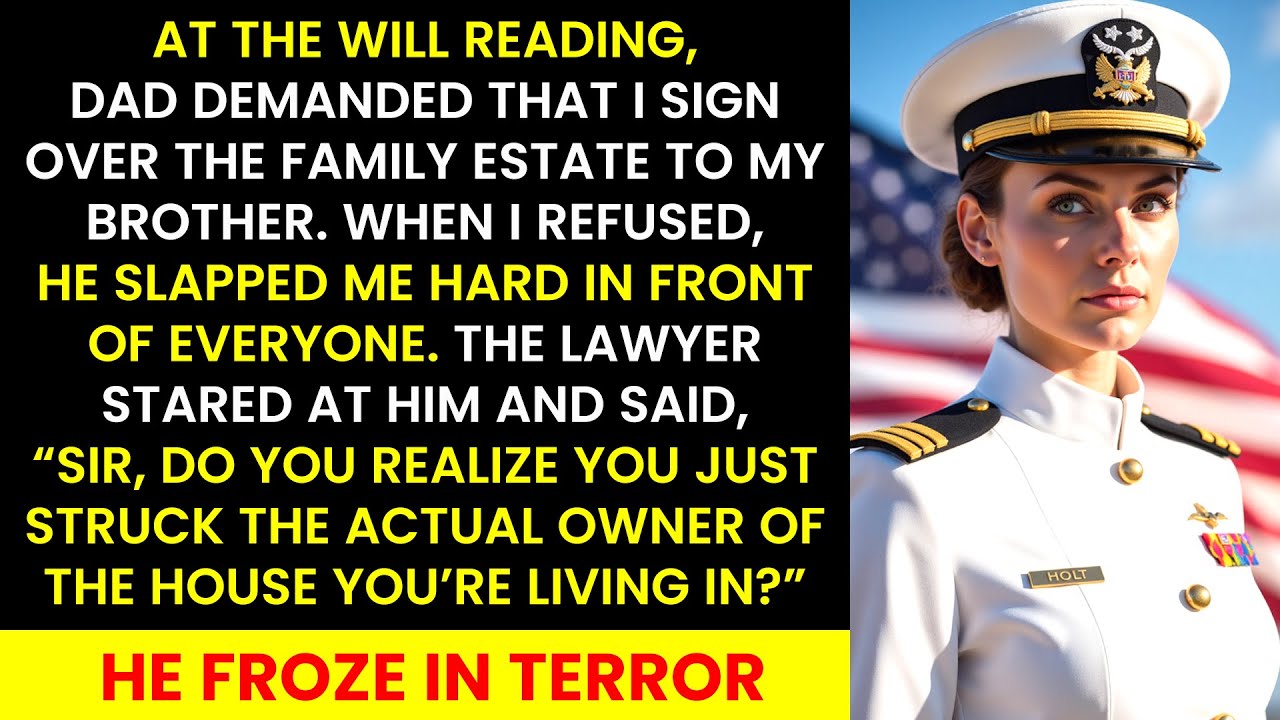
He’s a man. He needs this house more than you do. ” Eric, my older brother, just sat there smirking, legs crossed, acting like robbing me blind was his birthright. They thought I was still the weak black sheep they could bully.
But they didn’t know the man at the head of the table, my late grandfather’s attorney, was holding a file that wouldn’t just strip them of the roof over their heads—it was about to send my father to federal prison for bank fraud. The conference room at Harper and Dunn smelled of old money, lemon furniture polish, and stale recycled air. I walked in wearing my service dress, white uniform, ribbons perfectly aligned. To the Navy, I was a lieutenant.
To these people, I was invisible. Aunts who hadn’t sent me a birthday card in a decade buzzed like flies. Cousins who only called when they needed bail money watched me with calculating eyes, vultures circling a carcass. At the head of the mahogany table sat my father, Robert Holt.
His navy blazer strained at the buttons. Even from ten feet away, I could smell the sour stench of Jim Beam bourbon trying to hide under cheap cologne. He was already drunk at two in the afternoon on a Tuesday. Next to him, Eric scrolled through his iPhone, bored, as if attending our grandfather’s will reading was an inconvenience to his unemployed schedule.
Arthur Callahan, my grandfather’s attorney and oldest friend, cleared his throat. “Shall we begin? ”
“Cut the crap, Arthur,” my father interrupted, slamming his hand on the table. “Dad left the house to me.
Let’s just sign the papers. ”
Dad reached into his jacket and pulled out a crumpled piece of notebook paper, sliding it toward me. It was a handwritten note stating that I voluntarily relinquished all claims to the estate in favor of Eric. “What is this?
”
“A formality,” Dad sneered. “You’re in the Navy. You have a cot to sleep on and a mess hall to eat in. You don’t need a house in Connecticut.
Eric needs it. He’s a man. ”
“I’m not signing that. ”
“You selfish—” Dad hissed.
He lunged across the corner of the table, and his open palm connected hard with the side of my face. The crack echoed off the wood paneling like a gunshot. I tasted hot metallic blood as my lip split against my teeth. Uncle Bob half rose from his chair but didn’t move to help.
Eric actually laughed. I didn’t touch my face. I didn’t cry. I sat at attention, staring straight ahead.
Dad raised his hand again. Thump. Arthur slammed a massive legal binder onto the table with the force of a gavel, stopping him mid-swing. “Sit down, Robert!
” Arthur said, his voice dropping to a terrifyingly low register. “Stay out of this. She’s my daughter. I’ll discipline her how I see fit.
”
Arthur opened the binder and looked at the blood on my lip, then directly at my father. “Mr. Holt, I strongly suggest you keep your hands to yourself, because you just struck the actual owner of the house you’re living in. ”
The sting faded into a dull ache, but the memory it unlocked was sharper.
That slap wasn’t an isolated incident. It was the punctuation mark on a sentence written since I was five years old. In the Holt household, Eric was the golden child, the fragile prince who needed protection. I was the insurance policy, the backup plan, the one who was low-maintenance.
It started with birthdays. For my sweet sixteen, I came home from swim practice to a dark house. Mom was exhausted in the kitchen, a store-bought sheet cake with a clearance sticker still in its plastic container. Dad and Eric watched the Patriots game in the living room.
Dad didn’t even look up. He just yelled, “Maria, keep it down. It’s third and long. ” No happy birthday.
No balloons. Just a clearance cake and the flickering light of the TV. When Eric turned sixteen, Dad threw him a catered BBQ, invited half the neighborhood, bought him a brand-new MacBook, and promised a car if he brought his grades up. He never did.
But the real knife in the heart was the pool. I was varsity swim captain by junior year, waking up at 4:30 a. m. every day to train.
I broke the state record for the 100-meter butterfly during regionals. Standing on the podium, water dripping from my nose, I searched the bleachers for Robert Holt. The seat was empty again. He was at the principal’s office.
Eric had been caught smoking pot under the bleachers during gym class—his third strike, facing expulsion. That night, Dad screamed at the school district, threatening to sue for targeting his “sensitive boy. ” His solution was to drain his 401k and take out a second loan to send Eric to a $30,000-a-year private boarding school. I sat at the kitchen table doing my AP calculus homework, making myself as small as possible.
“Mom, I got the gold medal today,” I whispered. She kissed my forehead. “I know, honey. We’re proud of you.
But please don’t make a fuss right now. Your father is stressed. You’re strong, Maria. You’ve always been the strong one.
You can take care of yourself. Eric is weaker. He needs us more. ”
Because I was competent, I was punished.
Because Eric was a mess, he was rewarded. The breaking point came quietly. The summer after graduation, I needed a co-signer for a small student loan. Dad laughed in my face.
“I can’t sign that, Maria. My credit is tied up with Eric’s tuition. You’re smart. Figure it out.
”
Two days later, he bought Eric a brand-new jet ski as a graduation present. That was the day the little girl waiting on the bleachers died. I walked into my bedroom with the peeling paint and made a decision. I went to the Navy recruiting office in Norwalk the next morning and signed the papers before lunch.
Three months later, the morning I left for boot camp, the house was silent. Dad was hungover, asleep on the recliner. Eric wasn’t home. I opened the kitchen drawer, took out a roll of black Hefty garbage bags, and packed my entire life into two of them.
My clothes, my swim trophies, my few books. As I dragged those bags down the driveway toward my rusted Honda Civic, I caught my reflection in the car window. I looked like trash being taken to the curb. “I am never coming back,” I whispered.
Naval Station Great Lakes in the dead of winter was a physical assault. The wind off Lake Michigan found every gap in your uniform and tried to freeze you from the inside out. For me, the cold was a mercy. It numbed the pain of leaving.
My recruit division commander didn’t care about my feelings. He cared about one thing: could I follow orders? It started with the bed. Every morning at 0500, I stood in front of a twin-sized mattress learning hospital corners.
My hands cracked and bled from the dry air and constant scrubbing. Exhausted, running on four hours of sleep, I remembered a speech by Admiral McRaven—if you make your bed every morning, you’ve accomplished the first task of the day. So I made the bed. I smoothed the wrinkles.
I made it perfect. In that small act, I found something I never had in Westport: control. I couldn’t control my father’s drinking or Eric’s entitlement, but I could control this bed. I could control my uniform.
I could control my mind. Five years went by. I went from enlisted sailor to officer, earning my commission through sheer grit. I paid off my student loans.
I sat in my cheap IKEA chair in my small Norfolk apartment, watching the screen flash “PAID IN FULL. ” I owned myself. I didn’t owe Robert Holt a single dime. The phone rang two weeks later.
Caller ID: Dad. A tiny, foolish part of me—the little girl who waited on the bleachers—thought maybe he just wants to see how I am. “Maria, how are you, kiddo? ” Too loud, too cheerful.
I could hear the clink of ice in a glass. “Listen, honey. I’m in a bit of a bind. It’s Eric.
He got pulled over for a DUI. I need five grand for the retainer and bail. I know the Navy pays you pretty well. Could you wire me the money?
”
He wasn’t calling to ask if I was alive. He was calling because his golden child had messed up and he wanted the spare part to pay for the fix. “No,” I said. “Excuse me?
”
“No, Dad. I don’t have $5,000 for Eric’s bail. And even if I did, I wouldn’t give it to you. ”
“He’s your brother.
He’s sitting in a cell. You selfish, cold-hearted—”
“He’s thirty-three years old, Dad. Let him sit. ”
I hung up before he could finish the curse word.
I walked to my metal locker and opened the door. Taped inside, right at eye level, was a small black-and-white photograph of an old man standing next to a 1965 Mustang. My grandfather, Walter Morgan. He was the only one who had ever looked at me and seen a person, not a burden.
I touched the photo with my thumb. “I held the line, Grandpa. ”
I didn’t know it then, but Grandpa Walter had left me a shield. And in a few days, back in that lawyer’s office, that shield was about to become a sword.
The coppery taste of blood in my mouth triggered a memory, pulling me back to the only place I had ever felt safe. Suddenly, I wasn’t thirty-one. I was sixteen, sitting in a red vinyl booth at Harry’s Diner. Every Sunday, while Dad slept off a hangover, Grandpa Walter would wait for me in his Mustang.
He’d order black coffee and a slice of warm apple pie à la mode for me. The waitress, a woman named Dottie with a beehive hairdo, would bring our order without us asking. “How are things at the asylum? ” he’d ask.
“Dad bought a new boat,” I’d tell him. “But then he told Mom we can’t afford to fix the furnace. ”
Grandpa Walter didn’t get angry. He just shook his head with profound disappointment.
“Your father buys things he doesn’t need with money he doesn’t have to impress people he doesn’t like. He thinks being a man is about what you own. He’s forgotten that being a man is about what you protect. ”
He reached across the table and slid his own scoop of ice cream onto my plate.
“Don’t be like him, Maria. You have iron in your spine. I saw you swim last week. You didn’t quit when you were tired.
That’s worth more than any boat. Remember, money is just a tool. If you don’t control it, it controls you. ”
I didn’t know it then, but in those quiet moments over apple pie, Grandpa wasn’t just feeding me dessert.
He was testing my character against my father’s greed. And he had made a decision. Snap. The sound of Arthur Callahan unclasping the thick legal binder brought me crashing back to the present.
“Robert,” Arthur said, devoid of warmth. “You seem to be under the impression that this is a standard probate case. ”
“It’s not an assumption, Arthur. I’m his next of kin.
It’s the law. ”
“Under normal circumstances, yes. However, Walter was a man who planned ahead. He came to me thirteen years ago—specifically the week Maria left for boot camp.
He knew about your gambling debts, Robert. He knew about the second mortgage you took out on your own home. And he knew that if he left his property to you in a standard will, the bank or the IRS would seize it within six months to pay off your liabilities. ”
“That’s a lie!
” Dad shouted, but his face went pale. “Walter did not leave the house to you in his will,” Arthur continued. “In fact, the house hasn’t belonged to Walter for over a decade. On October 15th, 2011, Walter Morgan transferred the deed of the property at 42 Oakwood Lane into an irrevocable living trust.
”
“And who is the trustee? ” Eric asked, his voice cracking. “Is it me? ”
Arthur looked at Eric with pity, then turned his gaze to me.
He picked up a smaller handwritten letter from the file. “He asked me to read this note before I hand over the keys. ”
Arthur adjusted his glasses and began to read. “To my granddaughter Maria, if you are hearing this, I am gone.
I know your father has likely tried to bully you today. I watched you leave for the Navy with nothing but two garbage bags. You didn’t ask me for a dime. You stood on your own two feet.
You are the only person in this bloodline who understands the value of a dollar and the weight of integrity. The house is yours, Maria. It has been yours since the day you left. Welcome home, kiddo.
”
Arthur lowered the letter and looked at my father, whose mouth hung open in absolute horror. “So, Mr. Holt, when you just slapped Maria, you didn’t assault your daughter. You assaulted the landlord.
And I believe she has the right to evict you. ”
I walked out of Harper and Dunn with a set of keys in my hand that felt heavier than a loaded pistol. Arthur offered to call the police to escort me, but I refused. This was my house now.
In the Navy, you don’t ask the police to secure your ship. You do it yourself. I drove my battered Honda Civic straight to 42 Oakwood Lane. The house, a colonial-style mansion Grandpa Walter had built with pride, looked like it was suffering from a terminal illness.
The white paint peeled away in long gray strips. The shutters hung crookedly. The grass was a shin-high meadow choked with crabgrass and dandelions. A bright orange HOA citation was slapped on the front door.
In the driveway sat a shiny new leased Ford F-150, probably costing $800 a month while the house behind it rotted. The smell inside was thick and cloying—stale beer, dust, stagnation. The living room was Eric’s domain: an 85-inch 4K television, the latest PlayStation and Xbox, Domino’s pizza boxes stacked like Jenga towers, empty Monster Energy cans scattered across the floor. I looked at the chaos with cold military detachment.
I headed for the study, Grandpa’s old sanctuary. Dad had taken it over, burying the mahogany desk under mountains of unopened mail. I sat in the leather chair and started digging. The first layer was junk mail.
The second was darker—past-due notices from Verizon, Eversource, the water company. But at the bottom of the drawer, where he had shoved the things he really didn’t want to see, I found a thick envelope from First National Bank. Notice of default and intent to foreclose. Borrower: Robert Holt.
Property: 42 Oakwood Lane. Loan type: HELOC. Outstanding balance: $845,000. I froze.
This doesn’t make sense. Arthur said the house was in an irrevocable trust. To take out a home equity line of credit, you have to be on the deed. I scrambled through the papers and found a copy of the deed attached to the loan application.
There, at the bottom, was a signature: Walter Morgan. Dated two years after Grandpa died. My breath hitched. Dad hadn’t just been irresponsible.
He had forged a dead man’s signature. He had committed federal bank fraud to turn Grandpa’s legacy into a personal ATM for his booze and Eric’s toys. Outside, gravel crunched. The distinctive roar of a Ford F-150 engine revved aggressively in the driveway.
“Where is she? ” Dad’s voice screamed from the front yard. “Where is that ungrateful little traitor? ”
I looked down at the evidence of a felony that would put my father in prison for twenty years.
I didn’t feel fear anymore. I stood up, smoothing the front of my white uniform, and picked up the stack of papers. The inspection was over. It was time for the court-martial.
The front door slammed shut downstairs with enough force to shake the floorboards. “Maria! Get down here! I’m not done with you!
” I checked my watch. Based on the heaviness of his footsteps, I estimated I had less than two minutes before he made it up the stairs. Two minutes. In the Navy, you can launch a counteroffensive in less time than that.
I sat in Grandpa’s leather chair, my heart rate steady, my eyes locked on the stack of papers. The loan application was dated June 14th, 2019. My grandfather died in February 2017. The signature was shaky, mimicking Grandpa’s old-fashioned cursive, but I recognized the heavy, aggressive pen strokes.
It was Dad’s hand. He had walked into a bank two years after his own father’s funeral and pretended Grandpa was still alive to secure a loan. That’s identity theft and grand larceny. I flipped to the transaction history.
October 2019: wire transfer of $85,000 to BMW of Ridgefield—that was Eric’s M3, the one he wrapped around a telephone pole three months later. November 2019 onward: escalating cash withdrawals at Mohegan Sun casino, $5,000, $10,000, one weekend showing $50,000. My father was a whale, hemorrhaging money at the blackjack tables. And a monthly recurring payment of $12,400 to American Express, linked to a platinum card with a supplementary cardholder: Eric Holt.
They hadn’t just been mean to me. They were criminals. Parasites who had hollowed out this family from the inside. I wasn’t just holding a file.
I was holding the button to a nuclear option. Thump, thump, thump. The footsteps were in the hallway now. “Don’t go in there, Dad.
She’s crazy. ” Eric’s voice, high-pitched and whining. “Shut up, Eric. This is my house.
” The doorknob rattled violently. It was locked. “Open this door, Maria! Open it or I’ll kick it down.
”
I stood up slowly. I aligned the HELOC application, the bank statements, and the foreclosure notice perfectly in my hand. I checked my uniform one last time in the reflection of the window. I wasn’t the scared teenager packing garbage bags anymore.
I was an officer about to confront a hostile insurgent. Bam! The door splintered near the lock. He kicked it again, and with a loud crack, the frame gave way.
Robert Holt stood in the doorway, breathing heavily, his face a mask of red, sweaty rage. Eric peeked out from behind him, terrified. “Who do you think you are? ” Dad snarled, stepping into the room.
“You think you can just walk in here and lock me out of my own office? You are going to sign that deed transfer, Maria, right now. Or so help me God, I will—”
“You’ll what? ” I interrupted, my voice dangerously low.
“You’ll hit me again? You’ll forge my signature like you forged Grandpa’s? ”
Dad froze mid-step. Eric went pale.
“I know everything, Dad. I know about the HELOC. I know about the $845,000. I know about the casino runs to Mohegan Sun.
And I know you committed federal bank fraud to get it. ”
The color drained from my father’s face so fast it looked like he was having a stroke. “I— that— that’s not—”
“Arthur calls this a dispute over a will,” I said, stepping forward, forcing him back. “But the FBI calls this a felony.
” I tossed the file onto the desk. It landed with a heavy thud. “So let’s talk about who is really leaving this house today. ”
My father stared at the file, his face cycling through shades of purple.
But cornered animals bite. “You think you’re so smart? You come back here with your fancy uniform and your high-and-mighty attitude, checking my books like you’re the IRS? ”
“I’m checking the books because you stole the house, Dad.
”
“I didn’t steal anything! I raised you! I put food on your table! ” He took another step forward.
“Give me those papers, Maria. ”
“No. ”
That one word snapped the last thread of his control. With a roar, he lunged at me, hand raised, aiming for my face again.
He wanted to slap the defiance out of me. He wanted to put the little girl back in her place. But the little girl wasn’t home. My body moved before my brain processed the threat.
As his arm swung down, I stepped inside his guard, intercepting his wrist with my left hand while my right clamped down on his elbow. A basic joint manipulation technique from the Marine Corps martial arts program. Simple, efficient, brutal if necessary. I twisted his wrist outward, drove his elbow upward, and slammed him chest-first onto the mahogany desk, right on top of the pile of fraudulent loan documents.
“Ow! My arm! You’re breaking my arm! ” he shrieked.
I held him there, applying just enough pressure to keep him immobilized. I leaned down, my mouth inches from his ear. “I am not a sixteen-year-old girl anymore, Robert. And I am not a punching bag.
If you ever try to touch me again, I won’t just hold you down. Do you understand? ”
I released him and shoved him backward. He stumbled, catching himself on the bookshelf, rubbing his wrist, looking at me with wide, terrified eyes.
He realized for the first time in his life that he was physically outmatched. “You assaulted him! ” Eric yelled from the corner. “I’m calling the cops!
You’re a psycho! ”
“Go ahead, Eric,” I said, pointing to the phone. “Call the police. I’m sure they’d love to hear about the BMW you bought with a dead man’s money.
” Eric froze, his mouth opening and closing like a fish. I grabbed the stack of American Express statements and threw them at him. They fluttered through the air like snow. “Look at them, Eric.
Bottle service at Marquee. Dinners at Nobu. Weekends in the Hamptons. $12,000 a month.
”
“Dad said he had it covered,” Eric stammered. “He said it was an investment in my networking. ”
“He stole it,” I said, stepping closer, backing him against the wall. “He stole Grandpa’s identity to pay for your delusions of grandeur.
You aren’t networking. You’re unemployed. You’re a parasite. ”
I turned back to my father.
The bluster was gone. All that was left was a pathetic, scared man who knew the game was over. “And you, you aren’t the landlord. You aren’t the patriarch.
You’re a fraud. You’ve spent your entire life trying to look rich instead of being a good father. Grandpa Walter used to read the Bible to me on Sundays. Do you remember his favorite verse, Dad?
Galatians 6:7. Do not be deceived. God is not mocked. For whatever one sows, that will he also reap.
You sowed neglect, Dad. You sowed abuse. You sowed lies and greed. And now you are reaping the harvest.
”
“Maria, please,” Dad whispered, his voice cracking. “We have nowhere to go. The credit cards are maxed out. They’ll take the truck next week.
”
“That sounds like a you problem, not a me problem,” I said. I checked my watch. “It is 4:30 p. m.
I am the trustee of the Walter Morgan estate. I am revoking your permission to occupy this property effective immediately. ”
“You can’t do that! ” Eric squeaked.
“I can,” I said, pulling my phone out of my pocket. “I can have the sheriff here in ten minutes to remove trespassers. And while he’s here, I can hand him this file on the bank fraud. Your choice.
Leave on your own feet or leave in handcuffs. ”
The silence lasted five seconds but felt like an hour. Then, without a word, my father pushed himself off the bookshelf. He didn’t look at Eric.
He didn’t look at me. He just walked out of the room, his shoulders slumped, a broken man. Eric looked at me, then at the scattered papers, then at his father’s retreating back. “You’re crazy, Maria.
”
“Maybe,” I said, watching him scurry out the door. “But I’m crazy with a house, and you’re just a guest who overstayed his welcome. ”
The silence that followed was crushing. My father stood in the center of his ruined study, his complexion the color of old ash.
He knew I wasn’t bluffing. “Maria,” he whispered. “You— you wouldn’t. ”
“Try me,” I said, my thumb hovering over the screen.
“Bank fraud, wire fraud, identity theft. You forged a dead veteran’s signature to fund a gambling addiction. Do you know what the sentencing guidelines are for that amount of money? You’re looking at ten years, Dad.
Minimum. And the neighbors—oh, they’ll see it all. When the agents come, they’ll park right out front. Mrs.
Higgins next door will see you in handcuffs. ”
For a narcissist like my father, prison was scary, but public humiliation was fatal. His knees actually gave out. He slumped against the filing cabinet, his legs splayed out.
And then Robert Holt, the man who terrified me for my entire childhood, began to cry. It wasn’t a dignified weep. It was an ugly, heaving sob. “I can’t go to jail,” he blubbered.
“I’m sixty-two years old. I have high blood pressure. They’ll kill me in there. Maria, please.
I’m your father. ”
I looked down at him. I waited for an apology. I waited for him to say, “I’m sorry I stole from you.
I’m sorry I hit you. ” But it never came. He was crying for himself. He wasn’t sorry he did it.
He was sorry he got caught. But the real horror show was just beginning. Eric, frozen by the door, suddenly processed what this meant for him. He realized the ATM was broken.
The free ride was over. He didn’t rush to comfort his sobbing father. Instead, he turned on him. “You said you had it handled!
” Eric screamed. “You told me the trust was just a rumor. You told me the money was ours! ”
“Eric, I tried.
I did everything for you. ”
“You did nothing! ” Eric kicked the leg of the desk. “You let me buy that car.
You let me rack up the Amex. And now what? Now I’m supposed to go to jail too, because of you? ”
“I paid your debts!
” Dad yelled back. “I risked everything to keep you happy! ”
“You risked it because you’re a loser who couldn’t earn his own money,” Eric spat. “God, you’re pathetic.
Look at you crying on the floor like a baby. No wonder Mom was always miserable. ”
I stood there motionless, witnessing a scene almost Shakespearean in its tragedy. The two villains of my life were tearing each other apart.
The golden child was devouring the king. My father had raised Eric to be selfish and entitled, and now that monster was feeding on its creator. Eric turned to me, his eyes wild. “Maria, listen.
I didn’t sign anything. I didn’t know about the forgery. It was all him. You can’t report me.
I was a victim too. ”
“You spent the money, Eric,” I said quietly. “Ignorance isn’t a defense when you’re driving a stolen BMW. ”
“Get out,” I said again, my voice exhausted.
“Both of you. Before I change my mind about that phone call. ”
Eric snatched his keys off the floor and stormed out without looking back. We heard the front door slam, followed by the screech of tires.
Robert Holt sat amidst the wreckage of his lies, weeping softly. He looked smaller than I had ever seen him. He wasn’t a monster anymore. He wasn’t a patriarch.
He was just a sad, broken old man, abandoned by the son he worshiped. I expected to feel triumph. I expected the rush of victory. But I didn’t.
I felt pity—the cold, distant pity you feel when you see a rabid animal that has finally been put down. He was pathetic. And realizing he was pathetic stripped him of his power over me forever. I lowered the phone.
“Get up, Robert. We’re going to the kitchen. We need to talk about your surrender. ”
The late afternoon sun cast long shadows across the manicured grass of Willowbrook Veteran Cemetery.
I stood in front of a simple white marble headstone. Walter J. Morgan, US Navy. I reached into my pocket and pulled out a quarter.
It’s a military tradition. A quarter means you were with them when they passed away. I wasn’t there when Grandpa died—I was deployed in the Mediterranean—but in spirit, I had never left his side. I placed the coin on the cold stone.
“I got him, Grandpa,” I whispered. “I have him right where you knew he would end up. ”
For the last hour, I had been wrestling with a decision heavier than the foreclosure notice. One phone call to the FBI and Robert Holt would spend his golden years in a federal cell.
It would be justice. It would be vengeance. It would be exactly what the angry teenage girl wanted. But as I looked at Grandpa’s name, I remembered something he told me once when I was furious about Dad missing my swim meet.
“Maria,” he had said, puffing on his pipe. “Strength isn’t about how hard you can hit. It’s about how much you can lift. Sometimes the heaviest thing you have to lift is someone who has fallen.
”
I had been forsaken. I had been abandoned. But I had also been lifted up by the Navy, by Grandpa, by my own resilience. I didn’t need to destroy my father to prove I was strong.
Destroying him wouldn’t fix the house. It wouldn’t heal the past. It would just leave me with a ghost in a cage. I took a deep breath and knew what I had to do.
It wasn’t forgiveness. Not yet. It was something harder. It was discipline.
I drove back to 42 Oakwood Lane. My father was sitting at the scratched wooden table, not drinking, looking deflated. I sat down opposite him and placed a single sheet of paper on the table. It wasn’t a police report.
It was a handwritten contract I had drafted in the car. “I’m not calling the FBI, Dad,” I said quietly. His shoulders slumped and a sob escaped his throat. “Oh, thank God, Maria.
I promise I’ll stop. ”
I raised a hand. “I’m not calling them yet. This isn’t a pardon, Robert.
It’s a parole agreement. You aren’t going to prison, but you are effectively under house arrest. My house, my rules. ”
I tapped the paper.
“Item one. You are selling the Ford F-150 tomorrow. You can’t afford the lease, and you don’t need a truck to drive to the liquor store. You will use the proceeds to pay off the immediate interest on the HELOC so the bank doesn’t take the house next week.
”
Dad nodded frantically. “Okay. Yes, I can do that. ”
“Item two.
The master bedroom is no longer yours. You are moving your things into the downstairs guest room. ”
He flinched but didn’t argue. “Item three.
You need a job. Walmart is hiring greeters. Home Depot needs stockers. You are going to get a minimum wage job, and every single paycheck will be garnished by me to pay back the equity you stole from this estate.
”
“But what will people say? ” he whispered. “They’ll say you’re an honest man trying to fix his mistakes. Or they can say you’re a felon in federal prison.
Pick one. ”
He lowered his head. “I’ll get a job. ”
“And finally,” I said, “Eric.
He is banned from this property. If he shows up, I call the police for trespassing. Do we have an agreement? ”
I slid a pen across the table.
My father looked at the pen, at the contract that stripped him of his truck, his bedroom, his pride, and his favorite son. He looked at the daughter he had slapped just hours ago. He picked up the pen, his hand shaking, and signed his name. Robert Holt.
It wasn’t a signature of power. It was a signature of surrender. “Thank you,” he whispered. “Don’t thank me,” I said, standing up and taking the paper.
“Make your bed tomorrow morning. That’s how you thank me. ”
Three months later, I stood on the front porch of 42 Oakwood Lane holding a mug of hot apple cider. The house didn’t look like a foreclosure waiting to happen anymore.
The peeling paint had been scraped and primed. The knee-high jungle of crabgrass was gone. Inside, the house smelled like Thanksgiving—roasting turkey, sage stuffing, caramelized onions, and pumpkin pie. In the kitchen, standing over the oven with a pair of mitts, was my father.
Robert Holt looked different. The navy blazer was gone, sold at a consignment shop. He wore a simple flannel shirt tucked into loose-fitting Levi’s. He had lost weight.
He looked tired, but solid. “Hey,” he said, pulling the twenty-pound bird out of the oven. Steam billowed up. “Check the temperature on this for me, will you?
My eyes aren’t what they used to be. ”
“Sure, Dad. ” I grabbed the meat thermometer. He bragged about hauling fifty cases of flat-screen TVs before lunch at his Walmart job, about being up for shift lead.
Three months ago, this man thought manual labor was beneath him. Now he was working forty hours a week, paying me rent every Friday in cash. We sat at the dining room table, simple plates, the turkey, a bowl of mashed potatoes, and a can of jellied cranberry sauce because that was the only kind Dad liked. He had been sober for eighty-eight days.
“Maria,” he said, putting the carving knife down. He looked at me with clear eyes. “I want to say grace. ”
We bowed our heads.
“Lord,” he began, his voice raspy. “Thank you for this food. Thank you for this roof. And thank you for my daughter.
Thank you for giving her the strength to stop me when I couldn’t stop myself. I’m sorry, Maria, for everything—for the lost years, for the fraud, for not being the father you deserved. ”
The silence that followed wasn’t heavy like it used to be. It was peaceful.
“Thank you, Dad,” I whispered. “I forgive you. ”
And I meant it. I didn’t forget, but I forgave.
Because looking at him now, I realized my grandfather was right. People can change, but sometimes they need to hit the ground hard enough to break the shell they’ve built around themselves. Just then, headlights swept across the dining room window. A battered ten-year-old Toyota Corolla with a dented rear bumper pulled into the driveway.
It was an ugly car, but the man stepping out of it wasn’t the golden child in a Ralph Lauren polo. Eric was wearing a gray mechanic’s jumpsuit with a patch that said “Mike’s Auto Body. ” His hands were stained with grease. He looked thinner, leaner, hungrier.
He reached into the back seat and pulled out a white bakery box. “He came,” Dad said, his voice trembling. “I told him he could come for dinner,” I said, watching my brother walk up the path. “On one condition.
He had to drive a car he paid for, wearing clothes he bought, bringing food he purchased with his own money. ”
Eric stopped at the front door. He looked nervous, adjusted his collar, took a deep breath, and knocked. I opened the door.
There was no arrogance left in his eyes, just a quiet, tentative hope. “Hey, Maria,” he said, holding up the box. “I brought an apple pie. It’s not homemade, but I bought it with my paycheck.
”
“Apple pie is perfect,” I said, stepping aside. “Come in, Eric. Dinner is ready. ”
He walked in, the smell of grease and hard work mixing with the turkey.
He saw Dad standing in the hallway. They looked at each other, two men who had lost their fake kingdom but found their real footing. “Hey, Dad,” Eric said softly. “I like the flannel.
”
“Hey, son. ” Dad smiled, a genuine crinkly-eyed smile. “I like the jumpsuit. Suits you.
”
As I watched them walk into the dining room together, talking about Eric’s new job fixing transmissions, I felt a warmth spread through my chest that had nothing to do with the heating system. I walked to the mantle above the fireplace. There, in the center, was the framed photo of Grandpa Walter standing next to his Mustang. For years, I thought the inheritance was the house.
I thought the legacy was the money. But I was wrong. The money was just paper. The house was just wood and stone.
The real inheritance was this moment. It was the ability to take a broken, toxic mess and forge it into something real. It was the lesson that love isn’t about enabling people to be weak. It’s about challenging them to be strong.
“We made it, Grandpa,” I whispered. “We finally cleaned the house. ”
I turned around and walked into the dining room to join my family. Not the family I was born into, but the family I had built.
Looking back, I realized that the hardest battles aren’t fought on the ocean, but at our own kitchen tables. We are often taught that loving our family means saying yes to every request. But I learned that true love is brave enough to say no. By cutting off the financial lifeline, I didn’t hurt my father and brother.
I gave them back their dignity.