The sharp clink of my champagne glass cut through the dead silence of the ballroom, and I felt the eyes of two hundred guests boring into me. My father had just called me a disappointment, a weakling clinging to the glory of his house, and the room had laughed with him. My stepbrother Marcus had smirked with that arrogant satisfaction I knew too well. But a major in the United States Navy does not collapse under cheap sarcasm.
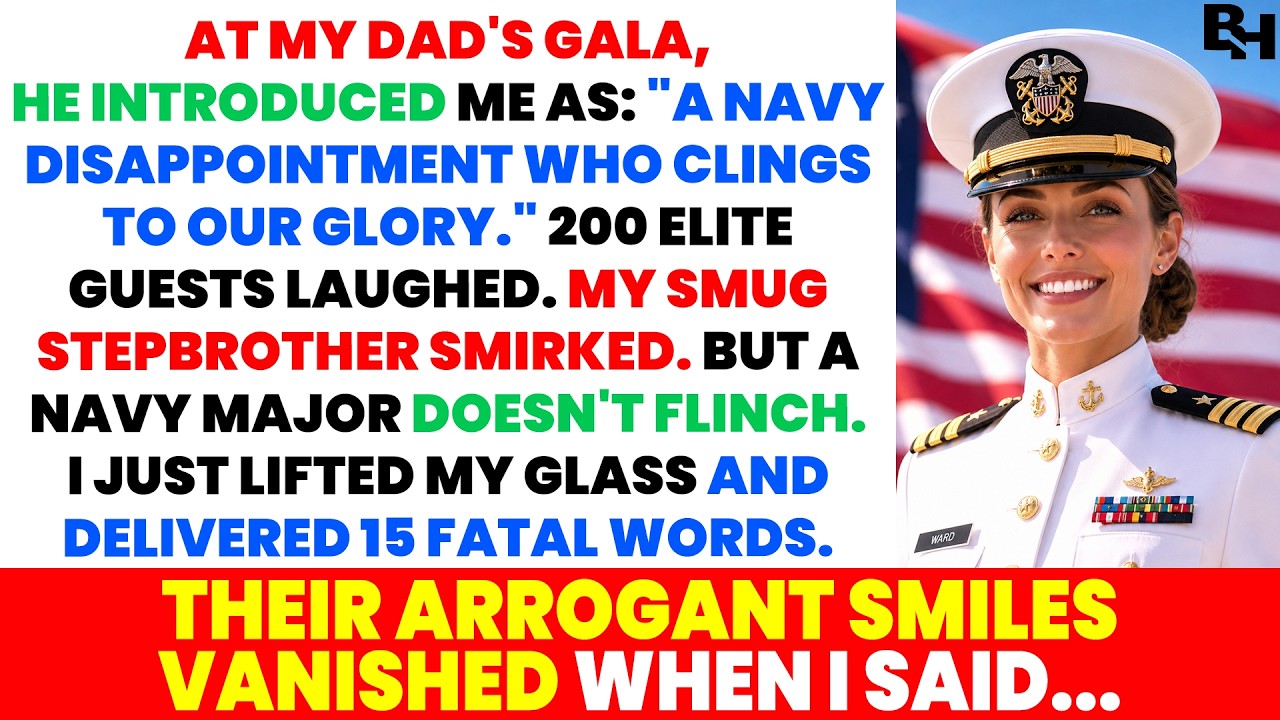
I did not shed a single tear, nor did I turn to flee. I stood perfectly straight with the textbook posture of a commanding officer, looked directly into the eyes of the man who had mocked me, and slowly raised my champagne flute. With a smile of freezing composure, I delivered the exact fifteen words that paralyzed the entire ballroom. Cheers.
It is finally time that you knew who this daughter of yours truly is. The clink of my glass echoed backward, morphing into the harsh clatter of my mother’s fine bone china teacup hitting its saucer. That sound dragged me back to when I was twenty, standing frozen in the sprawling colonial hallway of our home just hours after my mother’s funeral. The suffocating scent of stale lilies and sterile floor wax choked the air.
The heavy mahogany front door swung open and my stepmother, Linda, glided over the threshold. She did not walk in like a grieving guest offering condolences. She marched in like a conquering general claiming newly won territory. Right behind her, my stepbrother Marcus tossed his expensive leather jacket onto the banister, his eyes already scanning the rooms as if they belonged to him.
I stood by the staircase, clutching the edges of my black mourning dress. Linda paused by the fireplace and did not offer a single word of comfort. Her eyes locked onto me with a chilling predatory glare. Linda had spent her entire youth clawing her way up from the bottom of the social ladder, and her deep-seated insecurity demanded that she instantly eradicate any lingering traces of my mother’s presence in this house.
To her, I was not a grieving daughter. I was a direct threat to the massive Ward fortune she had finally secured through my father’s ring on her finger. That piercing stare was the opening move in a psychological siege I was absolutely not prepared to survive. Linda casually trailed her manicured fingers over the antique mantel, her gaze never leaving my face.
She picked up my mother’s favorite teacup, inspected the delicate porcelain, and set it down with a dismissive, heavy clack. My stepbrother sneered instantly, acting like the lord of the manor. He kicked his muddy designer shoes against the pristine baseboards, marking his territory with deliberate, ugly scuffs. I shifted my gaze toward the doorway of the drawing room.
My aunt Susan stood there, perfectly positioned in the shadows to witness this blatant territorial invasion. I looked directly at her, silently pleading for any blood relative to intervene. Susan’s eyes darted nervously to the floor. She shifted her weight, suddenly pretending to be deeply fascinated by the intricate pattern of the Persian rug.
Susan knew exactly what was happening. She recognized this as a ruthless takeover of my mother’s legacy. But just that morning, my father had promised her the lucrative vice president of communications position at his company. Her silence was bought and paid for.
The greed festering inside her rotting conscience cemented her cowardly complicity. By refusing to meet my eyes, Susan proved that in the Ward family, loyalty was just another commodity to be traded for a corner office. The suffocating realization that I was entirely surrounded by people who wished me gone settled over me like a lead weight. I was a captive trapped inside my own home, and every adult in my life had just silently agreed to look the other way.
In the agonizing months that followed, I learned to become a ghost within my own house to survive the daily psychological torment. I memorized exactly which floorboards creaked so I could navigate the hallways without drawing my stepmother’s venomous attention. I ate my meals alone in the cold kitchen long after they had finished their lavish dinners in the dining room. My father orchestrated this systematic erasure.
He ignored my existence entirely, brushing past me in the corridors as if I were a piece of misplaced furniture. Every time my father accidentally caught my gaze, I saw a flicker of intense hatred beneath his cold exterior. He did not just resent me. He hated what I represented.
I possessed the exact same unyielding spirit and sharp eyes as his first wife, the only woman who had never submitted to his narcissistic manipulation. Crushing my spirit, stripping away my confidence, and turning me into an invisible servant was his twisted, pathetic way of getting revenge on a dead woman he could never control. My stepbrother, fueled by his own hollow impostor syndrome, took immense pleasure in this dynamic. He would purposely knock over stacks of my college textbooks or casually spill hot coffee near my study notes just to watch me silently clean up the mess without a word of protest.
They wanted me to break. They desperately wanted me to scream and beg for their validation. I pressed my lips together so hard they went white, and I gave them nothing. I refused to give them the satisfaction of a breakdown.
Instead of crying in my bedroom, I sat in the shadowed alcove beneath the main staircase, using slow, deep, tactical breathing to swallow the burning injustice. From the shadows, I became a silent, calculating observer of their decaying empire. Through the crack in the heavy study door, I watched Victor Vance, who was merely a mid-level operations manager back then, continuously whispering poisonous flatteries into my father’s ear. I watched my stepbrother preen under unearned praise while Victor’s eyes flashed with hidden disgust at the golden child he was forced to serve.
The hierarchy was clear. They thought their psychological siege was slowly grinding me into dust, but they were fatally mistaken. Every sneer from Linda, every cowardly downward glance from Susan, and every cold dismissal from my father was cataloged in my mind. I was not breaking.
I was hardening. I made a silent, unbreakable vow in the dark of that hallway. I would not just survive this toxic house. I would forge myself into something none of them could ever touch.
I would watch them build their empire of lies, knowing that one day their own arrogant rot would bring it all crashing down. The girl clutching her mourning dress by the staircase was already dying. In her place, something colder, sharper, and infinitely more patient was being born. The clock in the hallway ticked past midnight, and I sat perfectly still in the dark.
My breathing steady, my eyes dry, my mind already calculating the first steps of an exit plan that none of them would see coming until it was far too late. The silent standoff finally erupted into its most devastating blow the week I turned twenty. I was abruptly summoned to the suffocating oak study. My father sat heavily behind his massive mahogany desk, his face set in stone.
Linda stood right behind him, playing the role of the deeply concerned, supportive wife, but her manicured fingers dug into his shoulders with greedy anticipation. Across from them stood Victor Vance. Victor slid a thick stack of forged financial reports across the polished wood, the papers landing with a heavy, damning thud. Victor’s calculated ambition pulsed in the room like a second heartbeat.
He knew my stepbrother was an absolute fool, incapable of running a lemonade stand, let alone a global logistics firm. Eliminating my competence and securing Marcus’s position as the golden child was Victor’s first tactical step toward eventually usurping the CEO seat for himself. Victor shot me a look of pure predatory triumph. He was handing my father the loaded gun, knowing full well my father was arrogant enough to pull the trigger on his own daughter.
The stench of expensive cigars hung thick in the air, mixing with old leather and polished wood into a smell I would never forget for as long as I lived. My father did not even bother to look me in the eye at first. He stared intensely at the fake numbers on the pages, taking a slow drag from his cigar, the glowing tip crackling softly in the heavy silence. The suffocating smoke filled the room.
Finally, he looked up, his eyes entirely devoid of warmth, and delivered the fatal blow with chilling indifference. Carol, the company is going through a tough time. Marcus needs tuition for his prestigious MBA program. Your courses bring no value to this house.
You have to drop out. The words hung in the air like a death sentence. In the dark corner of the study, my aunt Susan shifted uncomfortably. She stared at her designer shoes, her hands trembling slightly as she clutched her handbag.
Susan was terrified. She knew the company was not failing. She knew this was a blatant theft of my future to fund a stepbrother who bought his passing grades with my father’s checkbook. But her silence was the ongoing price for her corner office.
She swallowed her guilt once again, choosing her paycheck over my life. The cigar smoke curled toward the ceiling, and my father leaned back in his chair, waiting for the tears, waiting for the begging, waiting for the collapse he had carefully choreographed with Victor and Linda behind closed doors. I froze. The sheer audacity of the betrayal paralyzed my lungs.
My stepbrother, a reckless playboy who had never earned a single grade with his own brain, was being funded by stripping away my entire future. I looked directly into my father’s eyes, desperately searching for a single ounce of paternal love, a shred of hesitation. I found nothing but cold, unadulterated contempt. He wanted to break my will right there on the Persian rug.
He wanted to see me drop to my knees and beg for his mercy. My hands dropped to my sides. I dug my ten fingernails so deeply into the soft flesh of my palms that warm blood began to slick my skin. The physical pain was the only thing keeping my mind anchored to reality.
My stepmother, Linda, let out a soft, venomous sigh of relief, her eyes gleaming with the thrill of final victory. She had waited twelve months for this exact moment. The moment my mother’s last remaining legacy was officially erased from the Ward dynasty. I did not shed a single tear.
I refused to bleed for them where they could see it. My jaw locked so tight I could hear my own teeth grinding in the suffocating silence of that oak study. Victor Vance offered a slow, arrogant half smirk, victorious in his twisted manipulation. He expected a hysterical breakdown.
He expected me to scream about the injustice. Instead, I released the death grip on my bleeding palms. I squared my shoulders, locked my jaw, and offered my father one final dead-eyed stare that promised nothing but ice. I refused to give them a confrontation I could not yet win.
I turned sharply on my heel and walked out of the heavy oak doors without uttering a single word. Behind me, I could hear Marcus let out a loud, obnoxious laugh of triumph. They thought they had successfully destroyed me. But as I walked down that long hallway for the last time, I knew the truth.
My absolute silence was not a surrender. It was the coldest, most ruthless act of defiance I could possibly offer. I was leaving that poisoned house to forge myself into something they would never see coming. The bloody crescents drying on my palms were not wounds.
They were the last marks that house would ever leave on my body. Escaping that house was not enough. I needed to burn the victim out of my soul. I threw myself headfirst into the brutal steel furnace of the United States Navy.
The transition was a violent shock to the system. The physical agony of crawling through freezing mud, the blinding sweat stinging my eyes, and the deafening screams of drill instructors were a welcome distraction from the psychological torment of my past. As I dragged my exhausted body over a massive wooden barrier during a night drill, a fellow recruit, a kid from Texas who had nothing to his name, reached down and violently hauled me over the edge. He shot me a breathless, empathetic nod.
That single silent gesture of camaraderie hit me harder than any blow I had ever taken in that house. It was fierce, unconditional support I had never once received at my own family dinner table. Here in the freezing rain among absolute strangers, blood ties meant nothing and brotherhood meant survival. The Texas kid did not know my last name, did not care about my trust fund or lack of one.
He just saw someone struggling and pulled her up. My father had a hundred opportunities to do the same. He chose to push me down every single time. Former Navy drill instructor Walter Barnes, a man made of iron with eyes that could cut through steel, paced the training grounds like a hawk.
He watched me relentlessly push through a grueling obstacle course long after my muscles had failed. Every time my knees buckled, the mocking echo of my father’s voice lashed at my mind. Your courses bring no value. Those six words drove me back to my feet again and again until my hands were raw and my shins were bleeding against the wooden beams.
Barnes did not yell at me to move faster. He just watched, dissecting my movements with the patience of a man who had seen a thousand recruits and knew exactly which ones would last. Barnes had grown up in the brutal foster care system. He instantly recognized the feral, isolated independence of an unloved child.
While my father looked at me and saw worthless garbage to be discarded, Barnes looked at my bleeding hands and saw a natural-born commander. He saw raw potential that just needed to be aimed in the right direction. He stepped directly into my path, forcing me to halt my frantic march. I stood at rigid attention, my chest heaving, expecting a barrage of insults.
Instead, Barnes pulled me aside, away from the prying eyes of the platoon. His voice was gravelly and rough, but it held more genuine fatherly care than I had ever known in twenty years of life. He looked dead into my eyes, stripping away my defensive anger with a single unflinching stare. Ward, you have an unbreakable spirit.
Don’t use it to be angry. Use it to win. That single razor-sharp command slammed into my chest. It was the exact psychological anchor I desperately needed to maintain my sanity.
I was not just surviving anymore. I was being authorized to conquer. My aunt Susan had cowardly looked away when I was bleeding, but Barnes stared directly into my wounds and demanded greatness. I snapped a fierce, perfect salute, the rage in my chest instantly crystallizing into absolute freezing discipline.
For the first time in my life, an authority figure did not see me as a burden or a threat. Barnes saw a soldier, and that single moment of genuine recognition rewired my entire identity. The scared girl hiding beneath the staircase in that colonial house was finally, irrevocably gone. In her place stood a recruit with iron in her spine and ice in her veins, ready to turn every ounce of pain into something unstoppable.
From that moment on, I channeled my trauma into precision. Barnes became the father figure I never had, not through softness, but through relentless, unwavering standards. He pushed me harder than anyone in the platoon because he knew I could take it. Every morning at four-thirty, I was already running the perimeter, my boots pounding the gravel in the dark while the rest of the recruits were still in their bunks.
Barnes stood at the finish line with his arms crossed, never once telling me I did a good job, just nodding and raising the bar higher. I craved that nod the way I once craved my father’s approval. The difference was that Barnes actually gave it when I earned it. I poured my fractured soul into late-night logistics studies, mastering complex supply chain simulations while the rest of the sleeping quarters lay silent.
I learned to track global movements, anticipating failures before they happened. I systematically transformed from a discarded, voiceless girl into Major Carol Ward, an elite intelligence and supply chain officer trusted with the lives of thousands. When I finally pinned those golden oak leaves to my collar, I looked in the mirror and did not recognize the terrified girl from the oak study. The crisp navy uniform I wore was the ultimate armor.
It was an impenetrable shield built entirely of merit, discipline, and extreme competence, rendering me completely immune to the pathetic contempt of my past. Let my stepbrother play CEO with his forged reports and bought diplomas. I held the logistical lifeblood of the United States military in my hands. The face looking back at me in the mirror was steel.
No trace of tears. No trace of that cold kitchen. Just a soldier who would never again let anyone else determine her worth. When I was thirty, my grandmother Margaret, the original iron-willed founder of the company, passed away.
The funeral was a masterclass in suffocating hypocrisy. Standing near the marble crypt, I watched my stepmother, Linda, aggressively dab dry eyes with a silk handkerchief, performing grief for an audience she despised in private. Linda glared at me through her black veil, her knuckles white as she gripped her designer clutch. She lived in perpetual terror that my mere existence, combined with my grandmother’s quiet affection for me, would somehow derail Marcus’s inheritance.
She was terrified I was here in my crisp Navy dress blues to claim a slice of the estate. Across the manicured lawn, my uncle Robert stood alone, chain-smoking in the corner. When he caught my eye, he immediately hung his head, the cigarette trembling in his calloused fingers. Robert’s crushing guilt for staying silent when my father stole my tuition money ten years ago gnawed at him daily, paralyzing him in the presence of my unyielding military posture.
He was a broken man, too cowardly to speak, but unable to hide his shame. The cigarette ash dropped onto his scuffed boots, and he did not bother to flick it away. I watched the small gray cylinder burn down between his fingers, a slow, self-destructive ritual that mirrored the way his silence was consuming him from the inside out. I did not give Linda the satisfaction of a confrontation.
I stepped away from the crypt and was immediately intercepted by senior estate lawyer Eleanor Smith. Eleanor was cold, sharp, and entirely immune to my father’s bullying tactics. She pulled me aside into the shadow of an ancient oak tree, slicing through the heavy mournful air with absolute surgical precision. She handed me a heavily sealed manila envelope.
Margaret saw through her son’s cruelty. She set up this eight-hundred-thousand-dollar trust for you years ago. No one in the Ward family knows about it. The crisp rustle of the legal documents felt like a thunderclap.
I held the heavy papers, staring at the sheer financial firepower in my hands. I finally possessed the leverage to legally crush them, to buy out their debts, and humiliate my father publicly. But a military officer does not act on petty vengeance. I locked the money away as an absolute, impenetrable legal shield, ensuring I would never be cornered by their manipulation again.
Eleanor watched me with a rare flicker of respect as I slid the envelope into my uniform jacket without a word of celebration. Grandmother Margaret had seen the truth about her own son from the very beginning. She could not save me while she was alive without triggering his narcissistic wrath. So she saved me from beyond the grave.
The weight of that sealed envelope pressed against my chest for the rest of the funeral, a quiet, devastating reminder that the only person in my bloodline who truly loved me had to hide it like a crime. Three years before the gala, a twisted stroke of fate brought my two worlds crashing together. Ward Global Logistics legally won a massive Department of Defense subcontract. When the vendor list crossed my desk at the command base, I immediately filed a formal conflict of interest report.
But my superior, Colonel Daniel Reeves, trusted my absolute integrity and assigned me to oversee the supply chain anyway, citing my unmatched operational record. Night after night, I sat in the sterile, humming server room of the base. On my monitors, I watched Victor Vance and my stepbrother botch critical coordinates and delay vital shipments with stunning, careless regularity. Victor Vance arrogantly assumed his new algorithm was a stroke of logistical genius.
He strutted around their corporate office, blind to the catastrophic reality that his system was a burning trash fire held together by duct tape and delusion. Victor’s pathological need to cater to my father’s ego made him completely ignore the glaring operational red flags that were constantly threatening to collapse their entire fragile empire. I pulled up the error logs. Red line after red line of miscalculated routes and phantom inventory.
Every single mistake had Marcus’s fingerprints on it, sloppy data entries made by a man who could not be bothered to double-check a zip code before signing off on shipments meant for service members stationed in some of the most dangerous regions on Earth. Under the pale, unforgiving fluorescent lights of the base, I picked up a red pen and relentlessly crossed out their idiotic logistical errors. I did not intervene out of familial love. I intervened because real people stationed in remote hostile regions desperately needed those exact supplies on time and intact.
As the military liaison, I absorbed their catastrophic data, forcing my unit to work grueling overtime to translate their garbage into functional supply routes. I became the invisible filter, preventing their incompetence from triggering an immediate federal audit. While my father and Victor Vance raised glasses to their own brilliance, they were unknowingly surviving purely on the sweat and military expertise of the daughter they had discarded like garbage. The bitter irony burned in my chest.
The echoes of my father’s cruel voice, your courses bring no value, looped endlessly in my mind, perfectly overlapping with the sickeningly sweet praises I knew they were currently singing to themselves in their glass-walled boardroom across the city. I closed the server room door behind me, the fluorescent buzz fading into the quiet corridor. I stood there for three full seconds, my hand flat against the cold metal frame, letting the weight of that brutal irony settle into my bones. Then I squared my shoulders and walked away.
I had a duty to protect, regardless of who was undeserving of that protection. The haunting echo of my father’s past insults dissolved into the deafening thunderous applause of the present. The sterile hum of the server room snapped away, replaced by the blinding flash of event cameras and the suffocating scent of expensive cologne. I was standing in the center of the grand ballroom, three weeks before the confrontation in the parking lot, at my father’s lavish retirement gala.
Senator Thomas Sterling, the embodiment of political power, stood near the podium, showering my father with praise for his outstanding military contract and flawless logistical performance. My father puffed out his chest, soaking in the applause. He wore the exact same look of contemptuous, untouchable superiority that he wore in the oak study when he stripped away my future. He was parading a victory that I had secretly built for him, basking in the glory of an empire that would have burned to ash three years ago if I had not been holding it together with my own two hands.
The chandelier light caught the medals on my dress uniform, and not a single person in that room understood what those medals actually represented. Not just service to the country. They represented three years of silently carrying the dead weight of a family that had thrown me away, and then unknowingly begged for my help every time their supply lines collapsed. I sipped my champagne and let the bubbles sting the back of my throat, watching my father shake the senator’s hand with practiced fraudulent confidence.
My stepbrother Marcus strutted past me, swirling a glass of imported amber liquor. He loudly boasted to a group of investors about his visionary leadership and how his innovative strategies had single-handedly secured the military contract. Every word out of his mouth was a lie, and the investors nodded like obedient puppets. My aunt Susan glided by him, her eyes darting toward me.
She leaned in and hissed to a colleague that I only bothered to show up in my Navy uniform to beg for a handout from my successful father. Susan’s desperate, pathetic need to validate her own corrupt choices forced her to constantly belittle me. She had sold her soul for a corporate title, and seeing me stand tall and independent in a uniform I had earned terrified her. By insulting me, she was desperately trying to reassure herself that she had chosen the winning side all those years ago in the oak study.
I watched her fake a high-pitched laugh, the sound grating against my absolute silence. Marcus slapped a young investor on the back, spilling drops of his drink on the man’s Italian shoes without bothering to apologize. The investor flinched but said nothing. That was the Ward effect.
They surrounded themselves with people too intimidated or too invested to push back. The entire room was an echo chamber of false praise, and my family stood at the center of it, drunk on applause they had stolen from me. I stood perfectly still near the ice sculpture, my eyes scanning the room with the cold tactical precision of an intelligence officer. I locked eyes with Victor Vance across the ballroom.
He was aggressively raising a glass to toast my father, loudly praising Richard’s legacy. But I saw the micro-expression of pure, unadulterated disgust flash across Victor’s face when he glanced sideways at Marcus. Victor’s parasitic ambition was reaching its boiling point. He knew Marcus was an incompetent buffoon riding the coattails of a company he had never built.
Victor believed this entire logistics empire was a rotting sandcastle, and he was biding his time, waiting for the perfect moment to shove Marcus aside and claim the CEO throne for himself. Victor smirked at me across the ballroom, mistakenly thinking we were both just helpless spectators to the Ward family circus. He had absolutely no idea that I held the key to unraveling his carefully laid plans. The ice sculpture beside me dripped slowly onto the white tablecloth, each drop spreading into a widening stain that nobody in the room cared to notice.
That slow, spreading stain was exactly what was about to happen to every reputation in this ballroom. I memorized Victor’s smirk. I memorized Susan’s nervous laugh. I memorized my stepbrother’s empty boasting.
And I filed all of it away in the same mental dossier where I kept their forged reports and botched coordinates. Surrounded by their suffocating hypocrisy and the sickening sound of clinking glasses, I offered only a cold, razor-sharp half smile. I did not lash out. I did not scream about the injustice of my stolen tuition or the three years of grueling, unpaid logistical rescues I had performed for them.
An intelligence officer never reveals their hand before the final decisive move. I simply watched them dance on a stage built entirely of lies, utterly oblivious to the fact that I was the one who had been holding the strings all along. The timer on their grand illusion had officially expired. My father raised his microphone, clearing his throat to deliver the ultimate insult to his daughter, stepping directly onto the trap I had patiently set.
I adjusted the cuff of my uniform jacket, feeling the cool weight of the fabric against my wrist. The champagne flute was steady in my hand. Not a single tremor, not a single bead of sweat, just absolute terrifying calm. The moment I delivered my fifteen-word toast paralyzing the ballroom, I turned and strode out of the suffocating heat of the gala.
As I pushed through the heavy glass double doors and hit the freezing night air of the parking lot, rapid, furious footsteps pounded the pavement behind me. Carol, stop right there. My father’s roar tore through the quiet night, thick with unhinged fury. He charged out into the cold, flanked closely by Linda and Marcus.
Through the glass doors behind them, I saw Senator Sterling step out of the crowd, narrowing his eyes in deep, visible disgust at their uncultured screaming. The senator, a man who built his entire career on respect for military service, looked at my father as if he were a rabid dog barking at its own reflection. My boots crunched against the freezing gravel as I halted, waiting for the final confrontation. I did not run.
I did not flinch. I stood with my back to them for exactly three seconds, letting the cold air fill my lungs, letting them close the distance on their own desperate terms. Then I turned. My father’s face was a mottled furious purple.
The veins in his neck bulged against his expensive silk tie. Who do you think you are to insult me in front of the senator? He spat venomously, his fists clenched so hard his manicured nails dug into his palms. If you step into that car, I swear I will cut all ties.
You won’t get a penny of inheritance. You are no longer a Ward. Beside him, Linda watched with breathless anticipation, her greedy eyes wide and shining in the dim parking lot lights. Linda’s ultimate fantasy was finally playing out right in front of her.
She had spent twelve years whispering poison into my father’s ear to orchestrate the total legal eradication of my existence from the family fortune. My father was too blind with rage to realize he was performing her script word for word, dancing on strings she had been pulling since the day she marched over our threshold with her conquering stare. Marcus sneered, puffing out his chest, emboldened by my father’s rage, completely oblivious to the fact that his CEO title was entirely dependent on my silent mercy. A gust of frozen wind cut across the parking lot, snapping Linda’s silk scarf against her throat.
She did not notice. She was too busy savoring what she thought was my complete and total humiliation. The parking lot lamps cast long, distorted shadows across the asphalt, stretching their figures into monstrous exaggerated silhouettes that felt far more honest than the polished masks they wore inside the ballroom. I stopped.
I turned around slowly, my posture rigid, radiating the absolute unforgiving chill of an iceberg. There was no fear trembling in my chest. There were no tears welling in my eyes. You are mistaken, Richard.
My voice echoed evenly in the freezing air. You cut ties with me twelve years ago. Your garbage inheritance was never what I needed. Today, I am the one issuing the order to terminate this campaign.
I watched the arrogant smirk instantly vanish from Marcus’s face. He physically shrank back from the sheer crushing gravity of my tone. His puffed-out chest deflated like a punctured balloon, and for the first time in his pampered life, genuine fear flickered behind his glassy, unfocused eyes. My father’s jaw dropped in momentary shock.
He had expected a sobbing apology, a desperate plea for a second chance to be included in his will. Instead, he was met with a wall of steel that he could no longer penetrate, manipulate, or destroy. Linda’s breathless smile cracked at the edges, a tiny fissure of doubt spreading across her perfectly composed face as she realized, perhaps for the first time, that her stepdaughter was not a cowering girl anymore. I looked at the three of them, pathetic hollow figures shivering in their expensive designer suits against the biting wind.
They wielded money as a chain, completely ignorant that I had already shattered every link. Without waiting for a single stuttered reply, or giving them an inch of ground to argue, I turned my back on them. I decisively opened my car door, ignited the roaring engine, and drove off into the pitch-black night. The invisible, suffocating chains that had bound my neck for twelve years were completely gone.
I left them standing paralyzed in the freezing parking lot, choking on the bitter ash of their own public humiliation, entirely unaware that the countdown to their absolute destruction had officially begun. In the rearview mirror, I watched my father’s silhouette shrink, his arm still raised in furious gesticulation, screaming at the empty space where my car had been. Linda grabbed his arm, pulling him back toward the glass doors. Marcus stood alone, his hands hanging limp at his sides, his mouth still open.
I pressed the accelerator and the headlights cut through the dark New England highway. The roar of the engine was the only sound I needed. The days immediately following the gala were a cold, systematic dismantling. It was finally time for their system to run entirely on its own actual merit.
Sitting at my steel desk at the command base, surrounded by the sterile glow of military monitors, I officially stopped cleaning up their garbage. I pulled up the unedited raw data streams for Ward Global Logistics. I drafted a brutally honest, objective report detailing the fatal flaws, the manipulated shipment delays, and the staggering operational incompetence of their raw data. I formally recommended that the DoD cease all manual liaison interventions and force Ward Logistics software to integrate directly with our automated systems per the original contract requirements.
My colleagues in the intelligence unit shot me quiet, respectful looks. They knew the Ward name, but they also knew I was following military protocol without an ounce of personal bias. There was no malice in my keystrokes, only cold, hard facts. Every line I typed was verified against three independent data sources.
Every failure I documented was cross-referenced with the original shipping manifests and the falsified reports Victor had submitted to inflate his quarterly numbers. I pressed send, transmitting the unfiltered reality of Marcus and Victor’s disastrous leadership directly to the highest levels of the Department of Defense. I leaned back in my chair, listening to the rhythmic hum of the servers, knowing that a tidal wave was currently rushing toward Boston. And they had absolutely no idea how to swim.
Somewhere across the city, I could picture Victor Vance leaning back in his leather chair, swirling his whiskey, still believing his phantom genius was keeping the empire afloat. He had no idea the phantom was me, and the phantom had just walked away. Without my invisible hand manually rerouting their catastrophic errors, the Ward Logistics KPI metrics went into an uncontrollable vertical freefall. Within exactly five days, their entire supply chain shattered.
Cargo jammed at the eastern ports. Delivery coordinates were scrambled, leaving military shipments stranded in civilian yards with no forwarding instructions and no one competent enough to reroute them. Victor Vance had built his entire arrogant career on presenting falsified, polished data to manipulate my father’s towering ego. He had always believed his operational algorithm was foolproof.
Now, without me acting as the phantom safety net, his fake numbers could not hide the catastrophic gaping wounds of the system. In the downtown corporate office, phones rang frantically, a deafening chorus of angry clients and canceled contracts. I could picture Victor pacing his glass-walled office, tearing at his hair in absolute sweaty panic, screaming at terrified interns to find a phantom software glitch that did not exist. He could not accept the humiliating truth that he was, at his core, a complete fraud.
Marcus, the golden child CEO, barricaded himself in his corner office and refused to answer calls, reverting to the same cowardly instincts that had defined his entire privileged existence. He sat in the dark behind his locked door, scrolling through his phone, desperately searching for a logistics consultant who could untangle the catastrophe. Every firm he called quoted him six figures and a timeline that stretched past the military’s deadline. The golden child, who had laughed when my future was stolen, could not even pick up the phone without his voice cracking.
Linda left him fourteen voicemails in a single afternoon, each one more hysterical than the last, demanding he fix the crisis before the board discovered the true depth of his incompetence. My father’s cell phone rang every hour with livid government liaisons demanding answers. And for the first time in his arrogant life, Richard Ward had no daughter to secretly fix his problems. He paced his home office at two in the morning, a half-empty bottle of scotch on his desk, calling in favors from retired generals and old business partners.
Every single one of them politely declined. The word was already out. Ward Global Logistics was toxic, and nobody in Washington wanted their name anywhere near the wreckage. The Department of Defense has absolutely zero tolerance for incompetence that threatens national security.
Colonel Reeves reviewed my unredacted report, his jaw tightening as he scanned the catastrophic failure rates. He looked at me, confirming there was no personal vendetta clouding the data. I offered a sharp nod of confirmation. Without hesitation, he immediately authorized the termination for convenience clause, instantly severing the multi-million-dollar military contract to secure the supply lines.
The signature took three seconds. Three seconds to undo three years of my invisible labor. Across the city, Aunt Susan watched the company stock plummet on her trading monitor in real time, her hands shaking so violently she spilled her coffee across her pristine mahogany desk. Susan’s greed had finally delivered her to the exact ruin she had spent twelve years earning.
She had betrayed her niece for a corporate title that was now evaporating into worthless dust. The family turned on each other instantly. Through intercepted civilian communications, I heard reports of screaming matches echoing through the Ward boardroom as Victor, Richard, and Marcus pointed fingers like cornered rabid rats, each blaming the other for the collapse none of them had the competence to prevent. My father fired three junior analysts in a single afternoon, desperate to find a scapegoat.
Victor quietly began shredding documents in his office after hours, already planning his legal defense. Marcus simply stopped showing up to the building entirely, holed up in his penthouse apartment with the blinds drawn. I stood in the center of the command center, my arms crossed tightly over my decorated Navy uniform, watching the digital indicators of Ward Logistics being systematically purged from the secure military network. Red lights flashed across the global map, marking the exact locations where their access was being revoked one by one, like a surgeon removing infected tissue.
There was no dirty revenge plot. There was no screaming match, no thrown glass, no emotional breakdown. There was only the ruthless, objective law of reality asserting itself. For twelve years, they believed they were superior, untouchable titans of industry.
The ultimate punishment was simply taking away the unearned grace I had been secretly providing and handing them back their own unadulterated failure. I watched their digital empire dissolve on the screens, feeling nothing but the crisp, clean air of justice. Colonel Reeves stood beside me, his hands clasped behind his back, reviewing the transition protocols for the new logistics vendor. He did not offer praise or sympathy.
He offered something far more valuable: professional respect. A single firm nod that said more than any family embrace I had never received. I returned the nod and turned back to my monitors. The Ward name was being erased from the defense network one access point at a time.
Each revoked credential was another invisible chain dissolving into irrelevance. One week later, desperate, hemorrhaging cash, and utterly manic, my family exhausted every political favor they had left to beg for a high-level audience with the military brass, praying for an impossible pardon. They were directed to a heavily secured conference room inside the John F. Kennedy Federal Building in downtown Boston.
They sat nervously around the massive steel table. My father smoothed his tie, rehearsing his pitch, hoping to bribe or bully some faceless Navy general into reversing the contract termination. Linda clutched her pearls, her eyes darting toward the heavy oak doors every few seconds. When those doors finally opened, there was no stranger.
It was me. I walked in wearing my full immaculate dress uniform, my medals glinting under the harsh office lights, flanked closely by the imposing figure of Colonel Daniel Reeves. Eleanor Smith, acting as my personal legal counsel to officially sever all remaining financial ties to the Ward estate, stepped in right behind us. The room smelled of leather, expensive wood polish, and raw palpable fear.
Victor Vance, who had been confidently organizing his fraudulent papers and rehearsing his silver-tongued defense, missed the chair entirely and dropped to his knees. His kneecaps hit the marble floor with a sickening crack. The stack of papers in his hands fanned out across the polished surface like a losing poker hand. His face drained to the color of wet ash.
The confident tan from his country club weekends evaporated in an instant. Victor’s hyper-opportunistic instincts instantly connected the fatal dots. The realization slammed into him with the force of a freight train. For three entire years, his professional survival, his wealth, and his arrogant illusion of genius had depended entirely on the hidden mercy of the very woman he had helped destroy in that oak study twelve years ago.
He was nothing. Every chart he had presented, every quarterly report he had inflated, every smug toast he had raised at board meetings, all of it had been propped up by the invisible hands of the daughter they had collectively discarded. My father, however, was blinded by a sudden violent surge of narcissistic rage. Refusing to accept defeat, he leaped to his feet, overturning his chair with a loud crash.
The veins bulged dangerously in his purple neck. You dare use military power to exact revenge on your family. I will sue you. He roared, pointing a trembling accusatory finger at my face, desperately trying to reassert his dominance in a room where he no longer held a single card.
His voice cracked on the last word, betraying the panic beneath the fury. Linda’s hand shot out to grab his arm, not out of concern for him, but out of sheer terror that his outburst would make their situation even worse. Marcus pressed himself deeper into his leather chair as if trying to physically disappear into the upholstery. I did not flinch.
I stepped forward, raised the thick red-inked KPI failure report, and slammed it onto the glass table with a crack that echoed through the entire room. The glass shuddered. A pen rolled off the edge and clattered to the floor. The room fell dead silent.
No, Richard. For the past three years, I used my competence and integrity to protect the military’s project and inadvertently carried the burden of your incompetence and ignorance. That night, you reminded me that I have no obligation to save people who treat me like trash. Terminating the contract is not revenge.
It simply means I have stopped doing your work for you. I delivered the words with freezing mechanical precision. My father stared at the thick stack of documented failures, his mouth opening and closing. He finally realized that he was not a victim of a conspiracy.
He was simply a failure who had lost his invisible crutch. The color drained from his face in stages, the purple rage fading to a sickly white as the weight of every single falsified report, every botched shipment, every fabricated success story crashed down on him like a collapsing ceiling. Victor, still on his knees on the cold office floor, stared at the KPI report with the hollow, lifeless eyes of a man watching his own career obituary being written in red ink. Before my father could even attempt to formulate a lie, the office doors flew open again.
Uncle Robert stormed into the room, his eyes bloodshot, feral, and fiercely determined. He hurled a yellowed, meticulously kept bank ledger onto the glass table right on top of my military report. You have been evil enough, Richard. Robert roared, finally unleashing twelve agonizing years of suppressed corrosive guilt.
Robert had hated himself every single day since I was twenty, carrying the crushing burden of his brother’s secret like a stone in his chest. When the girl was twenty, you said there was no money. Lies. Her mother left her entire tuition in that account.
You stole it to provide for Marcus. I was a coward to stay silent. But not today. Robert’s voice cracked and his fists shook at his sides, his entire body vibrating with the force of a confession he should have made a decade ago.
At the revelation of the stolen money, Aunt Susan, who had quietly followed them into the office, let out a wretched sob. She collapsed against the hallway wall, sliding down to the floor in utter disgrace, knowing her complicit silence was now exposed to everyone in that room. Her designer handbag spilled open at her feet, lipstick and car keys scattering across the polished floor, a perfect, pathetic portrait of a woman whose carefully maintained facade had just been ripped apart at the seams. My father looked at Robert with a mixture of pure hatred and absolute terror, the realization dawning that his own brother had just handed his daughter the final piece of evidence needed to bury him completely and permanently.
In the suffocating dead silence of the ruined conference room, my father’s cell phone suddenly rang. The caller ID flashed brightly on the glass table. Senator Sterling. My father lunged for it, his hands shaking violently, answering on speakerphone as he prayed for a political lifeline, a miracle to save his dying empire.
Instead, the politician’s voice filled the room, carrying the absolute chill of a glacier. Richard, a man who steals his own daughter’s future and insults a military officer does not deserve any backing. All political support is terminated permanently. The line clicked dead.
The speakerphone sat on the glass table, the dead tone buzzing softly in the silence, the most devastating sound in the room. My father’s core, paralyzing terror of losing his elite prestige was finally realized. He was not just broke. He was a pathetic pariah, permanently exiled from the high society he had sacrificed his own daughter to impress.
His shoulders caved inward, his towering ego shattered beyond repair. Linda stared at the phone as if it had just pronounced a sentence on everything she had spent twelve years scheming to acquire, her perfectly painted lips trembling for the first time in her calculated life. She looked at my father, and for the first time, I saw something other than greed in her eyes. It was raw animal terror.
The social invitations, the charity galas, the country club memberships, the whispered envy of her friends, all of it was gone. She was no longer Mrs. Richard Ward, the elegant wife of a powerful CEO. She was the wife of a disgraced thief, and every door she had clawed her way through was slamming shut simultaneously.
The destruction in the room was absolute and irreversible. Without my father’s power to hold them together, the parasites immediately began to devour each other. Victor Vance scrambled to his feet and shrieked at Marcus, viciously blaming the golden child for the collapse of his grand scheme. Marcus cowered, whining like a cornered child, stammering that he only ever followed orders.
Uncle Robert turned his back on my father forever, spitting in disgust at the pathetic monster his brother had become, his marine shoulders squared with a resolve that had been buried for twelve years. Linda shrank violently into a corner, clutching her designer bag to her chest with white knuckles, her eyes wide with terror as she realized the massive fortune she had sold her soul to steal was evaporating into dust. They were trapped in a ruin of their own making, bound together by mutual hatred and impending bankruptcy. Victor jabbed his finger into Marcus’s chest, screaming that the incompetent fool had destroyed everything.
Marcus swatted his hand away and pointed at my father, blubbering that none of this was his fault. My father sat frozen beside his overturned chair, staring at the yellowed bank ledger Robert had thrown onto the table, the physical proof of his theft sitting in front of him like a tombstone engraved with his own name. I watched them tear each other apart for exactly ten seconds. I did not waste another breath mocking their misery or demanding an apology they were incapable of giving.
Their destruction was their own burden to bear, not mine. I turned sharply on my heels, snapped a flawless, deeply respectful salute to Colonel Reeves, acknowledging the brotherhood that had actually saved my life. I marched out of the room, my boots echoing with unwavering rhythmic authority against the hardwood floor. Eleanor Smith stood by the door, offering a rare approving nod as I passed.
I left the crumbling Ward dynasty behind me, fully consumed by the fire of their own unforgivable sins. The hallway was long and quiet. My steps were the only sound, each one measured, deliberate, and free. Behind me, I could still hear the muffled screaming, the accusations, the desperate scramble of people who had spent their entire lives avoiding accountability, finally being buried under its full crushing weight.
I did not look back, not once. The heavy hardwood beneath my boots felt solid and certain, a foundation that I had built myself one disciplined step at a time across twelve years and two hundred thousand nautical miles of service. Pushing open the heavy glass doors of the lobby, I stepped out into the brilliant, blinding Boston sunlight. The crisp morning air hit my face, clean and sharply alive.
I took a deep, lung-expanding breath, feeling the oxygen reach the bottom of my lungs for the first time in twelve agonizing years. The jagged wound in my chest was completely scarred over. There was no lingering fear, no unspoken anger, no desperate need for their validation. I thought about my mother.
I thought about her fine bone china teacup, the one Linda had picked up with those predatory fingers twelve years ago. I thought about the oak study, the cigar smoke, the forged reports, the blood drying in my palms. I thought about Barnes standing in the rain demanding greatness from a broken girl. I thought about the Texas kid pulling me over that wall.
I thought about grandmother Margaret hiding eight hundred thousand dollars in a sealed envelope because she knew her own son was a monster. True freedom was not about destroying them. It was about the profound realization that I no longer existed in their dark, pathetic world. I tilted my face up to the sun.
The warmth spread across my skin, and for a moment, I closed my eyes and let it sink into the bones that had been cold for so long. I am Major Carol Ward, a woman who built herself from the ash of her own family’s cruelty, entirely free, fiercely proud, and absolutely unbreakable. The Boston street stretched out ahead of me, wide and open, full of a future that belonged to no one but me.
I straightened my uniform one last time, adjusted my medals, and walked forward into the light.