She was standing in the shadow of her own porch, holding a tray of appetizers she’d spent four hours preparing, and listening to her husband tell a room full of his friends that she had reached her ceiling. Isabella Vance still remembers how the heat settled into the stones of that colonial porch in Savannah, and how the jasmine smelled just as thick and sweet as the smoke rising from the grill where the steaks had so recently been searing. She had spent the afternoon carefully arranging delicate appetizers for Julian’s weekly gentleman’s salon, an event he guarded with a theatrical kind of ferocity, a sacred gathering that he insisted was the engine room of his future empire. She had always played the part of the silent architect behind his comfort, the one who filled the wine, made the mood perfect, and made it seem effortless.
But then laughter erupted from inside the parlor, a sound so jagged and unfamiliar that her feet rooted themselves into the floorboards. It wasn’t his warm morning coffee chuckle, the one he reserved for her over quiet breakfasts. It was the sharp, arrogant roar of a man who believed himself king of a very small hill. She heard his voice next, cutting through the humidity with a terrifying casualness.
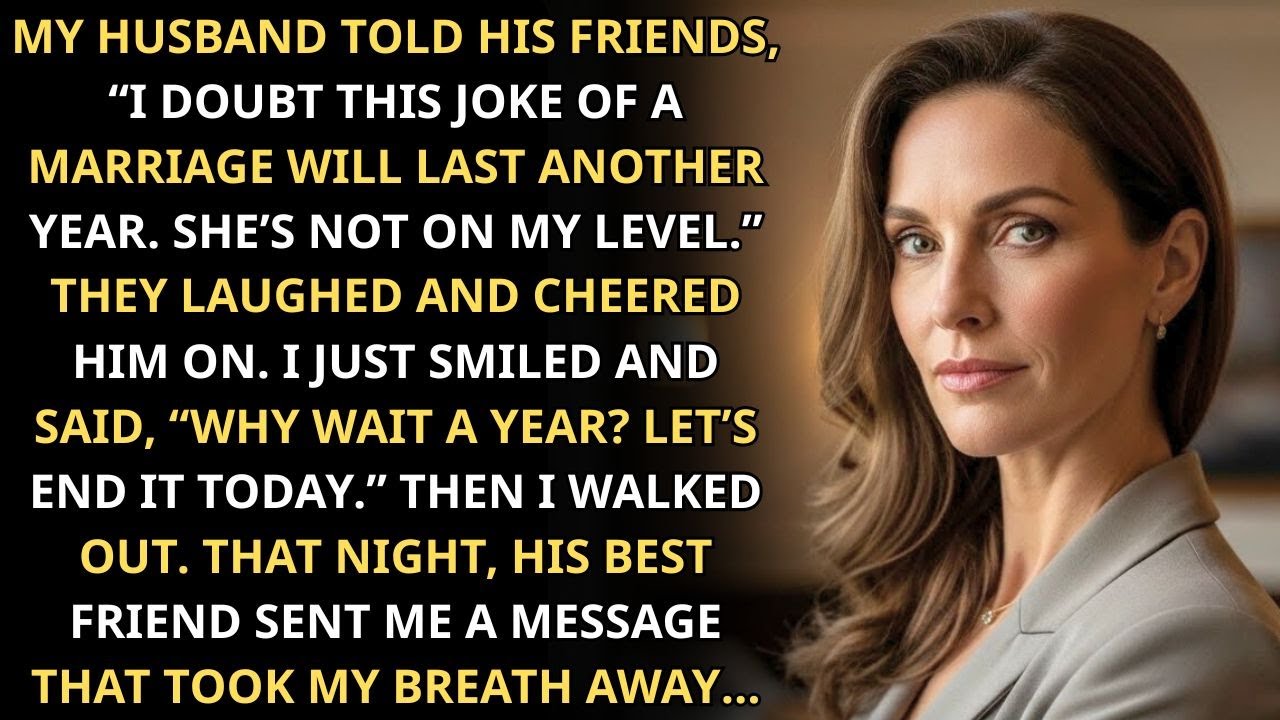
“I honestly don’t see this farce of a domestic union lasting through the next fiscal year,” Julian said. “Isabella is a fine woman in her own way, but let’s be realistic. She has hit her ceiling, while I am just beginning to touch the sky. She is nowhere near my level anymore, and keeping her by my side feels more like a charitable act than a partnership.
”
The words hit her like a physical blow, a cold wave that made the warm plates in her hands suddenly feel heavy and alien. Inside the dimly lit parlor, his inner circle leaned back in leather chairs she had personally sourced from an estate in Florence. They raised glasses filled with a vintage Bordeaux she had been aging for a special occasion. Their faces were illuminated by a flickering fireplace that seemed to mock her with its warmth.
Someone clapped a hand on Julian’s shoulder. Someone else let out a low, appreciative whistle. There were nods of predatory agreement, a collective validation of a man who was currently incinerating ten years of shared history for the sake of an audience. They were sitting on furniture her sweat had purchased, drinking wine her foresight had preserved, and toasting the inevitable arrival of her replacement.
For a long, agonizing minute, Isabella remained perfectly still, a statue of a woman draped in the shadows of her own home. Her body was a cage of ice, but her mind had never been more lucid, clicking into that high-definition clarity she usually reserved for complex architectural blueprints. She watched Julian bask in their approval, his chest swelling as if he had just delivered a masterpiece of a speech rather than a coward’s confession between bites of her artichoke toast. What stung the most wasn’t the cruelty of the insult itself, but the effortless comfort with which it lived in the room.
This wasn’t a drunken slip or a momentary lapse in judgment. This was a rehearsed sentiment, a narrative he had been polishing in the dark for God knows how long, a truth he felt safe enough to breathe only when he was certain she was out of earshot. It was the moment she realized her marriage wasn’t a sanctuary. It was a stage, and she had been the only one unaware that the play was a tragedy.
She set the heavy silver tray down on a stone side table with a silence that felt like a scream, then simply stood there breathing in the cold realization that the man she loved was a ghost, and the man in the room was a stranger she no longer wished to know. Before that night, the social circles of Savannah often whispered about how lucky Isabella was. They saw a woman who had built a boutique architectural firm from a single drafting table into a regional powerhouse, but in the same breath they credited her husband’s charm for her social standing. They saw a husband who was a visionary, a man who spoke in grand metaphors about tech startups and venture capital, even though none of his ventures ever seemed to move past the glossy slide deck phase.
What the world never saw was the deliberate, painful way Isabella had made herself smaller over the years to accommodate Julian’s fragile ego. She had started her company long before Julian ever uttered the word entrepreneur. In the early days, she was the one who pulled eighteen-hour shifts, navigating the labyrinth of city permits and demanding clients, while Julian searched for his calling. When the firm finally caught fire and the contracts started to climb into the millions, she handled the grit, the legalities, and the late-night crisis calls.
Julian, meanwhile, handled the storytelling, taking credit for the big ideas, while Isabella quietly absorbed the losses of his failed side projects. She had told herself that marriage was a marathon of patience, that supporting his delusions was a form of love, and that their success was a shared harvest, even when she was the only one sewing the seed. Every time her income doubled his, she stopped discussing the household ledger. When industry journals praised her innovative use of sustainable materials, she redirected the interviewer’s questions to Julian’s supposed role as her strategic adviser.
When he would stand at cocktail parties and joke about being the true visionary of the Vance household, she would simply smile, sip her drink, and let him have the spotlight, because protecting his pride felt less exhausting than confronting the hollow reality of their power dynamic. She had become the steady hand, the silent engine, the one who kept the lights on and the creditors at bay, while pretending not to notice that the scales were tipped so far in his favor that she was practically invisible. Her friends would often comment on what a strong couple they were, how Julian’s sparkle complemented her grounding presence. But Isabella knew the truth now.
She wasn’t part of a strong couple. She was just strong enough to carry two people on her back for a decade. Standing there in the dark, watching the man she had subsidized mock her very existence, the weight finally became too much to bear. She didn’t feel the urge to cry or scream.
She felt a profound, surgical sense of detachment. The marriage was a structure with a terminal foundation crack, and she was far too good an architect to try and save a building that was destined to collapse. She didn’t wait for a dramatic lull in the conversation. She simply reached out and pushed the glass doors open with a steady hand.
The sound of the sliding track was like a gunshot in the room. The laughter died instantly, replaced by a suffocating, guilty silence that tasted like ash. Julian turned toward her first, his face a grotesque mask of half-formed smiles and burgeoning terror. His eyes darted from the tray she had left outside to her face, searching for a sign of how much she had heard.
His friends followed suit, their bodies stiffening, their expensive watches glinting in the firelight, and all of them lowering their glasses like boys caught hiding in a forbidden pantry. Isabella stepped into the center of the room, her presence filling the space in a way that Julian’s loud bravado never could. She didn’t look at the guests. She looked directly at her husband.
“Why wait for the end of the year, Julian? ” she asked, her voice as calm and level as a desert horizon. “Let’s finish this tonight. I wouldn’t want you to feel trapped in a marriage you clearly don’t respect, especially with someone who has apparently hit her ceiling.
”
The silence that followed was so thick it felt physical. Julian opened his mouth to speak, but the man who was famous for his silver tongue found himself suddenly bankrupt of words. The version of him that knew how to gaslight and charm his way out of any corner had been replaced by a small, panicked figure who was just realizing his safety net had been retracted. Isabella didn’t wait for an apology she knew would be hollow.
She didn’t demand an explanation for the cruelty she had just witnessed. She simply turned her gaze to the men in the room, the ones who had been nodding along to her demise moments earlier. They couldn’t meet her eyes. One man became fascinated with the ice cubes in his drink, while another suddenly found a very urgent text message to attend to.
The collective ego of the room had evaporated, leaving behind nothing but the smell of expensive wine and cheap character. “I’ll have my things moved by morning,” she added, her tone almost polite, as if she were discussing a minor change to a floor plan. “Please ensure your friends finish the Bordeaux. It’s far too good to waste on a night as pathetic as this one.
”
She walked out of the parlor and straight to the master suite, her footsteps echoing on the hardwood floors she had chosen for their durability. She didn’t go to the guest room to hide. She went to the room that was supposed to be their shared sanctum and pulled her designer suitcases from the top shelf of the walk-in closet. The process of packing was mechanical, a series of precise movements that felt like muscle memory from a life she had forgotten she possessed.
She didn’t pack for a vacation. She packed for a relocation of her soul. She took her work blazers, the ones she wore when she was closing the deals Julian took credit for. She packed her laptop, which contained the blueprints for the next three years of her life.
She took the jewelry she had bought for herself to celebrate milestones he had ignored. Each item she placed in the suitcase was a brick she was reclaiming from a house that no longer belonged to her. She left behind the sentimental trinkets, the framed photos of their wedding in Tuscany, and the gifts he had bought with her own credit cards. Those things were part of the facade, and Isabella was done with shadows.
Julian appeared in the doorway twenty minutes later, his appearance disheveled, his breathing shallow and uneven. “Izzy, please,” he stammered, his voice cracking with a desperation that lacked any real substance. “You’re overreacting. It was just talk.
We were all drinking. You know how the guys get. We were just blowing off steam. ”
Isabella didn’t stop folding her silk shirts.
She didn’t even look up. “It wasn’t just talk, Julian. It was a confession. You didn’t joke about our marriage failing.
You joked about replacing me as if I were a piece of outdated software. ”
He tried to step into the room, his hand reaching out in a gesture of reconciliation that felt more like a threat. “I love you,” he said, the words sounding heavy and false in the air. “I’ve always been your biggest supporter.
”
Isabella finally stopped and faced him, her eyes as cold and unforgiving as marble. “You love the life I provide,” she corrected him. “You love the house, the car, the reputation, and the fact that I make you look like a success when you’re actually a professional failure. But you hate that you need me.
And that hatred is what I heard in that room tonight. ”
The color drained from his face, leaving him looking older and significantly less imposing. He opened his mouth to argue, but Isabella continued before he could find his footing. “I’m not just leaving because you insulted me, Julian.
I’m leaving because I know about the separate account you opened in the Caymans. I know about the conversations you’ve been having with my head of operations about a potential takeover. And I know you’ve been telling our board members that I’ve been struggling with my mental health lately, to explain why I might be stepping back. ”
Julian’s eyes widened, a flicker of genuine terror crossing his features.
“How do you know? ” he whispered. Isabella gave him a small, sad smile that didn’t reach her eyes. “Because I built a multi-million dollar company from nothing, Julian.
Do you really think I wouldn’t notice a leak in my own basement? I was waiting for you to find your conscience. I was waiting for you to prove me wrong. But tonight, you proved me right.
I’m not leaving because I’m hurt. I’m leaving because you’re a liability I can no longer afford to carry. ”
She zipped her final suitcase with a definitive snap and walked past him without a second glance. The air in the hallway felt lighter, as if the very atoms of the house were realigning now that the truth had been spoken.
As she reached the front door, her phone vibrated in her pocket. It was a message from an unknown number, a string of digits she didn’t recognize, but a tone she understood instantly. “Check your husband’s calendar for every second Thursday of the last 6 months,” the message read. “You aren’t the only one he’s been lying to.
”
A second message followed almost immediately. “I’m sorry it took me this long to tell you. I was afraid of what he would do to the firm. ”
The name at the bottom of the text sent a chill through her—Caleb Thornne.
Julian’s oldest friend, his business partner, the man who had been the loudest laugher in the room only an hour ago. Isabella stood on her front porch, looking out at the moss-draped oaks of Savannah, and realized that the betrayal was far more organized than she had ever imagined. This wasn’t just a husband’s insecurity. It was a coordinated campaign of erasure.
The next morning, the Savannah sun rose with a brutal, unforgiving heat. Isabella met Caleb in a secluded corner of a coffee shop on River Street, away from the prying eyes of the city’s elite. Caleb looked like a man who hadn’t slept in a decade, his eyes bloodshot and his hands trembling slightly as he clutched a paper cup. He didn’t offer a greeting.
He simply slid his phone across the scarred wooden table. “There’s a name for what he was doing,” Caleb said, his voice a low rasp. “He called it Project Eclipse. ”
Isabella scrolled through the messages, her face a mask of professional neutrality, even as her heart hammered against her ribs.
It was all there. The group chats, the shared documents, the strategic plan to paint Isabella as an unstable, emotional woman who was losing her grip on reality. Julian had been documenting her every late night, every moment of frustration, and every minor error, twisting them into evidence of a mental breakdown. He had been coaching the staff to bypass her for decisions, telling them she was going through a difficult time and needed to be protected from the stress of the business.
“He wanted the firm, Izzy,” Caleb whispered, leaning in so close she could smell the stale coffee on his breath. “He didn’t want to just leave you. He wanted to take the company and leave you with the reputation of a woman who had lost her mind. He was going to use the divorce to claim you were unfit to manage the assets.
Every Thursday night, we weren’t just drinking. We were reviewing the files. He had a lawyer, a publicist, and a plan to launch a new brand the day after the papers were served. ”
Isabella looked at a screenshot of a draft email Julian had written to their primary investor.
In it, he described Isabella as erratic and prone to outbursts, suggesting that a transition of leadership was the only way to save the firm’s upcoming waterfront project. The calculation was chilling. This wasn’t a crime of passion. It was a corporate raid on her soul.
“Why are you telling me this now, Caleb? ” she asked, her voice steady. “Why now, after months of helping him? ”
Caleb looked away, his jaw tightening.
“Because I saw your face last night when you walked into that room. And I realized that if he could do that to the woman who gave him everything, he’d eventually do it to me, too. I’m not a good man, Izzy, but I’m not as far gone as he is. ”
Isabella didn’t waste time on anger.
Anger was a luxury she couldn’t afford. She spent the next seventy-two hours in a war room of her own making, located in a high-rise hotel suite overlooking the harbor. She called Miriam Vance, her cousin and one of the most formidable litigation attorneys on the East Coast. Miriam arrived with a team of three paralegals and a forensic accountant who looked like he enjoyed dismantling people’s lives.
They went through ten years of records in three days. They tracked the secret accounts, the forged signatures on minor documents, and the digital trail of Project Eclipse. As they worked, the silence around Julian began to shatter. Other women began to reach out—the wives and girlfriends of the men in that room.
They sent audio recordings of Julian bragging about how he was the puppet master behind Isabella’s success. They sent emails he had sent from his burner account detailing his plans to liquidate her heritage properties. The sheer volume of evidence was staggering. Julian had built a house of cards, and he had done it using the very blueprints Isabella had taught him how to read.
The climax of the conflict didn’t happen in a courtroom. It happened in the glass-walled boardroom of Vance Urban Design. Isabella had called an emergency meeting of the board and the senior partners. Julian arrived early wearing his most expensive suit and an expression of practiced concern.
He had spent the morning telling anyone who would listen that Isabella had suffered a psychotic break and was currently being evaluated. He was prepared to take the helm to steer the ship through the storm he had created. But when he walked into the room, he didn’t find a group of sympathetic allies. He found Isabella sitting at the head of the table, flanked by Miriam and the forensic accountant.
The air in the room was cold, the kind of cold that precedes a killing frost. Julian tried to speak, his voice projecting a false warmth. “Izzy, honey, you shouldn’t be here. We talked about this.
You need rest. ”
Isabella didn’t blink. “Sit down, Julian,” she said. “We aren’t discussing my health today.
We’re discussing yours. Specifically, the health of your legal defense. ”
The presentation that followed was a masterclass in professional destruction. Isabella didn’t shout.
She didn’t use emotional language. She simply displayed the facts on the large overhead screen. Slide one, the secret bank accounts. Slide two, the forged signatures.
Slide three, the transcripts from the Project Eclipse group chats. The board members, many of whom had known Julian for years, watched in stony silence as the man they thought was a visionary was revealed to be a common thief of credit and capital. The final slide was a recording from the night of the dinner party, captured by a smart home device Julian had forgotten was connected to Isabella’s secure server. His own voice filled the room, mocking the marriage, mocking the board, and detailing exactly how he was going to bleed the company dry once he had Isabella out of the way.
Julian’s face turned a shade of gray that Isabella had never seen on a living person. He looked around the room for an ally, but Caleb Thorne was looking at his shoes, and the rest of the board was looking at their lawyers. “This is a misunderstanding,” Julian stammered, his voice thin and reedy. “This is a personal vendetta.
”
One of the lead investors, a woman who had mentored Isabella since her university days, stood up and closed her laptop with a sharp click. “It’s only a vendetta if it isn’t true, Julian,” she said, her voice dripping with disdain. “But the numbers don’t lie, and neither do you when you think no one is listening. ”
Isabella stood up, her presence commanding every eye in the room.
“You have one hour to vacate your office, Julian. My security team will escort you. You will sign the confession and the waiver of all marital assets, or Miriam will file the criminal charges we’ve already drafted. You wanted to be a leader, Julian.
This is what it looks like when a real leader cleans house. ”
Julian didn’t fight. He didn’t have the strength. He walked out of the boardroom, a ghost of the man who had laughed so loudly on the porch three nights ago, leaving behind a legacy of ash and a room full of people who finally saw Isabella for exactly who she was.
The months that followed the divorce were not a period of mourning for Isabella. They were a period of reclamation. The company stabilized with a speed that surprised the industry, largely because the friction Julian had been injecting into the culture was suddenly gone. Decisions were made with clarity.
Projects were executed with precision, and the team found a renewed sense of loyalty to the woman who had protected them from a predator they hadn’t even realized was among them. Isabella stopped making herself smaller. She moved into a penthouse that was all glass and light, a space that didn’t have room for shadows or secrets. She spent her evenings drafting new designs, not to prove her worth to a man, but because the work itself was her sanctuary.
She began to hear from women all over the country—architects, CEOs, artists who had heard her story. They told her about the Julians in their own lives, the men who used gaslighting as a management tool and resentment as a form of intimacy. Isabella realized then that her story wasn’t just hers. It was a blueprint for a quiet revolution.
She saw him one last time nearly a year later, in a nondescript hardware store on the outskirts of the city. Julian was standing in the plumbing aisle, staring at a set of faucet fixtures with a look of profound confusion. He looked diminished. His expensive suit replaced by a worn-out jacket.
His charismatic glow replaced by the dullness of a man who had finally realized he was ordinary. He caught her eye, and for a second she saw the old instinct flare up in him—the desire to approach, to charm, to rewrite the history of their ending. He took a half step toward her, his mouth forming the beginning of a greeting. But Isabella didn’t stop.
She didn’t glare. She didn’t even acknowledge the flicker of recognition in his eyes. She simply turned back to the shelf, compared two different types of industrial sealant, made her choice, and walked toward the checkout. She wasn’t ignoring him out of spite.
She was ignoring him because he was no longer a factor in her equation. He was a solved problem, a finished chapter, a structural flaw that had been successfully mitigated. As she drove away from the store, the Savannah sunset painting the sky in shades of bruised purple and gold, Isabella felt a sense of peace that was deeper than any success she had ever achieved in business. She understood now that the most powerful thing a person can do isn’t to seek revenge, but to achieve irrelevance.
Julian hadn’t lost because she had exposed him. He had lost because she had stopped carrying the weight of his ego. She had won not by shouting louder, but by telling the truth once and walking forward without looking back. The real lesson of her ten-year journey wasn’t about the cruelty of men or the fragility of marriage.
It was about the sacred importance of one’s own foundation. Life will always try to tell you that you are smaller than you are. It will try to convince you that your success is a shared commodity and your voice is a secondary melody. But the truth is a house built on someone else’s approval is a house that will always be at risk of falling.
Real strength is the ability to stand in the ruins of what you thought was your life and realize that you are the only architect you ever truly needed. Loyalty to a lie is not a virtue. It is a prison. And the moment you stop trying to save a person who is actively trying to erase you is the moment you finally become free.
Isabella Vance drove home to a house she had built with her own hands, in a life she had reclaimed with her own heart. And for the first time in a decade, the silence was not a threat. It was a masterpiece.