The phone rang at five in the morning, and Eleanor Vance knew, even before she answered, that the news would not be good. That hour of the day carried a particular kind of dread, a fragile silence that seemed to hold its breath, waiting to see whether joy or sorrow would break it. She had been awake for a while already, sitting at her kitchen table in her small Victorian townhouse in Nob Hill, watching the thick San Francisco fog swallow the streets outside. The city she had served for four decades as an archival researcher at the Legion of Honor was hidden beneath a blanket of white, and she felt, in that moment, that her own life was equally obscured.
The voice on the other end of the line was her son’s, Julian, and it sounded different. The warmth she remembered from his childhood, the easy laughter, the way he used to call her just to tell her about a book he had read, seemed to have been surgically removed and replaced with a polished, practiced smoothness. He didn’t ask how she was. He didn’t mention the cold fog or the tea she was holding.
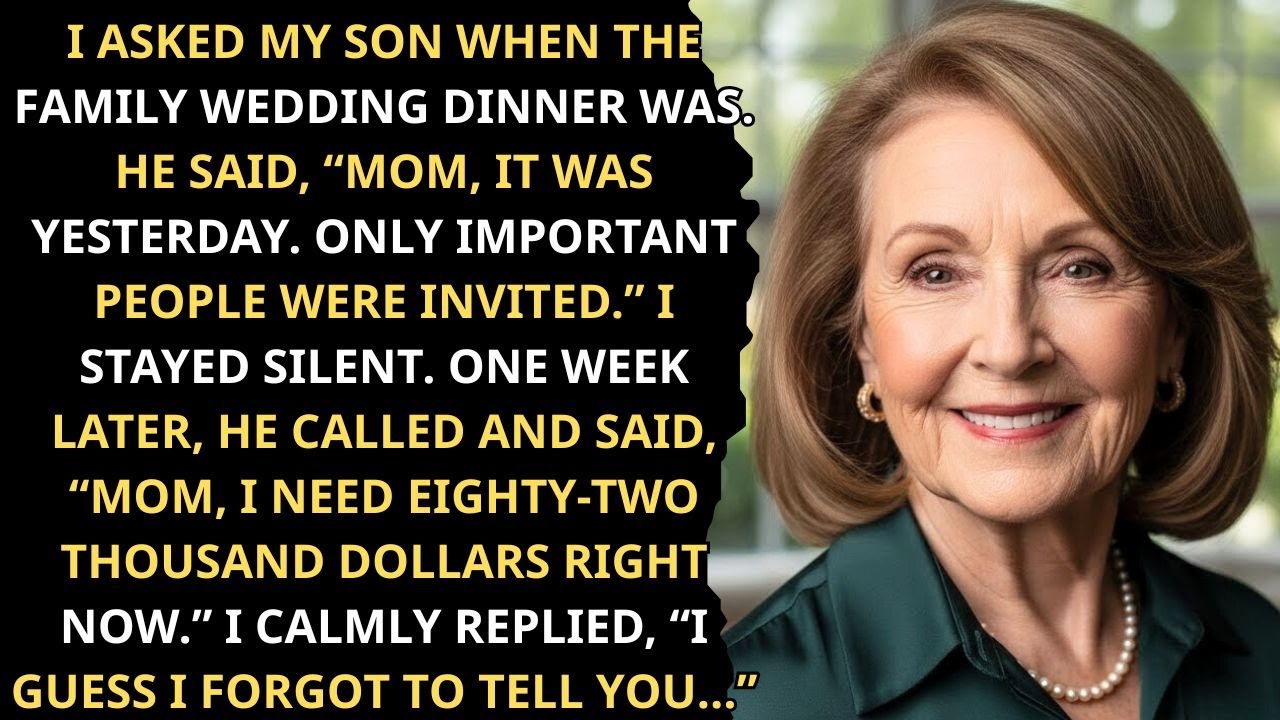
He simply told her, with a casualness that felt like a blade drawn across her skin, that he had married Saraphina Holloway the previous afternoon at a private vineyard in Napa Valley. The words hit Eleanor like a physical blow. She looked at her refrigerator, where she had circled a date on the calendar three months in the future. A date Julian had sworn was still being finalized, a date she had been planning for, saving for, dreaming about.
She had already bought a dress for that phantom day, a soft lilac lace that now hung in her closet like a garment prepared for a funeral that had never taken place. The dress had cost her two weeks of pension money, a small luxury she had permitted herself because she wanted to look like someone who belonged in her son’s new shimmering world. But now it was just a pile of useless fabric wrapped in plastic. She tried to speak, but Julian continued, his voice carrying over the line with the easy authority of a man who had never once doubted his right to be heard.
He explained the logistics of her erasure. He spoke about the Holloway family’s vision for the event, a concept he called social equilibrium. He suggested that the presence of people from certain backgrounds, people like his own mother, might disrupt the flow of the weekend’s aesthetic. Genevieve and Delaric Holloway, Julian noted with a terrifyingly smooth tone, felt that a wedding was a high-stakes performance of status, and Julian’s mother, with her practical shoes and her stories of museum basements, simply didn’t fit the brand they were trying to cultivate.
Eleanor listened, her hand trembling around the cold ceramic mug. She had spent the better part of forty years working in the basement of the Legion of Honor, carefully cataloging the shattered remnants of Roman pottery, preserving the fragments of civilizations that had crumbled centuries ago. She had built her life out of dust and dedication, out of the quiet, unglamorous work that kept the world’s treasures safe for future generations. And now, she realized with a cold clarity, she had become another broken artifact, a piece of history deemed incompatible with the new order of things, something to be swept away in the name of restoration.
But Julian’s voice shifted then. The cold, clinical tone he had used to describe her exclusion dissolved, replaced by a desperate urgency that Eleanor recognized from his childhood. It was the sound of a boy who had broken a window and needed someone else to sweep up the glass. He explained that there had been a slight complication with the Holloway family’s liquid assets.
Something about a temporary freeze on their offshore trust accounts due to a routine compliance audit. The wedding venue and the high-end catering firm were demanding immediate payment of eighty-two thousand dollars by noon. And Julian, with the audacity of a man who had never been told no, asked his mother to wire the money from her retirement fund. He promised it was just a bridge loan, a temporary fix that would be repaid with interest the moment the Holloways cleared their audit.
But Eleanor could hear the hollow echo in his words. The sound of a man who was selling his mother’s survival to pay for a mask he wasn’t even allowed to wear. The amount he was asking for was almost exactly what she had left in her supplemental savings, the nest egg she had built through forty years of skipping vacations and repairing her own shoes instead of buying new ones. She sat down at her small kitchen table, the wood scarred by years of Julian’s homework and the heavy weight of her own exhaustion.
She thought back to the decades of double shifts at the museum, the way she had meticulously cataloged the treasures of the world while her own life grew smaller and more threadbare. She remembered the winters she had spent wearing the same thin wool coat, the fabric worn down to the weave, so that Julian could have the latest laptop for his university courses. She remembered the nights she had spent at a small diner near the shipyards, scrubbing grease off the vents for extra cash, the scent of rancid oil clinging to her skin like a second identity. All of it had been for him.
For the boy who had once promised to build her a castle. A boy who was now asking her to dismantle her own foundation so that he could maintain the illusion of belonging to a family that wouldn’t even invite her to lunch. The archival researcher in Eleanor, the woman who knew how to find the truth buried under layers of dust and deception, began to stir beneath the surface of the grieving mother. She didn’t wire the money immediately.
Instead, she set down the cold mug of tea and walked to her small home office, where she kept a laptop that was older than Julian’s marriage. She opened a series of private databases she had access to through her years of professional networking, her fingers moving across the keys with a lethal, practiced precision. If the Holloways were as wealthy as Julian claimed, why was a world-class vineyard threatening to call the police over a bill that amounted to the price of a mid-range luxury car? Eleanor began to dig into the public records of Delaric Holloway, moving past the polished surface of his social media presence and into the dark, tangled weeds of his financial history.
What she found was a landscape of ruins. A series of shell companies that existed only to shuffle debt. A long list of litigation from vendors and former associates who had been left holding the bag. By nine in the morning, Eleanor had uncovered the truth that Julian was too blinded by ambition to see.
The Holloways weren’t pillars of society. They were professional illusions, grifters who used the appearance of wealth to lure in the next line of credit. The estate they lived on was in a state of quiet foreclosure. The private jet Julian had bragged about was actually a shared fractional ownership that hadn’t been paid for in six months.
They were a family of vultures, and Julian was their latest meal, a man they had groomed to be a bridge to a fresh source of capital. The eighty-two thousand dollars wasn’t for a wedding bill. It was a desperate attempt to keep the lights on for one more day, to prevent the entire house of cards from collapsing before they could find a way to pivot their debt onto someone else. Eleanor felt a cold, sharp anger beginning to replace the numbing grief.
A realization that her son wasn’t just a victim, but an accomplice in his own destruction. He had chosen this family, chosen their world of gleaming surfaces and rotten foundations, and he had chosen to make his mother pay for his entrance into it. Julian called again at ten, his voice now high-pitched and frayed at the edges. He told her that Saraphina was in tears.
That Genevieve was looking at him with a disappointment that felt like an execution. That his future in the firm depended on his ability to handle this minor administrative hiccup. He called her selfish for hesitating, accusing her of clinging to her money out of a spiteful desire to see him fail. And he reminded her that he was her only child, the only legacy she had left.
Eleanor listened to the venom in his voice, the way he turned her years of sacrifice into a weapon against her. She listened to the words that should have broken her, and she felt something inside her finally snap. It wasn’t a loud break. It was the quiet final click of a lock turning.
The sound of a woman who had finally decided that the archives were closed, and that the story of Julian Vance was no longer worth preserving. She looked out the window at the fog, which was beginning to lift, the sharp silhouette of the city emerging from the white shroud. And she realized she had to be just as sharp to survive this. Eleanor didn’t scream or cry.
She didn’t plead with him to remember the love they had shared. She simply told Julian that she would meet him and the Holloways for lunch at a high-end restaurant in the financial district, a place called the Gilded Leaf, where the light was bright and the truth was harder to hide. She dressed with a meticulous care that felt like preparing for a battle. She put on the lilac lace dress she had intended for the wedding, the fabric now feeling like armor rather than a funeral shroud.
She added a pair of vintage pearls that had belonged to her grandmother, the only pieces of jewelry she had ever inherited, and she walked out of her house with a manila folder tucked under her arm. When she arrived at the restaurant, Julian was already there, flanked by the Holloways. They looked like a portrait of refined elegance, a family of old money and impeccable manners. But Eleanor had seen enough forgeries in her years at the museum to recognize the cracks in the glaze.
Genevieve Holloway greeted her with a pitying smile that didn’t reach her eyes, a look that said Eleanor was a tiresome chore that had to be managed before the real business of the day could begin. The air in the restaurant was thick with the scent of expensive lilies and the underlying smell of old money. A scent Eleanor knew well from the museum galleries. But here, it smelled like decay.
The conversation at the table was a masterclass in passive-aggressive manipulation. Delaric spoke about the complexities of global finance. Genevieve lamented the decline of professional courtesy in the modern era. And Julian sat between them like a loyal lieutenant, nodding at every word, casting frequent, anxious glances at his mother’s purse.
They spoke to her as if she were a child. A simple woman who couldn’t possibly understand the high-stakes world they inhabited. They gently urged her to complete the transfer so they could all move past this unfortunate unpleasantness. Eleanor let them speak.
She watched the way they performed their roles with a practiced, desperate grace. She watched her son, the boy she had carried in her body, the boy who had once cried when he saw a bird with a broken wing, the boy who had promised to build her a castle, turn into a stranger who couldn’t meet her eyes. And then she reached into her bag and pulled out the manila folder, laying it on the pristine white tablecloth like a challenge. The folder contained the truth of their bankruptcy.
The tax liens. The foreclosure notices. The long history of unpaid vendors. A collection of records that no amount of social equilibrium could balance.
Eleanor opened the folder and began to read from the documents she had gathered, her voice clear and resonant, a sound that cut through the polite murmur of the restaurant like a bell. She spoke about the tax liens. She spoke about the foreclosures. She spoke about the long history of unpaid vendors that trailed behind the Holloway name like the scent of rot.
She watched the color drain from Delaric’s face. She watched Genevieve’s eyes turn into cold, hard stones of panic. And she watched Julian stare at the papers as if they were written in a language he didn’t understand, his mouth opening and closing in a silent, stunned protest. Eleanor didn’t stop until she had laid bare the entire fraud.
Exposing the Holloways as the bankrupt illusions they were, and Julian as the fool who had traded his mother’s heart for a seat at a table made of smoke. She felt a profound sense of relief. A release of the burden of being the silent anchor for a ship that had already sunk. The fallout was immediate and ugly.
Delaric tried to bluster, claiming the documents were forged or misunderstood, but his voice lacked the conviction of a man who actually believed his own lie. Genevieve turned to Julian and demanded that he silence his mother, her face contorting into a mask of aristocratic rage that looked more like the desperate snarl of a cornered animal. Julian, in a final pathetic attempt to reclaim his status, turned on Eleanor with a fury that made the other patrons stop and stare. He called her a bitter old woman.
A relic of a past that no longer mattered. And he told her that he would never speak to her again if she didn’t pay the bill and apologize for the embarrassment she had caused. Eleanor stood up then. Her lilac lace dress rustling in the quiet of the room.
And she looked at her son with a clarity that felt like the first deep breath she had taken in years. She told him that she was no longer paying for his life. That if he wanted to live in a house of cards, he would have to learn how to keep it upright himself. She explained that she had spent forty years building a life out of grit and honesty, and she would not allow him to turn her survival into a currency for his vanity.
Julian’s face was mottled red, his eyes full of a hatred that made her skin crawl. But she didn’t flinch. She had seen thousands of years of human failure in the archives, and she knew that the only way to end a tragedy was to stop playing the victim. She left the folder on the table, a parting gift for the Holloways to study, and she walked out of the restaurant without looking back.
The sunlight on the street felt warm and real. A stark contrast to the refrigerated atmosphere of the dining room. Eleanor walked through the financial district, her mind a whirlwind of memories and revelations. She thought about the boy who used to help her shell peas in the kitchen.
The boy who had cried when he saw a bird with a broken wing. And she wondered where that compassion had gone. Had she extinguished it by giving too much? By making the world too soft for him while she bore all the hardness?
She realized that by shielding him from the consequences of his actions for so long, she had denied him the opportunity to grow a spine. She had been the archive preserving every version of him, but she had failed to realize that some versions were corrupted beyond repair. As she reached the Embarcadero, she looked out at the bay, the water a deep, churning blue that matched the color of her soul. The weeks that followed were a period of profound redefinition.
Julian didn’t call, and Eleanor didn’t reach out. She realized that the silence between them was the most honest conversation they had ever had. She spent her days at the museum, not as an employee, but as a visitor. Sitting in the galleries and looking at the art with the eyes of a woman who had finally learned the difference between a masterpiece and a forgery.
She began to travel. Taking the trips she had always postponed because Julian needed a new car or a down payment on an apartment he couldn’t afford. She went to Kyoto in the spring, sitting in the quiet temples and watching the cherry blossoms fall like snow. A reminder that beauty is transient, but the earth remains.
She went to Florence in the autumn, walking through the corridors of the Uffizi, and realizing that the weight of history is lighter than the weight of a son’s resentment. She found herself on the rugged, honest coast of Maine in the winter. The air so cold it hurt to breathe, but it felt like a cleansing fire. She stayed in a small cabin, reading the books she had always meant to finish, and listening to the waves crash against the rocks.
She thought about forgiveness. Not as an act of reconciliation with Julian, but as an act of mercy for herself. She forgave the woman who had scrubbed grease for a boy who would eventually call her selfish. She forgave the mother who had believed that love was a transaction where sacrifice was the only currency.
She realized that worthiness is not a status to be granted by others, nor is it a commodity to be bought. It is a state of internal grace. A quiet, unshakable realization that your value is inherent and independent of the utility you provide to those who are too blind to see you. A year later, Julian appeared on her doorstep in Nob Hill.
Looking like a man who had finally discovered that a suit with no pockets is a difficult thing to wear. He had lost the Holloway lifestyle. The marriage had crumbled under the weight of the debt he had been forced to shoulder. And he was working as a junior clerk in a firm that didn’t care about his aesthetic.
He asked to come in. To sit at the oak table. To find the mother he had discarded. But Eleanor stood in the doorway and looked at him with a kindness that was also a boundary.
She told him that she loved the boy he used to be, but that she didn’t know the man he had become. And that he would have to find his own way back to the truth before he could find his way back into her house. He looked at her then, and for a fleeting moment, she saw the boy who had promised her a castle. But the man standing there was still looking for someone else to pay for the stones.
She closed the door and walked back into her kitchen. The psychological war she had endured had left scars, but they were the scars of a survivor, not a victim. She had learned that being an anchor for a sinking ship only ensures that you go down with it. By letting go, she hadn’t just saved her retirement fund.
She had saved the remainder of her life. She began to volunteer at a local literacy center, teaching adults how to read and write. Finding a profound satisfaction in helping others build their own foundations. She shared her stories of the museum, the history of the artifacts she had cataloged, and the lessons of the centuries she had spent in the archives.
She found a new community of people who valued her for her mind and her heart. Not for what she could provide or how she fit into an aesthetic. The legacy of the Vanes was no longer a matter of emeralds or high-society marriages. It was a legacy of resilience.
Of the quiet, fierce strength of a woman who chose her own survival over a beautiful lie. Eleanor walked into her kitchen and made a fresh pot of tea. The aroma of bergamot and steam filling the room with a sense of simple, profound joy. She looked out at the city she had served for so long, and she realized that she was no longer an archival researcher looking for the past.
She was a woman living in the present. A woman who had faced the void and found that it was not an empty space, but a place where a new life could finally take root and grow. The story was hers. The ending was hers.
And the worthiness was hers, forever and always. Eleanor thought about the concept of social equilibrium that Julian had mentioned on that fateful morning. She realized that equilibrium isn’t about fitting into a circle of elite strangers. It’s about the balance between what you give and what you keep for yourself.
It’s about the alignment of your actions with your values and the refusal to allow anyone, even your own flesh and blood, to turn you into a footnote in their own delusion. She looked out at the city, clear and sharp against the sky, and realized that her value was never a logistical decision. It was a steady, quiet light that had been burning in the library stacks and the diner grease all along. She was Eleanor Vance.
And she was finally, perfectly, and gloriously enough. The archival records of her life were now complete, but the book was still being written. She had reclaimed her narrative from those who tried to erase it, proving that the most beautiful part of a story is often the part where the protagonist finally decides to stop being a victim and starts being the hero. The silence of her house was no longer an echo of neglect.
It was a sanctuary of peace, a space where the truth was the only guest ever invited to stay. She had survived the Holloway grift, the betrayal of her son, and the cold gray fog of Nob Hill. And she had emerged as a woman who knew exactly what she was worth. The sixty-eight thousand dollars in her account wasn’t just money.
It was her freedom. Her security. And her promise to herself that she would never again be silenced by the vanity of others. Eleanor walked into her garden, the roses in full bloom and the air smelling of rain and salt.
She felt a sense of peace that surpassed all understanding. She had faced the dragon of her own misplaced guilt and had emerged victorious. She had seen the truth behind the gold leaf and the champagne, and she had chosen the honest, difficult path of self-respect. She looked up at the sky, the clouds finally parting to reveal a deep, endless blue.
And she realized that her life was not over. It was just beginning. She was the mistress of her own archives, the author of her own story, and the only person who got to decide if she was worthy of the sun. The tea was warm.
The house was silent. And Eleanor Vance was finally home. She had learned that the most important archives are the ones we keep in our own hearts. The records of our strength, our resilience, and our capacity to start over.
She had learned that even the most broken artifacts can be restored if given enough time and the right hands. Her hands were no longer chapped and red from the diner grease. They were steady and strong. The hands of a woman who had built a life out of truth.
She picked up a book, a volume of poetry she had always loved, and began to read. Her voice a soft, steady whisper in the quiet of the afternoon. The story of the Vanes would not be one of high-society triumphs or financial empires. It would be a story of a woman who knew the value of a single book, the weight of a mother’s heart, and the absolute necessity of self-worth.
It would be a story that reminded everyone who heard it that status is a shadow, but character is the mountain that casts it. Eleanor turned the page, a smile touching her lips as she found a verse about the sea. About the way it doesn’t apologize for its tide. She closed her eyes and listened to the sound of her own breath.
A steady, honest rhythm that didn’t owe a debt to anyone. She was free. She was worthy. And she was finally, beautifully herself.
The lessons of the museum had stayed with her, but she had added a new chapter of her own. She had learned that restoration is not about returning something to its original state, but about acknowledging the damage and moving forward anyway. Her life was a restored masterpiece, full of cracks and repairs, but stronger and more beautiful for having survived the pressure. The world would continue to turn.
The fog would continue to roll over San Francisco, and families would continue to build their houses of cards. But in a small Victorian townhouse in Nob Hill, a woman sat in the quiet and knew that she was the only one who held the key to her own archives. She had turned the eighty-two-thousand-dollar demand into a lesson in dignity, and she had turned a son’s betrayal into a testament of strength. Eleanor Vance had finished her tea, the warmth lingering in her bones, and she walked into the evening with her head held high.
A woman who was no longer afraid of the dark. The lesson she left behind was simple yet profound. We are not defined by the roles we play in other people’s lives, but by the love and respect we give to ourselves. We are not resources to be used or logistical decisions to be made.
We are the architects of our own worthiness, the gatekeepers of our own hearts, and the only ones who can decide if our story is worth telling. Eleanor Vance had told her story. And it was a masterpiece of resilience and grace. She was finally at peace with the silence, for it was no longer the silence of neglect, but the silence of a woman who had finally found her own voice.
As the stars began to appear over the bay, Eleanor stood on her porch and looked out at the city she had always loved. She felt a connection to the centuries of women who had stood in their own kitchens, facing their own betrayals and finding their own strength. She was part of a long, unbroken lineage of survivors. A woman who had taken the fragments of her life and built something whole and beautiful.
She was Eleanor Vance, and she was enough. The fog was gone. The bridge was clear. And the future was hers to write.
She stepped back inside and closed the door. The click of the lock a final, satisfied punctuation mark on a life well-lived. The ending was not an eighty-two-thousand-dollar party. It was a woman sitting in a chair, heading home to a house that was hers, to a life that was honest, and to a silence that was no longer an echo of neglect, but a song of freedom.
She had faced the void, and she had built a bridge out of the truth. The story was finally mine.