Five nights after my highway accident, I lay alone in room 412. At 11:47 p. m. , the door opened.
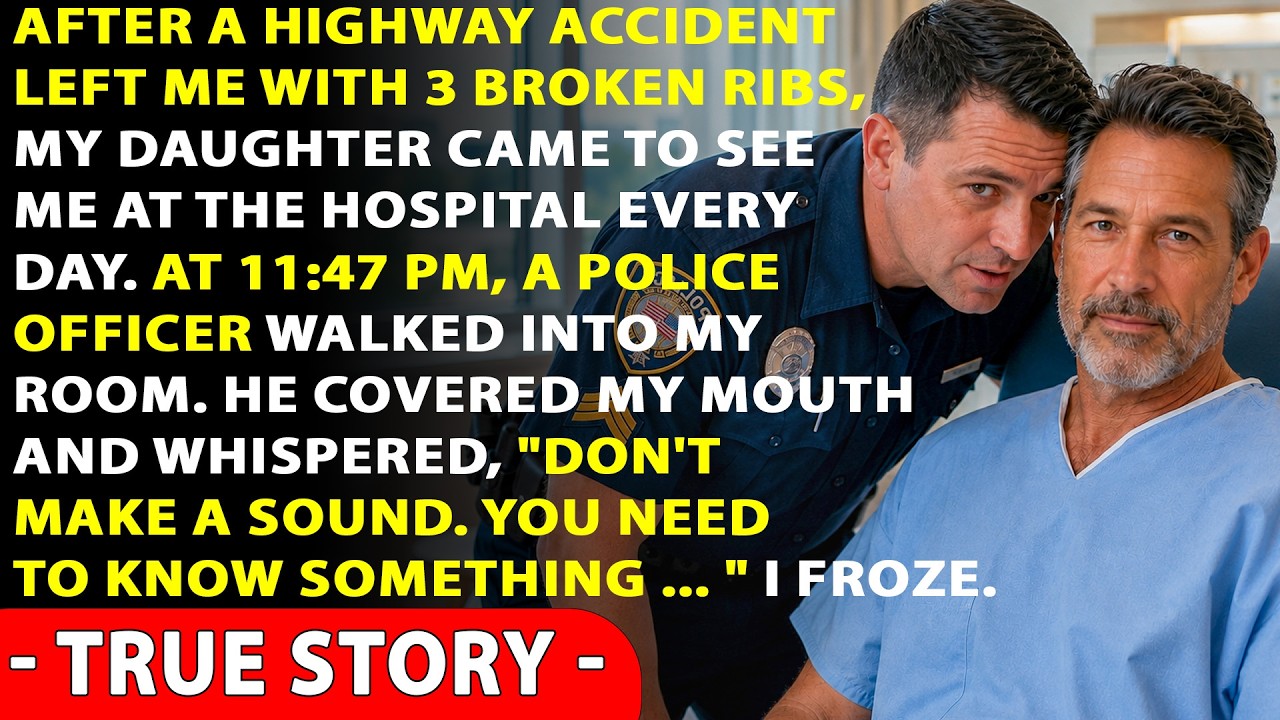
A police officer stepped in, locked the door, and covered my mouth. “Don’t make a sound, Mr. Hayes. I’m not here to hurt you.
”
I grabbed his wrist. Not to fight—my cracked ribs wouldn’t win that contest—but because it was what a frightened man would do. I was not frightened. I was watching.
“My name is Daniel Cross. LAPD Commercial Transport Division. ” His eyes swept the room while he spoke. “Your daughter is not managing your company.
She is dismantling it. ”
He told me Audrey had been redirecting freight contracts to outside operators since the day I was admitted. He warned me to be careful. But his gaze kept moving.
The nightstand. The closet. The tray table. He was looking for something.
“Is there anything in this room that belongs to the company? Documents, a laptop, a storage device? ”
He searched the nightstand, the closet, my jacket pockets. My phone.
He found nothing. After he left, I called Marcus Reed, my accountant of twenty-two years. “The drive is safe,” I said. “Don’t move it.
And starting tomorrow, watch everything. ”
—
Three days before the accident, I’d noticed something wrong in the routing data. I’d copied everything onto a small drive and given it to Marcus with instructions to keep it somewhere only he knew. Cross had searched every surface of my room and come away empty-handed.
Whoever sent him didn’t know about Marcus. Marcus called the next morning. Fourteen routing changes in the September numbers. All made in the ten days since I’d been admitted.
All carrying Audrey’s authorization codes. “Wrong like someone went in and changed them after the fact,” he said. I called Ethan Cole, a retired FMCSA inspector and my closest friend for thirty years. He’d talked me through a blown transmission in the Nevada desert once.
I trusted him with this. “Give me 48 hours,” he said. Ethan found the company that owned the truck that hit me. Sierra Pacific Transport LLC, registered in Nevada, hidden behind two layers of nominee directors.
The beneficial owner: a trust administered on behalf of Audrey Christine Hayes. I sat with that for a long time. Then I asked Ethan to keep digging. —
Ethan traced the money.
It wasn’t going to Audrey directly. It passed through intermediate accounts, including a “charitable organization” called the California Senior Assistance Fund, whose listed director was Deputy Chief Everett Shaw of the LAPD. The corruption reached higher than I’d imagined. Then Marcus told me about Sophie Mercer, a logistics coordinator at the yard.
She’d been instructed to use a revised manifest template for about twenty percent of shipments. Original cargo descriptions—precursor chemicals requiring federal permits—were changed to “general freight” and “equipment components. ” Hazardous material classifications removed entirely. She’d kept copies of everything.
Photographed originals, revisions, and emails from Audrey with the template instructions. She’d recorded herself going through the filing process, alone in a storage room, because she didn’t know who else she could trust. Sophie had been carrying that fear for six weeks. I told Marcus to tell her she wasn’t alone.
—
The conservatorship petition arrived on a Tuesday morning. Forty-two pages, filed by Audrey in Los Angeles Superior Court, asking to be appointed conservator of my estate. The supporting medical assessment came from Dr. Harmon, my attending physician.
It described confusion, impaired memory, difficulty processing complex information. None of it was true. But I understood the strategy. She couldn’t remove me through a shareholder vote, so she was taking control through the courts.
Ethan sent me Helen Vance, an attorney who specialized in exactly this kind of fight. She filed an immediate opposition to the emergency motion and requested an independent medical examination. “How long does that buy us? ” I asked.
“Four to six weeks. And if the criminal evidence is as strong as you’re describing, enough time for the FBI to become involved in a way that changes the legal landscape entirely. ”
Ethan traced the payments: $80,000 from a Langford Capital subsidiary to Dr. Harmon’s personal account.
The first payment, three weeks before my accident. The second, four days after I was admitted. He’d been paid to write that assessment before I was ever injured. —
Victor Langford.
The name underneath everything. He’d tried to buy Hayes Freight in 2017 at forty percent below market value. When I said no, he’d simply waited. Six years of patience, six years of watching, until he found the one way in.
My daughter. Ethan pieced it together from financial records and corporate traces. Langford met Audrey at an industry dinner in spring 2023, introduced himself as a private investor, never mentioned my company by name. He built the relationship over months.
By the time she understood what he was actually after, she was in too deep. When she tried to pull back, he told her that if she withdrew, I would be the one investigators looked at first. I didn’t know if that made it better or worse. She’d still done what she did.
But I needed to understand the difference between walking in willingly and being maneuvered there. —
Then Cross walked into the FBI field office on Wilshire Boulevard and asked to speak with someone from financial crimes. He’d been on Langford’s payroll for eighteen months—$62,000 paid through a holding company. He’d deleted the camera footage at the intersection where my accident happened.
He’d known a vehicle incident was planned. He sat in his car for twenty-two minutes after Langford called him with four words—“clean it up”—and then drove to Wilshire instead of doing what he was told. He told the FBI everything. The payments, the surveillance, the instructions, the name of Deputy Chief Shaw.
He understood that cooperation was his only remaining asset. Special Agent Rebecca Okafor led the investigation. She called the play: let Audrey move. She’d filed notice of an emergency board meeting to formalize the conservatorship.
Langford would be there to support it. The FBI would make the arrests at the meeting. —
The day before the meeting, I asked Dr. Harmon’s office to schedule my discharge evaluation.
The next morning, a nurse found me standing beside the bed in the navy suit I’d worn the day I signed Hayes Freight’s first major carrier contract. She handed me the discharge forms. I signed them with Helen Vance’s approval. Ethan was waiting in the parking lot.
We drove to Commerce in silence. When we turned onto the street past the yard, I saw the trucks lined up along the east fence—230 of them, engines quiet, waiting. My trucks. My people.
They’d kept doing honest work while the machinery above them had been used for something I’d spent thirty-five years fighting against. I carried the cardboard box into the conference room. Audrey stood at the head of the table, a restructuring plan glowing on the screen behind her. The color left her face.
“Dad,” she said, her voice cracking. “You should be resting. ”
“I’ve been resting long enough. ”
I set the box down and began laying documents on the table.
ELD data showing twenty-three routes with unauthorized stops. The Sierra Pacific corporate registration. The email chain between Audrey and Langford’s associate. The $80,000 paid to Dr.
Harmon. The $62,000 paid to Cross. “Deputy Chief Everett Shaw was taken into federal custody this morning,” I said. Audrey wasn’t looking at the documents.
She was looking at me. Her eyes were wet, completely full, one tear moving down her cheek. She didn’t wipe it away. “You didn’t build this company,” I said.
“You only used it. ”
The door opened. Special Agent Rebecca Okafor walked in with two agents. “Ms.
Hayes, I have a federal warrant for your arrest. ”
Audrey let go of the chair. She stepped back. She didn’t argue.
As they led her out, she looked back at me. Not the face of someone caught. The face of someone who’d been carrying something heavy for a long time and had finally, in the worst possible way, put it down. —
Victor Langford was arrested at LAX an hour later, sitting at a gate with a business-class ticket to Zurich.
He’d waited six years for the right moment. He’d simply waited too long. Afterward, Rebecca met me in the hallway outside the interview suite. She told me Audrey had asked about me.
Whether I was all right. “What did you tell her? ”
“I told her you were standing up. ” Rebecca paused.
“She said she was sorry. She talked before her attorney arrived. She wanted the record to show it. ”
I sat with that for a while.
Then I picked up my box and walked to the elevator. —
In the months that followed, Hayes Freight kept running. Marcus stayed. Sophie Mercer became director of compliance and redesigned the entire manifest system, with a direct reporting line to me.
I added an independent audit committee. Ethan joined the advisory board and drove down from Sacramento once a month. We had coffee in silence, watching the yard wake up. In June, a letter arrived on my desk.
The return address was a law office on Wilshire. Inside, a single sheet of paper, folded once. Two words, handwritten. I’m sorry.
I recognized the writing before I recognized what I was feeling. The way she formed her lowercase letters, the slight leftward lean she’d had since middle school. I opened the drawer of my desk and found the photograph I’d kept for thirty-nine years: Audrey at eight, sitting in the cab of the 1987 Peterbilt, both hands on the steering wheel, feet not quite reaching the pedals. I placed the letter beside the photograph.
Then I closed the drawer. Outside the window, the yard was full. Trucks pulling out one by one into the morning. Honest work, honest routes, honest people.
I had built it once. I had kept it. That was enough.