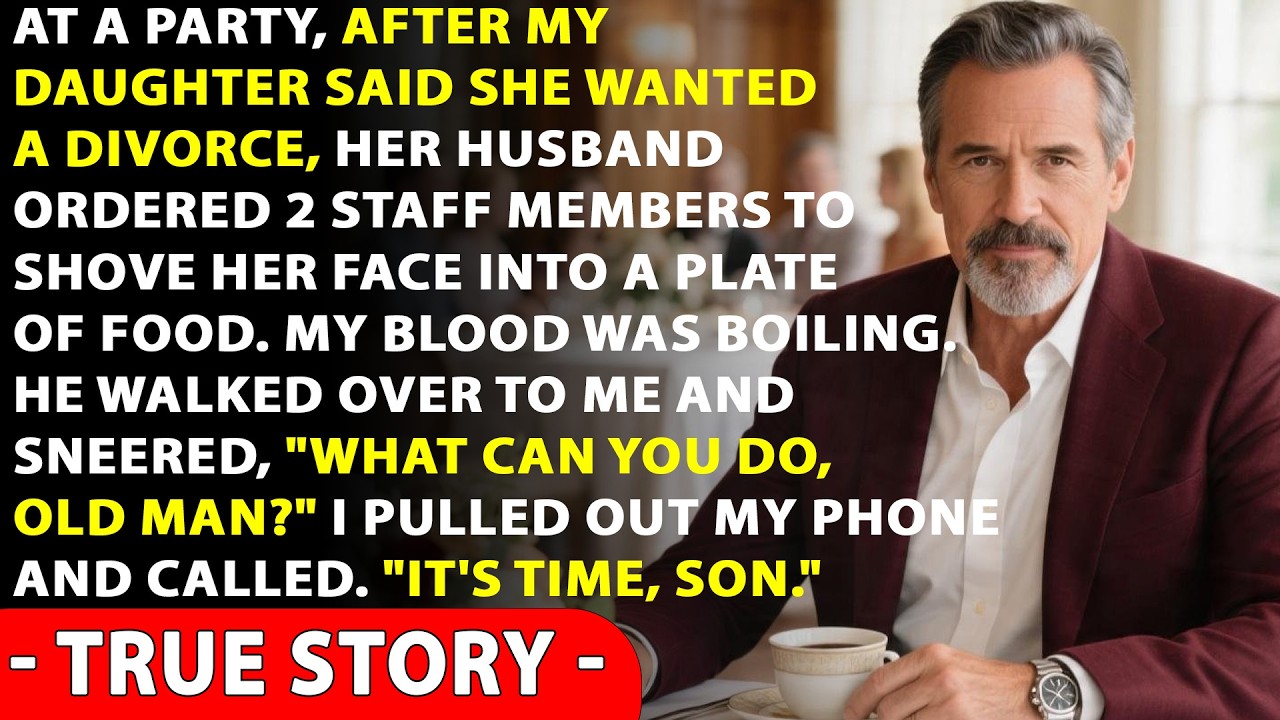
Victor Lawson humiliated my daughter in front of 120 guests at his summer pool party. He ordered two of his men to push her face toward a plate of food. Then he called me a washed-up old man when I stepped in. He had no idea what I’d been carrying for four months.
I built this world. Not the party, not the people, but the name that made it possible. I handed it to Victor Lawson eleven years ago, piece by piece, the way you hand tools to someone you believe in. The night began like all his nights.
Pool lights, string quartet, 120 people in linen and silk. Victor stood near the pool’s edge telling a story to a cluster of investors, his voice carrying just far enough to impress. Clare stood three feet to his left. Pale blue dress.
Dark hair pulled back. Champagne glass held with both hands, fingers wrapped around the stem like she needed something to hold on to. She was smiling. But I had known that smile since she was six.
It was the one she used when she didn’t want anyone to ask how she was doing. “She just needs to remember,” Victor announced, loud enough for the nearby tables, “that this life exists because of me. ”
Clare’s chin lifted. “You don’t see me as your wife anymore, Victor.
You see me as something you own. ”
The terrace went quiet all at once. Victor leaned in and said something low. I couldn’t hear it from where I stood, but I watched her face when she heard it.
Something changed in it. Not fear. Not the careful management she’d been performing all evening. Something older and more final—the expression of a woman who has just reached the last place she is willing to be pushed.
She said four words, loud enough for the nearest ten people to hear. “I want a divorce. ”
The color left Victor’s face. He had spent seven years building a structure that required Clare inside it, and divorce threatened everything he’d been quietly moving.
He gave the smallest nod to two large men near the pool house entrance. I was already moving. But the crowd was thick, and I lost two seconds. Two seconds I could not get back.
His men reached her first. By the time I pushed through, they had stepped back. Clare was straightening up. Food in her hair.
On the collar of her pale blue dress. Her eyes were bright with tears she refused to let fall. She stood straight, chin raised, not crumbling. Victor walked toward me, straightening his jacket.
“What do you think you can do? You’re just a washed-up old man, Robert. ”
My hands were shaking. Every instinct told me to respond.
But I hadn’t spent four months preparing for this night to throw it away in the next thirty seconds. I reached into my jacket. Took out my phone. Found Tyler’s name.
“It’s time, son. ”
Tyler picked up before the first ring finished. “I see you. Maggie’s ready.
Say the word. ”
I looked at Victor, still wearing that cold, satisfied expression. I looked at my daughter—food in her hair, chin up, watching me. “Hold position,” I said.
“Not yet. ”
I ended the call, crossed the cleared space, and put my hand on her shoulder. For the first time in six years, she didn’t pull away. “Come with me,” I said.
She came. We walked past the string quartet, past the catering staff who studied the ground as we moved, down the stone steps to the pool level, where the noise of 120 people suddenly felt very far away. Clare sat at the pool’s edge. Took off her heels.
Sat there without speaking. I sat beside her and said nothing either, because some silences are not empty. Some silences are doing the hardest work there is. Then she turned and looked at me with her mother’s eyes.
“How long have you known? ”
“Four months,” I said. “But to answer that properly, I have to go back further. ”
She pulled her knees to her chest.
“Then tell me. ”
So I did. Four months earlier, a fax came into my office on a Thursday evening. A real estate transfer agreement for a Santa Monica property I’d given Clare as part of her inheritance planning.
The receiving party was a company I’d never heard of. Crest View Holdings LLC. My nephew Tyler, a fraud attorney, traced it that same night. Crest View had been formed three days after Clare’s wedding.
Seventy-two hours after Victor stood at that altar, he filed paperwork in another state to begin dismantling everything his wife would ever own. The transfers were already moving. The Bel Air house where Clare cooked dinner and tended her garden on Sunday mornings. The Santa Monica investments.
And Eleanor’s account—the money her mother set aside in her final year, money she’d specifically designated for her daughter. Victor had drained it to less than fifteen percent in forty-three separate withdrawals. Never more than nine thousand at a time. Always below the threshold that triggers federal reporting.
He planned it, Clare. He researched it. I met her for coffee that week. I asked if she was happy.
She said of course, in the bright, rehearsed voice of someone who has learned that honesty costs too much. When I reached across the table and put my hand on hers, she pulled away before she knew she was doing it, then looked at her own hand like it belonged to someone else. I went to Patricia Holloway—Eleanor’s closest friend, a clinical psychologist. She gave the pattern a name.
Coercive control. It dismantles a person’s ability to trust her own perceptions. “If you show Clare the evidence privately,” Patricia said, “her first instinct will be to defend him. She’s been conditioned to do that.
She needs witnesses—people who see the same reality at the same moment. That’s the only thing that breaks through. ”
Tyler found the forgeries. Four signatures on Crest View transfer documents.
A forensic examiner confirmed they weren’t Clare’s. The notary who certified them, Gary Moss, admitted Victor paid him fifty thousand in cash. Moss also told us Victor had someone inside Whitmore Capital. Dennis Ford.
My CFO for fourteen years. Victor held a file on Dennis’s son—a securities violation that could end the boy’s career. Dennis refused at first. Then Victor sent the documentation, and Dennis cooperated.
But he kept something in his bottom drawer for eight months. Accounting records showing premium payments from Victor’s corporate account. Payments for a life insurance policy. Three million dollars.
Insured party: Clare Anne Whitmore Lawson. Sole beneficiary: Victor Lawson. My hands shook for the first time in thirty-five years. Then Victor’s assistant, Lena Hayes, drove to my office at night.
She’d accidentally heard a call Victor thought he’d ended—a call where he said the “final phase needs to be done before fall” and told someone to make sure Clare suspected nothing. She had the recording. And when Victor called me himself to threaten legal action—”Back off while you still can”—I recorded that too. Two days before the party, Tyler laid out the complete case.
Maggie had the projector, tested three times. Patricia repeated what she’d said about witnesses. Victor had invited me to his party. He thought he was setting the terms.
He had no idea I’d been inside his architecture for four months. When I finished, Clare sat for a long moment with her mother’s eyes on the water. Then she stood. She straightened her dress, wiped her face, and looked up at the terrace where the party was still going.
“Show them,” she said. We walked back up the stone steps together. Tyler was still in position by the event screen. I met his eyes and nodded once.
The projector connected in under ninety seconds. Victor’s voice filled the terrace. Not his public voice—his private voice, flat and efficient, the voice of a man who believes he is completely alone. “The final phase needs to be done before fall.
Make sure all the paperwork is clean. Don’t let Clare suspect anything. ”
Then the documents appeared. Crest View Holdings.
The formation date. The forensic report—side-by-side signatures. The insurance policy. Three million dollars.
Clare’s name. Victor’s name. Sole beneficiary. The terrace went still.
People stood with champagne they were no longer drinking. Victor tried to speak, reached for familiar tools—denial, indignation, appeal. I watched the faces nearest him stop responding the way he expected. Men I’d known for decades stood and walked toward the exit, pulling out phones.
People were calling their attorneys. Victor turned to Senator Harmon. “Jim, you know Robert. Tell them.
”
Senator Harmon set down his water glass and stood. “I have known Robert Whitmore for thirty years. I was introduced to Victor Lawson by Robert seven years ago. Robert opened doors for him that he could not have opened for himself.
” He looked at the room. “I think everyone should look very carefully at their contracts with this man before they leave tonight. ”
Then he sat down and resumed his conversation. Victor stood in the center of the terrace and understood there was nothing left to say.
The performance was over. Without an audience, a performance is just a man standing alone. Security escorted him down the stone path. He didn’t say a word.
Then I crossed the terrace to my daughter. She was shaking. Not from crying—from the effort of holding something enormous inside a body not designed to hold it. I remembered what Patricia had said: don’t try to catch her before she falls.
So I waited. She turned. She looked at me across the cleared space. And for the first time in six years, there was no performance between us.
Just my daughter. She crossed the terrace toward me, the way people walk when they’ve been carrying something heavy for a very long time and have finally been given permission to set it down. “Dad,” she said, her voice breaking. “I need—”
She pressed her hand against her mouth.
Her eyes spilled over. And she stopped fighting. I put my arms around my daughter. She grabbed hold of me with both hands, the way you grab something when you’ve been falling for a long time and have finally found something solid.
She cried against my shoulder in a way I hadn’t heard since her mother died. I held her and said nothing, because there was nothing to say. After a while, she pulled back. Pressed her palms against her eyes.
Straightened her shoulders. And looked at me with her mother’s eyes and something new underneath her exhaustion—something that looked very much like herself. The months that followed were not simple. The Attorney General opened an investigation.
The transfers were declared voidable. Clare’s assets moved back to her name. Gary Moss cooperated fully. Dennis Ford made a voluntary statement; his son was never charged.
On the morning that was confirmed, I got a text from Dennis. It said only: thank you. Lena Hayes left Victor’s company. I made three phone calls, and by the end of the month she had a better offer in Westwood.
Clare began seeing Patricia twice a week. She called me more often. She laughed more easily. In October, she mentioned she’d started carrying a sketchbook again—the small kind she used to fill with quick lines in graduate school, the kind Victor had said was impractical.
I established the Eleanor Whitmore Foundation that year. Legal support and psychological resources for people navigating coercive control. Named for the woman who understood before anyone else that something was wrong, who said so quietly at a kitchen table one night, and who was told she was tired. In December, my phone rang in the late afternoon.
“Did you eat today? ” Clare’s voice was easy, unguarded. Not performing anything. “I was going to order from that Thai place on Colorado.
I thought maybe you’d want something. ”
“Order me whatever you’re having. ”
We talked for forty minutes about nothing that mattered and everything that did. When I hung up, I sat with the last of the afternoon light on the window and thought about a single sheet of fax paper that had come into my office on a Thursday evening in February and started all of this.
I thought about Eleanor at a kitchen table saying, “I don’t like him, Robert. ” I thought about my daughter’s voice just now—easy, unguarded. The voice of someone who had found her way back to something she’d been missing for a long time.