The first thing I was aware of was the ceiling. White acoustic tile, a fluorescent hum. The second thing was that my left arm was not answering. My left leg, the left side of my mouth—all of it felt like it belonged to someone else.
But my mind was clear. That was the part I kept checking, the way a man pats his pockets for his wallet. My mind was completely clear. I could not speak.
When I tried, a shapeless sound came out. A nurse named Clara figured out that I could blink once for yes and twice for no. She was kind, careful, and smart. I would need all three.
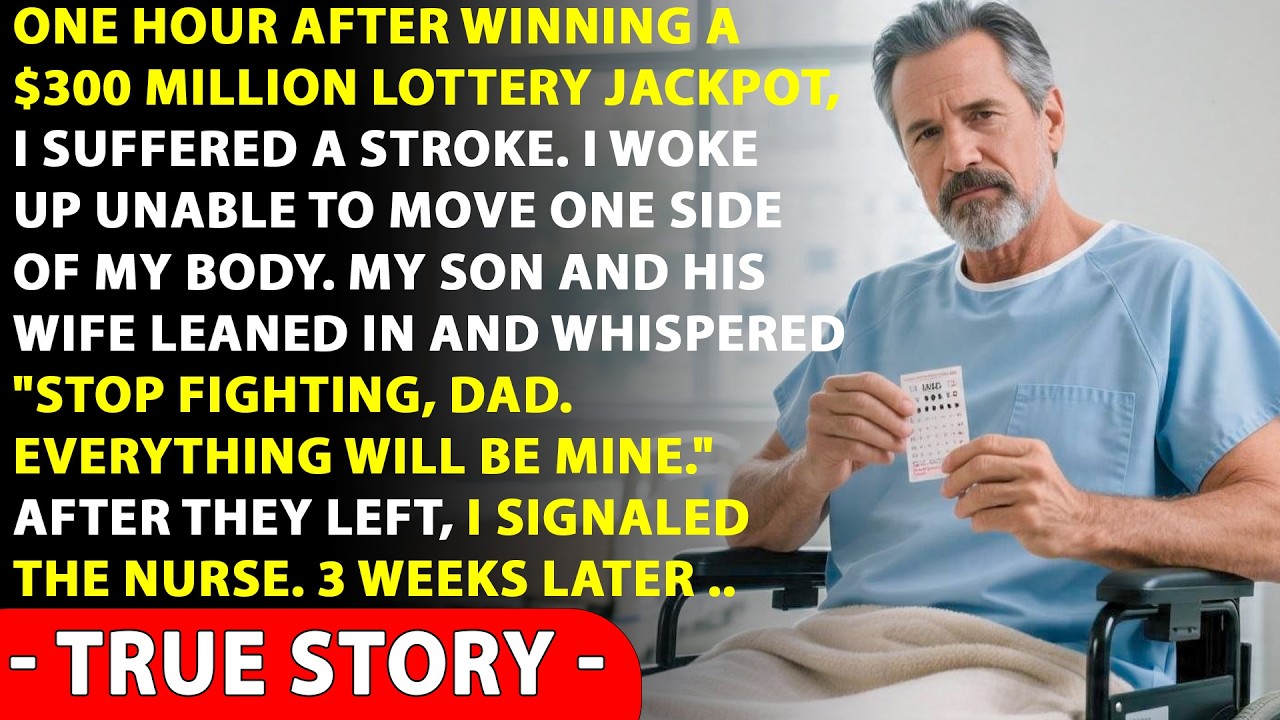
Then my son and his wife arrived. Brandon stood at the foot of the bed, looking at me the way people look at cars that have been in accidents. Victoria’s eyes moved around the room, past the monitor, past the IV line, lingering on the shelf where my belongings sat in a plastic bag. Brandon leaned close to my ear and whispered, “Don’t fight it, Dad.
You’ve lived long enough. Everything will be mine. ”
He straightened. He patted my hand once.
At normal volume, he said, “We’re here for you, Dad. You just rest. ” Then they left. The door clicked shut.
I lay there with the grief rolling through me. Underneath it, something else was forming. Something quiet and deliberate. The way gears align before a watch begins to run.
My name is Arthur Mills. I’m seventy-two. I spent thirty-eight years as a practical watchmaker in Fresno—not the glamorous kind, the kind people come to when their grandfather’s watch has stopped keeping time. My wife Dorothy died of pancreatic cancer eleven years ago.
The house still smelled like her sometimes. Lavender and cedar. I never explained it, and I stopped trying. My pension was $1,140 a month.
After bills, I had maybe $250 left. I sent $400 to my son every month. Brandon was thirty-eight. He lived forty minutes away with his wife Victoria.
He’d tried a food truck, an e-commerce store, a landscaping company. Each one bled money. Each one failed. He blamed the economy, the weather, the permits, the employees.
A father doesn’t point out the pattern. A father answers the phone. The Friday that changed everything started like any other. I bought my regular lottery ticket at Miller’s Corner Store—same six numbers Dorothy had picked twenty years ago.
Her birthday, mine, the year we got married. I checked after lunch. The numbers came up one at a time. All six matched.
$300 million. Before I could tell anyone, the pain arrived at the back of my skull. A pressure so sudden and complete I actually looked at the ceiling, as if something had fallen on me. Then the left side of my body went wrong at once.
I sat down on the floor between the armchair and the coffee table. The ticket was still in my shirt pocket, against my chest. I thought one clear thought: I need to hide this somewhere they’ll never look. Mrs.
Holloway next door heard the thump. She called 911. At the hospital, I learned I was still trapped in a body that wouldn’t obey. But my mind ran cleanly, the way a movement I’d serviced myself runs.
Clara helped me communicate. And after Brandon and Victoria left, after their four words sat in the room like something sour, I pointed at the plastic bag with my belongings. Clara brought it to the bed. In the shirt pocket was the lottery ticket, folded in quarters.
She unfolded it. She read the numbers. Her expression went very quiet. She refolded it without a word and held it in her closed hand.
Then she found my phone and held it where I could see. With her help, I sent a message to Edward Callaway, my oldest friend. Yes. Kitchen shelf.
Yes. Old tin cookie box. Yes. Take it now.
Tell no one. Edward had a spare key to my house. He found the tin box on the shelf above the stove, between the Earl Grey tea bags and the oatmeal canister. Inside were batteries, a spare key, Dorothy’s old grocery list, and the ticket, sealed in plastic.
Edward took it to Sacramento and claimed the prize as my authorized representative. After taxes, it came to roughly $191 million. Eighty-five percent went into two funds. One was a locked trust for my grandson Sam until his twenty-fifth birthday.
The other was a charitable fund for three organizations Dorothy had volunteered with. Fifteen percent stayed for me. Not a dollar in Brandon’s name. Not a dollar in Victoria’s.
While I lay in that hospital bed, my son was making his own plans. He borrowed $15,000 from a lender named Gary Holt. He signed a contract without reading past the first page. He used the money as a down payment on a black Chevrolet Tahoe.
Victoria ordered handbags, boots, luggage, a $940 skin care package. She photographed the handbags and posted them to Facebook with the caption “new chapter. ”
They never once asked Dr. Reed how I was actually doing.
They didn’t need to. In their minds, the ending had already been written. All that remained was the minor detail of a dying old man revealing where he had hidden a piece of paper. They had no idea the paper was already gone.
Dr. Reed agreed to document my recovery accurately but restrict access to it. My health care proxy named Edward Callaway as my sole authorized contact. When Brandon tried to borrow against my house, he learned the property was in an irrevocable trust for Sam.
When he asked about my care costs, Dr. Reed showed him a payment confirmation: all hospital bills and twelve months of continuing care, paid in full by Edward as trustee. Brandon stood in the hallway afterward and made a phone call. I heard Clara describe it later.
The tight voice of a man trying to sound calmer than he was. “Gary, it’s me. We have a problem. ”
On the ninth day, Clara sat down and told me Victoria had brought two men to my house.
They loaded my television, my refrigerator, my kitchen table, and boxes of personal items into a pickup truck. Including the mahogany case that held my pocket watch collection. Forty-seven watches I had restored over four decades. Some of them genuinely rare.
Victoria sold them to a secondhand shop for $800. Edward drove to the shop and bought them back for $3,200. He brought the case to my hospital room and set it on the table without a word. Mrs.
Holloway found Dorothy’s grocery list on the sidewalk, blown out of one of the boxes. She kept it for me. Brandon and Victoria’s twenty-one days ran out on a Thursday morning. Gary Holt came with two men and collected the Tahoe, the handbags, the luggage, the boots.
Victoria’s purchases went out the door in boxes. The remaining balance still wasn’t covered. The apartment locks changed by five o’clock. They were out on the curb with garbage bags.
I heard all of this from Clara. I felt the heavy sorrow of a father watching his son make every wrong choice in exactly the wrong order. Love doesn’t stop just because someone has broken your heart. It just hurts differently.
My grandson Sam came to see me alone. He sat down, took my right hand in both of his, and asked if I was scared. I blinked twice. He said he’d looked up TIA on his phone, and most people recover pretty well if they get help fast.
He’d written a thank-you card to Mrs. Holloway. He just needed a stamp. That nearly broke me open.
By the eighteenth morning, I sat up in bed by myself. By the twenty-first, I spoke clearly enough to say, “Good morning, Clara. ” She walked me to the hospital entrance. She carried the watch case and my bag.
At the door, she looked at me the way she had that first day. “Go home, Mr. Mills,” she said. I went.
The house was stripped. The kitchen table Dorothy and I bought at an estate sale forty years ago was gone. The refrigerator we gave ourselves for our twentieth anniversary was gone. The rooms had the hollow quality of spaces that have been lived in and abandoned.
Brandon and Victoria were in the living room. They didn’t hear me come in. Brandon was saying something about needing two more weeks. Victoria was saying she was done.
Then Brandon saw me, and his phone dropped from his hand and hit the floor with a sharp crack. I stood in the doorway with the watch case in one hand and a cup of coffee in the other. I looked at my son. I looked at my daughter-in-law.
Then I said the only thing there was to say. “I thought you said I’d lived long enough. ”
The silence after that was enormous. Brandon found his voice first.
“Where’s the ticket? Dad, we need to talk about the ticket. ”
I set the newspaper on the counter. The front page showed Edward Callaway standing in front of the California Lottery headquarters in Sacramento.
The caption read, “Fresno man claims $300 million jackpot on behalf of winner. ”
Brandon read it once. Then again. His face went flat.
“That’s Edward,” he said. “Yes. He claimed it three weeks ago. Day five.
”
I told him where the money went. The trust for Sam. The charities in his mother’s memory. The fifteen percent for me.
Brandon said, “That’s our money. ” The words cracked at the edges. “You can’t just give it all away. ”
“It was never yours,” I said.
“And you meant what you said in that hospital room. I heard you. ”
I opened the back door. The November air came in cold and clean.
“I think you should go now. ”
Victoria left first, pulling her rolling suitcase. Brandon stood there a moment longer, looking at the empty shelves, the missing table. Then he walked out.
I changed the locks that afternoon. Brandon came back and sat on the front step in the cold. I gave him one key. “It’s for emergencies,” I said.
“Not an invitation. ” He took it and walked away with his hands in his pockets. That night, a knock came at 11:14. Brandon stood on the step in an old gray canvas jacket from before the businesses failed.
He was not wearing the dark green one. He knelt on the concrete, his hands flat on the step, and cried. “Dad,” he said. “I don’t know what I became.
”
I let him in. Then I picked up my phone and pressed play. For six months, I’d worn a hearing aid with Bluetooth that recorded ambient audio and synced to my phone. The recording was forty-one seconds long.
It began with hospital sounds and ended with Brandon’s voice, calm and clear. “Don’t fight it, Dad. You’ve lived long enough. Everything will be mine.
”
Brandon stood in the kitchen doorway and listened to his own words. The color left his face. He didn’t speak. I set the phone down.
I opened the front door. He walked past me without a word, down the front path, through the gate, and onto the sidewalk. I watched him reach the end of the block. I watched him turn the corner.
Then I closed the door. I stood there with my hand on the knob, listening to the house settle around me. The refrigerator hummed. The oak tree moved in the wind.
Outside, the November night was dark and cold and quiet. I didn’t feel triumphant. I didn’t feel satisfied. I felt something I had not felt in a very long time.
Something quiet and complete and entirely my own. I felt free.