The sound of porcelain shattering against the imported Italian marble was loud, but it was the silence that followed which truly deafened me. A silence so heavy, so suffocating, it felt like the air had been sucked out of the room. Then came the sound that haunts my nightmares. Not a scream, not a cry, but the dry, rhythmic sound of clapping.
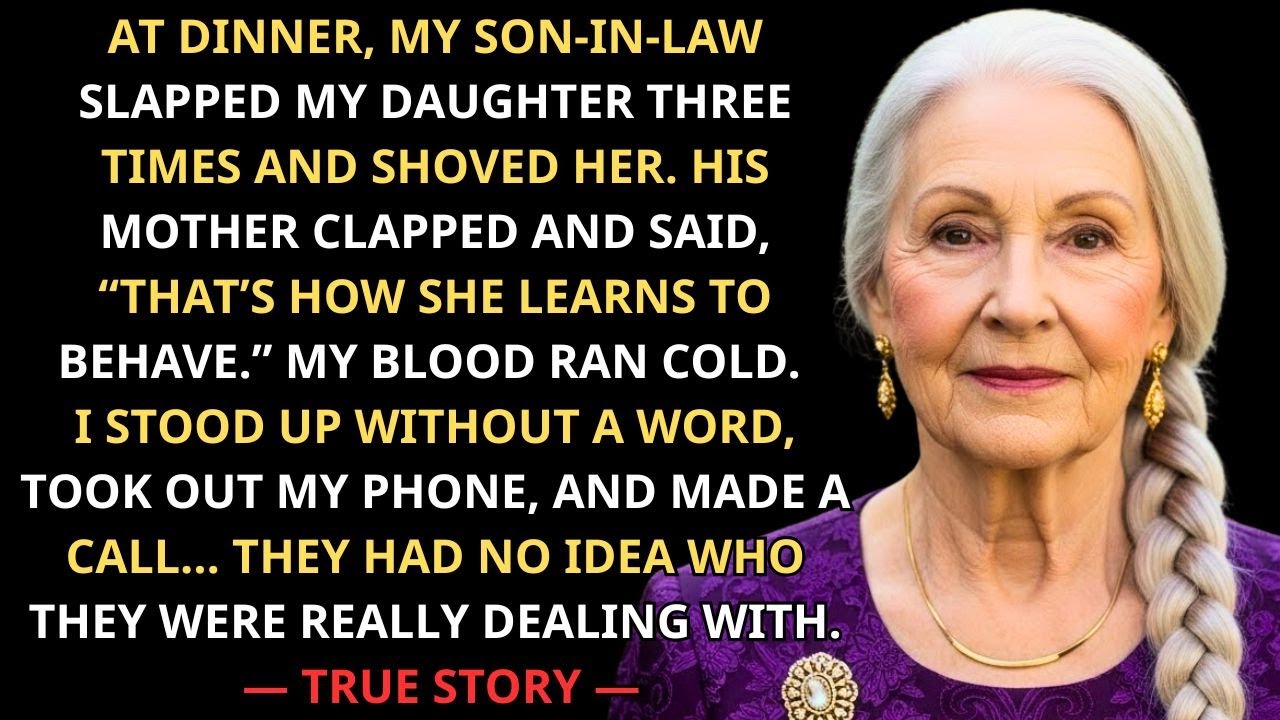
Slow, deliberate applause from the head of the table. “That is how a mother teaches her son,” the woman said, her voice dripping with icy satisfaction. “Discipline is the highest form of love, Julian. She will thank you for it later.
”
My name is Evelyn Sterling. I am 60 years old. For 35 of those years, I have been a shark in the courtroom, a senior partner at one of San Francisco’s most prestigious litigation firms. I have destroyed corporate monopolies, negotiated billion-dollar settlements, and looked into the eyes of cold-blooded killers without blinking.
But nothing in my three decades of legal warfare prepared me for the sight of my only daughter, Claire, crumpled on the floor of a dining room in Pacific Heights, a red handprint blooming on her cheek, while her husband stood over her and his mother applauded. The date was November 12th, the third anniversary of my husband Marcus’s passing. Claire, my brilliant, artistic Claire, had insisted I not spend the evening alone. “Come over, Mom.
Julian is having his mother over. We’ll make Dad’s favorite roast. It will be nice. ”
It was never nice at the Thorn residence.
Julian Thorn was 31, a venture capitalist with a smile that could charm the skin off a snake and eyes that never quite warmed up. Behind him always loomed Victoria Thorn, a relic of old San Francisco money, a woman who wore her widowhood like a crown and treated people like chess pieces. The table was set with military precision. Crystal glasses aligned perfectly, silverware polished to a mirror shine.
Claire was in the kitchen wearing a long-sleeved turtleneck, unusual for the warm heating. She looked diminished. That is the only word for it. My daughter, who used to fill a room with her laughter and her blueprints, now seemed to occupy less space, moving with a hesitation that set my nerves on edge.
“You look tired, darling. ” I reached out to touch her arm. She flinched. It was microscopic, a reflex she tried to hide instantly.
“Just work, Mom,” she whispered. “The new project is demanding. Julian likes things to be perfect. ”
The conversation at dinner was a minefield.
Victoria spent the first course dissecting Claire’s appearance, her hosting skills, her choice of napkins. “This roast is a bit dry, don’t you think, Julian? One would think that with all the time Claire spends at home now that she’s stepped back from the firm, she could master a simple oven temperature. ”
Claire swallowed the criticism, her hand trembling as she reached for her water glass.
“I’m sorry, Victoria. I’ll do better next time. ”
Julian didn’t look at her. He swirled his red wine.
“You know how mother likes it, Claire. It’s about attention to detail. ”
I tried to steer the conversation to neutral ground, but Victoria cut me off with a wave of her diamond-clad hand. “Women who work too much often lose touch with their true purpose, Evelyn.
Perhaps that is why Claire struggles. She didn’t have a model of domestic submission growing up. ”
I gripped my fork until my knuckles turned white. “My husband and I raised a brilliant, independent woman, Victoria.
We didn’t raise a servant. ”
Then it happened. Claire, sensing the impending explosion, tried to pour more wine into Julian’s glass to distract him. Her hand slipped.
A splash of red wine, no larger than a coin, landed on the pristine white tablecloth. The world stopped. Julian slowly placed his napkin on the table. He looked at the stain, then at Claire.
The look wasn’t angry. It was disappointed, the way one looks at a dog that has soiled the carpet. “You are clumsy. ”
“I am so sorry.
I’ll get it out. Club soda will—”
She never finished the sentence. Julian stood up. The motion was fluid, practiced.
He didn’t wind up. He just swung. The back of his hand connected with Claire’s cheek with a sickening crack. The force threw her out of her chair and onto the marble floor.
I sat frozen for exactly three seconds. In those three seconds, my brain processed 35 years of legal precedents, criminal statutes, and the agonizing realization that I had missed the signs. Then I heard the applause. Victoria was clapping, lightly, politely, as if she had just witnessed a successful piano recital.
“That is how she learns. ”
The freeze response broke. I stood up, pulled my phone from my clutch, and hit speed dial for Deputy Chief Harrison, a man whose career I had saved years ago and who owed me everything. “What are you doing?
” Julian asked, wiping his hand with a napkin. “I am calling the police. ”
“You wouldn’t dare. ” Victoria scoffed.
“This is a family matter. Do not embarrass yourself, Evelyn. ”
“This is Evelyn Sterling,” I said into the phone, maintaining eye contact with the monster who had just struck my daughter. “I am at 2400 Broadway.
Domestic violence in progress. Assailant is on the premises. Victim is injured. I am a witness.
”
Julian laughed, a dry, arrogant sound. “You think the police will touch me? Do you know who I am? Do you know who my investors are?
”
“I know exactly who you are, Julian. You are a felon, and I am going to make sure you never see the outside of a prison cell again. ”
The police arrived in eight minutes. In that time, Julian poured himself another drink, and Victoria tried to explain to me that I was overreacting, that men need to assert dominance, that her husband Arthur used to do the same and she was better for it.
Every word she spoke was a nail in her own coffin, and she was too arrogant to realize I had already started the recording app on my phone. They handcuffed him. As they led him out, he looked at Claire. “You are making a mistake, Claire.
You are nothing without me. ”
And Victoria, standing by the fireplace, hissed at me. “You have declared war, Evelyn. You have no idea the forces you have just unleashed.
”
I looked at her, holding my trembling daughter in my arms. “I am the war, Victoria. ”
I took Claire back to my house in Noe Valley. She was 29 years old, but that night she looked like a child again, broken and small.
I sat by her bed and replayed the last three years in my mind. The warning signs were there, flashing like neon I had chosen to ignore. The way Julian would subtly critique her outfit before they went out. The way Claire stopped seeing her college friends.
The way she constantly checked her phone, terrified of missing a call from him. We call it coercive control in the legal world. It is a slow poison, colorless and odorless, until it kills you. The war Victoria promised began the next morning.
My firm received a formal complaint filed against me for unethical conduct. Julian’s lawyers filed for an emergency hearing claiming Claire was mentally unstable. Within 48 hours, rumors were swirling. People whispered that Claire had been drinking heavily, that she had been self-harming, that poor Julian had been trying to get her help.
Claire sat at my kitchen island three days later, looking at her phone. “They’re destroying me, Mom. Look at this. ” She showed me a post from a former bridesmaid about standing by friends who are falsely accused and the danger of vindictive women.
“It’s gaslighting on a massive scale. They want you to break. They want you to recant. ”
“Maybe I should.
Maybe I did provoke him. I spilled the wine. I knew how much he hated stains. I knew he was stressed about the IPO.
”
I grabbed her shoulders. “Claire Sterling, look at me. Spilling wine is an accident. Hitting your wife is a crime.
There is no universe where you are responsible for his violence. ”
“But you don’t understand, Mom. He loves me. His father was tough on him.
”
His father. That was the thread I needed to pull. I spent the next week doing what I do best. I investigated.
While Julian was out on bail, paid for by Victoria within an hour of his arrest, I dug into the Thorne family history. The official story on Arthur Thorne was a tragic fall, a drunken stumble over the railing of the penthouse. But wealthy men don’t just fall off balconies without someone noticing. I tracked down the staff who worked for the Thornes twenty years ago.
Most were dead or had moved back to their home countries. But there was one name: Maria Gonzalez, the live-in nurse for Arthur Thorne in his final months. I found Maria in a small retirement community in Daly City. The fear in her eyes when I mentioned the name Thorne was palpable.
“Mrs. Thorne is a powerful woman. She told me if I ever spoke about that night, she would ensure my son lost his scholarship. My son is a doctor now.
I cannot risk his career. ”
I placed a photo of Claire on the table, the bruise clearly visible. “This is my daughter. She is living with the son of the woman you fear.
If we don’t stop them, he is going to kill her. Just like she killed Arthur. ”
It was a gamble, a wild, desperate accusation. But Maria’s face crumbled.
“She didn’t push him,” Maria whispered. “Not with her hands. But she drove him to it. He was frail, used a cane.
She was screaming at him, telling him he was weak, pathetic. He backed away. The railing was loose. She knew it was loose.
She had fired the contractor who was supposed to fix it. She watched him lean back. She watched him fall, and she didn’t call 911 for 20 minutes. She sat there and finished her drink.
”
“And Julian? Where was Julian? ”
“He was 10 years old. He was hiding behind the curtains.
He saw everything. When the police came, Victoria took him aside and told him exactly what to say. She told him Daddy was drunk and clumsy, that they had to be strong. She turned that boy into a vault.
She taught him that empathy was weakness and eliminating problems was strength. ”
I had the ammunition. Now I needed the warhead. Back home, things were escalating.
Julian had started violating the restraining order in subtle ways: deliveries of flowers with no card, cars parked down the street that drove away when we looked, emails to Claire’s work address saying “I forgive you. ” Claire was fraying. She wasn’t sleeping. She paced the hallways at night.
“He’s going to win, Mom. Everyone believes him. His lawyers found out I went to therapy in college after Dad died. They’re twisting my grief into madness.
”
Then came the night that changed everything. Three weeks after the dinner. I was late coming back from the office, preparing the affidavit for Maria. I had left Claire with a security guard, a burly ex-cop named Miller.
When I turned onto my street, I saw police lights. I abandoned my car in the middle of the road and ran. The front door of my house was smashed open. Inside, it looked like a hurricane had passed through.
Miller was sitting on the steps, bleeding from a head wound. “Where is she? Where is my daughter? ”
I ran through the kitchen, stepping over broken glass.
In the garden, under the relentless rain, I found them. Julian had broken in, bypassed the alarm, and blindsided Miller. He had Claire cornered against the old oak tree Marcus had planted. He was soaking wet, his expensive suit ruined, his eyes wild.
He held a landscaping brick in his hand. “You are ruining everything! ” he screamed. “We were perfect!
We were the power couple! Why can’t you just behave? ”
Claire was shaking, but she wasn’t cowering. “Because I am not your property, Julian!
I am not an object you can polish and break whenever you feel like it. ”
“I love you! ” he roared, raising the brick. “That isn’t love!
”
I stepped into the garden, my voice booming with every ounce of courtroom authority I possessed. “That is possession, and it is over. ”
Julian spun around. “You poisoned her against me.
My mother was right. You are the cancer. ”
“Drop the brick, Julian. The police are already here.
”
Red and blue lights were washing over the garden fences. Officers were swarming the perimeter, guns drawn. Julian looked at the police, then at Claire, then at me. For a second, I saw the scared 10-year-old boy hiding behind the curtains.
Then I saw the monster Victoria had cultivated. He dropped the brick, not in surrender, but in disgust. “This is all a misunderstanding. My wife is hysterical.
I was just trying to calm her down. ”
Officer Martinez tackled him before he could finish the sentence. The aftermath broke the dam. The violation of the restraining order, the assault on a security guard, the attempted assault on Claire—it was too much even for Victoria’s money to bury.
Julian was held without bail. Two days later, I went to visit Victoria Thorne. She was sitting in her drawing room, drinking tea, pretending her world wasn’t collapsing. “Get out of my house.
”
I placed a file on the table. It contained Maria’s sworn affidavit, the maintenance records for the balcony railings from twenty years ago, and the recording of Victoria applauding while her son beat my daughter. “You have two choices, Victoria. One, you liquidate Julian’s assets to pay for a settlement that will ensure Claire never has to work again unless she wants to.
You step down from the charity boards and plead no contest to obstruction of justice. Or two, we go to trial. I will put Maria on the stand. I will reopen the investigation into Arthur’s death, and I will play the recording of you clapping for an abuser on every news station in the country.
”
She looked at me with pure, undiluted hatred. “You are a vulgar woman. ”
“And you,” I replied, “are a mother who sacrificed her son’s soul to feed her own ego. You created a monster because you were too weak to love a human being.
”
She signed the settlement. Julian was sentenced to eight years in prison for aggravated assault, burglary, and battery. Victoria retreated from society, a pariah in the golden cage she had built. But the real ending isn’t a legal victory.
It’s what happened last week, two years later. I was sitting in my garden reading a book. The oak tree where Julian had cornered Claire was blooming with new leaves. Claire walked out carrying a tray of lemonade.
She looks different now. Her hair is cut short, a messy bob that suits her. She wears paint-stained overalls. She opened her own small architecture studio focusing on sustainable housing for low-income families.
She smiles with her whole face now. She sat down beside me and took my hand. “Mom. I got a letter from him, from prison.
”
“Did you read it? ”
She nodded. “He says he’s sorry. He says he’s taking anger management classes.
He says he realizes now that his mother warped him. ”
“And how do you feel? ”
“I feel nothing. For a long time, I hated him.
Then I feared him. But now, I just feel pity. He’s a tragedy. But I am not.
I am a survivor. ” She squeezed my hand. “You saved me, Mom. You fought when I couldn’t.
”
“No, my darling. I just reminded you of who you were. You saved yourself the moment you stood up in that rain and told him no. ”
We sat there in silence, listening to the birds.
I realized something profound. We spend so much time teaching our daughters to be polite, to be accommodating, to keep the peace. We forget to teach them that their voice is a weapon and their dignity is a fortress. Silence is the accomplice of violence.
When we hear the glass shatter, we must not look away. We must speak. We must act. Because sometimes the difference between a tragedy and a survival story is just one person refusing to be quiet.
I still practice law. But now I specialize in helping women find the exit door before the house burns down. Because the strongest force in the universe isn’t a court order or a bank account. It is a mother watching over her child, ready to burn the world down to keep her safe.
Sometimes love doesn’t look like a hug. Sometimes love looks like a witness stand, a recording device, and the absolute refusal to back down. And sometimes it looks like a mother in a garden, holding her daughter’s hand, knowing the war is finally over.