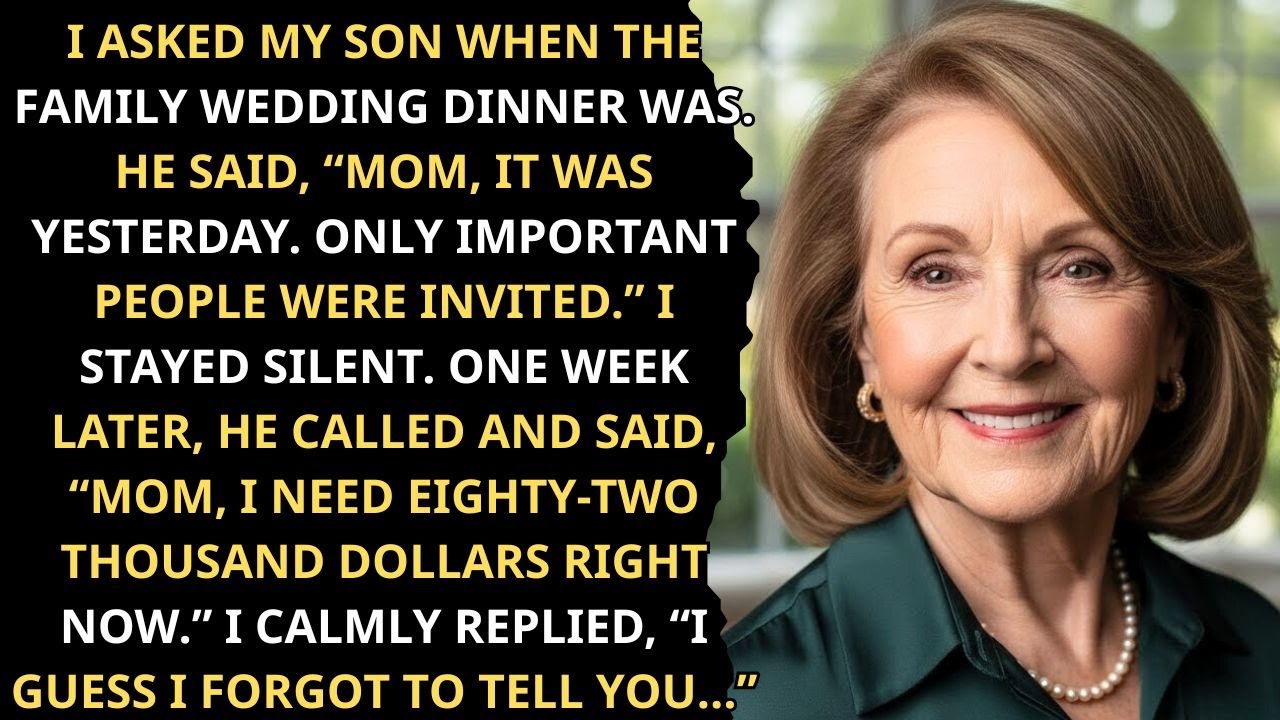
At five in the morning, while fog strangled San Francisco in a thick white shroud, Eleanor Vance’s phone rang. Her son Julian’s voice came through the line, bright and casual, telling her he had married Saraphina Holloway the previous afternoon at a private vineyard in Napa Valley. The words hit her like a physical blow. She stood frozen in her Nob Hill kitchen, a cold mug of tea in her hand.
On the refrigerator, a date was circled three months out—a date Julian had sworn was still being finalized. The lilac lace dress she had bought for that phantom day hung in her closet, two weeks of pension money spent to look like she belonged in his new world. Four decades as head archival researcher at the Legion of Honor had taught her to find truth buried under layers of dust and deception, but nothing had prepared her for the clinical coldness of her own son. Julian explained the logistics of her erasure.
The Holloways had a vision for their event, something they called social equilibrium. His mother, with her practical shoes and her stories of museum basements, didn’t fit the brand they were cultivating. He had been worthy enough to inherit her marrow, but she was not worthy enough to stand in the sun as his mother. He described her exclusion as a strategic decision, not a betrayal.
As if she were a piece of equipment incompatible with a new operating system. Then his voice shifted, taking on a desperate edge Eleanor recognized from his childhood—the sound of a boy who had broken a window and needed someone else to sweep up the glass. There was a complication. The Holloways’ offshore accounts were frozen during a routine compliance audit.
The venue and caterer were demanding $82,000 by noon. Julian asked his mother to wire the money from her retirement fund. He promised it was a bridge loan, repaid with interest the moment the audit cleared. The amount was almost exactly what she had left in her supplemental savings.
The nest egg she had built through forty years of skipping vacations and repairing her own shoes. Eleanor sat at the scarred oak table, the wood worn by years of Julian’s homework and her own exhaustion. She remembered the winters spent in the same thin wool coat, worn down to the weave, so Julian could have the latest laptop for university. The nights she had spent scrubbing grease off vents at a diner near the shipyards, the rancid oil clinging to her skin like a second identity.
All of it had been for him, for the boy who had once promised to build her a castle. Now he was asking her to dismantle her own foundation so he could maintain the illusion of belonging to a family that wouldn’t even invite her to lunch. She didn’t wire the money. Instead, she opened the private databases she had access to through years of professional networking, her fingers moving with lethal precision.
If the Holloways were as wealthy as Julian claimed, why was a world-class vineyard threatening to call the police over a bill the price of a mid-range luxury car? She cross-referenced court filings, property records, and business registrations. She found a landscape of ruins. Shell companies that existed only to shuffle debt.
A long list of litigation from vendors and former associates who had been left holding the bag. The estate was in quiet foreclosure. The private jet Julian had bragged about was a shared fractional ownership that hadn’t been paid for in six months. The Holloways weren’t pillars of society.
They were grifters, professionals who used the appearance of wealth to lure in their next line of credit. Julian was their latest meal, groomed to be a bridge to fresh capital. The $82,000 wasn’t for a wedding bill. It was to keep the lights on for one more day.
Julian called again at ten, his voice high-pitched and frayed. Saraphina was in tears. Genevieve was looking at him with disappointment that felt like an execution. He called his mother selfish, accused her of clinging to her money out of spite.
He reminded her that he was her only child, her only legacy. Eleanor listened to the venom. And she felt something inside her snap—not a loud break, but the quiet click of a lock turning. The archives were closed.
The story of Julian Vance was no longer worth preserving. She told him she would meet him and the Holloways for lunch at the Gilded Leaf in the financial district. She dressed with meticulous care, preparing for battle. The lilac lace dress.
Vintage pearls her grandmother had left her. When she arrived, Julian was already there with the Holloways, who looked like a portrait of refined elegance until you looked closely enough to see the cracks in the glaze. Genevieve greeted her with a pitying smile that didn’t reach her eyes. Allaric spoke of global finance with practiced ease.
Genevieve lamented the decline of professional courtesy. Julian sat between them like a loyal lieutenant, nodding at every word, his eyes flicking to his mother’s purse. Eleanor let them perform. Then she reached into her bag and pulled out a manila folder, setting it on the white tablecloth.
Inside were the tax liens. The foreclosure notices. The unpaid vendor claims that trailed behind the Holloway name like the scent of rot. She began to read from them, her voice clear and unhurried, cutting through the polite murmur of the restaurant like a bell.
She watched the color drain from Allaric’s face. Genevieve’s eyes went hard and cold. Julian stared at the papers as if they were written in a language he didn’t understand. Allaric blustered, claimed the documents were forged.
Genevieve turned to Julian and demanded he silence his mother. The aristocratic mask had slipped into the desperate snarl of a cornered animal. Julian turned on Eleanor with a fury that made nearby tables go quiet. He called her a bitter old woman, a relic.
He told her he would never speak to her again if she didn’t pay the bill and apologize. Eleanor stood. Her lilac dress rustled in the silence. She told him she was done paying for his life.
If he wanted to live in a house of cards, he would have to learn to keep it upright himself. She had spent forty years building a life out of grit and honesty, and she would not let him turn her survival into currency for his vanity. She left the folder on the table and walked out into the sunlight, without looking back. The weeks that followed were a period of quiet redefinition.
Julian didn’t call. Eleanor didn’t reach out. The silence between them was the most honest conversation they had ever had. She spent her days at the museum as a visitor, sitting in the galleries and studying paintings she had walked past for decades, noticing details she had been too tired to see.
She was learning the difference between a masterpiece and a forgery. She traveled. Kyoto in the spring, cherry blossoms falling like snow. Florence in the autumn, the corridors of the Uffizi.
A small cabin on the coast of Maine in winter, where the air was so cold it hurt to breathe, and the waves crashed against the rocks like a cleansing fire. She forgave herself. Not as a way back to Julian, but as a mercy for her own life. She forgave the woman who had scrubbed grease so her son could have the latest laptop.
She forgave the mother who had believed love was a transaction where sacrifice was the only currency. Worthiness, she realized, was not a status granted by others. It was a quiet, unshakable understanding that her value was inherent, independent of the utility she provided to those too blind to see her. A year later, Julian appeared at her door.
The marriage had crumbled under the weight of the debt he had been forced to shoulder. He was working as a junior clerk at a firm that didn’t care about his aesthetic. He asked to come in, to sit at the oak table, to find the mother he had discarded. Eleanor stood in the doorway with a kindness that was also a boundary.
She told him she loved the boy he used to be, but she didn’t know the man he had become. He would have to find his own way back to the truth before he could find his way back into her house. For a fleeting moment, she saw the boy who had promised her a castle. But the man before her was still looking for someone else to pay for the stones.
She closed the door. She began volunteering at a local literacy center, teaching adults to read and write. She found a community of people who valued her for her mind, for her stories of the museum, for the history she carried. Not for what she could provide.
Not for how she fit into someone else’s vision of social equilibrium. One evening, she sat in her garden, roses in bloom, and opened a volume of poetry she had always loved. She read a verse about the sea, about the way it doesn’t apologize for its tide. She closed her eyes and listened to her own breath, steady and honest, owing nothing to anyone.
The legacy of the Vances would not be emeralds or high society marriages. It would be the quiet, fierce strength of a woman who chose her own survival over a beautiful lie. The fog had cleared. The bridge rose sharp against the evening sky.
And the rest of her life was hers to write.