The crystal flutes clinked like shattering ice. Downstairs, Beatrice Thorne laughed, and then she said the words that turned my blood to slush. The sun-drenched room I occupied was needed for a new executive home office, and at 82 I was little more than a piece of antique furniture that no longer fit the minimalist aesthetic of their social-climbing lives. She didn’t whisper.
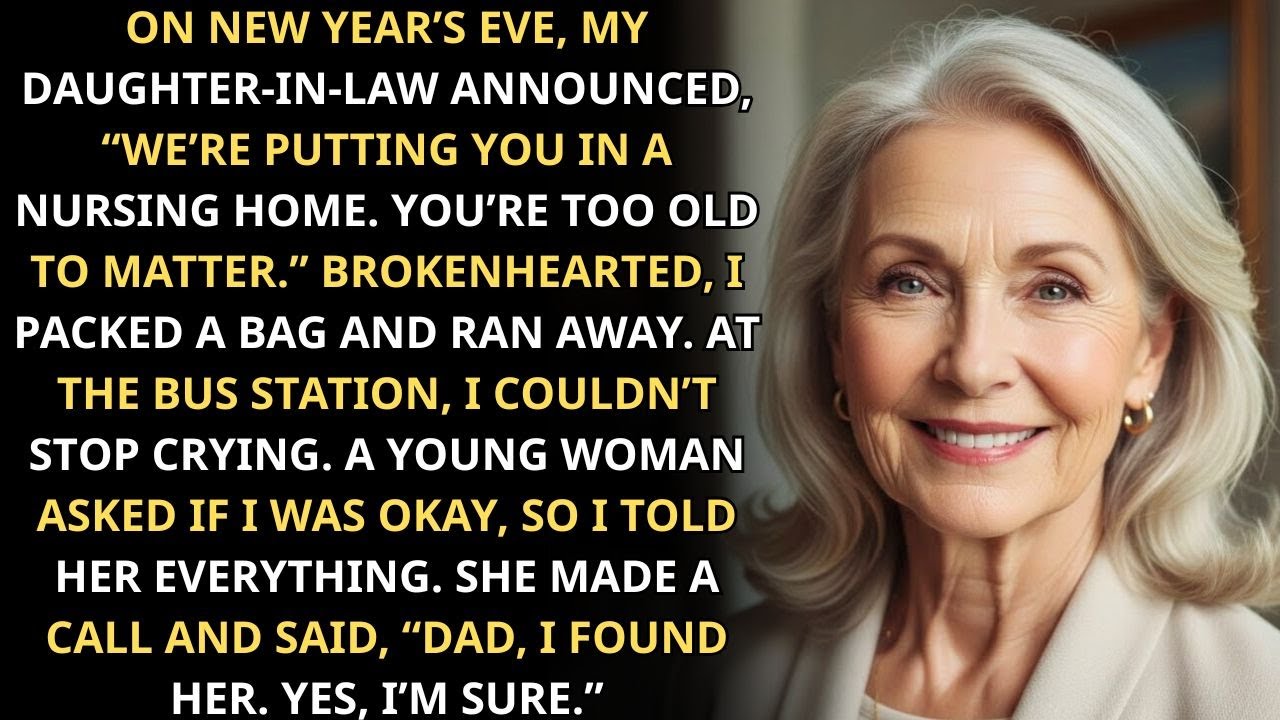
She didn’t care if the woman who cooked her meals, laundered her silk blouses, and raised her two sons was listening from the shadows. She said the paperwork for Shady Pines was already processed, and that my presence at their New Year’s Eve gala would be an unnecessary complication. My son Julian stood beside her, swirling his amber drink. He didn’t defend me.
He didn’t remind her of the years of care, the sacrifices, the work I had done so he never felt the cold bite of poverty after his father died. He just nodded and muttered that I’d be happier among people of my own vintage, as if I were a bottle of wine being sent to a forgotten cellar because the label had begun to peel. I retreated to my room. I pulled a tattered floral suitcase from under the bed, its leather cracked like the skin on my own hands, and packed the fragments of a century into its hollow belly.
My name is Evelyn Thorne. For 42 years I was the pulse of Oak Creek Public Library and the guardian of a thousand stories. Yet here I was, being edited out of my own family’s narrative like a typo on a page. The move to Emerald Heights had been framed as an act of love.
Julian convinced me to sell my sun-drenched cottage, arguing the stairs were dangerous for my brittle bones, the garden too much work. He promised me a suite, a place of honor, a role as matriarch. But once the check from the sale cleared and vanished into the down payment on this cold monument to his ego, the walls closed in. Beatrice replaced my sturdy oak furniture with sharp-edged pieces that offered no comfort.
She donated my library to a thrift store, claiming the dust was bad for the boys. She relegated my meals to the kitchen island while they dined in the formal room, saying the adult conversation would be too fast-paced for me. I let myself be diminished inch by inch, believing the price of proximity to my grandchildren was the slow erasure of my own identity. That night, I didn’t leave a long, weeping letter.
I wrote three searing sentences on cream stationery. I told them I was not furniture to be moved when the décor changed. I told them I was taking back what remained of my life. And I told them not to look for me, because they would never find the woman they had tried so hard to break.
I stepped out the service entrance into the cold December air. The bus station was three miles away through silent, sleeping suburbs. My doctor would have said the walk was impossible for my aging hips. But rage is a powerful lubricant for old joints.
The station was all neon and desperation. I sat on a hard blue plastic bench, the vibration of idling engines thrumming through my boots, and watched the digital clock count down to the 11:15 bus to Willow Creek. It was a small, forgotten patch of land my parents had left me in their will, a cabin on the edge of a lake so still it mirrored winter stars. Julian and Beatrice didn’t know I still held the deed.
The initial rush of adrenaline began to fade. I thought of my grandsons, who had slowly stopped visiting because their mother told them I needed rest. I thought of the birthdays where my thoughtful gifts were tucked into back closets because they didn’t fit the aesthetic of a modern childhood. A sob escaped me, then another.
I wept for the woman who had spent her life building bridges for others, only to find herself stranded on a crumbling, lonely island. A voice broke through: “Are you okay? ”
I looked up through tears to see a young woman in a dark blue medical coat, her hair pulled back in a tight bun, her eyes full of genuine concern. I tried to say I was fine, just waiting for my bus.
She didn’t walk away. She sat down beside me and said, “My name is Elena. I just finished a double shift at the city hospital. I’ve seen that look on many faces.
It’s the look of someone who has been carrying the weight of the world and just realized the world isn’t carrying them back. ”
I don’t know why I did it. Perhaps it was the fluorescent light, or the bone-deep exhaustion. But the story spilled out of me in a torrent.
I told her about the library, about Julian’s childhood, about the marble floors I had scrubbed until they shone, about the champagne toast that had been my social execution. I told her I was going to a falling-apart cabin with nothing but $3,000 hidden inside a hollowed-out copy of Great Expectations and a heart that felt like it had been put through a meat grinder. Elena listened without empty platitudes. She held my hand, warm and vital against my cold papery fingers.
When I finished, she walked a few yards away and made a quick, hushed phone call. My heart hammered. Was she calling the police? Calling Julian to report a wandering old woman?
But she came back before I could even pick up my suitcase. “Please don’t be afraid,” she said. “I just called my father. He’s been looking for a specific woman for a very long time.
I think you’re the person who saved his life forty years ago. ”
I stared at her, confused. When I told her I had taught at Old Mill Elementary before moving to the library, she had frozen. Her father, she explained, was a boy everyone had written off, until one teacher saw the brilliance beneath the hunger and the holes in his shoes.
A black SUV pulled up to the curb. A tall man with silver hair stepped out. His face bore the lines of a man who had worked hard for every ounce of his success, but his eyes were unmistakable. They were the eyes of a seven-year-old boy named Marcus Sterling.
The boy who sat in the back of my classroom, drawing intricate diagrams of machines he wanted to build. The boy who arrived every winter morning without a coat, his shoes held together with gray duct tape. He walked toward me with pure reverence, then dropped to one knee on the dirty, gum-stained linoleum. “Mrs.
Thorne. I have spent twenty years trying to find you. You bought me a blue Parker pen in the winter of 1984. You told me my mind was a kingdom no one could take away.
You gave me the books that taught me how to become an engineer. And you never told anyone. You let me believe in magic. ”
I couldn’t speak.
He saw my suitcase, my tear-stained face, and didn’t ask what had happened. Elena had already told him. “You are not going to a bus station,” he said, his jaw tightening. “You are never going to be alone or discarded again.
You’re coming with us. ”
I tried to protest, the old habit of not wanting to be a burden rising up. But Marcus wouldn’t hear it. He told me about the Sterling Foundation, a charity for underprivileged students, all named in my honor.
He told me his home had a guest cottage waiting, filled with light and books. And as we drove away from the neon glow, he asked about the house I had sold, the bank accounts Julian managed, the way I had been treated. His professional calm sharpened into something formidable. “Mrs.
Thorne, what they did isn’t just a family dispute. It’s systemic predatory abuse. They coerced you into selling your assets, isolated you from support, and tried to institutionalize you without consent to seize your resources. This is not how your story ends.
This is where we start the rewrite. ”
The Sterling estate was nothing like the Thorne house. Marcus’s wife Clare hugged me at two in the morning, smelling of lavender, and served me hot tea and homemade soup. They didn’t put me in a back room.
They sat me at a large wooden table and listened to every word as if my stories mattered. I realized then that Beatrice had spent years gaslighting me into believing I was senile. Here, my presence was a blessing, not a burden. The next morning, Marcus made the call.
I sat in a comfortable armchair, my heart racing, while he placed Julian on speaker. He didn’t shout. He simply stated facts. He represented me now.
A full forensic audit of the sale of my home was being initiated. Any attempt to contact me or proceed with the nursing home placement would be met with a restraining order and a lawsuit for elder financial abuse and psychological coercion. Julian’s voice crackled through the phone, frantic. “Who is this?
You can’t just take my mother. This is a family matter. ”
Marcus smiled a cold, sharp smile. “I’m the boy she saved when you were too busy being a child of privilege to notice her sacrifice.
And I’m the man who is going to make sure she gets back every cent, every book, and every ounce of dignity you stole from her. ”
The long silence on the other end was the most satisfying sound I had heard in twenty years. Over the next few months, investigators uncovered a trail of betrayal deeper than I had imagined. Beatrice had systematically siphoned my social security checks into a private account.
She had forged my signature on a power of attorney document while I was recovering from the flu. Marcus’s team recovered nearly $400,000, and I used it to restore the cabin at Willow Creek. We turned it into a sanctuary, a small sturdy house with a wide porch overlooking the shimmering water and a library open to every child in the village. I became the woman I was always meant to be.
An elder. A storyteller. A woman who knew her worth to the penny. The most difficult day came six months later, when Julian arrived at my door.
He looked ten years older. His expensive suit was wrinkled, his arrogance drained. Beatrice had left him the moment the money stopped and the scandal touched their elite social circles. He sat on my porch and stared at the lake for a long time.
Finally he whispered, “Mom. I honestly didn’t know how bad it was. ”
I looked at him and felt no maternal urge to rush over and make it better. I felt a quiet sadness for the man who had traded his mother’s soul for a marble floor.
“You did know, Julian,” I said, my voice firm. “You knew every time you watched me eat a cold sandwich alone while you hosted parties. You knew every time you let her speak to me as if I were a ghost. You didn’t lose your way.
You chose a path that didn’t include me as a human being, only as a resource to be exploited. ”
He wept then, bitter and honest, the way he hadn’t since he was a small boy who fell off his bicycle. I didn’t kick him out. I didn’t invite him to move in.
We are rebuilding now, slowly, painfully, on a foundation of truth instead of convenient obligation. He comes every Sunday now. He helps me in the garden, and we sit on the porch and talk. Last week he told me he finally understood why I loved the library.
It wasn’t just the books. It was the belief that every person’s story matters. I saw a glimmer of the boy he used to be before the world told him success was measured in marble and glass. There is hope for him yet, just as there was hope for me.
The road to Willow Creek was long and paved with more tears than I ever thought I could cry. But it led me home. Home is not a place you’re put into. It’s a place you build with the people who truly see you.
I stand in my garden now, as the sun sets over the mirrored water, and I feel no anger. Anger is too heavy for an old woman to carry. I am Evelyn Thorne. I am no longer a ghost haunting the hallways of a house that didn’t want me.
I am the architect of my own ending. And it is a masterpiece of resilience and quiet justice.