Isabella heard the crack first. Not of ice—this was Savannah, thick summer air clinging to her skin—but of her husband’s voice through the glass doors, casual as a blade. “Let’s be realistic. She’s hit her ceiling, and I’m just beginning to touch the sky.
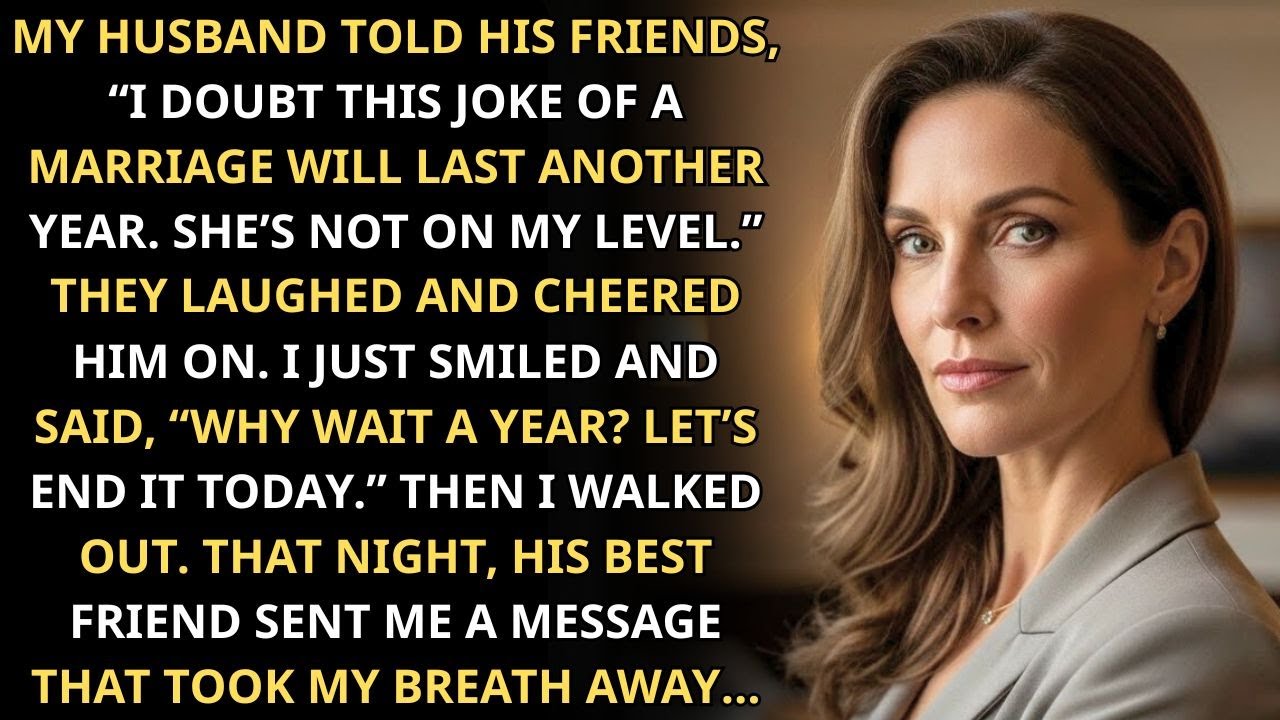
Keeping her by my side feels more like a charity than a partnership. ”
She stood on the porch, balancing a tray of appetizers she had spent four hours building, listening to Julian pitch her replacement to a roomful of men drinking her Bordeaux. The laugh that followed was not the warm chuckle he saved for her. It was a roar, a jackal’s laugh, the sound of a man who believed he was king of a very small hill.
Inside, his circle leaned back in leather chairs she had sourced from Florence, nodding along. They were sitting on furniture her sweat had purchased, drinking wine her foresight had chosen, toasting to the inevitable arrival of a superior model. Isabella did not cry. She did not scream.
She set the tray down on a stone table with a silence that felt like a scream, and stood there in the dark, listening to the story he had been rehearsing without her. This wasn’t a drunken slip. It was a confessional, polished in the dark, safe to breathe only when he thought the source of his lifestyle was out of earshot. She knew the truth now.
She had carried two people across a decade of 18-hour shifts while he talked about visions. She had made herself smaller, let him take credit for the big ideas, steered interviewers toward his supposed strategic genius. She had been building his image while he was measuring her for a coffin. She pushed the glass doors open.
The sound of the track was a gunshot. The laughter died. Julian turned, his face half-formed, searching hers for a sign of how much she had heard. His friends froze, expensive watches glinting in the fireplace light.
Isabella stepped into the center of the room. She looked only at Julian. “Why wait until the end of the year? Let’s finish this tonight.
I wouldn’t want you feeling trapped with someone who’s apparently hit her ceiling. ”
The man who was famous for his silver tongue had nothing to say. She walked out and went to the master suite. From her personal stash in the walk-in closet, she pulled suitcases meant for escape.
She packed her blazers, her laptop, the blueprints for the next three years of her life. She left the wedding photos, the trinkets, the gifts made with her own credit cards. Julian appeared twenty minutes later, disheveled and breathless. “Izzy, please.
You’re overreacting. It was just talk. ”
“It wasn’t just talk, Julian. It was a confession.
”
He reached for her. “I love you. I’ve always supported you. ”
She stopped folding her silk shirts.
“You love the life I provide. The house, the reputation. You love that I make you look like a success. But you hate that you need me.
And that’s what I heard tonight. ”
He argued, but she had more. “I’m not leaving because you insulted me. I’m leaving because I know about the Cayman account.
I know about the calls you’ve been making to my head of operations. And I know you’ve been telling the board I’m struggling with my mental health, to soften the ground for a takeover. ”
“How do you know? ”
“Because I built a multi-million dollar company from nothing, Julian.
Did you think I wouldn’t notice a leak in my own basement? ”
She zipped her suitcase and walked past him. At the front door, her phone vibrated. An unknown number.
“Check your husband’s calendar for every second Thursday of the last six months. You aren’t the only one he’s been lying to. ”
The next message identified the sender: Caleb Thornne. Julian’s oldest friend.
The loudest laugher in that room tonight. He met her the next morning in a coffee shop on River Street, looking like a man who hadn’t slept in years. Without greeting, he slid his phone across the table. “He called it Project Eclipse.
”
Isabella scrolled. Group chats. Shared documents. A strategic plan to paint her as unstable, erratic, losing her grip—steps to isolate her from the company, then claim she was unfit to manage the assets.
Julian had documented her late nights, her moments of strain, her minor errors, twisting them into evidence of a breakdown. There was a draft email to her primary investor describing her as prone to outbursts. “This wasn’t a crime of passion,” she said. “It was a corporate raid on my soul.
”
“Why are you telling me this now, Caleb? ”
“Because I saw your face last night. And I realized if he could do that to the woman who gave him everything, he’d eventually do it to me, too. ”
She didn’t waste time on anger.
Within seventy-two hours she had turned a hotel suite into a war room. Miriam Vance, her cousin litigator, arrived with paralegals and a forensic accountant who looked like he enjoyed dismantling lives. They gutted ten years of records—the secret accounts, the forged signatures, the digital trail of Project Eclipse. And then the other women started contacting her.
The wives and girlfriends of the men in that room sent audio clips, emails, burner messages. Julian’s house of cards was built on blueprints she had taught him to read. The climax came in the boardroom of Vance Urban Design. Julian arrived early, in his finest suit, wearing a mask of practiced concern.
He had spent the morning telling anyone who would listen that Isabella had suffered a psychotic break. He was prepared to steer the ship. He walked into the room and found Isabella at the head of the table, flanked by Miriam and the accountant. Her eyes were steady.
“Sit down, Julian. We’re not discussing my health today. We’re discussing your legal defense. ”
The presentation was clinical.
Slide one: the secret accounts. Slide two: the forged signatures. Slide three: transcripts from Project Eclipse. The final slide was a recording from the dinner party, captured by a smart home device he had forgotten she owned.
His own voice filled the room, mocking her, mocking the board, detailing how he would bleed the company dry. Julian’s face turned gray. He looked for an ally. Caleb was staring at his shoes.
The investors were staring at their lawyers. “This is a misunderstanding,” Julian stammered. One of the lead investors, a woman who had mentored Isabella from the start, closed her laptop sharply. “It’s only a vendetta if it isn’t true, Julian.
The numbers don’t lie. And neither do you, when you think no one is listening. ”
Isabella stood. “You have one hour to vacate your office.
You’ll sign the confession and the waiver of all marital assets, or Miriam will file the criminal charges we’ve already drafted. You wanted to be a leader, Julian. This is what it looks like when a real leader cleans house. ”
He walked out without another word.
In the months that followed, the company stabilized faster than the industry expected. The friction Julian had injected into the culture was gone. Decisions had a new clarity. Isabella stopped making herself smaller.
She moved into a penthouse of glass and light, with no room for shadows. She heard from women across the country—architects, CEOs, artists—who had their own stories about the Julians of the world. What she had learned, she passed on like blueprints. She saw him once more, almost a year later, in a hardware store on the edge of town.
He was in the plumbing aisle, staring at fixtures with the dull confusion of a man who had realized he was ordinary. Behind him, that old charm flickered for a second. He took a half-step toward her. She didn’t stop.
She didn’t glare. She didn’t feel anger or pity or satisfaction. She turned back to the shelf, chose a sealant, and walked to the checkout. He was no longer a factor in her equation.
He was a solved problem. A finished chapter. Driving home, the sunset turned Savannah to bruised gold, and Isabella felt a peace deeper than any business success. Ten years, she thought, and the most powerful thing she had done was walk away without looking back.
Loyalty to a lie is a prison. The moment you stop saving a person who is actively trying to erase you, you finally breathe. She drove home to a house built with her own hands, a life reclaimed with her own heart. For the first time in a decade, the silence was not a threat.
It was a masterpiece.