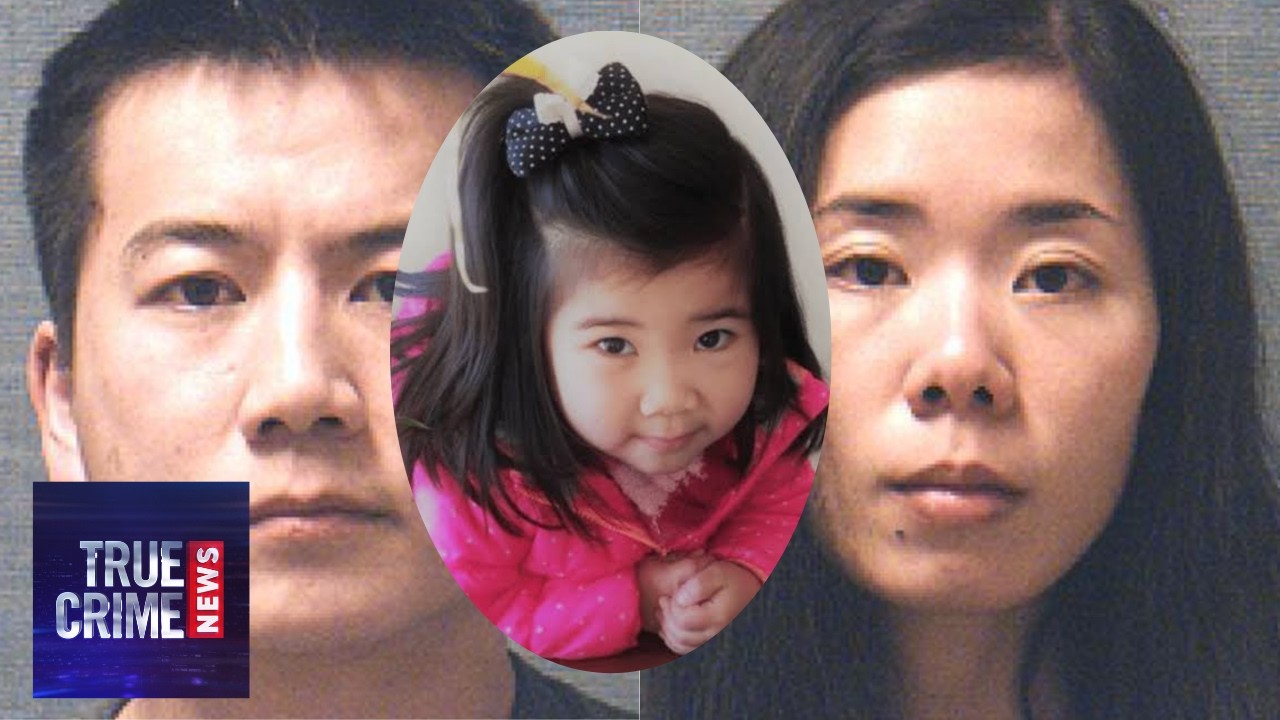
The interrogation room at the Jackson Township Police Department was cold, sterile, and unforgiving, a stark contrast to the warm, bustling Chinese restaurant that had become the epicenter of a nightmare. The video, never before released to the public, captures the raw, chilling confessions of Liang Zhao and Mingming Chen, the parents who killed their own five-year-old daughter, Ashley Zhao, and then hid her body in a salt container within their own establishment. The footage, obtained exclusively by Crime Watch Daily, lays bare the calculated deception and the horrifying final moments of a little girl whose life was extinguished by the very people meant to protect her.
The transcript of the 911 call, played in the background of the interrogation, is a masterclass in feigned panic. Liang Zhao’s voice cracks with manufactured urgency as he tells the dispatcher that his daughter is missing. He claims she was last seen sleeping in the back of the restaurant around 5 p.
 m. on a frigid January evening in 2017. The temperature outside had plummeted to six degrees, a detail that would later become a cornerstone of the parents’ initial cover story.
They wanted investigators to believe Ashley had wandered out into the brutal Ohio winter, a narrative that would paint them as grieving, helpless victims.
But the detectives on the case were not fooled. The interrogation video shows them methodically dismantling the parents’ story, piece by piece. Officer: “We searched the entire restaurant for a missing child.
We were thinking that she possibly had gone somewhere that the parents just didn’t know where to find her at within the restaurant. Looking for a place where a child might hide.” The pause that follows is heavy with implication.
The detective leans in, his voice dropping to a near whisper. “Not where someone would hide a child. Absolutely.”
The distinction is critical. A child hides in a closet or under a bed. A killer hides a body in a salt container, in a storage area, in the ceiling.
The video shows the moment the facade crumbles. Liang Zhao, his face a mask of exhaustion and guilt, begins to confess. He describes the events of that night with a chilling detachment, as if recounting a mundane chore.
He says his wife, Mingming Chen, had become enraged because Ashley had soiled her diaper. It was a common trigger for the couple, who ran the Ang’s Asian Cuisine restaurant in Jackson Township, a business that demanded long hours and left little patience for the normal accidents of childhood. “She peed on her diaper and she pooped on her diaper,” Liang Zhao says in the video.
“It’s always the same thing. You know, the bad things. They make me angry.
And I can’t control myself and I killed her.”
The confession is a torrent of horrifying detail. Mingming Chen, according to the interrogation, slammed Ashley’s head into the floor. The impact was violent, immediate, and fatal.
The little girl’s breathing became labored, then stopped. Liang Zhao says he tried to perform CPR, but it was too late. The child was gone.
The couple then faced a terrible choice: call for help and face the consequences of their rage, or cover up the crime and continue their lives. They chose the latter, a decision that would transform a tragic accident into a premeditated act of concealment.
The interrogation video captures the cold, calculating nature of their plan. Liang Zhao describes how he wrapped Ashley’s body in a blanket and carried her out to the family car. He placed her in a car seat, a grotesque parody of normalcy, and drove her to the restaurant.
There, he and his wife worked together to hide the body. They found a large, industrial-sized salt container in the kitchen, used for seasoning the food they served to unsuspecting customers. They stuffed Ashley’s lifeless body inside, sealed the container, and placed it in a storage area in the ceiling.
 For three days, while the community searched for the missing girl, while volunteers braved the cold, while police dogs and drones scoured the area, Ashley’s body lay hidden just feet away from the dining room where her parents continued to cook and serve meals.
Detective: “And then I went home and I went out with a woman. What were your plans to do after maybe we quit looking for her?” Liang Zhao’s answer is almost incomprehensible.
“I don’t know. We didn’t have a plan. We just wanted it to go away.”
The casualness of his response is chilling. The couple had no long-term strategy for disposing of the body. They were simply hoping that the search would eventually be called off, that the case would grow cold, and that they could return to their lives as if nothing had happened.
They even opened the restaurant for business as usual the next day, serving food to customers who had no idea that a child’s corpse was hidden above their heads.
The interrogation of Mingming Chen is equally disturbing. She sits across from the detective, her face devoid of emotion. She does not cry.
She does not express remorse. She simply answers questions in a flat, monotone voice. Detective: “My job in here today is to find out what happened to cause your daughter’s death, Ming.”
She nods, as if understanding a simple instruction. “Your daughter’s dead. I just don’t understand.
I know that you’re not crying. You said I don’t have nothing left, isn’t that what you told me? You don’t have no tears left.
You don’t have nothing left. Mingming, your daughter’s dead.”
The detective’s words hang in the air, a desperate attempt to pierce the wall of indifference that Mingming Chen has built around herself. She finally speaks, her voice barely a whisper. “I didn’t mean to 𝓀𝒾𝓁𝓁 her.
I just got so angry. She wouldn’t stop crying. She wouldn’t stop messing her pants.
I just wanted her to be quiet.” The confession is a stark admission of a parent overwhelmed by the pressures of work and life, a parent who snapped under the strain and took it out on a defenseless child. But the law does not recognize such excuses.
The law sees a mother who beat her daughter to death and then tried to hide the evidence.
 The investigation revealed a pattern of 𝓪𝓫𝓾𝓼𝓮. Neighbors and family members later testified that Ashley had often been seen with bruises and welts. The parents had a history of harsh discipline, using physical punishment to control their children.
The night of her death, Ashley had simply made a mess. It was a common occurrence for any toddler. But for Mingming Chen, it was the final straw.
She struck her daughter with such force that the child’s skull was fractured. The autopsy report would later confirm that Ashley died from blunt force trauma to the head.
The cover-up was as damning as the murder itself. The couple not only hid the body but also lied to police, to the media, and to the community. They participated in search parties, they gave tearful interviews, they even posted a missing child flyer on the restaurant’s front door.
All the while, they knew exactly where Ashley was. The deception was so complete that for three days, investigators believed they were dealing with a tragic disappearance. It was only when a detective noticed inconsistencies in the parents’ stories that the focus shifted from a search to a homicide investigation.
The interrogation video shows the moment the detectives confront Liang Zhao with the evidence. They tell him that a search of the restaurant has yielded nothing, that they are expanding the search to the surrounding area. They ask him if he is sure Ashley didn’t leave the building.
He hesitates, his eyes darting around the room. Then, he breaks. He tells them the truth, the whole truth, in a rambling, disjointed confession that leaves the detectives stunned.
He describes the anger, the violence, the death, and the cover-up. He describes how he and his wife worked together to hide the body, how they went back to work, how they pretended that everything was normal.
The trial was a media sensation. The courtroom was packed with reporters and onlookers, all eager to see justice served for little Ashley. The prosecution presented a mountain of evidence, including the interrogation videos, the autopsy report, and testimony from experts who described the severity of the child’s injuries.
The defense argued that the killing was an accident, a moment of temporary insanity brought on by stress and exhaustion. They pointed to the couple’s long hours at the restaurant, their financial struggles, and their isolation from family and friends.
But the jury was not swayed. They saw the videos. They heard the confessions.
They understood that this was not a momentary lapse in judgment but a calculated act of violence followed by a cold-blooded cover-up. In the end, Mingming Chen was found guilty of murder. She was sentenced to 22 years in prison.
As part of her plea agreement, she accepted a lesser charge of involuntary manslaughter, but the judge made it clear that he considered her actions to be nothing short of murder. “The horror of being beaten by her own mother,” the judge said, his voice trembling with emotion, “and I use the word mother with great pain. It’s insulting to mothers who do what they are supposed to do for their children.
No number of years is enough. A hundred years is not enough.”
 Liang Zhao, who cooperated with prosecutors and testified against his wife, received a lighter sentence of 12 years. He was convicted of child endangerment and obstruction of justice, charges that reflected his role in the cover-up rather than the killing itself. His testimony painted a picture of a domineering wife who controlled the household and the business, a woman who flew into rages at the slightest provocation.
He claimed that he was afraid of her, that he went along with the cover-up because he didn’t know what else to do. The jury believed him, at least enough to spare him the murder charge.
But the families of Ashley Zhao will never be whole. The little girl who loved to play with her dolls, who had just returned from a visit with her grandparents in China, who was described by neighbors as a sweet and happy child, is gone forever. Her parents, the people who should have loved and protected her, are the ones who took her life.
And the restaurant where she died, where her body was hidden, where her parents continued to serve food to the public, stands as a grim monument to a tragedy that should never have happened.
The interrogation video, now public, serves as a stark reminder of the darkness that can lurk behind closed doors. It is a cautionary tale about the pressures of modern life, the dangers of unchecked anger, and the terrible consequences of a parent who loses control. The voices of Liang Zhao and Mingming Chen, captured on tape, will forever echo in the halls of justice, a testament to the fragility of life and the depths of human depravity.
The case of Ashley Zhao is closed, but the questions it raises about parenting, mental health, and the criminal justice system will linger for years to come.
The community of Jackson Township has tried to move on, but the memory of that cold January night remains. The restaurant has been closed, its windows boarded up, a silent sentinel to the horror that unfolded within its walls. A small memorial has been erected in a nearby park, a place where people can go to remember Ashley, to leave flowers and toys, to pray for a child who deserved so much more.
The sign reads, “In loving memory of Ashley Zhao, forever 5 years old.” It is a simple tribute to a life cut short, a life that ended not by the hand of a stranger, but by the hands of the ones who were supposed to keep her safe.
The legal proceedings are over, but the emotional scars will never heal. Mingming Chen will spend the next two decades in a federal prison, after which she will be deported to China. Liang Zhao will serve 12 years, a sentence that many believe is too lenient for his role in the cover-up.
But the law has spoken, and the case is closed. The only thing left is the memory of a little girl, and the chilling video that revealed the truth about her final moments. The interrogation room, the cold tile floor, the flat monotone of a mother confessing to murder—these images will stay with anyone who watches the footage, a haunting reminder of the worst that humanity has to offer.
The detective who conducted the interrogation has since retired, but he still thinks about the case. He thinks about Ashley, about the way her parents described her death as if it were an inconvenience. He thinks about the three days she lay in that salt container, while her parents went about their business, serving egg rolls and fried rice to customers who had no idea.
He thinks about the moment he realized that the parents were lying, that the search was a charade, that the little girl was never going to be found alive. It is a burden he will carry for the rest of his life.
The case of Ashley Zhao is a tragedy in every sense of the word. It is a story of a child who was failed by the very system that was supposed to protect her. It is a story of a community that rallied together to search for a missing girl, only to discover that she had been hidden in plain sight.
It is a story of a justice system that struggled to find a fitting punishment for a crime that defied comprehension. And it is a story that will be told for generations, a cautionary tale about the fragility of life and the darkness that can consume even the most ordinary of people.
The video of the interrogation is now part of the public record, a permanent record of a mother and father who killed their child and then tried to hide the evidence. It is a document of horror, a window into a world of rage and desperation and cold, calculated deception. It is a reminder that evil does not always wear a mask, that it can look like a tired parent, a hardworking restaurant owner, a member of the community.
And it is a call to action, a plea for all of us to pay attention, to look for the signs, to intervene before it is too late. For Ashley Zhao, it was too late. But for other children, there is still hope.