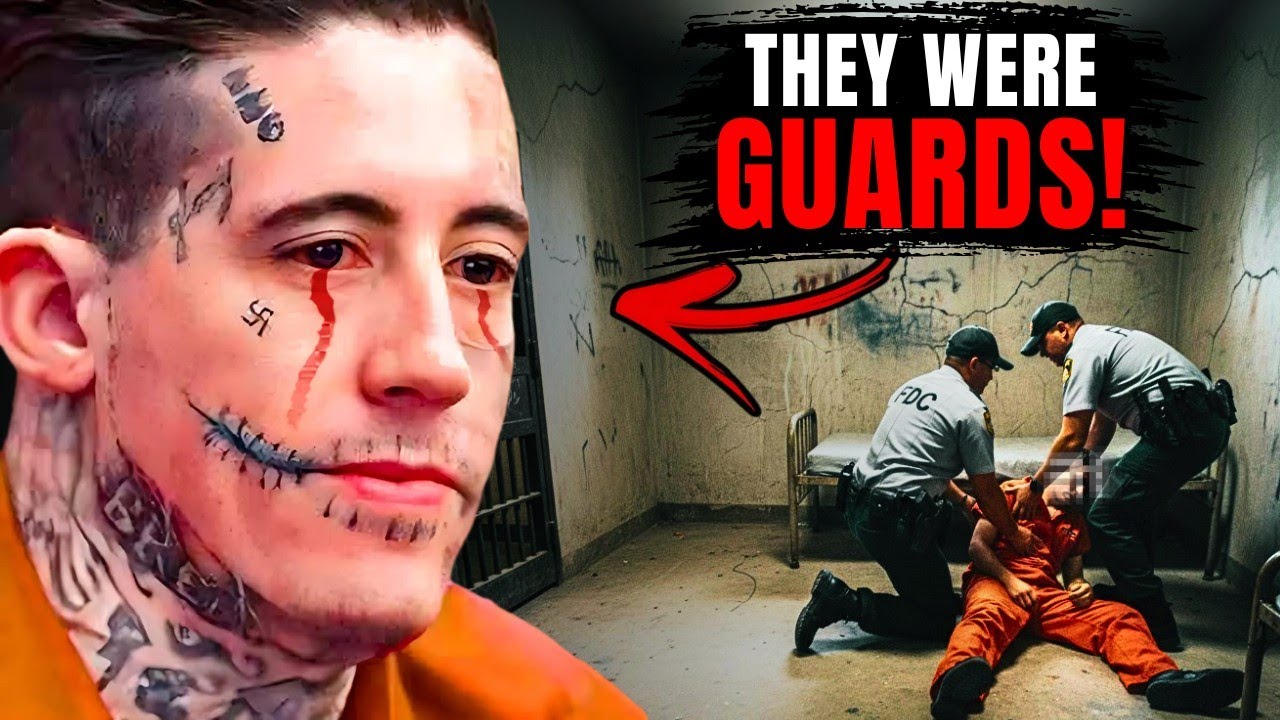
Convicted double murderer Wade Wilson, one of Florida’s most notorious death row inmates, was found lifeless inside his prison cell at Union Correctional Institution and then dramatically revived by medical staff, prompting a firestorm of explosive allegations that he is now leveling directly at the corrections officers charged with keeping him alive. The man who terrorized Southwest Florida with a brutal 2019 killing spree is claiming in newly surfaced handwritten letters that the prison system orchestrated his attempted murder, and he is begging the outside world to listen before his attackers strike again.
The letters, penned by Wilson himself from his cell on death row, paint a chilling portrait of a man who believes he narrowly escaped a coordinated assassination. The handwriting is rushed, frantic, and laden with desperation, a stark departure from the calculated demeanor he displayed in court. In one of the most stunning passages, Wilson writes of the incident in the past tense, declaring, “Angie, it was all a setup and they had me killed.”
The phrasing suggests he considers himself already dead, merely existing on borrowed time after his revival.
According to the timeline pieced together by prison records and Wilson’s own correspondence, the sequence of events reads like a conspiracy thriller. Wilson was discovered unresponsive in his cell following what officials described as a reported fentanyl overdose, with no pulse and no breathing. Emergency medical intervention followed, with prison personnel performing what can only be described as a modern-day resurrection, stabilizing the inmate and bringing him back from the brink of death.
That act, however, has become the central paradox in Wilson’s narrative.
Medical staff did not simply revive him; they subsequently moved him to Suwannee Correctional Institution, a facility that Wilson’s supporters describe as comparatively lenient, offering more freedom and better conditions than the stark confines of death row. For roughly one month, Wilson reportedly enjoyed the relative comfort of this new environment, making phone calls, communicating with supporters, and spreading his version of events to the world. But then, without warning and for reasons that remain unclear, corrections officials transferred him back to Union Correctional Institution, returning him to the exact same death row unit where he had allegedly died.
Wilson’s handwritten notes, obtained exclusively and verified as authentic, allege that this return is no coincidence. He explicitly names prison staff members in the correspondence, accusing them of complicity in a plot to end his life. “Prison officials wanted me dead and they used other inmates to get to me and do it,” he writes, leveling direct accusations against unnamed corrections officers and administrators.
The letters describe a coordinated effort involving multiple levels of the prison hierarchy, not merely guards turning a blind eye but officials actively orchestrating the operation from above.
The convicted killer further alleges that inmate informants and gang members are being deployed as weapons against him. He claims that fellow death row inmates have been making overt comments and threats indicating that his death is imminent, that his time is short, and that they intend to finish what was started. According to Wilson, these individuals are preparing for a second attempt, operating with the explicit or tacit approval of the very authorities responsible for his safety.
The repetition of a desperate plea punctuates the correspondence: “Tell the world. Tell the world. Tell the world.”
Wilson also alleges that his lifelines to the outside world are being systematically severed. He claims his attorney phone calls are being denied, his access to mail and communication is being blocked, and he is being isolated in a manner that will leave him defenseless when his attackers return. Perhaps most chillingly, he asserts that prison officials have already devised a cover story, planning to make his future murder appear to be a complete accident, a manufactured scene designed to insulate the conspiracy from scrutiny.

At the center of Wilson’s fear lies a prison gang known as The Unforgiven. Wilson bears extensive facial and head tattoos associated with this white supremacist group, including gang insignia and markings that identify him as affiliated. Yet Wilson maintains he was never an actual member of the organization.
In the brutal hierarchy of prison culture, wearing gang tattoos without proper membership is considered the ultimate disrespect, an offense that carries a death sentence in its own right. Wilson claims corrections officials have deliberately housed him in cells surrounded by Unforgiven members.
These are not idle threats, according to Wilson’s correspondence. The Unforgiven take such affronts with deadly seriousness, and the gang possesses both the means and the organizational capability to carry out violent retribution inside the prison walls. Wilson argues that by placing him directly in the path of heavily tattooed gang members who view him as a pretender, prison officials are effectively signing his death warrant while maintaining plausible deniability.
The real danger to his life is undeniable, but the question remains whether the prison system is actively participating or merely indifferent.
This is not the first time Wilson has made explosive claims about his treatment behind bars. In previous accounts, he alleged that prison staff were pumping harmful chemicals through his cell’s air vent as an invisible form of slow-acting chemical warfare. His supporters, mobilizing in a panic, flooded news outlets with complaints and demanded official investigations into the alleged poisoning campaign.
Wilson described a systematic effort to 𝓀𝒾𝓁𝓁 him through the ventilation system, claiming he could feel the effects of the poison over time, weakening him cell by cell.
That theory, however, collapses under technical scrutiny. Prison ventilation systems are designed to serve multiple cells simultaneously, routing air through shared ductwork. It is functionally impossible to target a single inmate’s cell with chemical agents without contaminating the entire housing unit.
The air would affect every other inmate on that corridor, not just Wilson. The impossibility of the claim raises serious questions about his credibility, and it establishes a pattern of behavior in which Wilson manufactures elaborate narratives of persecution that do not withstand logical examination.

Equally troubling are the persistent reports of Wilson’s continued substance use behind bars. A woman named Bonnie Wiggins, identified as a supporter, was arrested and remains incarcerated to this day after being caught attempting to smuggle contraband into the prison for Wilson. Former inmates from the Florida Department of Corrections have gone on the record stating that Wilson regularly spends donated money from his supporters not on legal defense but on illicit substances.
While supporters believe they are funding his appeals, Wilson is reportedly using those funds to maintain a steady 𝒹𝓇𝓊𝑔 habit.
Multiple sources confirm that Wilson’s days on death row are consumed by the pursuit of intoxication, that he is locked up with little to do except seek the next high, and that his supporters unknowingly provide him with the financial means to do so. This documented pattern of substance 𝓪𝓫𝓾𝓼𝓮 and access to contraband makes the circumstances of his so-called fentanyl overdose appear far less mysterious. The reality may be far simpler than the conspiracy theory he is selling: a man with a known 𝒹𝓇𝓊𝑔 problem took a lethal dose of a dangerous substance, survived, and then faced consequences.
This brings us to the massive logical contradiction that undoes Wilson’s entire narrative. If the prison staff truly orchestrated his death, if they coordinated with gang members to administer a lethal overdose, if they were partners in a conspiracy to murder him, then why did those same staff members immediately rush to his cell and fight to save his life? Wilson was found with no pulse and no breathing, unresponsive and effectively dead.
The guards had the perfect opportunity to let nature take its course, yet they chose instead to perform emergency procedures and revive him.
No elaborate murder conspiracy would include the vital step of heroic medical intervention to bring the victim back to life. The response of the prison medical team is fundamentally incompatible with the claim that the prison system wanted Wilson dead. A more plausible explanation is that Wilson, who has a documented history of heavy substance use, overdosed unintentionally, perhaps on a batch stronger than expected.
When he survived, he faced real consequences: potential disciplinary charges, loss of privileges, and a diminished ability to communicate with the supporters who fund his lifestyle.
Faced with those consequences, Wilson appears to have done what he has always done, which is to construct a dramatic narrative that shifts blame and preserves his image. By claiming to be the victim of an elaborate murder plot, he transforms his own recklessness into a cause for sympathy. His supporters, rather than questioning his 𝒹𝓇𝓊𝑔 use, rally around him with renewed vigor, sending more money, making more calls, and amplifying his message of persecution.

The “tell the world” refrain is not a genuine plea for help but a calculated rallying cry designed to keep the narrative alive.
The gang threats Wilson faces are real, and they constitute the only genuine danger he confronts. Bearing Unforgiven tattoos without membership is a legitimate and serious threat to his life inside the prison system. But the broader conspiracy theory involving prison officials, orchestrated overdoses, and coordinated cover-ups is a work of fiction, a masterfully crafted manipulation designed to exploit the empathy of good-hearted people.
Wilson is mixing just enough truth with fabricated detail to make his story compelling and plausible to those who want to believe him.
Wilson is exactly what he has always been: a manipulative killer who will say anything, do anything, and exploit anyone to achieve his own ends. This is the same man who traded the location of a victim’s body for a McDonald’s meal during his murder investigation. He lied consistently throughout his trial, he made impossible claims about chemical warfare from his cell, and he manipulated women into smuggling drugs into a maximum-security prison on his behalf.
His history is defined not by victimhood but by predation.
The only conspiracy at work here is Wilson’s conspiracy to manipulate good-hearted supporters into enabling his continued criminal behavior from death row. The prison staff who saved his life deserve recognition, not baseless slander. The gang members who threaten him represent a genuine risk, but they do not act as agents of the state.
And the letters, so urgent and desperate, are the product of a master manipulator who knows exactly which buttons to press to keep his audience hooked. Wilson is not the victim of a prison murder plot; he is the author of his own gripping fiction.