Federal death row inmate Dylann Roof sits alone in a concrete cell at USP Terre Haute, Indiana, with no execution date on the calendar — and the psychological toll of indefinite isolation may be far more brutal than the lethal injection he was sentenced to receive.
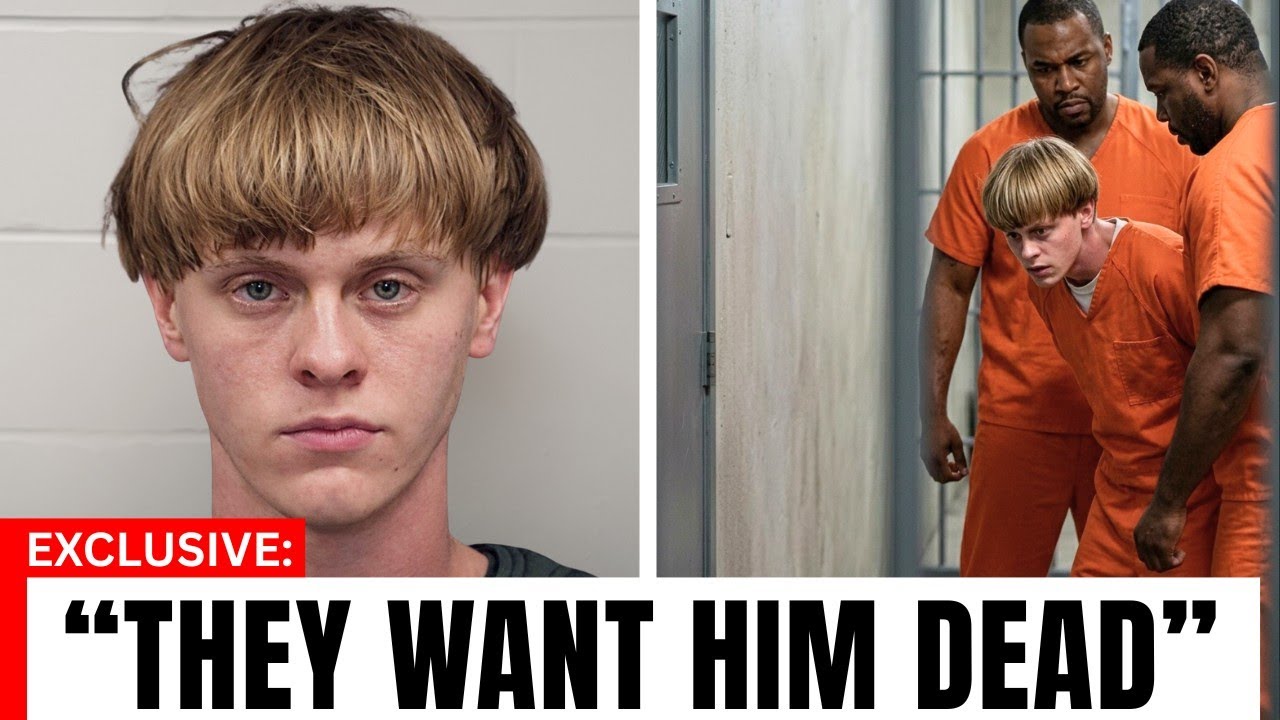 Roof, now 32, was condemned to die for the 2015 racially motivated massacre of nine Black parishioners at Emanuel African Methodist Episcopal Church in Charleston, South Carolina. But nearly a decade later, he remains alive, confined to a special unit where human contact is almost nonexistent.
The reality of his punishment has sparked a fierce debate among legal experts, psychologists, and victims’ families: Is prolonged solitary confinement on death row actually worse than execution itself?
On June 17, 2015, Roof walked into a Bible study at the historic church, sat with worshippers for nearly an hour, then opened fire during the closing prayer. He killed nine people: Reverend Clementa Pinckney, Cynthia Hurd, Susie Jackson, Ethel Lance, Depayne Middleton Doctor, Tywanza Sanders, Reverend Daniel Simmons Sr.
, Reverend Sharonda Coleman Singleton, and Myra Thompson.
Roof showed no remorse at any point during his trial. In December 2016, a federal jury convicted him on 33 counts and sentenced him to death — the first federal hate crime death sentence in U.
S. history. He fired his lawyers, refused a mental health defense, and essentially ensured his own execution.
But the legal machinery of capital punishment moves slowly. His appeals dragged through the courts for years. In 2021, the Fourth Circuit upheld his sentence.
In 2022, the Supreme Court declined to hear his case.
Then came December 2024. President Joe Biden commuted 37 of 40 federal death sentences to life imprisonment.
 Roof was explicitly excluded. Biden’s office said the exclusion applied to cases involving terrorism and hate-motivated mass violence.
That decision left Roof as one of only three men remaining on federal death row.
The others are Robert Bowers, who killed 11 worshippers at Pittsburgh’s Tree of Life synagogue, and Dzhokhar Tsarnaev, convicted in the 2013 Boston Marathon bombing.
But even among this small group, Roof’s situation is uniquely bleak. He has no scheduled execution date.
Federal executions have effectively halted since the Biden administration imposed a moratorium in 2021. No new dates have been set.
This means Roof faces an indefinite period of near-total isolation inside the special confinement unit at Terre Haute — the same facility where Timothy McVeigh was executed in 2001.
Former correctional officers describe the unit as “extraordinarily quiet.” Each cell contains a bed, desk, toilet, and shower. Inmates leave only for brief, heavily supervised movement.
Meals arrive through a slot in the door. There is no communal area, no interaction with the general prison population.
In October 2023, all federal death row prisoners were moved to an even more restrictive section.
 Fellow inmates reported rapid psychological deterioration. On December 1, 2023, inmate Naci Khalil Arraiol was found unresponsive in his cell and pronounced dead. Fellow prisoners say he had become deeply withdrawn and despondent after the move.
Psychologists call this the “death row phenomenon” — severe psychological decline caused by prolonged, indefinite uncertainty about one’s own execution. A 2017 study in the journal Lancet Psychiatry found that long-term solitary confinement can cause cognitive decline comparable to traumatic brain injury.
Roof’s attorneys filed another motion to vacate his death sentence in April 2025, arguing trial lawyers misled him and the judge was biased.
That motion was denied. As of early 2026, Roof remains in his cell with no end in sight.
The victims’ families are deeply divided on what justice looks like.
Some, like Felicia Sanders — who survived the massacre by playing dead as her son Tywanza was killed — supported keeping Roof on death row. Others, like Reverend Sharon Risher, who lost her mother and two cousins, came to oppose capital punishment entirely.
One survivor expressed frustration that every appeal pulls Roof back into the news cycle, reopening wounds that families are trying to heal.
Life without parole, she noted, would have quietly removed him from public consciousness.
The philosophical question remains: Is death the ultimate punishment, or is living for decades in a concrete box, deprived of human contact and hope, something more psychologically devastating?
 Immanuel Kant argued that just punishment must acknowledge the humanity of the person being punished.
Critics of indefinite solitary confinement say it does neither — it does not execute, it does not rehabilitate. It simply waits.
For Roof, that waiting may stretch on for years, possibly decades.
He may die of natural causes in that cell before the state ever carries out his sentence. And for the families of the Emanuel 9, the legal system’s glacial pace has become its own form of torment.
The legacy of the nine lives lost on June 17, 2015, is not Roof.
It is the extraordinary act of grace shown by their families two days after the massacre, when they stood in a courtroom and offered forgiveness to a man who showed none in return.
Roof remains in his cell at USP Terre Haute, waiting. Whether that constitutes justice or something worse than a lethal injection is a question the country has not yet answered — and may never answer with certainty.