Part One — The Daughter They Thought Had Failed
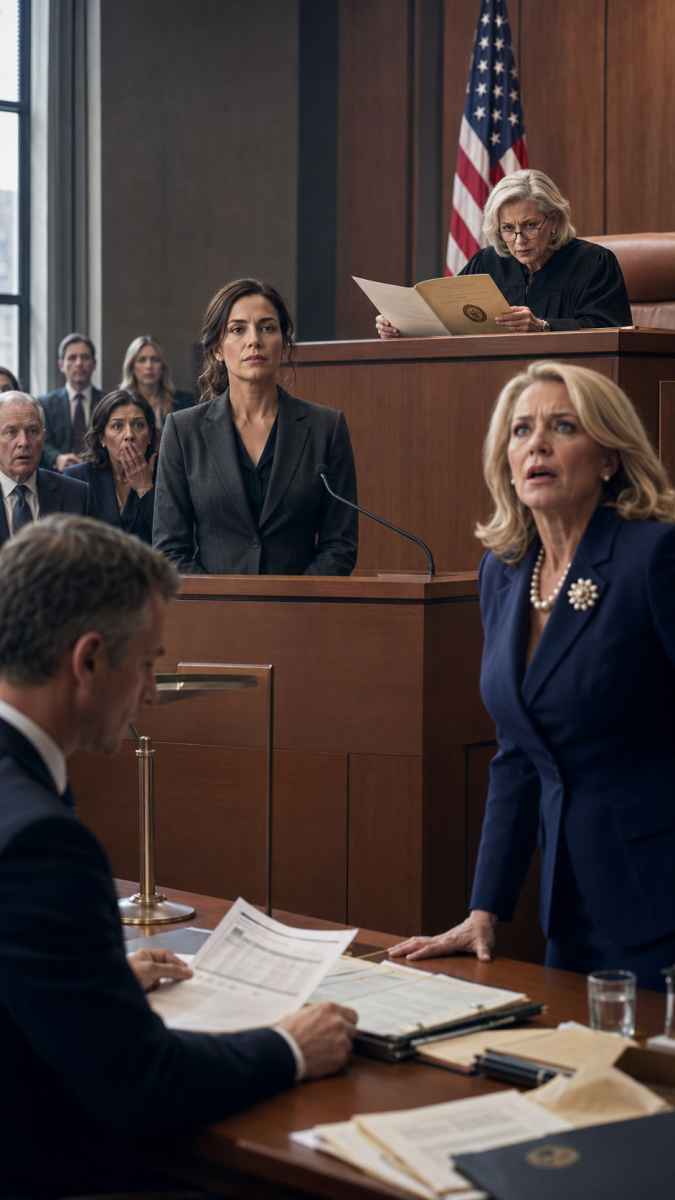
The morning my sister asked a judge to declare me financially incompetent, she wore our grandmother’s pearl brooch on her navy suit. She had taken it from the jewelry box before the estate was inventoried, but that was not the detail that frightened her when I entered the courthouse. What frightened her was the black file in my attorney’s hand—and the gold seal on the document inside it. For fifteen years, my family had treated me like the daughter who could not survive the real world. By sunset, they would learn that I had been quietly investigating people exactly like my sister.
If you have ever been underestimated by the people who should have known you best, stay with me. This story is not about revenge, although revenge would have been easier. It is about what happens when someone mistakes your silence for weakness, your patience for ignorance, and your love for permission. My name is Evelyn Mercer. I was forty-three years old when my older sister dragged me into probate court in Richmond, Virginia, over an inheritance neither of us truly needed. She expected me to cry, surrender and thank her for taking control. Instead, I let her tell every lie she had prepared.
My sister, Victoria Mercer, had been winning rooms since childhood. She was eight years older than I was, beautiful in the disciplined way that made other people straighten their backs around her. At sixteen, she was class president. At twenty-two, she graduated near the top of her law-school class. At thirty-eight, she became an equity partner at Bellamy, Pike & Mercer, a litigation firm whose lobby displayed marble columns and photographs of governors shaking hands with senior partners. Our parents spoke of her victories as if they had personally argued each case. My mother saved magazine profiles about Victoria in a leather album. My father introduced her as “our brilliant attorney” before strangers had even asked.
I was the family’s unfinished sentence. At nineteen, I left Hawthorne University after two semesters. That was the version everyone remembered. They did not remember that I had transferred to a smaller college after reporting a professor who traded grades for private favors. They did not know the university had pressured me to withdraw my complaint or that Victoria, already a young associate, had advised me not to “destroy a respected man over something difficult to prove.” I left because staying meant pretending nothing had happened. My parents called it another example of my emotional instability. Victoria called it evidence that I lacked the temperament for serious work.
What they never bothered to learn was that I finished my degree at night. I earned a scholarship to law school in Maryland, passed the bar on my first attempt and began working in the consumer-protection division of the state attorney general’s office. From there, I moved into professional misconduct: attorneys who stole from trust accounts, falsified invoices, concealed conflicts or used the law as a weapon against vulnerable clients. I became good at recognizing the distance between a polished reputation and the truth beneath it. Eventually, I was appointed deputy director of the Commonwealth Office of Legal Integrity and given a seat on a disciplinary review panel. My work was confidential. My family’s lack of curiosity made keeping it that way remarkably easy.
At holidays, when my father asked whether I was “still doing clerical work for the state,” I said yes. When Victoria offered to introduce me to someone who might find me a “real administrative position,” I thanked her. I watched her dominate the table, correct people who were not wrong and turn every disagreement into a trial she had already decided she would win. Silence was not surrender. Silence gave people room to reveal themselves. Victoria revealed more than she understood.
Our grandmother, Rose Callahan, was the only person who asked me direct questions. She did not know every detail of my cases, but she knew I was an attorney. She also knew why I kept that fact from the family. After my grandfather died, I visited her every Sunday for nine years. We tended tomatoes, read mystery novels and argued about whether old houses remembered the people who had lived inside them. Victoria visited on Christmas, sometimes Easter, and whenever a photographer from the historical society was expected. Grandma noticed the difference, though I never asked her to reward it.
When Grandma died at ninety-one, she left her restored farmhouse, investments and remaining savings equally to Victoria and me. The estate was worth a little over $2.4 million. Victoria learned the terms in our grandmother’s sunroom, beneath a clock that had stopped at 4:17 the morning she died. She did not cry. She stared at the attorney and asked whether “equally” meant exactly fifty percent. Two weeks later, she filed a petition claiming Grandma had suffered cognitive decline and that I had manipulated her. She also asked to be appointed sole trustee over my share because, according to the filing, I had “a lifelong history of instability, unemployment and impaired judgment.”
My mother called the petition an act of love. My father said Victoria was protecting me from wasting money. Neither had asked to see my home, my bank statements or the retirement account I had funded for eighteen years. They repeated what Victoria told them because her version preserved the family order: she was competent, and I was not. Three days before the hearing, my attorney, Naomi Pierce, received an anonymous envelope containing copies of billing records from Victoria’s firm. The same records appeared in an investigation already sitting inside my locked office. On top was a handwritten message: She knows someone is looking. She plans to make you look unstable before you can speak.
Naomi studied the note, then looked at me across her conference table. “Evelyn, if your sister has connected you to the investigation, this probate case may not be about the inheritance at all.”
My phone rang before I could answer. It was Grandma’s former housekeeper, sobbing so hard I could barely understand her.
“Miss Evelyn,” she whispered, “your sister came to the house. She found the blue box your grandmother told me to hide.”
Then the line went dead.
Part Two — The Case She Built from Lies
The blue box had belonged to my grandfather. It was a small steel document case with chipped paint, an old combination lock and a strip of masking tape across the lid. Grandma stored tax receipts inside it for decades. During her final year, she told her housekeeper, Mrs. Alvarez, to place it behind loose paneling in the upstairs linen closet. I assumed it contained private letters or an updated list of family belongings. I did not know why Victoria wanted it badly enough to frighten a seventy-year-old woman—until Naomi and I reached the farmhouse and found the closet wall torn open.
Mrs. Alvarez sat in the kitchen with an ice pack against her wrist. Victoria had arrived with a locksmith and a letter claiming she had authority to inventory the property. When Mrs. Alvarez objected, one of Victoria’s assistants blocked the door while Victoria searched upstairs. No one struck her, but when she tried to call me, the assistant grabbed her phone. Victoria took the blue box and warned that interfering with an estate investigation could expose Mrs. Alvarez to criminal charges. It was nonsense delivered with sufficient confidence to sound terrifying.
We called the sheriff. Victoria returned the box that evening through her attorney and claimed there had been a misunderstanding. The lock had been broken. Inside were receipts, old insurance papers and three empty file folders. Whatever Grandma had hidden was gone. Naomi photographed every item and requested emergency preservation orders covering Victoria’s phone, office email and any documents removed from the farmhouse. Judge Helena Ward granted part of the request but declined to postpone the hearing. Victoria’s petition would proceed Monday morning.
Courtroom 4B was smaller than television courtrooms and more dangerous because nothing inside it felt theatrical. The walls were pale wood. Fluorescent lights erased flattering shadows. Judge Ward entered without ceremony, a silver-haired woman with a voice so quiet that attorneys stopped moving to hear her. Victoria sat behind her legal team rather than arguing the case herself. She wore Grandma’s brooch above her heart and gave me a sad, forgiving smile, the expression of a devoted sister burdened by my decline.
Her first witness was our cousin Malcolm, a real-estate broker who had borrowed money from Victoria twice. He testified that Grandma forgot his name at Thanksgiving and called him by his father’s name. Naomi asked when this happened. Malcolm said November 24. Naomi produced photographs and hospital records showing Grandma had spent that Thanksgiving recovering from pneumonia at St. Anne’s Rehabilitation Center. Malcolm had been celebrating in Arizona. After several painful pauses, he admitted Victoria had reminded him of the date before court.
The second witness was Dr. Howard Bell, a retired neurologist who had never examined Grandma. He reviewed selected medical notes and testified that confusion was “consistent with possible cognitive impairment.” Naomi handed him the complete records. The missing pages included three cognitive assessments performed within eighteen months of the will, each finding Grandma mentally competent. Dr. Bell claimed he had not received those pages. Victoria’s lead attorney, Charles Renner, blamed a copying error. Judge Ward wrote something on her legal pad and did not look up for a long time.
Next came Sheila Dunn, Grandma’s neighbor. She described my weekly visits as “intense” and said Grandma seemed dependent on me. Naomi asked whether I had begun visiting after the will was changed. Sheila admitted my Sunday visits had started nearly a decade earlier. She admitted I brought groceries, repaired the porch steps and drove Grandma to medical appointments. Finally, she admitted Victoria had promised to recommend Sheila’s son for a position at her law firm. “That wasn’t payment,” Sheila insisted. “It was kindness.” Judge Ward asked whether the kindness had been offered before or after Sheila agreed to testify. Sheila’s silence answered.
During lunch, Victoria cornered me near a courthouse window while Naomi spoke with the clerk. People flowed around us carrying paper cups and thick files. Victoria kept her smile in place for anyone watching.
“This humiliation can stop today,” she said.
“You filed the case.”
“I’m trying to save you from yourself. Withdraw your opposition. I’ll manage both shares, send you eight thousand dollars a month and keep the principal protected.”
“My principal?”
“You know what I mean.”
“I know precisely what you mean.”
Her eyes narrowed. “Do you? Because competent adults don’t vanish for fifteen years and refuse to explain their lives.”
“Competent families usually ask.”
“You always wanted to punish us for not chasing you.”
I studied her face, looking for fear beneath the makeup. “What was in the blue box?”
For the first time, her smile slipped. “Old papers.”
“Then why were the folders empty?”
“Grandma was losing her mind. She probably moved things.”
“Before or after you broke the lock?”
Victoria stepped closer. “Walk away, Evelyn. You are playing inside a system you do not understand.”
Naomi appeared beside me. “Ms. Mercer understands enough to know that communicating directly with a represented party is inappropriate.”
Victoria looked at her as though she were a junior employee. “This is a family conversation.”
“No,” Naomi replied. “You turned it into evidence.”
The afternoon’s financial expert was meant to finish me. Martin Kessler, a forensic accountant retained by Victoria, projected charts showing irregular spending: travel to Baltimore, payments to private consultants, cash withdrawals and a mortgage that appeared large compared with the salary Victoria claimed I earned as a state administrator. Naomi let him describe my life as reckless for nearly forty minutes. Then she asked whether he had verified my actual income. He had relied on figures supplied by Victoria. Had I ever missed a mortgage payment? No. Defaulted on a debt? No. Filed bankruptcy? No. Been sued by a creditor? No. My credit score was 824. My retirement and investment accounts exceeded $900,000 before Grandma’s estate was considered.
Judge Ward removed her glasses. “Mr. Renner, what exactly is the financial incapacity your client is asking me to prevent?”
Renner rose. “The concern is not merely arithmetic, Your Honor. It is susceptibility, secrecy and emotional coercion. We have evidence the decedent was turned against Ms. Victoria Mercer.”
He produced an affidavit signed by Grandma’s former nurse, Dana Holt. According to the document, I told Grandma that Victoria wished she were dead and would place her in a nursing home unless I received half the estate. Dana claimed she heard the conversation three weeks before Grandma signed the will.
The accusation was so specific that my stomach tightened. Dana had cared for Grandma. Judge Ward could dismiss cousins and neighbors as biased, but a nurse carried weight. Naomi requested a short recess and showed me the affidavit. The signature looked genuine.
Then I noticed the date.
Three weeks before Grandma signed the will, Dana Holt had not yet begun working for her.
Naomi smiled without humor. “We can prove that.”
Before court resumed, the clerk handed her a sealed envelope. Inside was an emergency notice from the disciplinary review panel authorizing a narrow disclosure of my occupation because my professional competence had been placed directly at issue.
Beneath it was a second document we had not requested.
It showed that Dana Holt had received twenty-five thousand dollars from a client-trust account controlled by Victoria.
Naomi closed the folder. “Your sister didn’t just buy an affidavit.”
“What did she do?”
“She used money belonging to someone else.”
Across the courtroom, Victoria saw my face and understood that we had found something.
Her attorney called my name.
“Petitioner calls Evelyn Mercer.”
As I rose, Victoria leaned toward Renner and whispered urgently—but it was already too late to stop the question that would destroy the story she had spent fifteen years building.
Part Three — The Occupation Nobody Asked About
I took the oath with my right hand raised and Grandma’s empty chair somewhere in my memory. Naomi could have called me during our defense, but Victoria wanted me first. Her attorneys believed cross-examining me without preparation would expose the fragile, resentful sister described in their petition. Renner began gently. He asked why I left college, why I had concealed my employment and why I rarely attended family events. Each question invited shame. I answered with dates, records and the calm I had learned while interviewing attorneys who thought anger could intimidate facts.
“Isn’t it true,” Renner asked, “that you allowed your family to believe you had failed to complete your education?”
“I allowed them to believe what they chose not to verify.”
“Please answer yes or no.”
“No. I told my parents I had transferred. They said changing schools was another form of quitting.”
“Did you provide them with your graduation announcement?”
“I mailed one to their home.”
My mother shifted behind Victoria.
“Did they attend?”
“No.”
“Why not?”
“My sister was receiving a professional award that weekend.”
Renner glanced at Victoria, irritated by an answer he had not expected. He changed direction and asked about my Sunday visits. Had I discussed the estate with Grandma? Once. Grandma told me she planned to divide everything equally. I told her it was her property and her decision. Did I resent Victoria? I said resentment was not a legal disability. Judge Ward almost smiled.
Then Renner made the mistake Naomi had anticipated.
“Ms. Mercer, what qualified you to evaluate your grandmother’s capacity or question the professional judgment of the distinguished attorneys involved in this proceeding?”
Naomi stood. “The witness may answer.”
Judge Ward nodded. “I would also like to hear the answer.”
I looked at Victoria. She was already shaking her head at Renner.
“I am an attorney,” I said. “I currently serve as deputy director of the Commonwealth Office of Legal Integrity. I also sit on a state disciplinary review panel examining allegations of attorney misconduct.”
For one complete second, no one moved.
My father whispered something that sounded like my name. My mother pressed a hand against her chest. Renner’s mouth remained open before he remembered to close it. Judge Ward leaned forward.
“You are licensed in Virginia?”
“Yes, Your Honor, as well as Maryland.”
“How long have you practiced?”
“Seventeen years.”
“And your current work concerns professional misconduct?”
“Fraud, misuse of client funds, billing irregularities, conflicts of interest and related ethical violations.”
Victoria rose. “Your Honor, my sister’s employment has no bearing on testamentary capacity.”
Judge Ward’s gaze hardened. “Your petition describes her as chronically unemployed and incapable of understanding basic financial matters. Her employment has considerable bearing on whether you made that representation in good faith. Sit down, Ms. Mercer.”
Victoria sat, but the color had left her face.
Renner requested a recess. Judge Ward denied it. His next questions became cautious, yet caution could not rescue the case. He asked whether I had used government access to investigate my own family. I had not. Had I reviewed confidential complaints involving Victoria? I explained that a screened team handled matters involving relatives and that I had formally recused myself three years earlier when her name first surfaced. That answer produced a murmur from the gallery.
Renner stopped. Victoria grabbed his sleeve. After a whispered argument, he asked the question she wanted answered.
“What complaints?”
Naomi objected, not because she feared the answer but because procedure required it. Judge Ward examined the sealed authorization and allowed limited testimony.
“Three years ago,” I said, “the office received a complaint alleging that Ms. Victoria Mercer inflated hours billed to an elderly client. Two later complaints alleged undisclosed conflicts and improper withdrawals from client-trust accounts. I was recused immediately. The investigation remains open.”
Victoria shot to her feet again. “That is a lie.”
Judge Ward’s voice cut across the courtroom. “Another interruption and I will have you removed.”
Naomi then presented the payment to Dana Holt. Twenty-five thousand dollars had been transferred from a settlement account established for seventy-six-year-old Walter Greene, a former client of Victoria’s firm. The payment occurred six days before Dana signed the affidavit. Its description read: Medical consulting services. Dana was not a consultant on Mr. Greene’s case. She had never met him.
Renner stared at the transaction as if it had appeared from another planet. “My client did not provide this to us.”
“I imagine not,” Naomi said.
Dana Holt was waiting outside under subpoena. When called back, she denied receiving money from Victoria until Naomi showed her the bank record. Dana claimed it was payment for private nursing services. She could not describe the services. She then admitted Victoria had asked her to sign a statement drafted by someone at Bellamy, Pike & Mercer. Dana had objected to the date but was assured “the exact timing didn’t matter.” Victoria promised the payment would be treated as a consulting fee.
“Did Evelyn Mercer ever make the statements in your affidavit?” Naomi asked.
Dana’s eyes filled. “Not in those words.”
“Did she say Victoria wanted Rose dead?”
“No.”
“Did she threaten to place Rose in a nursing facility?”
“No.”
“What did Evelyn say?”
Dana swallowed. “Rose asked what would happen if she couldn’t live alone. Evelyn said she would arrange whatever let Rose feel safe, even if she had to move into Evelyn’s house.”
The affidavit did not merely exaggerate a conversation. It inverted it.
Judge Ward ordered the document preserved for referral to prosecutors and the state bar. Victoria finally understood that losing the inheritance case was now the smallest danger in the room. She whispered to Renner, but he stepped away from her and asked permission to confer privately. Judge Ward granted fifteen minutes.
In the hallway, my parents approached me as if I were a stranger they recognized from a dream.
“You’re a lawyer?” my father asked.
“Yes.”
“For seventeen years?”
“Yes.”
“Why didn’t you tell us?”
“I did. You told me Victoria’s ceremony was more important than my graduation.”
My mother began crying. “We thought that was a certificate program.”
“You never opened the invitation.”
She reached for me, then stopped. There was no gesture large enough to cross fifteen years in a courthouse hallway.
At the far end, Victoria was shouting at Renner in a conference room. The door opened, and he emerged alone. He informed Naomi that his firm was seeking permission to withdraw because Victoria had concealed material facts and may have submitted false evidence. Before we returned to court, Mrs. Alvarez called again.
She had remembered what was inside the blue box.
Not letters. Not financial records.
A small digital voice recorder Grandma used because arthritis made writing painful. She recorded reminders, descriptions of property and conversations with professionals. Three months before her death, she told Mrs. Alvarez the recorder contained “insurance against a lawyer who had forgotten the difference between family and ownership.”
The recorder was missing.
But Grandma had synchronized it to a tablet.
The tablet had been given to my father after her death.
I turned toward him. “Where is Grandma’s tablet?”
His expression collapsed.
“Victoria took it yesterday,” he said. “She told us she needed to erase private medical information before strangers saw it.”
At that moment, a deputy stepped from the courtroom and asked Victoria to return. She was not in the conference room.
Her handbag remained on the table. Her car was gone.
And the tablet containing Grandma’s final recordings was still connected to the family cloud account.
The location signal was moving toward the James River.
Part Four — What My Grandmother Had Really Hidden
Judge Ward issued an immediate order prohibiting the destruction of estate evidence. The sheriff’s office did not launch a dramatic pursuit; real emergencies rarely arrange themselves for spectacle. A deputy called Victoria and calmly informed her that deleting or damaging the tablet could result in obstruction charges. Naomi contacted the cloud provider to preserve synchronized data. My father opened the family account on his phone and watched the location stop near a riverside park. Twenty-three minutes later, deputies found Victoria sitting inside her car with the tablet on the passenger seat.
She had not thrown it into the river. She claimed she had driven there because she needed air. Yet forensic technicians later discovered she had attempted to reset the device three times. The password failed because Grandma had replaced it with my birthday six months earlier. That detail hurt more than I expected. Grandma had known someone might try to erase her voice, and she had trusted the date of my birth to protect it.
Court resumed the next morning. Victoria appeared with a criminal-defense attorney and a different probate lawyer. Her new counsel withdrew the petition challenging the will, but Naomi opposed dismissal without findings. We had spent months defending against sworn accusations. A vulnerable nurse had been paid with a client’s money. Mrs. Alvarez had been intimidated. Evidence had nearly disappeared. Judge Ward agreed that quietly withdrawing the petition would not protect the court or the estate.
The recordings were admitted under seal and played in limited portions. Grandma’s voice emerged thin but unmistakably clear.
On the first recording, she spoke with her estate lawyer about dividing everything equally.
“I love both girls,” she said. “Victoria thinks love should follow rank. Evelyn has spent her life believing she must make herself smaller so the rest of us stay comfortable. I will not put that mistake into my will.”
Her attorney asked whether I had pressured her.
“Evelyn asked me to leave the money to a literacy foundation if that made me happy. She is the only person in this family who never counted my possessions while I was still using them.”
My mother covered her mouth.
The second recording was more damaging. Victoria had visited Grandma four months before her death. She did not know the recorder was running.
“You cannot split the estate with Evelyn,” Victoria said. “She will waste it or let someone steal it.”
Grandma answered, “Your sister owns her home and has more saved than you did at her age.”
“That isn’t the point.”
“Then what is?”
“I have responsibilities. A reputation. Children who will need schools and opportunities.”
“You have no children, Victoria.”
“I may someday.”
“So might Evelyn.”
“She’s forty-three.”
There was a long silence. Then Grandma said, “There it is. You believe the world owes you a larger share because you approve of your own life.”
Victoria’s recorded voice grew cold. “After everything I have achieved, you’re rewarding her for bringing groceries.”
“I am not rewarding either of you. Equality is not a punishment.”
The final recording had been made eleven days before Grandma died. Victoria arrived with documents naming her sole trustee and granting her authority over my share. She told Grandma signing would prevent “government complications” because of my employment. Grandma refused.
Then Victoria said something none of us expected.
“If you don’t sign, Evelyn may be dragged into the billing investigation. Her office is already looking at the firm. I can say she accessed confidential records. I can say she used you to get evidence against me. Do you want her career destroyed?”
Grandma’s reply came without hesitation. “Is that why you are doing this? Not for money. To silence her?”
“You don’t understand.”
“I understand that my successful granddaughter is afraid of the sister she calls a failure.”
The recording ended with the scrape of a chair and Grandma saying, “Leave my house.”
Victoria had not filed the inheritance petition merely because she resented an equal share. She wanted legal control over me. If appointed trustee, she could demand financial disclosures, monitor my accounts, create a public record questioning my competence and portray my involvement in any disciplinary case as personal retaliation. The probate proceeding was designed as advance defense strategy. She intended to discredit the investigator before the investigation became public.
There was one final twist even I had not foreseen. The person who sent Naomi the anonymous billing records was not an employee at Victoria’s firm. It was Charles Renner, her original lead attorney. Months earlier, Renner noticed discrepancies between the hours Victoria reported and the work actually performed. When he questioned her, she threatened his partnership. He quietly preserved records but feared reporting her without corroboration. The fabricated probate evidence convinced him she would sacrifice anyone to protect herself.
Renner testified under subpoena before the disciplinary panel. His evidence exposed more than inflated invoices. Victoria had diverted settlement funds from five elderly clients into a consulting company controlled by a college friend. Part of that money funded her capital contribution when she became a partner. Another portion paid Dana Holt. The blue-box folders had contained copies of letters from Walter Greene, who was Grandma’s childhood friend. Walter had complained to Grandma that money from his settlement had disappeared. Grandma began recording conversations after Victoria dismissed his concerns.
The investigation expanded quickly once the court referred the affidavit. Victoria was temporarily suspended from practicing law. Her name came down from the firm’s glass lobby before formal charges were filed. She later pleaded guilty to felony embezzlement, obstruction and subornation of perjury. Because she cooperated in recovering client funds, she received four years in prison rather than the decade prosecutors initially sought. The disciplinary board revoked her license permanently.
People sometimes ask whether I enjoyed watching her fall.
The honest answer is no.
There were moments of satisfaction: hearing the judge reject every false allegation, watching stolen money return to people who had trusted her, seeing Mrs. Alvarez receive a written apology and compensation. But Victoria was still my sister. I remembered her teaching me to ride a bicycle, sleeping on the floor beside me during thunderstorms and fighting a bully who tore my coat in fifth grade. Human beings do not become simple when they do terrible things. The sister who protected me once and the woman who tried to destroy my career were the same person. That truth was harder to carry than hatred.
Judge Ward dismissed the challenge to Grandma’s will with prejudice. She ordered Victoria to pay my legal fees from her own assets and barred her from serving in any fiduciary role involving the estate. Grandma’s property was divided equally, exactly as she intended. I used part of my share to purchase Walter Greene’s home after his family discovered it was at risk from debts created during Victoria’s representation. He remained there without rent until his death two years later. The rest established a legal-aid fund for older adults facing financial exploitation by trusted professionals or relatives.
My parents wanted immediate forgiveness. Their first apologies contained too many explanations: Victoria was persuasive, I was private, they thought I did not want them involved, they had only tried to keep peace. I told them peace built on one child’s humiliation was merely comfort for everyone else. My father listened. My mother argued, cried and then—slowly—began listening too.
We did not repair our family over one dinner. We began with coffee in public places. I corrected them whenever they called Victoria’s crimes “mistakes.” They learned to ask about my work without comparing it with hers. My mother found the unopened graduation announcement in a box of old mail. She brought it to my office one afternoon, still sealed after seventeen years.
“I want to open it now,” she said.
“You can.”
Inside was a photograph of me in my graduation gown. On the back, I had written: I hope one day you’ll be proud of me too.
My mother sat in the reception area and wept. I did not comfort her immediately. Some grief needs to finish speaking before forgiveness interrupts it.
Victoria wrote to me during her second year in prison. The letter contained no request for money, no accusation and no claim that I had ruined her life.
“I built my identity around being better than you,” she wrote. “When I discovered you had succeeded without needing the family to witness it, I felt as though you had stolen something from me. The truth is that your life never belonged to me. Neither did Grandma’s money, our parents’ admiration or the law itself. I used all of them as property.”

I read the letter three times.
Then I put it away for six months.
Forgiveness is not amnesia, and love does not require immediate access. When I finally visited her, we sat across from each other beneath unforgiving lights. She looked older. The polished certainty was gone, leaving someone smaller and more recognizable.
“You knew I was being investigated,” she said.
“I knew there was an investigation. I recused myself.”
“You could have warned me.”
“You were an attorney. You knew stealing from clients could lead to consequences.”
She nodded. “I kept expecting you to say you won.”
“This was never a game to me.”
“It was to me,” she whispered. “That was the problem.”
When she was released, I did not give her a job or invite her to manage the foundation. I helped her find a therapist who specialized in professional collapse and reentry. She found work processing records for a construction supplier—honest, ordinary work performed without a title beside her name. Our parents struggled to accept that she would never practice law again. Victoria, surprisingly, accepted it before they did.
A year later, we met at Grandma’s farmhouse before selling it. The tomato garden had gone wild. Dust covered the sunroom table where the will had been read. Victoria stood beneath the stopped clock and removed Grandma’s pearl brooch from her pocket.
“I should have returned this long ago,” she said.
“You should have.”
She placed it in my hand.
“Do you want it?”
“No.”
“Neither do I.”
We donated it to the local historical society with Grandma’s letters and gardening journals. The small exhibit says nothing about the court case. It describes Rose Callahan as a school librarian, community volunteer and stubborn grower of tomatoes. That would have pleased her.
The farmhouse was sold, but I kept the blue steel box. It sits in my office now, still chipped, its broken lock unrepaired. Inside are no secret recordings or stolen documents. I keep the unopened envelope from my graduation, Victoria’s prison letter and a photograph of Grandma standing in her garden with dirt on her knees.
They remind me that evidence does not only prove guilt. Sometimes it proves a life existed even when people refused to see it.
If this story reminded you of someone whose silence has been mistaken for failure, share it with them—and follow our page for more stories about family, betrayal and the moment hidden strength finally enters the room.
My sister believed she lost because I had concealed the truth about my career.
She was wrong.
She lost because she spent fifteen years talking about who I was—and never once cared enough to ask.
By the time she finally learned the answer, she was standing before a judge who already knew exactly what a lie could cost.