Part One — The Room They Chose Without Me
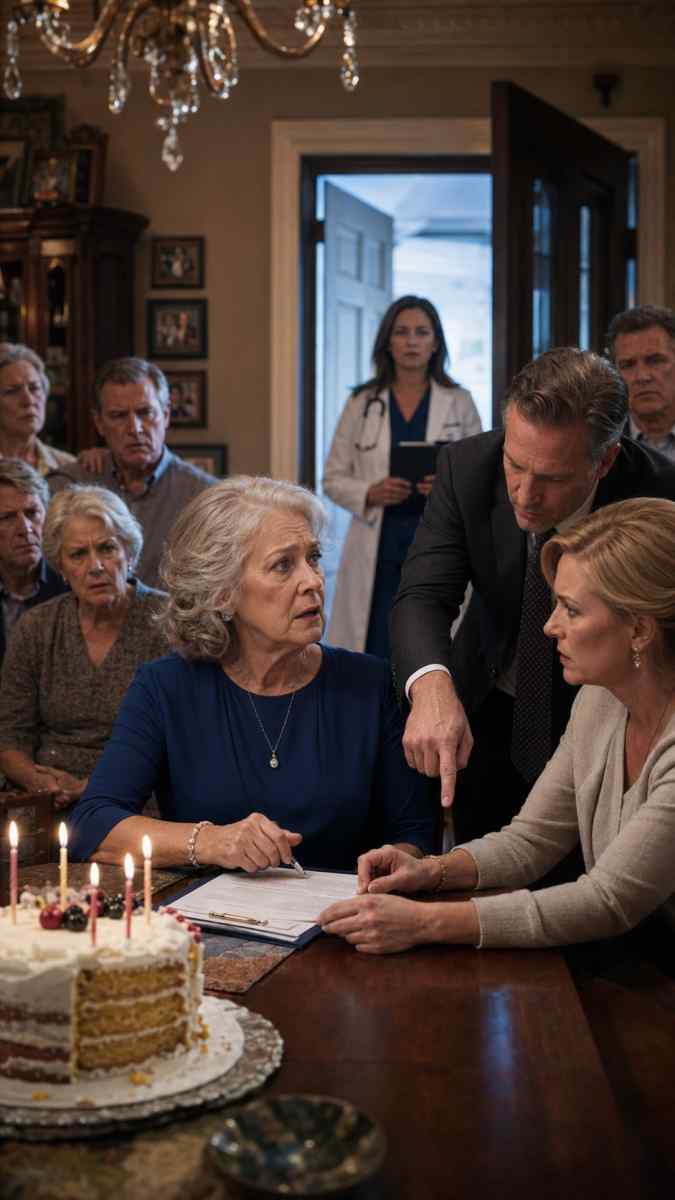
My daughter placed a memory-care contract beside my birthday cake and told twelve relatives that I was no longer capable of living alone.
Then her husband slid a pen toward me and whispered, “Sign tonight, Evelyn. By morning, the house won’t be your decision anymore.”
Before I tell you what happened when another woman walked through the front door carrying the original deed, follow our page for more stories about ordinary people who discover that growing older does not make their dignity negotiable.
I turned seventy-one on a cold Sunday in October. My daughter, Claire, had offered to host a “small family dinner” at my home in Lexington, Kentucky. By six o’clock, my dining room was filled with cousins I rarely saw, two neighbors from church, my younger brother, Claire’s husband, Richard, and my nineteen-year-old granddaughter, Sophie. Claire had ordered catering, arranged white roses around the room and placed framed family photographs on the mantel. At first, I thought the effort was kindness. Then I noticed that every photograph showed me after my husband died—alone, gray-haired and looking tired. There was not one picture of me running my accounting office, renovating the house or standing beside the rental properties I had managed for twenty-six years.
Claire waited until the cake was cut before tapping her spoon against a glass. “Mom,” she began, using the tender voice people reserve for children and the terminally ill, “we all love you too much to keep pretending everything is fine.” Richard lowered the lights. Sophie stopped eating. My brother stared at his plate as Claire produced a navy folder stamped with the silver logo of Hawthorne Grove Memory Residence. She had toured it twice. She had selected a furnished room overlooking a courtyard. She had even paid a nonrefundable deposit for admission on November first—twelve days away.
“You’ve been forgetting things,” Claire announced. “You missed a dentist appointment. You left your garage open. Last month, you accused Richard of taking papers from your office.”
“I did not accuse him,” I said. “I watched him.”
Richard gave the family a patient, wounded smile. “This is what we mean.”
Several relatives shifted uncomfortably. Claire opened the folder to a page marked FAMILY CONSENT PLAN. The monthly cost was $7,400. My home would be sold to pay for it, and Claire would receive temporary authority over my accounts during the transition. I read every line while the food cooled around us. For thirty-four years, I had been a forensic accountant. I had reconstructed bankrupt companies from coffee-stained receipts and discovered hidden money in corporations whose attorneys earned more in a week than I earned in a year. Numbers had never frightened me. But that document did—not because I misunderstood it, but because I understood exactly what my daughter was attempting.
“You reserved a room for me,” I said, “without asking whether I wanted one.”
Claire covered my hand with hers. “If we waited until you understood, it might be too late.”
Sophie inhaled sharply. My brother whispered Claire’s name, but Richard leaned forward. “Evelyn, nobody is taking anything from you. We’re protecting the value of the house before your judgment deteriorates further.”
There it was: the house.
My husband, Samuel, and I had bought it in 1988 for $92,000. Over the years, Lexington had expanded around us. A medical development company had recently offered $1.2 million for three adjoining properties, including mine. Claire knew about the proposal because I had mentioned it at Christmas. What she did not know was that I had rejected it. This was the home where Samuel had built Sophie’s first swing, where Claire had recovered after her divorce and where I had cared for my husband through seventeen months of cancer. It was not merely square footage waiting to become someone else’s parking lot.
Claire pushed the pen closer. “Please don’t make this harder than it needs to be.”
I looked around the table. Every person there had received some version of her story before arriving. Concern had already been organized into a jury. Most of them would have called me competent a month earlier. Now they watched to see whether refusing to surrender my life would prove I was incapable of managing it.
I picked up the pen.
Claire’s shoulders relaxed.
Then I drew a slow line through the signature box.
“I won’t need the room,” I said. “But it’s fortunate you paid the deposit.”
Her expression tightened. “Why?”
“Because you and Richard may need somewhere affordable after December.”
Richard laughed once. “What is that supposed to mean?”
“The house you live in has been sold.”
Silence fell so completely that I heard the old refrigerator switch off in the kitchen.
Claire’s chair scraped backward. “You cannot sell my house.”
“Then you should have learned whose house it was.”
Her face lost its color.
Fifteen years earlier, when Claire’s first husband disappeared with their savings, I had purchased the brick townhouse where she and Sophie still lived. I kept the title in a family holding company to protect it from her ex-husband’s creditors. Claire paid modest rent for three years. After she married Richard, the payments gradually stopped. I never complained. I believed a mother should not keep a ledger of every kindness.
That belief had nearly cost me my freedom.
Richard stood so abruptly that his wineglass overturned. Red wine spread across my white tablecloth as he pointed at me. “This proves she’s unstable. She thinks she can throw her own daughter into the street.”
“I don’t think I can,” I replied. “I know the closing date.”
Claire stared at me as if I had struck her. “You’re lying.”
Before I could answer, the doorbell rang.
Sophie rose, but Richard caught her wrist. “Nobody leaves this table.”
The bell rang again.
I folded the memory-care contract, placed it beneath my cake plate and looked directly at my daughter.
“That,” I said, “will be the woman who bought your house.”
Part Two — The File Beneath His Desk
The woman at my door was not the buyer.
It was Dr. Lillian Price, a neurologist Claire had never met but whose name was already written inside Richard’s folder.
Three weeks earlier, after finding my locked office drawer open and several tax records missing, I had begun preparing. I underwent a full neurological and cognitive evaluation at the University of Kentucky. Dr. Price tested my memory, reasoning, attention, language and ability to manage complex finances. I scored above average for my age in every category. She had come to return a notebook I had accidentally left in her office—and, at my request, to witness what my family intended to do.
Claire recovered first. “This is a private dinner.”
Dr. Price glanced at the memory-care paperwork. “Then perhaps my medical opinion should not be inside that folder.”
Richard quickly closed it.
I invited Dr. Price to sit. She declined dinner but remained near the doorway as I asked Richard to reopen his documents. He refused. Claire began crying, saying I had turned a loving intervention into a public attack. She told everyone I had become secretive, hostile and obsessed with property. Each accusation sounded polished because it was. They had repeated the same phrases in emails to relatives, calls to my church and a written statement submitted to my primary physician.
Dr. Price listened, then asked one question.
“Mrs. Mercer, who first suggested that your mother had dementia?”
Claire looked at Richard.
That glance told me more than any answer.
Richard had entered our family seven years earlier. He was charming, attentive and always willing to solve a problem nobody had asked him to touch. He described himself as a property investment consultant, although his business seemed to consist mostly of phone calls, lunches and promises. After marrying Claire, he convinced her that paying rent to my holding company was “an insult between relatives.” I let the payments stop because Sophie was starting college and Claire claimed they needed the money. Within two years, Richard installed a marble kitchen, leased two luxury cars and began talking about purchasing vacation properties.
Then his company failed.
At least, that was what he told us.
The truth was uglier. Richard had guaranteed loans for a development that never received zoning approval. He owed investors almost $600,000. If he could control the sale of my home and the townhouse, he could hide the loss long enough to find another deal. Hawthorne Grove was not a destination chosen for my safety. It was the fastest way to remove me from my own financial decisions.
Dr. Price removed a sealed envelope from her bag. “Mrs. Mercer completed a comprehensive examination seventeen days ago. She showed no evidence of dementia, mild cognitive impairment or compromised judgment.”
My brother released a breath. One church friend looked at Claire in disbelief.
Richard did not appear surprised.
That frightened me more than anger would have.
“You knew she was being tested,” Claire said to him.
“I knew she was seeing doctors. That doesn’t mean this doctor is right.”
“She is board-certified,” Dr. Price replied.
“Doctors disagree.”
“Yes. But ethical doctors generally examine patients before diagnosing them.”
Richard gathered the folder and walked toward the hall. Sophie stepped into his path. She was trembling, but she did not move.
“What else is in there?” she asked.
“Family records.”
“Records about Grandma?”
“Move, Sophie.”
She looked at her mother. “Tell him to open it.”
Claire wiped her face. “This has gone far enough.”
“No,” Sophie said. “It went too far before I knew it started.”
For weeks, Sophie had heard Richard and Claire whispering after midnight. She had seen Hawthorne Grove brochures hidden beneath bills. Two nights before my birthday, she found an unsigned guardianship petition on the home printer. It listed episodes that had never occurred: a kitchen fire, a fall down the stairs, a confused drive across state lines and an incident in which I supposedly failed to recognize my granddaughter.
Sophie had photographed every page.
When she said this, Claire looked genuinely horrified.
That was the moment I realized my daughter did not know everything Richard had done.
He had told her the petition was merely a safety measure. He had not shown her the invented incidents or the page authorizing him—not Claire—to control the proceeds from my property sales. He had built one story for the relatives, another for my daughter and a third for the court.
Richard’s voice became cold. “Sophie, you went into my private office?”
“You wrote that Grandma forgot who I was.”
“She called you Sarah last Thanksgiving.”
“Sarah is my middle name. She has called me that when she’s angry since I was five.”
A few relatives laughed nervously. Richard’s face hardened.
I asked Sophie to bring her phone. While she retrieved it, I told the family about the townhouse. The property was not registered in my personal name but in Mercer Family Holdings, a company Samuel and I created decades earlier. After his death, I retained fifty-one percent ownership. The remaining forty-nine percent had been placed in a trust.
Claire stared at me. “Whose trust?”
“Sophie’s.”
My granddaughter stopped halfway into the room.
Samuel had established the trust after Claire’s first marriage collapsed. He loved his daughter, but he had watched fear make her surrender too many decisions to stronger personalities. The townhouse was intended to provide Sophie with stability until she turned twenty-one. After that birthday, she and I would decide together whether to keep or sell it.
Sophie would turn twenty-one in December.
The buyer was prepared to pay $510,000. After the small remaining mortgage and taxes, Sophie’s trust would receive nearly half the proceeds. Claire and Richard had no legal ownership at all.
“You sold the place where I live,” Claire whispered.
“I accepted an offer after your husband tried to have me declared incompetent.”
“You’re punishing me.”
“No. I am refusing to finance the person helping you betray me.”
She looked toward Richard, perhaps expecting him to defend her. Instead, he was calculating again.
“How much goes to Evelyn?” he asked.
Every face turned toward him.
Not: Where will we live?
Not: What about Claire?
Only: How much?
Claire heard it too.
Dr. Price quietly excused herself after giving my brother a copy of her report. Before leaving, she warned me that anyone who had fabricated medical incidents might attempt something more aggressive once exposed.
She was correct.
At 2:14 the following morning, police lights flashed across my bedroom ceiling.
Two officers stood on my porch with Richard. He claimed I had threatened suicide, waved a gun and locked myself inside the house. Under Kentucky law, he said, I required an emergency psychiatric evaluation.
I owned no gun.
But when the officers searched the drawer beside my bed, they found one.
It was wrapped in Richard’s handkerchief.
And beneath it lay a note written in handwriting that looked almost exactly like mine.
Part Three — The Signature That Was Too Perfect
The note said I had become a burden and wanted to “leave the house before others could take it.”
For one terrible second, even I stared at the words in confusion.
Then I saw the letter E.
Throughout my career, clients had often misspelled Evelyn as “Evelynn.” To prevent errors on tax filings, I developed a habit of making the first E with a long lower stroke. The forged note copied that habit perfectly.
Too perfectly.
My personal handwriting had changed after arthritis stiffened my right thumb. For the past three years, I had written with my left hand. Richard’s note reproduced the signature I used on financial documents a decade earlier—the same signature found in company archives and on the original townhouse lease.
The officers listened as I explained. One remained skeptical until Sophie arrived wearing pajama pants beneath her winter coat. She showed them photographs of Richard’s guardianship petition and a message he had sent Claire three hours earlier: “If Evelyn becomes an immediate danger, the court won’t wait.”
Richard claimed the gun had always belonged to Samuel.
Sophie asked him to unlock his phone.
He refused.
That refusal did not prove a crime, but it changed the atmosphere. The officers placed the weapon in an evidence bag and asked Richard to leave. I agreed to a voluntary medical assessment, not because I doubted myself, but because I wanted an independent record created that night. At the hospital, I was found calm, oriented and in no danger to myself.
At seven in the morning, Claire arrived alone.
Her hair was unwashed, and she wore the same black dress from dinner beneath a wool coat. She stood beside my hospital bed holding Richard’s navy folder. There were no tears now.
“I opened everything,” she said.
Inside were debt statements, draft guardianship papers and emails between Richard and a real-estate broker named Mason Vail. The plan had begun five months earlier, when the medical developer increased its offer for my land. Richard expected to receive a management fee if he arranged the sale. Once I entered Hawthorne Grove, he intended to petition for emergency control, sell my home and transfer the proceeds to a new investment company.
Claire knew he wanted the house sold. She knew he was collecting examples of my supposed forgetfulness. She knew he wanted authority over my accounts.
But she claimed she had not known about the gun, the forged suicide note or the false medical incidents.
“Do you expect me to believe you?” I asked.
“No,” she said. “I expect you to decide after I tell you everything.”
That was the first honest sentence she had spoken in months.
Claire’s life had been built around a fear of instability. When she was twelve, Samuel’s construction business nearly collapsed. For almost a year, debt collectors called our home. We survived because I discovered that Samuel’s partner had been stealing from the company. I reconstructed the accounts, testified in court and kept our family from bankruptcy. Claire remembered none of that clearly. What she remembered was hearing us argue at night and seeing a foreclosure notice taped to the door before the case was resolved.
She grew up believing homes vanished whenever adults lost control.
When her first husband emptied their bank account, that childhood terror returned. I bought the townhouse and solved the emergency, but I never explained the ownership arrangement. I thought silence preserved her dignity. Instead, it allowed her to pretend she had rebuilt her life without help. Richard stepped into that illusion and promised she would never feel powerless again.
“I knew you weren’t helpless,” she said. “But I thought you were becoming stubborn. Richard said we had to act before you gave everything away or refused the developer’s offer.”
“I did refuse it.”
“I know.”
“Why?”
“Because he told me the land was worth twelve million dollars.”
I sat up.
The medical developer had offered $1.2 million for my property. The number was generous, but nowhere near twelve million.
Claire opened the folder to an internal planning map Richard had obtained through Mason Vail. The company did not merely want my house. It intended to construct a regional neurological hospital across nine acres. My property controlled the only viable entrance from the main highway. Without it, the surrounding parcels were nearly useless.
Richard had learned that the company was prepared to pay as much as $12.4 million.
He planned to purchase my property through an anonymous shell company for $1.2 million, then resell it to the developer. My supposed dementia would ensure I never understood the difference.
Claire lowered her head. “I thought some of that profit would save us. I knew it was dishonest, but Richard said you already had enough. He said Sophie would inherit money someday. He said nobody was being hurt.”
“You were placing me in a locked memory unit.”
“I told myself you would be safe.”
“You told yourself whatever allowed you to take what you wanted.”
She nodded.
I wanted to scream at her. Instead, I asked the hardest question.
“If the gun had worked—if the police had believed him—would you have spoken?”
Claire looked at me for several seconds.
“I don’t know.”
The truth hurt more than a comforting lie, but it was finally something solid.
Richard was arrested that afternoon after investigators found his fingerprint beneath the gun’s magazine and recovered footage from my neighbor’s doorbell camera. At 1:37 a.m., it showed him entering through my side door with a key Claire had given him months earlier. The forged note, the false report and the guardianship documents turned what he called a “family misunderstanding” into multiple criminal charges.
Mason Vail began cooperating immediately.
The scandal spread through our family. Relatives who had questioned my mind suddenly called to say they had “always felt something was wrong.” Church friends delivered casseroles. My brother apologized for remaining silent at the dinner.
Daniel, my nephew, asked why I did not expose everyone sooner.
“Because I needed evidence,” I said. “And because some betrayals are easier to recognize once people hear themselves defending them.”
Claire moved into a hotel. I did not invite her into my home. Sophie stayed with me during her college break, sleeping in the room where Claire had grown up. At night, I sometimes heard my daughter’s car pause outside. She never came to the door.
Richard’s bail hearing occurred one week later. His attorney argued that he had acted from sincere concern for an elderly relative. The prosecutor displayed the forged note, the medical report and emails detailing his expected profit from the land. Bail was set far beyond what he could pay.
As officers led him away, Richard turned toward Claire.
“You knew,” he shouted. “Tell them you knew the plan.”
Claire stood without answering.
He smiled then—not kindly, but with the satisfaction of someone who had saved his final weapon.
The prosecutor approached me after court. “Mrs. Mercer, we recovered another document from Mr. Langley’s computer. It changes the case.”
She handed me a copy.
It was a contract signed four months earlier, authorizing Richard to negotiate the sale of my land after I was declared incapacitated.
At the bottom was Claire’s signature.
And beside it, serving as witness, was Sophie’s.
Part Four — What My Daughter Finally Chose
Sophie denied signing the contract.
She did not cry or hesitate. She examined the page and pointed out that it used her full legal name, Sophia Rose Mercer, while she had signed everything as Sophie Mercer since middle school. Richard had copied her formal signature from the trust documents stored in my office.
Claire’s signature was genuine.
She admitted it before anyone tested the ink.
“I signed one page,” she told the prosecutor. “Richard covered the rest and said it allowed him to speak to the developer. I knew it involved Mom’s property. I didn’t know it depended on declaring her incompetent.”
The prosecutor asked whether Richard had forced her.
“No.”
“Threatened you?”
“No.”
“Then why did you sign?”
Claire looked toward me. “Because I wanted the money.”
That confession cost her.
She was not charged in connection with the planted gun, but investigators treated her as part of the attempted financial exploitation. Her cooperation reduced the consequences, yet it could not erase her choices. Richard eventually pleaded guilty to fraud, forgery, filing a false police report and attempted exploitation of a vulnerable adult. Mason lost his real-estate license. Hawthorne Grove refunded the deposit after discovering that Richard had misrepresented my medical condition.
But legal outcomes were the simple part.
Families do not heal because a judge signs the correct order. They heal, if they heal at all, through a slower process without court dates.
I canceled the sale of the townhouse. Not for Claire.
For Sophie.
At twenty-one, my granddaughter became co-trustee as Samuel intended. She chose to keep the property and rent it to a young family at a fair price. The income would fund graduate school. Claire moved into a modest apartment and began working full-time for the first time in sixteen years.
I did not rescue her from the move.
I helped carry one box.
Inside were the white roses from my birthday dinner, dried and brittle. Claire had kept them as a reminder of the night she almost surrendered her mother for a house she did not own.
“Do you hate me?” she asked as we stood in her empty apartment.
“No.”
Her face crumpled with relief.
“I don’t trust you,” I continued. “Those are different things.”
The relief disappeared, but she nodded.
We began meeting once a week at a counselor’s office. In the first session, Claire apologized for allowing Richard to manipulate her. I rejected the apology. It turned her into another victim and removed her responsibility. In the fourth session, she tried again.
“I knew you were competent,” she said. “I helped people doubt you because your competence stood between me and money. I used your age as a weapon. I am sorry.”
That apology I accepted.
Acceptance was not forgiveness. Forgiveness was not restoration. Restoration would require years of truth told when lying was easier.
Meanwhile, the medical developer returned with a new offer: $11.8 million for my property and an adjacent rental I owned. Their attorney assumed I would seize the money after learning how much the land was worth.
I declined again.
The newspapers later described me as sentimental. They were wrong. I negotiated.
The company received a ninety-nine-year lease for part of the land. I kept ownership, protected the old house and required the development to include a publicly funded clinic specializing in dementia evaluation and elder-abuse prevention. A portion of the lease income created the Samuel Mercer Legal Defense Fund, which helps older adults obtain independent medical exams and attorneys when relatives attempt fraudulent guardianships.
Dr. Price joined the advisory board.
So did Sophie.
The greatest surprise came six months after Richard’s conviction, when Hawthorne Grove invited me to speak to its staff. The residence itself had not participated in his fraud, but its admissions process had failed. Employees had accepted a deposit and prepared a room without ever speaking to the person who was supposed to live there.
I stood beneath the same silver logo that had appeared on Claire’s folder and told them, “If an older person is absent from every conversation about their future, you are not creating a care plan. You are assisting in a disappearance.”
Afterward, a woman named June approached me. She was eighty-two, elegant and furious. Her son had brought her to Hawthorne Grove after claiming she could no longer manage her farm. She whispered that she wanted a lawyer.
We found her one.
Her son had already listed the farm.
The sale was stopped four days before closing.
That became the real purpose of the fund. Not revenge. Not punishment. A locked door for people whose own families had begun measuring the value of the walls.
Claire asked to volunteer. My first instinct was no. I feared she wanted to transform shame into a performance of redemption. Sophie suggested giving her work nobody could praise publicly. So Claire began answering the private phone line on Tuesday nights, listening to frightened parents describe sons and daughters who had taken their keys, intercepted their mail or scheduled medical appointments behind their backs.
She was not permitted to offer legal advice. Her job was to listen, document and connect each caller with help.
After nine months, she told me about a seventy-six-year-old teacher whose daughter had hidden her glasses before a cognitive exam to make her appear confused.
“I wanted to drive to that woman’s house,” Claire said, “and tell her daughter exactly what she was doing.”
“What stopped you?”
“The realization that someone should have said it to me.”
There was no self-pity in her voice. That mattered.
On my seventy-third birthday, we held dinner at my house again. No catered food. No staged photographs. Sophie cooked pot roast from Samuel’s recipe. My brother brought a crooked chocolate cake. Dr. Price arrived with June, whose farm was now protected by a conservation trust.
Claire came last.
She carried the navy Hawthorne Grove folder.
For a moment, the room became still.
She placed it before me and opened it. The old contract was gone. Inside were handwritten letters from twenty-seven older adults whose homes or savings the legal fund had helped protect.
The last letter was from Claire.
Mom,
I used to believe security meant owning enough that nobody could take anything from me. Richard understood that fear and fed it until I was willing to take from you first.
You bought me a home when I had nowhere to go. I repaid you by trying to remove you from yours. No explanation can make that smaller.
I cannot ask you to forget. I can only become someone who no longer needs you to.
I closed the folder.
Claire was crying, but she did not reach for me or ask whether she was forgiven. For the first time in her life, she allowed an apology to exist without demanding immediate relief.
That was when I held out my hand.
She crossed the room and took it.
Not everything returned to what it had been. She never received a key to my house again. She did not manage my medical appointments or finances. Love did not require me to restore the access she had abused.
But she came every Saturday morning.
Sometimes we spoke. Sometimes we drank coffee in silence. The silence was different now. It no longer hid what one of us was afraid to say.
Sophie graduated two years later and entered law school. She plans to specialize in elder rights. The townhouse income pays part of her tuition, and she works the rest off at the fund. On the wall above her desk hangs a framed copy of Samuel’s trust.
Beneath it, she placed one sentence:
LOVE WITHOUT RESPECT IS ONLY CONTROL WE HAVE GIVEN A BEAUTIFUL NAME.
As for my house, I still live there.
I climb the stairs slowly. I occasionally forget appointments. Once, I left the garage door open all night. Age has not made me invincible, and independence does not mean refusing help forever.
Someday, I may choose a smaller home. I may need someone to manage my medications or drive me to the store. If that day comes, Sophie and Claire will help me—not because they have voted on my competence, but because I have written a plan that preserves my voice for as long as I have one.
The original memory-care contract remains in my desk.
Across the signature line, beneath the mark I drew through it, I eventually wrote four words:
ASK ME WHILE I’M HERE.
That is what Claire failed to do.
It is what too many families fail to do when an older parent becomes slower, quieter or less convenient. They speak around the person. They create plans in private. They confuse control with care and inheritance with entitlement.
Concern is not proven by how quickly you take someone’s keys.
Love is not proven by how gently you remove their choices.
And age does not turn a human being into a house waiting for its next owner.
My daughter once reserved a room where she thought I could be safely forgotten. Instead, that folder helped protect dozens of people she would never meet.
Perhaps that is the strangest kind of justice—not watching the person who hurt you suffer, but making certain the weapon they used cannot harm someone else.
If this story reminded you of someone whose voice is being ignored, call them before making another decision on their behalf. Ask what they want. Listen while they are still there to answer.
And if you believe dignity has no expiration date, share this story and follow our page for more stories about family, courage and the quiet strength of people the world mistakes for powerless.