Before we step into the desert heat and the eighty-three seconds that no official record will ever admit happened, I need you to know this: the quietest people in the room are often the ones who have already survived what the loud ones only train for. If stories of underestimated strength, buried files, and the moment arrogance finally meets its match keep you turning pages long after midnight, stay with me.
“Take her weapon. Now.”
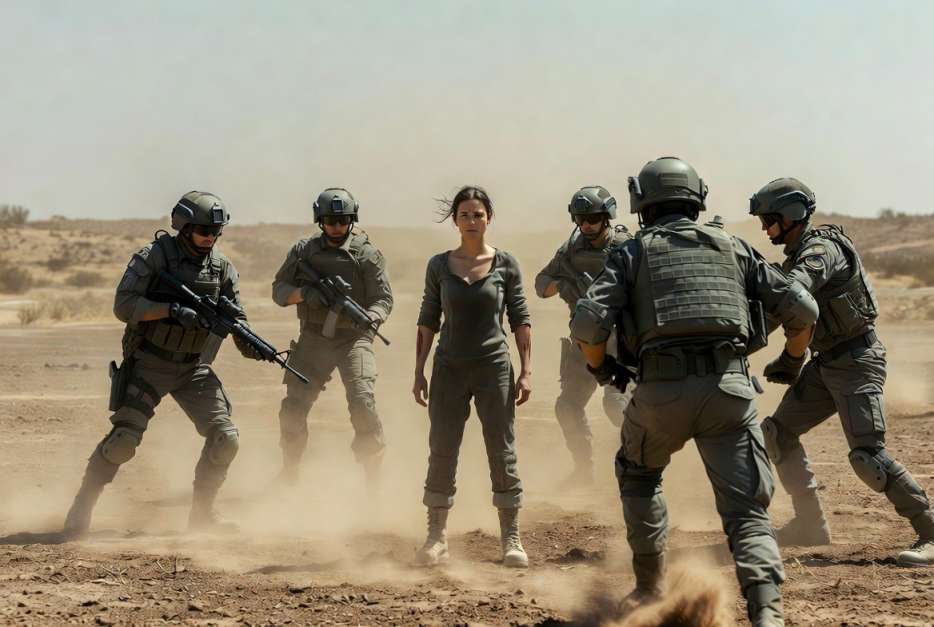
The order cut through the Arizona afternoon like a blade drawn in silence. Five instructors moved without hesitation, closing a circle around the woman in civilian boots and a plain gray shirt. What happened next would not appear in any after-action report. It would not be discussed in open channels. It would simply vanish—along with the assumption that every candidate who walked through the gates of Camp Ironveil could be measured, ranked, and broken on schedule.
Three weeks earlier, the convoy had rolled to a stop at South Gate under a sky the color of hammered copper. Seventeen candidates stepped out into heat that felt personal. Most of them carried the same tight jaw, the same caffeine tremor, the same wide-eyed calculation of how long they might last. One of them did not.
Sergeant Cole Brennan watched from the shaded platform above the processing line and felt the first wrong note. The woman’s file photo did not match the person standing in the dust. No unit patch. No issued boots. Just a quiet posture that suggested she had already counted the exits, the blind spots, and the number of people who would need to move if something went sideways.
Her name on the manifest was Lena Voss. Seven pages. Vague postings. No medals. One line buried at the bottom that made Commander Mara Hale’s skin go cold when she first read it: Previous clearance—Shadow Archive. Status: sealed.
Brennan muttered to no one in particular, “She’s not green. She’s just covered in dust.”
He had no idea how right he was.
The first outdoor assessment began the next morning on Range Shadow-9. Brennan walked the formation like a man inspecting livestock. Most of the candidates looked exactly as expected—lean, eager, still measuring themselves against each other. Lena stood with her hands loose at her sides, eyes half-lidded against the glare. Private Avery Quinn, third of seven children and therefore skilled at noticing what others overlooked, felt the hair on her neck lift. The woman beside her did not scan for approval. She did not stumble over new protocol. She simply occupied space as if the ground had already decided she belonged there.
When the weapons drill began—field-strip the M-17 adaptive carbine, clean, reassemble, fifteen minutes—most recruits fumbled. Some panicked. Lena approached the rifle as if it might bite. Her fingers moved slowly, uncertainly. Avery watched the hesitation and felt something colder than the desert wind. Every part came free with the quiet certainty of muscle that had done this in the dark, under fire, with blood on the hands. She finished in five minutes and forty seconds, then sat back and looked mildly lost, as if the whole thing had been luck.
Avery whispered to herself, “That’s not struggling. That’s camouflage.”
Brennan never noticed. His attention was already fixed on the next way to make the quiet woman break.
The harassment sharpened each day. Brennan’s voice grew more theatrical, more personal. He found fault in her stance, her breathing, the way she laced her boots. Lena answered every correction with the same two words, delivered without edge or apology: “Yes, Sergeant.”
Avery started timing her morning runs. Seven minutes, forty-five seconds per mile. Every single day. Not a pace. A calibration.
On the range, Brennan stationed himself directly behind her, arms crossed, ready with the next demeaning line. Targets sat at standard qualification distance. Around them, candidates fought the basics—grip, breath, trigger control—producing a scatter of holes that told the truth about nerves. Lena raised the carbine as if consulting a memory she only half trusted. She fired five times, each shot spaced with deliberate care.
When the target came back, Master Gunner Frank Voss, a man who had trained special-operations teams for twenty-two years, went pale. Five rounds. One ragged opening dead center in the bull’s-eye. He had seen groupings like that three times in his life. Every name attached to those groups had later been redacted from records that were not supposed to exist.
Brennan dismissed it as luck and walked away still clutching the story he preferred.
Hand-to-hand came next. Brennan’s style was pure dominance—slam them hard enough and the lesson sticks. Lena was paired with a former college wrestler who outweighed her by seventy pounds and had never lost on a mat. She looked uncertain. The technique she used was textbook, the one Brennan had demonstrated. The big man hit the ground with a sound that made nearby candidates wince. He stood, nodded, and the drill should have ended.
Avery saw what Brennan missed. The weight shift a half-second early. The millimeter adjustment of grip. The leverage that was cleaner, faster, and older than anything taught on this range. When Brennan told her to use more force and less finesse, Lena simply nodded. The nod did not say agreement. It said she had already done this with people who mattered more.
By the end of week three, the entire cadre had decided Lena Voss was the administrative mistake of the cycle. Soft. Civilian. Out of place. Avery alone kept watching the way the woman absorbed every insult the way stone absorbs rain—without changing shape.
Then Major Drake called the Reality Check.
Thirty seconds against five of Camp Ironveil’s best. Fail and you were gone, black mark forever. He looked straight at Lena when he said it. “You’ve struggled with basic competencies since day one. Let’s see if anything from your civilian life translates.”
Avery felt her stomach knot. Every instinct she had ignored since the first day began screaming the same quiet warning: they had picked the wrong person.
Word spread before dawn. Soldiers from every unit found reasons to stand along the perimeter of Range Shadow-9. Medics laid out trauma kits. Field officers folded their arms and waited. Commander Hale had spent the night rereading the sealed line in Lena’s file. Archival tier. Observe only. Classified under shadow folder.
The five chosen men stretched in the early light like men who already knew the ending. Rook. Vance. Keller. Soto. Draven. They had planned it the night before—overwhelm with speed and angles, end it clean, make the humiliation complete.
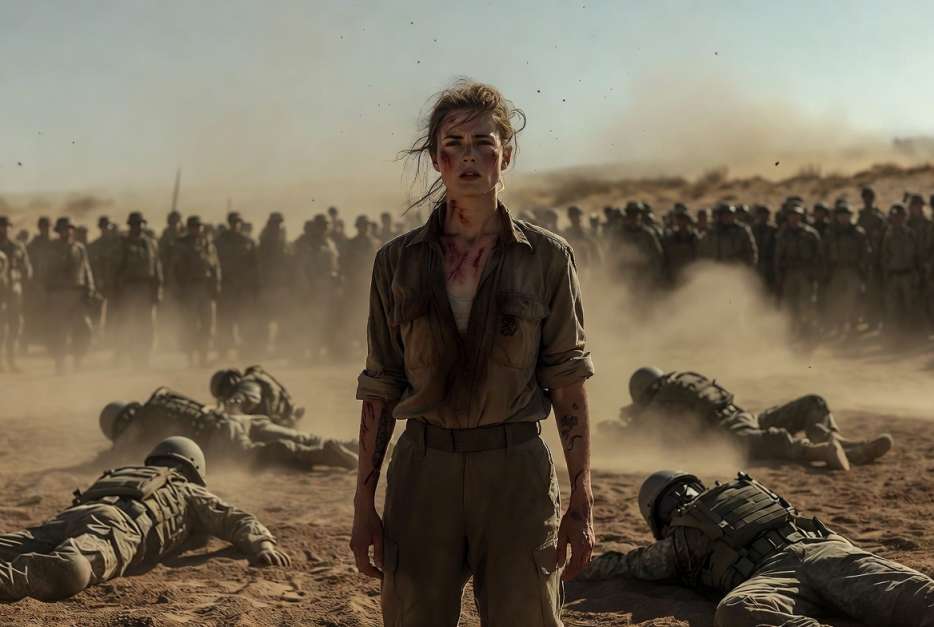
When Lena stepped out of the equipment bay, the air changed. Her gait was different—centered, efficient, conditioned rather than trained. She rolled up her sleeves. The scars did the talking her file never would: bullet tracks, surgical cross-hatches, the white memory of shrapnel. Commander Hale exhaled once, soft and final. “She’s not a candidate,” she said under her breath. “She’s a relic.”
Major Drake raised the whistle. “No weapons. Stay standing or surrender. Any last words?”
Lena turned. Her voice was steady, almost conversational. “Just one. When this is over, will you finally admit you never knew what you were looking at?”
The whistle blasted.
Rook came first—two hundred thirty pounds of forward momentum, shoulder lowered like a freight train. Lena moved exactly eight inches left at the last possible instant. Not a retreat. A redirection. Her hand touched the base of his neck once. He collapsed as if the foundation of a building had simply decided to leave.
Vance and Keller came from opposite flanks. Physics betrayed them. They collided in the space she had already vacated. Before either could rise, a palm strike deadened one shoulder; a precise kick locked the other knee. Done.
Soto dropped low, reaching for legs that were no longer where legs should be. She rose above him like smoke. The elbow found the base of his skull with clinical economy. He folded.
Less than twenty seconds. Only Draven remained—the strategist, the silent one. His hands had begun to tremble. He was no longer looking at a sparring partner. He was looking at a language he did not speak.
He stepped back. Then again. “I yield.”
The words barely carried. Lena did not smile. She moved among the fallen with the same quiet care a medic might use, checking each man for lasting damage. Only pride had been broken.
Private Avery Quinn started clapping. Soft at first. Then louder. Others joined until the entire range stood, not in celebration, but in the stunned recognition that they had been in the presence of something extraordinary and had been too certain of their own eyes to see it.
Eighty-three seconds. Lena picked up her towel, slung her bag, and walked away with the same unhurried grace she had shown the day she arrived.
Commander Hale saw the tattoo beneath the rolled sleeve as Lena passed—six parallel lines, one of them crossed out. The mark of Unit Phantom. The unit that never existed on paper. The seventh line crossed out meant she had been presumed dead.
Within hours Lena Voss was quietly reassigned. New title: advanced combat instructor. Her true past remained sealed. Her name was never spoken aloud again on the open channels of Camp Ironveil.
But the eighty-three seconds refused to stay buried in the minds of those who had watched. For years afterward, instructors would lower their voices when the story surfaced, the way people lower their voices around graves.
The official explanation never came. The footage never surfaced. Clearance levels that do not officially exist closed over the event like desert sand over tracks.
Here is the part the system never intended anyone to know.
Lena Voss was never a candidate.
She had been the last living operator of Unit Phantom—the team whose methods had been stolen, diluted, and turned into the very training doctrine Camp Ironveil now taught with such confidence. After the unit was erased in a mission that left her the sole survivor, higher command decided the doctrine itself had grown soft, arrogant, and dangerous. They needed proof. They needed the original.
So they sent her in under a clean file and a false name, ordered to do nothing but observe—until the moment the instructors forced her hand. The Reality Check was never meant to happen. When it did, she simply reminded them what the original standard looked like.
The five men she put down were not random elites. They were the current instructors of the very curriculum built from her old unit’s bones. Their failure was the point. Their arrogance was the data.
That is why the footage remains buried. Not because the military is ashamed of a quiet woman. Because it is ashamed of how thoroughly it had forgotten what real lethality looks like when it no longer needs to shout.
Lena still walks the ranges some mornings, sleeves rolled, scars visible only if you know where to look. New candidates still underestimate the calm ones. She never corrects them out loud. She simply waits. And every so often, when the heat shimmers just right and the wind carries the right memory, someone on the line will finish a drill a little too cleanly, a little too fast, and Avery Quinn—now a senior instructor herself—will catch Lena’s eye across the sand and give the smallest nod.
The rules were rewritten in eighty-three seconds. Most people will never know. The ones who do never forget.
If this story stayed under your skin the way it stayed under mine, share it with someone who still believes the quiet person in the room has nothing left to prove. There are more buried truths waiting. I’ll bring the next one when the clearance dust settles.