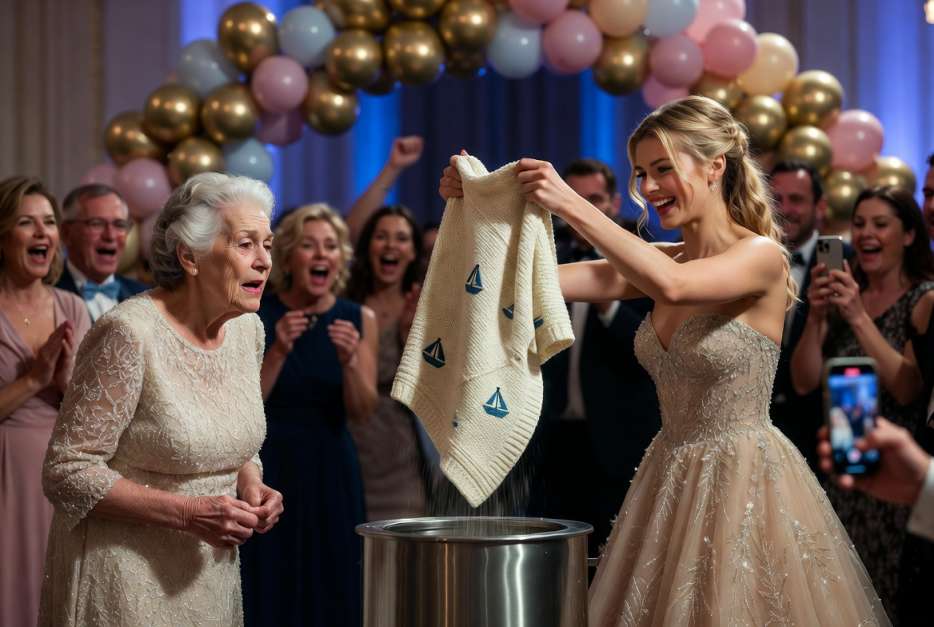
The second the blanket hit the bottom of that stainless-steel trash can, every polite conversation in the room died. My daughter-in-law tilted her head for the camera, flashed a perfect smile, and said the six words that would crack our family open: “We only use designer things here.”
I am sixty-eight years old. My name is Margaret Hale. For four decades I ran a small alterations shop on Maple Street, the kind of place where women brought wedding dresses that needed one last prayer and men brought funeral suits that needed to fit one last time. I know the difference between something that costs money and something that is worth everything. That afternoon, in a living room full of peonies and gold balloons, my daughter-in-law taught me that some people still cannot tell the two apart.
I did not raise my voice. I did not cry in front of twenty people and a phone that never stopped recording. I simply walked to the trash can, lifted my blanket out, brushed off the torn wrapping paper, folded it the way I fold everything—corners sharp, edges clean—and walked out the door.
My son called me three hours later. His voice was already broken.
“Mom… what was inside that blanket?”
I sat at my kitchen table with the cream wool still smelling faintly of banana peels and floral garbage bags. My husband’s last gift was still sewn into the lining, safe. I answered him the only way I could.
“Why do you ask, Michael?”
That is where the real story begins.
Part 1
Frank had been gone ten months when the invitation arrived. Heavy cardstock. Gold edges. A dress code for a baby shower. I almost laughed. Frank would have muttered something about people who spend more on paper than on people. But Frank was not here to mutter. He had died on a Tuesday in March, the same quiet way he had lived—no drama, no long goodbye, just a hand that grew cold in mine while the machines kept beeping like they still believed they could save him.
He had left me one clear instruction.
A week before the end, when we both knew the calendar was lying, he asked for the old cigar box on the top shelf of his closet. I had never opened it in thirty years of marriage. Inside were savings bonds, stacked by year, rubber-banded the way only a careful man would stack them. On the envelope, in his blocky pencil: For our first grandbaby.
“I started these the year Michael turned ten,” he told me, voice thin but eyes clear. “Figured someday there’d be a little one. Wanted to hand them a head start nobody could take away.”
He told me the total. Just under fifty thousand dollars. Then he told me the part that mattered more than money.
“Don’t just give them an envelope, Maggie. They’ll buy a stroller and forget. Sew it into something. Make her open the blanket. Make them find it. Make it last.”
So I knitted.
Cream wool soft as cloud, tiny blue sailboats along the border because Frank had loved the water more than any boat he never owned. In one corner, small enough to miss unless you knew to look, I put his initials—F.H. Four months of work. Some mornings my fingers refused to close around the needles until I ran them under hot water and coaxed them like stubborn children. Arthritis does not care about love. It only cares about how much you are willing to pay.
On the underside I sewed a flat pocket the way I used to hide travel money in coat linings for nervous customers. Into that pocket went every bond and one sealed envelope that said: To be opened when you’re eighteen. Love, Grandpa Frank.
I wrapped the blanket in plain cream paper. No gold edges. No designer ribbon. Just a soft blue bow the color of the sailboats.
I walked into that shower carrying thirty years of a dead man’s patience and four months of my own ruined hands. I walked in happy.
That was my first mistake.
Sophia sat under a balloon arch the color of expensive silence. Her mother, Diane, narrated every gift like an auctioneer. Cashmere onesies. A stroller that cost more than my first car. A diaper bag with a name I could not pronounce. Each one held up to the camera, brand announced, giver tagged in the air.
My box was last.
Diane read the tag with the gentle condescension people reserve for children’s macaroni art. “From Grandma Margaret.”
Sophia pulled off the paper. For one heartbeat I saw her register the handmade unevenness, the thing magazines now call “artisan.” Then her nose wrinkled the way it does when something common walks into a room that has been carefully curated against common things.
“Oh,” she said. “Did you make this?”
“I did, sweetheart.”
I started to lean forward, ready to tell her about the seam, about Frank, about feeling along the bottom.
She was already talking over me, to the room, to the phone.
“That’s so sweet. It’s very… homemade.”
Diane laughed that tinkling laugh. “Bless her heart.”
Then Sophia stood, blanket over her arm, and walked to the tall steel trash can at the end of the gift table.
“Okay, so,” she said, laughing for the camera, “I love Grandma, but we have a whole aesthetic for the nursery, and—” she held the blanket out over the open can—“we only use designer things here.”
She let go.
The room laughed. Not everyone. Just enough. The nervous follow-the-leader laugh of people who have decided the powerful person in the room is the one being funny.
My son stood against the wall, pale, mouth open, then closed. He said nothing.
That was the second that still lives in my chest.
Not the blanket in the bin.
My son’s mouth closing.
I stood. Walked to the can. Lifted the blanket out. Folded it. Put it in my bag.
“It’s all right, dear,” I said, voice steady. “It’s not really your kind of thing. I’ll keep it.”
Then I left.
In the car I held the blanket against my chest and smelled garbage and cried until the tears stopped and something colder and clearer took their place.
Frank’s last wish had been make it last.
You cannot hand a legacy to someone who throws legacies away for content.
The phone rang as I walked into my kitchen.
It was my sister-in-law, Carol.
“Margaret… after you left I told Michael. About the bonds. About the letter. The look on his face—”
I closed my eyes.
Three minutes later my son called, voice already breaking on the single word Mom.
“Please tell me you took the blanket home. Please tell me you have it.”
“I have it,” I said. “It’s safe.”
He exhaled like a man coming up from deep water.
Then he asked the question the whole day had been driving toward.
“Mom… what was folded inside that blanket?”
I looked at the cream wool on my table, the pocket still sealed, Frank’s thirty years of patience still hidden.
And I knew the next words would change everything.
Part 2
I told him the truth without softening it.
“Your father’s savings bonds, Michael. All of them. Every birthday and every bonus for almost thirty years. They’re worth forty-seven thousand dollars. And the letter he dictated in the hospital for the baby to open at eighteen. So a boy who will never meet his grandfather can still hear from him.”
Silence on the line.
Then the sound I had not heard from my son since he was small—raw, helpless, breaking.
“I didn’t stop her, Mom. I was right there and I didn’t stop her.”
I let him cry. Sometimes that is the whole job.
Later he told me what those minutes after the blanket dropped had been like. Standing by the wall, swallowing the urge to cross the room because Sophia was laughing and the phone was rolling and making a scene would have ruined her day. Telling himself it was just a blanket. Choosing easier, the way he had chosen easier for years.
Then Carol appearing at his elbow, shaken, saying the words that made the floor disappear: fifty thousand in bonds… your father’s last letter… just like Frank wanted.
He said he turned and looked at the empty trash can and for one horrible minute believed the gift was gone—hauled to a curb because he had stood there and laughed the little nervous laugh.
He walked out of the party without speaking to his wife. Sat in the driveway with his hands shaking on the wheel. Then called the only person who would know.
That night he told Sophia.
I was not there, but I heard both versions later, and the difference tells you everything.
Michael’s version: he sat her down shaking and told her what she had thrown away on camera. Her first words were not oh my God or is it gone. Her first words were: “Well, how was I supposed to know? Who sews money into a blanket? That’s insane. This is kind of her fault, honestly.”
Sophia’s version, when it reached me: she had been blindsided, made to feel terrible over an honest mistake, and nobody appreciated how stressful planning a shower was.
Not once, in any telling, did she say I’m sorry and mean it.
I made my decision that same night.
I did not lock the bonds away to be cruel. I locked them away because a woman who answers throwing a dead man’s heart in the trash with “honestly, that’s kind of her fault” is not a woman you hand an unlocked inheritance to.
The next week I went to the bank. A kind young man confirmed the total. Forty-seven thousand and change. Then I sat with a woman named Patricia who handles these things and set up an education trust for the baby—Oliver, though they did not know the name yet. Locked. Administered independently. The money would go to the child and only the child. Not to Sophia. Not to Michael. Not to me.
It cost me something to lock my own son out too. I will not pretend otherwise. But Frank’s wish had been for the grandbaby, and the cleanest way to honor a wish is to make it impossible to bend.
I kept the original letter. I made no copies. And I planned a family dinner.
Sunday. My house. Everyone.
Carol arrived early to stand at my shoulder the way Frank would have wanted. Michael came gray and quiet, carrying the newborn who had arrived on a rainy Thursday with his grandfather’s exact frown. Sophia came polished again, wary. Diane came because missing it would have looked worse than attending.
I had set the table with the good plates and the pot roast that smells like forty years of ordinary love. In the center, where the flowers would usually go, I laid the blanket. Washed clean. Sailboats bright. Frank’s initials in the corner. Inner pocket facing up.
Sophia’s eyes went to it the second she walked in. Her face did something complicated. I think she had hoped the uncomfortable thing would simply disappear the way uncomfortable things do for people used to having discomfort handled for them.
We ate first. I insisted. You do not do the hard thing on an empty stomach.
Then I cleared the plates, sat back down, and put my hand flat on the cream wool.
“I’d like to give Oliver his gift from his grandfather now,” I said. “Properly this time. The way Frank asked me to before he died.”
The table went still.
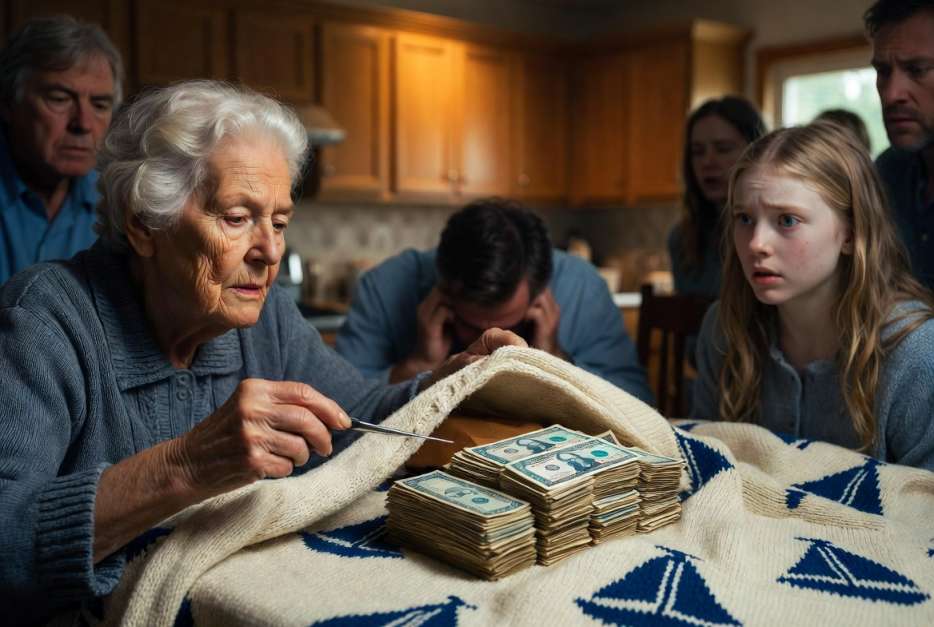
I picked up the seam ripper.
Part 3
I opened the pocket slowly, the little tool sliding through stitches I had sewn with such care. One by one I laid the contents on the clean table like a banker counting a fortune.
“These,” I said, setting down the thick rubber-banded stack, “are United States savings bonds. Your father bought them, Michael. A few at a time, every birthday and every bonus, starting the year you turned ten. The envelope in his closet said For our first grandbaby. They came due this year. They’re worth forty-seven thousand dollars.”
The number moved around the table like cold air.
“And this,” I said, setting down the sealed envelope gently, “is the last letter your husband ever wrote. He dictated it in the hospital. It’s for Oliver to open on his eighteenth birthday, so a boy who will never meet his grandfather can still sit down someday and hear from him.”
I looked directly at Sophia. My voice stayed warm and steady, which somehow made it worse.
“This is what you held in your hands at the shower. Forty-seven thousand dollars and the last words of a dying man. This is what you called homemade. This is what you dropped in the trash can on camera in front of twenty people because it didn’t match your aesthetic.”
Nobody breathed.
Sophia reached for the version where she was the victim.
“You can’t put this on me. How was I supposed to know? Who sews fifty thousand into a blanket and doesn’t tell anyone? That’s a trap. You set me up.”
“I didn’t let you do anything,” I said. “Your husband’s father asked with his dying breath that the gift be hidden in something handmade so it would be treasured instead of spent. I honored him. I assumed—foolishly, I’ll grant you—that no one would throw a handmade blanket in the garbage. That assumption was my only mistake. The throwing was entirely yours.”
“It was a joke,” she said. “It was for the—”
“Camera,” I finished gently. “I know. That’s rather the whole problem.”
I folded my hands.
“You only use designer things, Sophia. You told the whole room. So you took the only priceless thing you were given that day and put it in the trash because it didn’t come with a logo and because your friend was filming and because you have been taught your entire life that worth is something printed on a tag. There is no tag on love. There is no brand on thirty years of a man saving for a child he knew he might not live to meet. You couldn’t see it because you’ve never been taught how to look. And it nearly cost your son his inheritance and his grandfather’s last words.”
Diane started to speak. I looked at her once.
“Diane. You taught her how to look. I’d sit this one out.”
She sat it out.
Then I told them what happened next.
“Oliver gets every cent. Frank saved it for the baby and the baby will have it. But not the way it was meant to be given. I can’t hand an open inheritance to a household that throws legacies in the trash for content. This money is going into a locked education trust administered independently for Oliver and Oliver alone. It cannot be spent, borrowed against, or touched by his parents. Not by Sophia. Not by you, Michael. Not by me.”
Michael nodded slowly. I saw the ache in him—the locking out included him, and he did not argue because he knew he had earned it by the wall that day.
“And the blanket,” I said, “comes home with me tonight. Oliver can have it when I see it will be honored and not before. A thing isn’t safe in a house that didn’t know it was precious.”
Sophia opened her mouth. Michael spoke first, in a voice I had never heard him use with her.
“Sophia. Don’t. Not one more word. Not about the blanket. Not about whose fault. Not one more word.”
For the first time since I had met her, she closed her mouth and kept it closed.
It had taken forty-seven thousand dollars and a dead man’s letter to give my son a spine. But there it was.
There was one thing left.
“Frank wrote one part for all of us,” I said. “A little opening for the day the family first learned about the gift. He made me promise to read it out loud when that day came.”
I took a second, smaller envelope from my cardigan pocket. My hands shook—not from arthritis this time.
I read my husband’s words in my kitchen with his grandson asleep in his son’s arms.
Part 4
“If you’re hearing this,” I read, “then the little one has finally arrived, and I’m sorry I couldn’t be there to be a nuisance about it. I’ve been saving for this baby since Michael was ten years old, because the best thing my own grandfather ever gave me wasn’t money. It was the proof that someone was thinking of me before I existed. That’s what’s in this blanket. Proof you were wanted, little one, by an old man who never got to meet you. Spend the money on something that lasts. And whatever you do—” my voice broke, and I let it—“be the kind of family that knows the difference between what a thing costs and what a thing is worth. Your grandmother does. Learn it from her. All my love, Frank.”
Carol was weeping openly. Michael had his face pressed to the top of his sleeping son’s head, shoulders shaking. Sophia stared at the blanket on the table—the one she had thrown away—and for the first time, I think, actually saw it.
It was too late for easy forgiveness. But it might have been the beginning of learning how to look.
I folded the letter back into its envelope.
“I didn’t do this to humiliate you, Sophia,” I said, “though I understand it feels that way. I did it because that baby is going to grow up in your house learning your values, and someday he’s going to need to know there was another way to measure things. The bonds are for his future. The letter is for his heart. And the blanket—” I rested my hand on it—“is just to remind everyone, including me, that the most precious thing in a room is almost never the most expensive one.”
I looked at my son.
“Michael. You stayed quiet at that shower because quiet was easier. You’ve stayed quiet your whole life because it was easier. I’m not angry at you. But I need you to hear me as your mother. The blanket survived because I refused to be quiet about what it was worth, even when being quiet would have been so much more comfortable. That’s the inheritance, son. Not the bonds. That.”
He nodded. He could not speak. He did not need to.
“I’m Oliver’s grandmother,” I said to the whole table. “Not optional. Not a thrift-store relative you tolerate at holidays. I made that baby a blanket with hands that don’t work the way they used to, and I will be in his life fully, or this family and I will have a much harder conversation than this one. Those are the terms.”
Nobody argued with the terms.
In the months that followed, the trust sat quietly doing exactly what Frank intended—waiting, patient, thinking in decades the way he always had. Brooke’s video of the trash-can moment had already been seen by more of the family than Sophia realized. She took it down the day Michael told her the truth, but the internet keeps what it is given. She spent a long quiet season being known in her own circle as the woman who threw away her child’s inheritance for a laugh. I did not do that to her. She filmed it herself.
Diane and I are not close. We never will be. But she has stopped saying “bless her heart” to me, which I count as a small diplomatic victory.
Sophia and I are careful. She has never fully apologized. She is not built for it. But three weeks after the dinner she asked me, in a small voice, if I would teach her to knit. I said yes. We made a lopsided, ugly, wonderful little hat for Oliver together. Her first handmade thing. She kept it. She did not throw it away.
It is a start.
Michael changed the most. Grief and shame did to him what forty years of comfort never could—they grew him a backbone. He came to me alone one evening, sat at the same kitchen table where the blanket had been, and said, “I’ve been replaying the shower. I keep landing on the same thing. I didn’t fail Dad when I let the blanket go in the trash. I failed him a hundred times before that. Every time I stayed quiet to keep Sophia happy. The blanket was just the one I couldn’t unsee.”
“That’s a hard thing to know about yourself,” I said.
“You knew it about me for years. Why didn’t you ever say?”
“Because some things a person has to find for himself. I could have told you a thousand times. It took a blanket in a bin to make you believe it.”
He is different now. He speaks up. He and Sophia are in counseling. He still keeps Frank’s old fishing hat on the hook by the door, but now he has told Oliver he will teach him to fish himself—the way Grandpa would have.
“I’m still learning how not to choose easier,” he told me. “But I’m choosing it on purpose now. That’s new.”
It is. And I am proud of him. Better late.
The blanket lives on Oliver’s crib now. It took a few months—long enough for me to be sure the house it was going into had learned, even a little, what it was holding. When I finally brought it over, Sophia had cleared a place of honor. She had put away the designer throw that used to be there. She did not say a word about aesthetics. She just watched me lay Frank’s sailboats over her son, touched the corner with the initials, and said quietly, “F.H. I never even noticed that was there.”
“Most people don’t,” I said. “You have to know to look.”
My hands are worse this winter. Some mornings the needles win and I cannot knit at all. But I am making Oliver a sweater—slowly, a few rows on the good days—with his grandfather’s initials hidden in the cuff where he will find them someday if he knows to look.
Because that is what we do, the homemade grandmas. We sew ourselves into things quietly, and we wait.
Frank taught me that. Time pays interest on patience.
If there is one thing I would hand you from all of this, it is this: the world will tell you, louder every year, that worth is a thing you can read off a label. That the expensive gift is the real one and the homemade one is sweet but lesser. Do not believe it. The most valuable things in any room are almost always the quiet ones—made by hand, given without logos, easy to throw away if you have never been taught how to look.
Learn how to look.
And whatever you love, sew it into something that lasts. Never let anyone tell you it belongs in the trash.
That is my story. One homemade blanket. One trash can. And a love worth more than the whole designer room.
If this story reminded you of a handmade gift you still treasure, tell that person tonight. And if you believe love is measured by more than price tags, stay with me—there are more stories waiting.