The divorce papers hit the marble counter like a gunshot.
I signed them with a hand that didn’t feel like mine, while the twin pink lines on the pregnancy test still glowed under the kitchen light. Three years of marriage. Three years of cooking his soft meals for that stubborn stomach. Three years of pretending I didn’t notice how his eyes never quite landed on me the way they once landed on my sister. And now David wanted out—clean, cold, and twenty million richer if I signed before the contract expired in thirty days.
I should have cried. Instead, I laughed. A small, broken sound that tasted like metal.
My name is Elena Voss. For seven years I loved a man who never chose me. When my sister Lila fled the country two weeks before their wedding, our families shoved me into the white dress so the business alliance wouldn’t collapse. David signed a three-year contract the night we married. No feelings. No future. Just convenience and a clock ticking toward freedom. I told myself I could make him fall. I studied recipes for his ulcers. I learned pressure points for his migraines. I became the perfect shadow wife.
Then Lila came home.
She stepped off the plane looking like a storm that had forgotten how to stop raining—thinner, harder, still the center of every room. Our parents orbited her like planets. David’s sleeve was wet from holding the umbrella over her head while the rain soaked him through. I watched them from the doorway of my childhood home and felt the old story rearrange itself around me: Lila the heroine, David the prize, Elena the footnote who holds the place until the real love returns.
Something inside me snapped that night—not into pieces, but into something sharper.
I refused the extra twenty million. I refused to disappear. And when David spat that he’d had a vasectomy years ago, that the child couldn’t be his, I looked him dead in the eye and said the one thing he never expected from his quiet, obedient wife:
“Then whose baby is it, David? Because you’re the only man I’ve ever touched.”
His face went white. Mine stayed calm. For the first time in three years, I wasn’t performing gentleness. I was performing war.
The next weeks became a slow, exquisite torture. I clung to his arm at family dinners. I ordered him to fetch fish across the table while Lila watched with hollow eyes. I slept until noon and left his coffee cold. When his stomach rebelled after a night of spicy hot pot with my sister, I brought him hospital porridge made from leftovers and told the nurse it was a shame to waste good food. Watching the vein pulse in his forehead became my favorite sport.
Then Simon Kane walked into the hospital corridor.
David’s archenemy. Tall, refined, the kind of man who looked like he belonged on a magazine cover and ruined lives for sport. He had tried to steal Lila once. He had tried to charm me after the wedding. I used to think he was just another shark circling. That day he leaned against the wall outside David’s room, gold-rimmed glasses catching the light, and said softly, “Making that man bleed looks good on you, Elena.”
I stepped on his foot hard enough to make him hiss. He only smiled wider.
I decided then: I would keep the baby. I would raise it alone in some quiet town far from both of them. I would not hand my child over like a plot device in someone else’s love story. The doctor confirmed what the nightmare book in my head had already whispered—abortion could kill me. So the child stayed. My bloodline. My future. Not theirs.
The night I finally signed the divorce papers—after selling my exit to Lila for five million cash—I walked out of my parents’ house with nothing but a suitcase and a hollow chest. No one stopped me. No one asked if I was okay. I was the supporting character exiting stage left so the leads could have their encore.
A black Maybach rolled up to the curb. Simon stepped out like he’d been waiting his whole life.
“Divorced?” he asked, voice low and almost gentle. “Good. Now nothing stands between us.”
I should have run. Instead I laughed again, the same broken metal sound, and told him he was insane. He only opened the passenger door wider.
I moved two thousand miles to a coastal town that smelled of salt and second chances. I bought a little flower shop with peeling blue paint and a bell that sang when the door opened. I changed my number. I blocked every reminder of the life that had treated me like furniture.
On my third morning, the door across the street opened and Simon Kane stepped out in a linen shirt, holding two coffees, looking like he’d lived there forever.
“Coincidence,” he said, eyes dancing. “Or destiny. Your pick, Cherry.”
I slammed my door. The coffee stayed on my mat, still hot.
He kept coming. Nine roses every Tuesday. Soft questions about the baby. A quiet presence that never demanded, only waited. I told myself I was using him—the perfect way to twist the knife in David’s pride. I told myself the warmth in my chest when he massaged my swollen ankles was just hormones.
Then the car came.
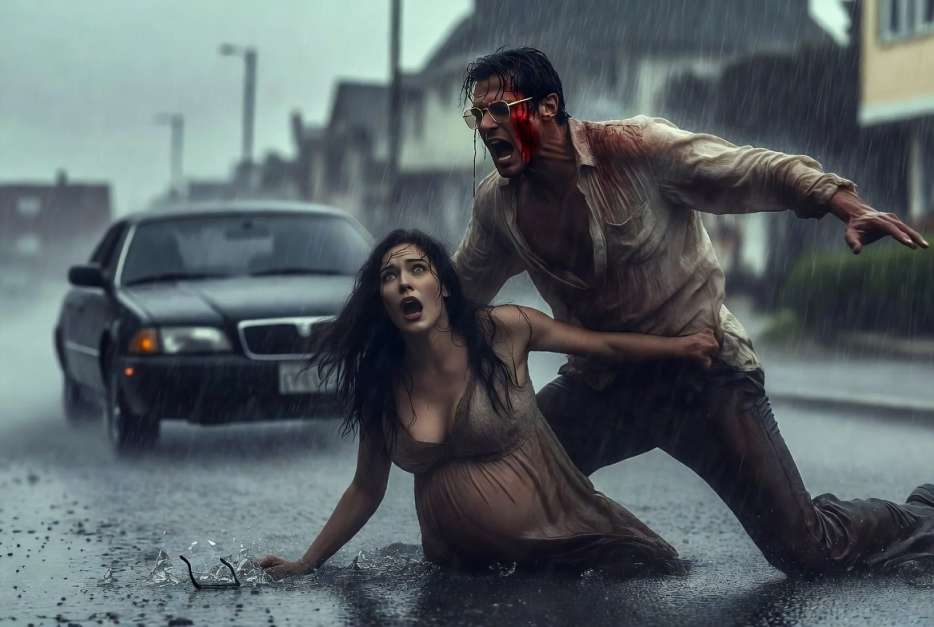
I was carrying a crate of white peonies across the street. Tires screamed. Time slowed. I froze like the useless heroine I used to be. Suddenly I was on the pavement, Simon’s body over mine, gold glasses shattered, leg bent at an angle that made bile rise in my throat. Blood on the asphalt. His voice, strained but still teasing: “I’m a black belt, Elena. A little metal can’t kill me.”
At the hospital he made me massage his shoulders and fetch water like a spoiled prince. When David stormed in—thinner, darker under the eyes, smelling of whiskey and regret—Simon grinned through the pain and called me his girlfriend loud enough for the whole floor to hear.
David grabbed my wrist. “Come home. I was wrong. I love you.”
I looked at the man who had once been my entire world and felt nothing but the ghost of an old ache. “You had three years,” I said. “You spent them waiting for someone else. I’m done waiting.”
I walked back into Simon’s room. Behind me, David made a sound like something breaking that couldn’t be fixed.
Three months later Simon’s leg “magically” healed the day I clutched my stomach in fake pain. He jumped up, panic written all over his perfect face, then froze when he realized he’d been caught. The grin that followed could have lit the entire Eastern seaboard.
“Power of love,” he whispered, and for the first time I didn’t step on his foot.
I let him stay.
The baby came on a rainy Tuesday smelling of lilies. Simon held my hand so hard I thought the bones would crack, clumsy and terrified and somehow perfect. When our daughter—yes, our—opened her eyes, they were David’s exact shade of storm-gray. Simon kissed her forehead like she was the rarest flower in the shop and whispered, “Hello, little thief. You’re stuck with me now.”
I thought that was the end of the old story.
I was wrong.
Part 2
Four years after I left the city that never loved me back, I married Simon Kane in a chapel that smelled of salt air and white roses.
Our daughter, now three and already bossy, scattered petals like confetti. Only Simon’s closest people came. No business partners. No family who had treated me like a spare. Just us, the ocean wind, and a future I had built with my own two hands. When Simon slid the ring onto my finger, I turned my head for half a second—
And saw him.
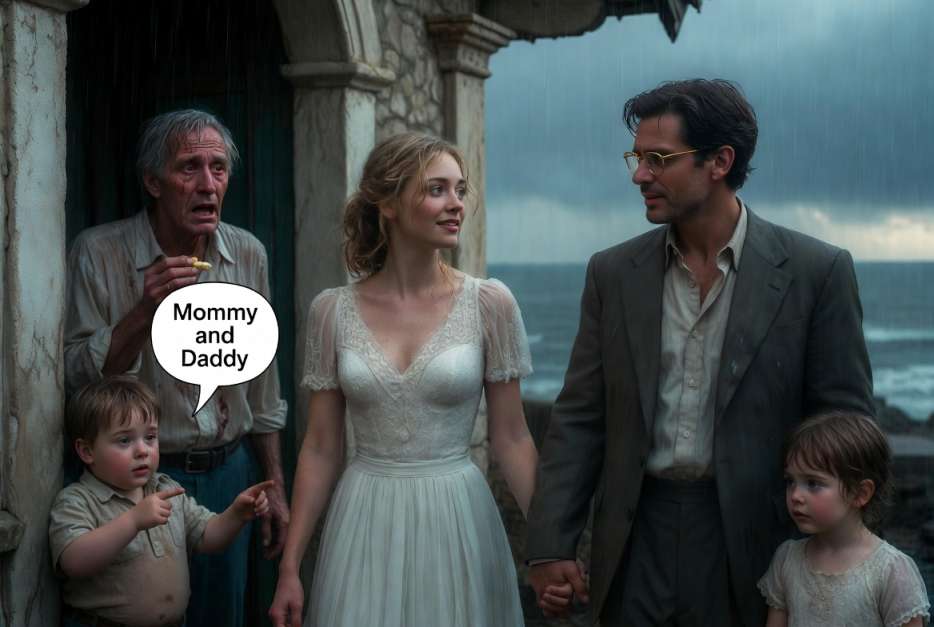
David stood at the back of the chapel like a ghost who had forgotten how to haunt properly. Older. Hollowed. The arrogant set of his shoulders gone. Beside him was a little boy, maybe four, clutching a candy he refused to take from a stranger. The boy’s face was a miniature of the man I once loved. My breath caught. For one terrible second the old book tried to rewrite itself again: the discarded wife, the lost child, the tragic reunion.
I walked past them both without slowing. Simon’s hand found the small of my back, warm and certain. Outside, under a sky the color of forgiveness, David finally spoke.
“That kid…” His voice cracked like thin ice. “Is he—”
“Mine,” I said. Not cruel. Just true. “In every way that matters. Don’t come looking again, David. If you do, you’ll never find us.”
He made a sound then—raw, animal, the sound of a man realizing too late that some doors stay locked forever. I didn’t look back. I took my husband’s hand and my daughter’s sticky fingers and walked toward the car that would take us home.
That night, after the cake was eaten and the little ones were asleep, Simon pulled me onto the porch swing overlooking the dark water. The same swing where he had once pretended his leg still hurt just to keep me massaging it. Moonlight caught the faint scar on his forehead from the car, the one he still joked about.
“You never asked,” he said quietly, “why I followed you across the country. Why I bought the house across the street before you even landed. Why a man like me—who ruins things for sport—suddenly wanted to raise another man’s child and call her Daddy.”
I waited. The ocean breathed around us.
“I died once,” he said. Simple. Flat. Like he was telling me the weather. “In another life. You were my childhood sweetheart. Same schools. Same bus rides. I built a company just so I could buy you a house by graduation. The night I came to propose, a truck took you instead. I searched every city after that. Friends called me crazy. I lay down in the woods one day and let the leaves cover me, waiting for you to come get me.”
His fingers traced the inside of my wrist, the place my pulse lived.
“I woke up in this body. Simon Kane. Born to destroy David Hawthorne for sport. I didn’t remember why until the day I saw you looking at him the way you used to look at me. The memories came back like a flood. Every smile. Every late-night study session. Every time you stole the last dumpling and pretended you didn’t. I knew then. I had one job left in any lifetime: find you, keep you, and never let another man make you small again.”
Tears slipped down my face, warm against the cool night. Not sad tears. Something older. Something that felt like coming home after a very long war.
“You stepped on my foot the the first week,” he murmured, half-laughing. “I almost cried. Not from pain. From relief. My girl was still in there. Still fighting.”
I kissed him then—slow, deep, tasting salt and second chances and a love that had survived death itself. Inside the house our daughter mumbled in her sleep, calling for both of us in the same breath. Somewhere far away, a man who had once held all the power sat alone with his regrets and a child who would never call him Daddy.
I used to believe I was the supporting character in someone else’s novel.
I was wrong.
I was the entire library.
And this time, I wrote the ending myself.