CHAPTER 1: THE ORDER
“Take that filthy thing off, or I’ll have you dragged out in handcuffs.”
Judge Everett Sloan pointed at my old olive tactical jacket like it had personally insulted the American flag behind his bench. Two court officers shifted toward me. Mason Keen sat at the defense table, pale and silent, while Harrison Langston smiled from the front row as if he had already bought the verdict.
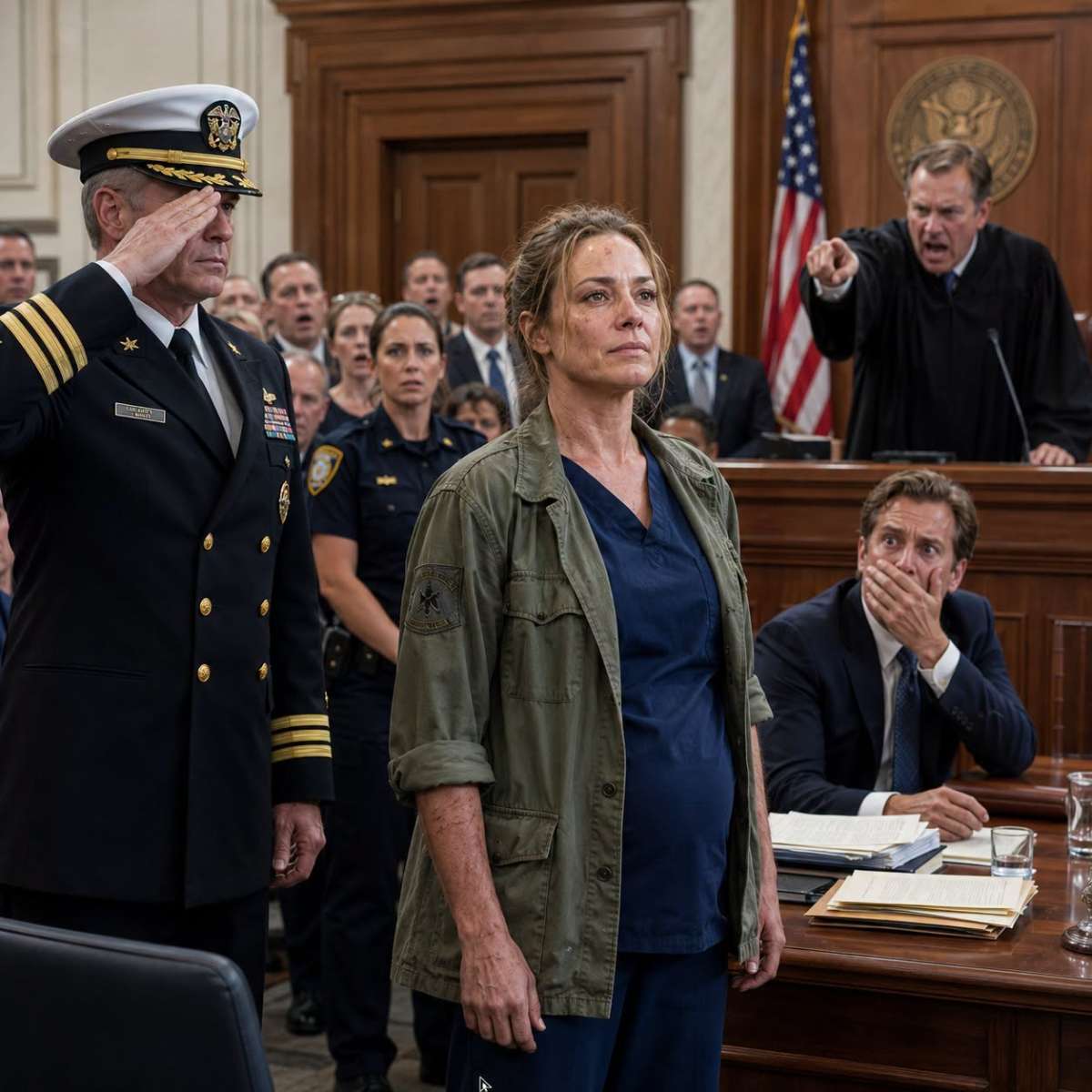
That smile told me more than the police report ever had.
I had come straight from a thirty-six-hour shift at Pacific Mercy Medical Center. A pileup on Interstate 5 had filled our emergency department before sunrise. Seventeen patients. Four critical. One teenager whose mother kept asking whether he would still graduate in June. By noon, dried blood had turned the knees of my navy scrubs brown, and cold coffee had left a ring on my locker-room bench.
I had fifty-three minutes to cross downtown San Diego and testify for Mason.
Going home to change would have cost twenty.
So I pulled the jacket from my locker.
The left shoulder was scorched. The cuffs were frayed. A black patch on the right sleeve read PHANTOM 4. I had not worn it in public for years, but the scars underneath were screaming from the hospital shift, and long sleeves kept strangers from staring.
I thought the jacket would help me disappear.
Instead, it made me the first target in the room.
“Your Honor,” I said, “I came from a mass-casualty shift. I’m here under subpoena.”
Sloan leaned forward. His silver hair was perfect. His robe did not have a wrinkle. He looked like the kind of man who had never eaten a cold turkey sandwich over a hospital sink or slept in his car between shifts.
“I did not ask where you came from,” he said. “I ordered you to remove that costume.”
A few people laughed.
Not loudly. Just enough.
Mason’s lawyer, Aaron Delaney, rose. “Your Honor, Ms. Donnelly is a trauma nurse and a material witness.”
“She looks like she slept under a bridge.”
Harrison Langston laughed this time.
He owned half the new condos near the waterfront, sponsored the Fourth of July parade, and sat in the front pew at Saint Matthew’s every Christmas. In our small corner of the city, men like Harrison did not need to shout. They donated a new church roof, bought breakfast at the diner for deputies, and expected doors to open before they reached them.
Three weeks earlier, his son Trevor had cornered a waitress named Paige Moreno in an alley behind the Harbor Light Diner.
Mason heard her say, “Please don’t make me scream.”
He found Trevor pressing a folding knife against her ribs while two friends blocked the exit.
Mason was a former Army medic. He disarmed Trevor, dropped the other two men, then used a hollow ballpoint-pen tube to keep Trevor breathing after blood clogged his airway.
That should have made him a witness.
Harrison made him the criminal.
By sunrise the next morning, the knife had disappeared from the police report. Paige had stopped answering calls. Two detectives described Mason as unstable. A local station aired his old booking photo from a bar fight that had been dismissed eight years earlier. Harrison’s attorney called it “an unprovoked veteran rage incident.”
People believed the clean suit.
They always do at first.
I met Mason eight months earlier at a veterans’ recovery group held in the basement of a Methodist church. He sat beneath a crooked Thanksgiving food-drive banner with his arms crossed and said nothing for an hour.
Neither did I.
After the meeting, he saw me rotating my left wrist because the nerve pain had started. He placed a cold water bottle beside me and walked away without asking what happened.
That was the beginning.
Not romance. Not friendship exactly.
Recognition.
Now he gave me the smallest shake of his head from across the courtroom.
Don’t do this for me.
He knew what was under the jacket. He had never seen it, but he knew enough not to ask.
Sloan tapped his gavel. “Remove it, Ms. Donnelly, or spend forty-eight hours in county custody.”
I glanced at the ceiling camera.
A red light blinked above the jury box.
Good.
“Is the courtroom recording?” I asked.
Sloan’s mouth tightened. “Everything in this room is on the record.”
“Even your order to have officers strip clothing from a female witness?”
The air changed.
Aaron covered a cough that might have been a laugh. Harrison stopped smiling for half a second.
Sloan recovered fast. “No one said strip. Remove the jacket.”
“I prefer to keep it on.”
“Your preferences do not matter here.”
That sentence landed harder than he knew.
Four years earlier, in a cave in Yemen, I had heard men begging for morphine while fire rolled through the entrance. My preferences had not mattered there either. Only time, pressure, blood loss, and whether my hands could keep moving after the nerves in my arms began to cook.
I learned something in that cave.
Power speaks loudly when it thinks no one important is listening.
So I stayed still.
Sloan nodded to the court officers. “Assist her.”
They stepped forward.
My body reacted before my mind did. My feet planted. My shoulders lowered. The pain in my arms vanished under a rush of old training.
“Don’t touch me,” I said.
Both officers stopped.
I did not raise my voice. I did not need to.
Sloan stared at the patch. “Phantom Four. Is that from some paintball club?”
Harrison snorted.
Then Sloan said the word costume again, louder, crueler, making sure the gallery heard him.
What he did not know was that the courtroom door never sealed correctly.
What he did not know was that Admiral Conrad Barrett was standing in the hallway.
And what none of them knew was that I had already found the missing knife.
The knife was only the first thing Harrison Langston had paid to make disappear, and I had receipts.
CHAPTER 2: THE HALLWAY
The door opened with a soft hydraulic sigh that somehow cut through every other sound in the room.
Admiral Conrad Barrett did not rush. He never had. Even when the world was on fire, the man moved like he had already calculated the cost of every second and decided the price was acceptable.
He wore the summer white uniform of a four-star flag officer—blinding under the fluorescent lights, the gold braid on his sleeves catching every eye that had been laughing thirty seconds earlier. Two silver stars on each shoulder. The ribbon rack looked like a child’s crayon box had exploded across his chest. He was sixty-two, tall enough that the doorframe seemed to duck for him, and his face carried the kind of quiet authority that made even career politicians sit up straighter.
The two court officers who had been closing on me froze mid-step. One of them actually took a half-step backward, as if the polished floor had tilted.
Barrett’s gaze found the patch first.
Then it found my face.
Something old and private passed behind his eyes. He did not smile. He did not need to.
“Court is still in session,” Sloan said, but the gavel in his hand looked suddenly heavy.
Barrett ignored him. He walked the center aisle the way a man walks onto his own bridge. When he stopped three feet from the witness stand, the entire gallery had gone silent enough to hear the air-conditioning vents rattle.
“Petty Officer First Class Elena Donnelly,” he said. His voice was low, precise, carrying the soft coastal Virginia of a man who had never needed to raise it. “Phantom Four. Yemen. The extraction that should not have been possible.”
My throat closed. Four years of carefully constructed quiet life cracked like thin ice under a boot.
Harrison Langston’s smile had vanished completely. He looked at the admiral the way a man looks at a storm front he cannot buy off.
Barrett turned just enough to include the judge. “Your Honor, I am here as a character witness and as a representative of the Department of the Navy. This woman is not wearing a costume. She is wearing the only jacket that walked out of a burning cave with three critically wounded operators and a hard drive the Joint Chiefs still classify. The burns under that fabric earned her the Navy Cross. The same Navy Cross I pinned on her myself in a sealed ceremony at Bethesda.”
A murmur rolled through the gallery like wind through dry grass.
Sloan’s face had gone the color of old paper. “Admiral, this is a state court matter—”
“And this is a federal officer of the United States Navy being ordered to strip in open court by a judge who just called her service a paintball hobby.” Barrett’s tone never rose, but every syllable landed like a gavel of its own. “I am requesting a brief recess so that Ms. Donnelly may testify without further… assistance from your officers.”
The two officers had already retreated to the wall. One of them was staring at the patch like it might explode.
Sloan cleared his throat. The gavel tapped once, weakly. “Ten-minute recess. Counsel, chambers.”
He fled through the side door. Harrison Langston stood so fast his chair scraped. For the first time since I had entered the room, he looked at me as if I might actually be dangerous.
Barrett waited until the judge was gone. Then he stepped closer. Close enough that only I could hear.
“You still have the knife, don’t you?” he murmured.
I met his eyes. Four years melted away. I was back in the cave for half a second—smoke, screaming, the smell of cooking meat that used to be skin—and then I was in a San Diego courtroom again with dried blood on my scrubs and a four-star admiral who had once told me that the only thing worse than dying for your country was surviving and staying silent.
“Yes, sir,” I said. “And the receipts.”
A ghost of the old approval touched the corner of his mouth. “Then let’s make sure the right people hear them.”
He turned and walked toward the defense table. Mason was staring at me like he had never seen me before. Aaron Delaney looked like a man who had just watched a grenade roll under the table and fail to explode.
I stayed in the witness box.
The jacket stayed on.
And somewhere in the front row, Harrison Langston was already calculating how much it would cost to make an admiral disappear.
He was about to learn that some things do not have a price.
CHAPTER 3: THE CAVE
Four years earlier.
The cave smelled of cordite, dust, and the sweet-copper stink of arterial blood. Outside, the Yemeni night was a black wall of wind and incoming fire. Inside, the temperature had climbed past the point where sweat evaporated. It just sat on your skin like oil and waited to cook you.
I was twenty-nine years old, a Special Amphibious Reconnaissance Corpsman assigned to Phantom 4—six operators, one corpsman, one job: get the package out of a collapsed tunnel network before the secondary charges finished what the first ones started.
The package was a hard drive. The hard drive had names. The names belonged to people who paid other people to make American contractors vanish in the desert and call it bad luck.
Chief Petty Officer Reyes was already dead when I reached him. The blast had taken most of his left side. I still checked for a pulse because that is what you do when the world is ending and your hands need something to do.
Petty Officer Torres was conscious. Both femurs shattered. He kept trying to sit up and reach for his rifle. I pushed him flat and packed the wounds with every QuikClot gauze I had left. His blood was already turning the dust into black mud.
“Donnelly,” he gasped. “The drive.”
“I’ve got it.” I had jammed the waterproof case into the cargo pocket of my trousers ten minutes earlier, right before the second charge cooked off and dropped half the ceiling.
Lieutenant Junior Grade Harlan was the worst. Burns over sixty percent of his body. The kind of burns that make the air smell like a barbecue no one wants to remember. His eyes found me through the melted skin of his eyelids.
“Tell my wife,” he whispered. “Tell her I didn’t leave the package.”
“You’re going to tell her yourself.”
I lied. That is also what you do.
The fire found the entrance ten minutes later. Orange light spilled across the rock like liquid judgment. Heat rolled over us in waves. My left sleeve caught first. Then the right. I felt the nylon melt into my skin and kept packing Harlan’s chest wounds because if I stopped, he would die faster.
The pain was not sharp. It was a slow, wet scream that lived under the skin and would never fully leave.
Extraction came at 0347. A MH-60 that had no business flying that low in that weather. They dragged us out one by one. I walked. I do not know how. My arms were already blistering under the ruined sleeves. The hard drive was still in my pocket. Reyes was not.
At Bethesda they cut the jacket off me. The patch came with it—black fabric fused to blackened skin. A nurse with kind eyes asked if I wanted to keep it.
I said yes.
They gave me a new one later, clean and regulation. I never wore it. The burned one stayed in a sealed bag in the bottom of my sea bag until the day I left the Navy. Then it lived in the back of a hospital locker in San Diego, waiting for a morning when the scars hurt worse than the risk of being seen.
I never told the full story of the cave. Classification. Guilt. The particular silence that settles on people who come back when others do not.
But Admiral Barrett knew. He had been the one on the radio that night, the calm voice telling the pilots to go anyway. He had met the bird on the deck of the carrier. He had looked at what was left of my arms and said, “You kept them alive long enough. That’s the only math that matters.”
Then he pinned the Navy Cross on a hospital gown and told me the citation would stay sealed for twenty-five years.
I believed him.
I still do.
CHAPTER 4: THE KNIFE
I found the knife three days after the alley.
Paige Moreno had not returned to the Harbor Light Diner. Her manager said she quit by text. No one had seen her. The police report listed the weapon as “not recovered.” Mason sat in county lockup on assault charges that should have been self-defense and citizen’s arrest.
I went back to the alley at 2 a.m. on a Tuesday because that is when the night shift ends and the city’s secrets are too tired to hide.
The dumpster behind the diner smelled of old grease and wet cardboard. A single security light buzzed overhead, painting everything the color of weak tea. I had a penlight, a pair of nitrile gloves from the hospital, and the kind of stubbornness that had once kept a hard drive alive through fire.
The knife was under a flattened pizza box six feet from where Mason said Trevor had dropped it. Folding blade. Black handle. Still crusted with something dark that flaked when I touched it. I bagged it in an evidence envelope I had taken from the ED supply closet and wrote the date, time, and GPS coordinates on the label in permanent marker.
Then I did something the police had not bothered to do.
I went looking for Paige.
She was staying with a cousin in National City, in a two-bedroom apartment that smelled of baby formula and fear. When she opened the door and saw me in scrubs and the burned jacket, she almost closed it again.
“I’m not here for the police,” I said. “I’m here because Mason kept Trevor breathing after he tried to cut you. And because someone paid you to forget.”
Her eyes filled. She let me in.
On the kitchen table was an envelope. Thick. Cash. No return address. Twenty thousand dollars and a handwritten note that said only: You were never there. Stay never there.
I photographed everything. The envelope. The note. The serial numbers on the bills that still had bank bands. Paige’s hands shook when she told me about the two men who had visited the night after the alley—suits, quiet voices, the kind of calm that is more threatening than shouting. They had known her daughter’s daycare schedule. They had known her mother’s address in Tijuana.
“They said if I talked, the next envelope would be smaller and the visit would be longer,” she whispered.
I gave her my hospital badge number and told her to call if they came back. Then I took the knife, the photos, and a copy of the note and put them in a safe-deposit box at a credit union that did not have Harrison Langston’s name on the donor wall.
That same night I sat in my car outside the veterans’ group church and waited until Mason’s temporary release bond cleared. When he walked out looking like a man who had aged a decade in seventy-two hours, I handed him a cold water bottle the way he had once handed me one.
He didn’t ask questions. He just said, “You found something.”
“I found enough.”
He looked at the jacket. At the patch. At the way I held my arms carefully away from my body because the nerve endings still lit up when fabric brushed them wrong.
“You’re going to burn for this,” he said quietly.
I almost smiled. “Already did. Once. It didn’t take.”
CHAPTER 5: THE RECEIPTS
Recess lasted fourteen minutes. When court resumed, the temperature in the room had changed.
Sloan’s voice was carefully polite. The court officers stayed against the wall. Harrison Langston sat with his hands folded so tightly the knuckles looked bloodless. His attorney—a sleek man named Victor Crowe who specialized in making rich men’s problems vanish—had arrived during the break and now whispered urgently into Harrison’s ear.
Aaron Delaney called me back to the stand. His hands were shaking slightly. I liked him for that. Fear meant he still believed the system could surprise him.
“Ms. Donnelly,” he said, “you stated you are a material witness. Can you tell the court what you observed on the night of June fourteenth?”
I told them.
Not the version in the police report. The real one. How I had been two blocks away leaving a late shift when the radio call went out for a disturbance behind the Harbor Light. How I arrived as Mason was already controlling the scene—Trevor on the ground, airway open, the two friends running. How Paige was shaking so hard her teeth chattered. How I saw the knife on the ground before a man in a dark windbreaker scooped it up and walked away while the first patrol car was still turning the corner.
Victor Crowe objected on every possible ground. Hearsay. Speculation. Prejudice. Sloan overruled most of them with the weary air of a man who had just been reminded that four-star admirals have long memories and longer reach.
Then Aaron asked the question that mattered.
“Ms. Donnelly, did you later recover that knife?”
The gallery leaned forward as one organism.
“Yes.”
“And do you have it with you today?”
I reached into the inner pocket of the jacket—the one that still smelled faintly of smoke and antiseptic—and pulled out the sealed evidence bag. The black handle was clearly visible through the plastic. The dried blood looked almost black under the courtroom lights.
Harrison Langston made a sound like air leaving a tire.
Aaron entered it as Defense Exhibit 1. Then he entered the photographs of the cash envelope, the note, the bank bands. Paige Moreno’s signed affidavit, taken two nights earlier in my living room with a notary who owed me a favor from a car-accident case.
Victor Crowe’s objections grew louder and more desperate. Sloan’s gavel came down harder each time.
When Aaron finished, the prosecutor—a tired woman named Reeves who had clearly been handed a case she did not want—asked only three questions. All of them tried to paint me as a biased friend of the defendant with a history of trauma and possible PTSD.
I answered them the way I had answered questions in after-action reviews: short, precise, no emotion that could be used against me.
Then Admiral Barrett stood from the gallery.
“Your Honor, if it please the court, I would like to offer a brief statement regarding the character and credibility of this witness.”
Sloan looked like a man calculating the political cost of saying no to a four-star in a room full of cameras. He nodded.
Barrett did not take the stand. He simply stood in the aisle and spoke.
“Elena Donnelly is the reason three families still have sons and husbands. She is the reason a classified operation did not become an international incident. She has never sought recognition, never given interviews, never used her service for personal gain. If this court chooses to believe a man who pays witnesses to disappear over a woman who walked through fire to protect people she barely knew, then this court will have to explain that choice to a great many people who wear the same uniform I do.”
He sat down.
The silence that followed was the kind that changes rooms permanently.
Sloan called another recess. This one lasted forty minutes. When we returned, the prosecution requested a continuance. The defense did not object. Mason’s charges were not dismissed that day, but the air had left the case like a punctured lung.
As I left the stand, Harrison Langston stood. For a moment I thought he might speak. Instead he simply looked at me with the cold, measuring stare of a man rewriting every calculation he had ever made about power.
I held his gaze until he looked away first.
Outside the courthouse the afternoon sun was brutal. Mason waited on the steps with Aaron. Admiral Barrett stood a few yards away talking quietly into a phone.
Mason’s voice was rough. “You didn’t have to do that.”
“Yes I did.”
He looked at the patch again. “Phantom Four. You never said.”
“Most people don’t need to know.”
“I think I do.”
Before I could answer, a black SUV with tinted windows rolled slowly past the courthouse steps. The passenger window lowered just enough for me to see Victor Crowe’s face. He was not smiling. He was memorizing.
Barrett ended his call and walked over. “They’ll come harder now. Langston doesn’t lose gracefully. I’ve already made some calls. You two need to stay visible and stay together for the next seventy-two hours. After that, the federal interest in witness intimidation should be… educational for him.”
Mason nodded once. I felt the old familiar weight settle across my shoulders—the weight of being the person other people looked to when the fire started.
I had spent four years trying to put that weight down.
Apparently the universe was not finished with me yet.
CHAPTER 6: THE NIGHT SHIFT
Pacific Mercy at 11 p.m. smelled of bleach, fear, and the particular metallic tang that lives in every emergency department after midnight. The overhead lights hummed a flat note that never changed. Somewhere a cardiac monitor sang its lonely song.
I had been back on shift for six hours. The jacket hung in my locker. The scars itched under fresh scrubs. Every time the ambulance bay doors opened I expected Victor Crowe or one of Langston’s quiet men. Instead I got a construction worker with a nail through his hand, a teenage girl whose boyfriend had “accidentally” burned her with a cigarette, and a homeless veteran who smelled of cheap vodka and old grief.
The veteran looked at my arms when I rolled up my sleeves to start the IV. The grafted skin was shiny and tight, a map of something that had tried to erase me and failed.
“Helmand?” he asked.
“Yemen.”
He nodded like that explained everything and closed his eyes while the saline ran.
At 1:17 a.m. my phone buzzed with a blocked number. I almost didn’t answer. Then I did.
Paige’s voice was a whisper on the edge of panic. “They’re outside. Two cars. Same men. They know I talked. They know about the affidavit.”
I was already moving. “Stay on the line. Do not open the door. I’m coming.”
I told the charge nurse I had a family emergency. She looked at my face and didn’t ask questions. Good people rarely do when they see that particular expression.
The drive to National City took nineteen minutes with the light bar I kept in the glove box for exactly these nights. Mason met me two blocks from Paige’s building, already out of his truck, already scanning rooftops and alley mouths the way men who have walked patrol scan everything.
“Barrett’s people are ten minutes out,” he said. “Federal protective detail. We just need to hold.”
We didn’t knock. Paige’s cousin opened the door the second she saw my face. Inside, Paige sat on the floor with her daughter asleep against her chest. The little girl was three. She had a stuffed elephant missing one eye.
Through the blinds I counted two dark sedans and four men. Professional. Patient. The kind of patience that ends with someone disappearing into a van that never reaches a police station.
Mason’s voice was calm. “I’ve got the back stairwell. You take the front.”
I looked at him. Really looked. The quiet man from the church basement who handed out water bottles was gone. In his place stood the Army medic who had kept Trevor Langston breathing with a ballpoint pen while two men tried to stop him.
“Copy,” I said.
We didn’t have weapons. We had presence, training, and the knowledge that the men outside preferred soft targets who cried and signed NDAs. We were neither.
When the first man reached the second-floor landing, I stepped out of the shadows with my hospital ID held high like a badge and my voice in the register that used to freeze junior sailors in place.
“Federal witness under protection. You take one more step and this becomes a RICO case before breakfast. Your choice.”
He stopped. The second man behind him stopped. In the silence I heard Mason’s boots on the back stairs and the distant wail of approaching sirens that did not belong to San Diego PD.
The men looked at each other. Then they looked at the patch still visible on the jacket I had thrown over my scrubs when I left the hospital. Something in their calculation shifted. Professionals know when the cost-benefit has turned toxic.
They left without a word.
The federal detail arrived four minutes later. Paige and her daughter were gone within the hour to a safe location Barrett’s people had already prepared. I stood on the sidewalk with Mason while the black sedans disappeared into the night and felt the old familiar tremor start in my hands—the one that came after the danger passed and the body finally admitted it had been afraid.
Mason saw it. He didn’t pretend not to. He just stepped closer so that his shoulder brushed mine and the tremor had somewhere to go.
“Still standing,” he said.
“Barely.”
“Barely counts.”
I almost laughed. It came out as something closer to a sob. He didn’t comment on that either. Some silences are the only kindness left.
CHAPTER 7: THE EMPIRE
Harrison Langston’s empire was not built on concrete and glass alone. It was built on favors, fear, and the quiet understanding that certain names never appeared in certain police reports.
By the third day after the courtroom, the federal interest Barrett had promised arrived in the form of two quiet women from the U.S. Attorney’s office and a stack of subpoenas that made Victor Crowe’s face turn the color of old milk. Bank records. Phone logs. Property transfers. The cash that had gone to Paige was only the beginning. There were others—two previous waitresses, a former employee at one of Langston’s restaurants, a college student who had dated Trevor for six weeks and then transferred schools without explanation.
Patterns are beautiful when you finally have enough light to see them.
I spent those days living in a borrowed safe house with Mason and a rotating pair of federal agents who drank too much coffee and never quite relaxed. The scars on my arms itched constantly. Sleep came in fragments. Every time I closed my eyes I was back in the cave or the alley or the courtroom, watching power try to rewrite reality one smile at a time.
On the fourth night Mason found me on the small balcony overlooking a nameless stretch of canyon. The marine layer had rolled in early. The air smelled of salt and distant freeways.
“You’re going to wear a hole in the railing,” he said.
I looked down. My hands were white-knuckled on the metal. I made them let go.
“He still thinks he can buy his way out,” I said. “Men like him always do. Until the moment they can’t.”
Mason was quiet for a long time. Then: “What happens after? When this is over and the cameras leave and Barrett goes back to Washington.”
I didn’t have an answer that didn’t feel like a lie. The quiet life I had built—hospital shifts, anonymous apartment, the careful avoidance of anything that looked like belonging—had already burned. The jacket was out of the locker. The patch had been seen. There was no putting the fire back in the bottle.
“I don’t know,” I said. Honesty felt dangerous and necessary at the same time. “I spent four years trying to be small enough that the world would forget I existed. It didn’t work.”
He turned to face me fully. In the dim light his eyes were darker than usual. “Then stop trying. Be the size you actually are.”
Something in my chest shifted—not the old pain of the scars, but something newer and almost as frightening. Recognition again. Only this time it had edges that felt like hope.
I didn’t kiss him. Not then. The moment was too raw, too full of unfinished danger. But I let my shoulder rest against his, and for the first time in years the contact didn’t make the nerves scream. It just felt like standing next to someone who understood that barely counting was sometimes the only victory available.
Inside the safe house a phone rang. One of the agents answered, listened, and looked straight at me.
“They found the second knife,” she said. “The one from the previous waitress. Langston’s private security chief kept trophies. Idiot.”
I closed my eyes. Somewhere in the dark, an empire built on silence was beginning to hear its own foundations crack.
CHAPTER 8: THE VERDICT
The continuance became a dismissal eighteen days later.
Not because Harrison Langston suddenly grew a conscience. Because the U.S. Attorney’s office unsealed a fifty-two-page indictment that included witness intimidation, conspiracy, and two counts of obstruction that reached all the way into the San Diego County District Attorney’s office. Judge Everett Sloan took an abrupt medical leave and never returned to the bench. Victor Crowe stopped returning calls. Trevor Langston was arrested at a private airstrip trying to board a flight to Costa Rica with a fake passport and seventy thousand in cash.
Mason’s charges evaporated like morning fog under a hard sun. The local stations that had run his old booking photo now ran the Navy Cross citation Barrett had quietly authorized for limited release. The narrative flipped so fast it left skid marks.
I watched it happen from the back of a federal courtroom this time—not as a witness fighting to keep her jacket on, but as the woman who had refused to let the truth stay buried under money and smiles.
Harrison Langston never looked at me during the proceedings. He stared straight ahead with the rigid posture of a man who had finally encountered a force that did not negotiate. When the judge ordered him held without bail pending trial, something small and permanent broke behind his eyes. I almost felt sorry for him. Almost. Then I remembered Paige’s three-year-old and the way her hands had shaken around a stuffed elephant, and the almost died quietly.
Outside the federal building the sky was the hard bright blue that San Diego wears like a dare. Mason stood with his hands in his pockets, looking younger than he had in weeks. Aaron Delaney was already talking to a cluster of reporters, his face lit with the particular joy of a public defender who had just watched the machine fail to crush someone.
Admiral Barrett found me near the fountain. He looked tired in the way only people who carry other people’s secrets for decades look tired.
“You kept the package again,” he said.
I knew he didn’t mean the hard drive. “Someone had to.”
He studied the jacket. The scorched shoulder. The frayed cuffs. The patch that had started everything. “You should have that cleaned and framed.”
“No, sir. It still has work to do.”
A rare, real smile crossed his face. “Phantom Four. Stubborn until the end.” He sobered. “There will be blowback. Men like Langston have friends who don’t appear in indictments. Stay sharp. And if you ever decide the hospital isn’t enough… the Navy still has a place for people who walk through fire and refuse to lie about it.”
He left me with that. I stood alone for a long moment, feeling the sun on the scars through the thin fabric of my shirt. For the first time the heat didn’t feel like a threat. It just felt like weather.
Mason walked over. He didn’t ask if I was okay. He already knew the answer was complicated.
“Coffee?” he said. “The kind that doesn’t come from a hospital machine.”
I looked at him—the former medic who had kept a monster breathing so the monster could face justice, the quiet man who handed out water bottles and stood in stairwells when the dark cars came. Something in my chest that had been clenched since Yemen finally loosened a fraction.
“Yeah,” I said. “Coffee.”
We walked away from the federal building together. Behind us the news cameras were already packing up, hunting the next story. Ahead of us the city kept moving the way cities do—indifferent, loud, full of people who would never know how close the truth had come to staying buried under a clean suit and a perfect smile.
I touched the patch once, lightly, the way you touch a scar that has finally stopped hurting quite so much.
It was still filthy.
It was still mine.
CHAPTER 9: WHAT THE SCARS REMEMBERED
Six months later.
The veterans’ group still met in the Methodist church basement. The Thanksgiving banner had been replaced by a lopsided Christmas one that someone had forgotten to take down. The coffee was still terrible. The folding chairs still squeaked.
I sat in the same spot I always had. Mason sat beside me now instead of across the circle. We didn’t hold hands. We didn’t need to. The quiet between us had become a language of its own.
Paige Moreno came once. She brought her daughter and the one-eyed elephant. She didn’t speak during the sharing time. She just sat and listened and left a small thank-you note on my chair that said only: She sleeps through the night now. So do I.
Harrison Langston’s trial was still months away. The empire was in freefall—properties sold under pressure, partners vanishing, the perfect Christmas pew at Saint Matthew’s suddenly empty. Trevor was in federal custody. The second knife and the trophy collection had opened doors no amount of money could close again.
I still worked nights at Pacific Mercy. The blood still got on the scrubs. The teenage patients still asked questions about graduating. The difference was that when the nerve pain flared and I reached for the jacket, I no longer felt like I was hiding. I felt like I was putting on the only armor that had ever fit.
One rainy Tuesday I came home to find a plain envelope under my apartment door. No return address. Inside was a single photograph—old, slightly blurred, taken on the deck of a carrier at night. Six operators and one corpsman. Reyes was still alive in it. Harlan’s face was whole. Torres was flipping off the camera. I was in the middle, laughing at something no one else would ever remember.
On the back, in Admiral Barrett’s precise handwriting: They knew. They were proud. Stop carrying them alone.
I sat on the floor of my living room with the rain hammering the windows and cried for the first time since the cave. Not the controlled leakage of stress or exhaustion. The real thing. The kind that comes up from the place where grief and gratitude share a wall and finally knock it down.
Mason found me like that when he came over with takeout. He didn’t ask. He just sat on the floor beside me, shoulder to shoulder, and let the rain and the silence do the work.
When the storm passed and the crying stopped, I showed him the photograph. He looked at each face the way medics look at wounds—carefully, without flinching.
“They look like they trusted you,” he said.
“They did. I got three of them home. Not four.”
He was quiet. Then: “Three is not nothing. Three is everything to the people who got them back.”
I leaned my head against his shoulder. The scars on my arms rested against his shirt without protest. Outside, San Diego kept raining like it had something to wash clean and wasn’t finished yet.
“Stay,” I said. It wasn’t a question about the night. It was a question about the rest of the nights.
He didn’t answer with words. He just reached over and took my hand—carefully, the way you take something precious that has been through fire—and held it like it was the only answer that mattered.
CHAPTER 10: THE PATCH
One year after the courtroom.
I still wore the jacket on cold nights and long shifts. The scorched shoulder had been carefully patched by a leatherworker in Ocean Beach who asked no questions and charged too little. The PHANTOM 4 patch remained exactly as it had been the day the fire tried to take it—black, slightly melted at the edges, impossible to ignore.
Mason and I had moved into a small bungalow near the water that smelled of salt and second chances. He worked construction and volunteered two nights a week at a free clinic for veterans. I still ran trauma at Pacific Mercy, but I also spent one day a month at the VA teaching combat trauma nurses how to keep their hands steady when the world was ending. The scars still hurt when the weather changed. I still rotated my wrist when the nerves woke up angry. The difference was that now someone noticed, and handed me a cold water bottle, and didn’t need the story explained.
Harrison Langston took a plea. Fifteen years. His empire was gone. Trevor got eight. The second waitress from the trophy collection testified via video from a new city with a new name and a daughter who no longer had nightmares. Paige sent a Christmas card with a photo of her little girl holding a brand-new elephant with both eyes.
Admiral Barrett retired quietly. At his ceremony he wore the same summer whites. When the cameras were gone he found me in the crowd and pressed a small box into my hand. Inside was a replacement Navy Cross, this one authorized for open wear.
“The citation is still sealed,” he said. “But the medal doesn’t have to be. Wear it if you want. Or don’t. You’ve already earned the only recognition that matters.”
I kept the medal in the same drawer as the photograph of Phantom 4. Some things are too heavy for daily wear. Some things are exactly heavy enough to keep you honest.
On a clear evening in late spring I stood on the small deck of the bungalow watching the sun drop into the Pacific. Mason came out with two beers and the easy silence we had learned to trust. The jacket hung on the back of a chair, catching the last light. The patch looked almost ordinary until you knew what it had walked through.
“You ever going to take it off for good?” he asked.
I thought about the judge’s voice. Take that filthy thing off. I thought about the cave and the fire and the hard drive and the three men who came home because my hands refused to stop. I thought about Paige’s daughter sleeping through the night and the way power sounds when it finally realizes someone important is listening.
“No,” I said. “Not for good. Just for tonight.”
I left the jacket on the chair. We sat side by side as the sky turned the color of old bruises healing. Somewhere in the city a new night shift was starting at Pacific Mercy. Somewhere a waitress was locking up without looking over her shoulder. Somewhere a man who had once believed money could bury anything was learning how long fifteen years could feel.
And on a wooden chair that faced the ocean, a filthy olive jacket with a melted patch waited patiently for the next time the world needed someone who already knew how to walk through fire and keep the package safe.
I reached for Mason’s hand in the dark. His fingers closed around mine—warm, steady, present.
The scars under my sleeves were quiet.
For the first time in a very long time, so was I.
THE END